Essay
When Life Begins with Death
In Vienna, a hospital offers palliative care to babies with debilitating diagnoses.
January 19, 2026
Try 3 months of unlimited access. Start your FREE TRIAL today. Cancel anytime.
START FREE TRIAL NOW
[.article__paragraph--cap] [.small-caps] Sometimes, life is just starting [.small-caps] when you have to let go of it. That’s the unavoidable reality that confronted Doris and Johannes when they were expecting their first child. “It doesn’t look good,” Johannes remembers his wife telling him on the phone – and suddenly their entire world came to a halt. It was December 23, 2020. Their baby’s life, though it had only just begun, was already falling apart. Doris’s gynecologist advised her to terminate the pregnancy immediately, pending the confirmation of his suspicions by amniocentesis.[.article__paragraph--cap]
A few weeks later, the results were in: Doris and Johannes’s child had “13q deletion syndrome” – a rare genetic disorder with a minimal life expectancy. The anxious father’s gaze happened to fall on further information in the report: “female chromosome set.” When they asked the doctor if the baby was a girl, he responded with a curt “yes,” and once again urgently recommended terminating the pregnancy. That way, he told them, they could start focusing right away on having a healthy child. “Of course you can decide for yourselves,” he went on, “but 90 percent of the couples in your situation would terminate the pregnancy today.” His advice was clear. So was Doris and Johannes’s certainty that they would not be following it.
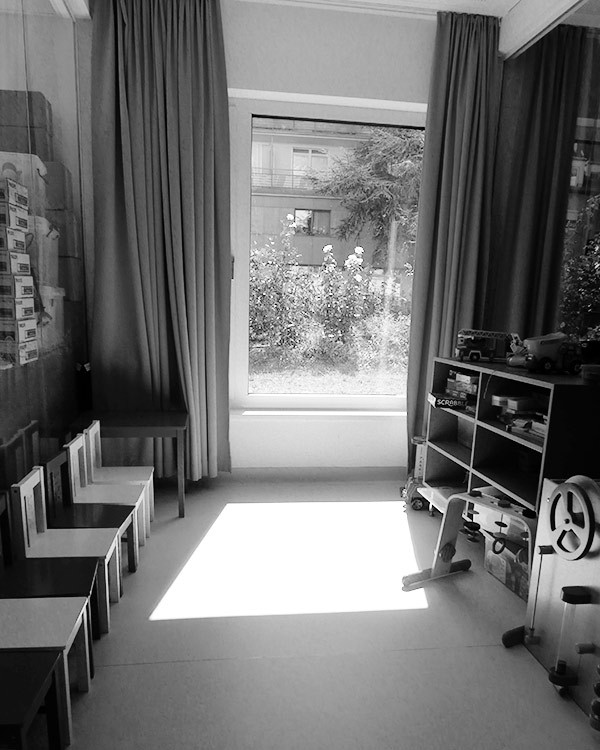
[.imgcaption] [.smalltext] All photographs courtesy of Doris and Johannes. Used by permission. [.smalltext] [.imgcaption]
Through a “life protection agency,” as pro-life associations are commonly known in Austria, the young couple learned of a possible alternative. Since 2020, Vienna’s St. Josef Hospital has been offering perinatal palliative care. Here, couples like them who wish to welcome a child with debilitating or life-threatening diagnoses are supported in realizing their dreams.
With almost four thousand births a year, St. Josef is one of the largest maternity clinics in Austria, and daily life is characterized by happy new beginnings. In the midst of it, though, is a safe space for those whose path is different. Here, a different sort of care and healing takes place, with quiet acceptance and holistic care.
Sister Teresa Schlackl, chief ethics officer at St. Josef, describes it as a “beautiful and difficult task.” Of course, the news of a life-threatening or fatal diagnosis is always difficult for anyone. Your world collapses. But the decisive difference at St. Josef is how this reality is approached and dealt with. For Schlackl, a Salvatorian nun, it is clear that every life has equal value, whether it lasts a second or ninety-eight years. But in her experience, most people have difficulty believing this, which makes comforting them difficult. “In such situations, I have to learn the meaning of simply standing by.”
As she explains, the focus is not on prolonging life at any cost, but on the question: How can we treat the child with as much dignity and love as possible? Together with the family, a path is planned: from personal counseling and a carefully coordinated birth plan to medical and emotional care and sensitive support in saying goodbye. Families are accompanied from the beginning to the end of the process – and beyond. Parents are allowed to experience every emotion: fear and grief, but also the love and joy of every precious moment spent together with their child.
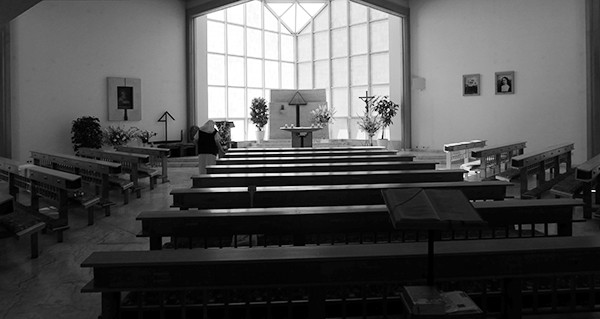
Initially, parents bring their fears and hopes to pediatrician Dr. Andrea Schiller, a member of the interdisciplinary team. “At first, they hope that the baby isn’t sick after all. Then they are preoccupied with worries and fears, such as: What will our baby look like? Will it suffer? Will it be in pain? What will it be like when it dies?”
Dr. Schiller is always happy to share a couple’s optimism – she does not feel it is her place to take away anyone’s hope. However, she also sees it as her job to help them take a close look at the situation at hand: “Thankfully, we work very closely with the gynecologists, and that way, we can all be together during ultrasound examinations and see, for example, that a baby is much too small, or that it has no lungs or no kidneys. That makes it easier to comprehend what is going on.”
[.article__paragraph--cap] [.small-caps] Doris and Johannes [.small-caps] were one of the first couples to take advantage of St. Josef’s program. After those harrowing conversations with their gynecologist, they felt relief at being finally accepted for who they were – the parents of a severely disabled child whose life they wished to honor and welcome. Anna was born on June 27, 2021. “We were even feeling positive by the time we drove to the hospital for the birth,” recalls Johannes.[.article__paragraph--cap]
Because Anna’s brain did not develop normally, due to the genetic defect, no one could tell her parents exactly what would happen at her birth. Nor could anyone predict whether and how the biological processes that occur in a healthy baby after birth would transpire in her particular case. Would her brainstem be too deformed to control her breathing? Would her nervous system be able to coordinate vital processes?
As it turned out, Anna managed everything herself, “with hardly any help,” Johannes adds, smiling as he talks about the birth. “Considering that we didn’t know if she would even survive delivery – if it would be her death – it was incredibly beautiful.” As he speaks, there is something in his eyes of that special sparkle fathers have when they boast about their children’s achievements. And though she only weighed a delicate three pounds, she quickly began to nurse and show strong signs of life. A week later, the new parents were able to take their daughter home – another overwhelming moment.
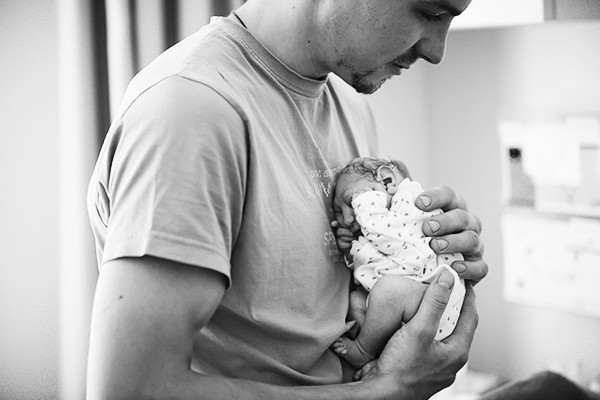
[.imgcaption] Johannes holds his newborn daughter, Anna, 2021. [.imgcaption]
Even at St. Josef, little Anna stands out. Most children of parents who opt for palliative care die while still in the ward. “In most cases, the fact is that the baby is terminally ill; or it was an ectopic pregnancy and can’t survive. That can seem unbelievable to a mother who feels the baby in her belly moving,” Dr. Schiller says. And so she always tries to guide parents to live as fully as possible in the present moment – in the here and now. If a woman is seven months pregnant, Dr. Schiller allows everything to be fine, even just for that moment. Let it be a moment for joy, love, and gratitude.
The point of no return is the birth. “Up to that point, you can hope,” says Sister Teresa. In an oncology ward, she notes, people have a very different attitude toward death: they look it in the eye. At birth, naturally, they don’t expect it. But none of that matters for this nun. For her, it is standing together at the beginning and the end of life that counts. Beyond all the medical interventions and clinical support, it is simply being there for people that is so infinitely precious. Dr. Schiller agrees. “At the moment when life comes to an end, it’s about being there. In my experience, mothers in particular are simply glad that someone is there. It’s not about saying anything. It’s about being there and simply going through it together. Simply enduring the death of a child, as sad as it is.”
Meanwhile, there is the option of having a photo taken by a professional photographer. Farewell rituals are tailored to the wishes of individual families. A child might be baptized or blessed. Parents are encouraged to do “normal” things like washing, bathing, dressing, and holding their child. All this allows parents to remain close – right there with their child – as his or her life is drawing to a close. “It’s about letting them participate in what’s happening – letting them understand, in the deepest way,” Dr. Schiller says.
Then, they suddenly notice that the baby is growing cold; the little body changes. As hard as that moment is, Dr. Schiller says, it is important, because it gives parents a healthier way to grieve – that is, it leaves them with something concrete that can be worked through. Saying goodbye is easier to cope with when you have had a relationship with the dying child – because the relationship is what ultimately remains.
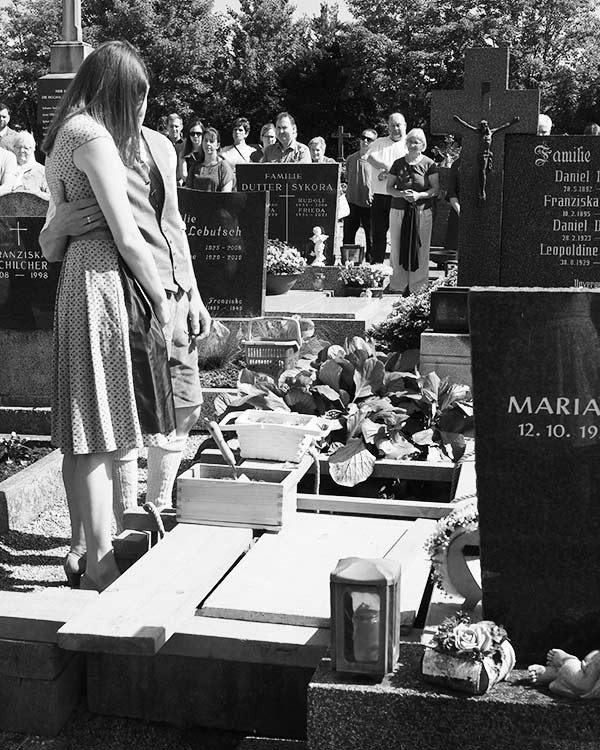
[.imgcaption] Doris and Johannes say goodbye to their daughter, 2022. [.imgcaption]
[.article__paragraph--cap] [.small-caps] In the early morning [.small-caps] of May 13, 2022, just six weeks shy of her first birthday, little Anna passed away. A few days later, her extended family took leave of her. “We would have loved to experience so much more with Anna,” her parents admit. “The beautiful thing about our story is that for us, there are no unanswered questions. Anna’s story has a beginning, a middle, and an end.”[.article__paragraph--cap]
Johannes is convinced that if they had followed their gynecologist’s advice and terminated the pregnancy, he and Doris would have been left with a host of unanswered questions. “Even if you disregard ethical and religious aspects, or personal convictions, this is a valid reason to decide in favor of giving birth,” he says.
As part of St. Josef’s perinatal palliative care program, parents are encouraged to take advantage of counseling with psychologists and pastors, if they wish, after the death of a child. Two months after the birth, they are invited to a follow-up meeting, and every year a memorial service is held. Sister Teresa gets goose bumps when she describes the atmosphere in the chapel – the sense of community that arises from shared experience in a place where there is room for conversation and exchange. “That is always our concern, after all: the healing of the whole person. Life may be short, but our humanity goes on.”
It is also about creating a place of remembrance for the parents and sharing memories. “We – the staff here – are often the only ones with whom the parents have shared the presence of their child. We are the only other witnesses to the fact that the baby was really there.”
[.article__paragraph--cap] [.small-caps] In a culture [.small-caps] where dying is given little space in public life, there is a particularly strong taboo around the death of unborn and newborn children. After all, birth is marketed with rose-colored glasses as an event of pure joy. But as the staff at St. Josef knows, the reality is more complex. It is simply a fact that a pregnancy can be highly problematic. This is why the program at St. Josef was initiated: because healthcare professionals saw the need and were determined to address it rather than look the other way.[.article__paragraph--cap]
Perinatal palliative care is not so much about a wing or a ward of St. Josef as an approach to care. In fact, it is a comprehensive program that is supported by the entire hospital and takes place in multifaceted ways. Nurses, midwives, pediatricians, and gynecologists sit down together at the same table from the very beginning. Pastoral counselors and psychologists are also involved at an early stage. Case managers help parents with administrative matters such as filling out forms. If parents take a child home to die, a mobile childcare service is contacted and instructed on how to provide support.
All in all, the program illustrates the myriad possibilities that arise when institutions and committed people make a joint effort together – when interdisciplinary cooperation becomes part of the hospital culture, and flexibility and personal needs and convictions are supported by leadership. Sister Teresa explains, “Two things are needed: first, the institution that says, ‘We are going to offer this kind of care’; and second, the employees who say, ‘We are going to support this.’ Because it is very intensive work, and it demands a lot.”
So far, five or six couples have taken advantage of the service each year. For Sister Teresa, that is not enough. “Our goal is to make the service better known. It should not just be a silent option, but a visible and recommended alternative. Women and families should be enabled to choose this path.”
[.article__paragraph--cap] [.small-caps] When Anna was three months old, [.small-caps] the family went back to the hospital where Doris had her initial examinations: she and Johannes had made an appointment with the head of the gynecology department. “We made a checklist with suggestions for the staff – how to deal with a diagnosis of severe disability.” Among other things, the list suggested contacting the perinatal palliative care team at St. Josef. “Who knows what they will actually do?” says Johannes. “But at least we know they have the hospital’s information flyer on hand.”[.article__paragraph--cap]
Shortly after Anna’s death, Johannes began telling her story to others. At first, he found it extremely difficult, but it seemed too important not to share. “Maybe someone who has experienced something similar will stumble across it. Maybe I can help even just one person to overcome some of their fear.” He remembers that at the beginning, he and Doris kept asking themselves, “Why is this happening to us?” Later, over the course of the pregnancy, there were other conversations – especially after they began to realize that they were not alone. During the six long months between diagnosis and birth, it helped them to read and hear about other couples whose children were confronted with a similar fate – to be informed and thus encouraged. By the time Anna arrived, in spite of all the uncertainties, they had gained a strong sense of confidence.
[.article__paragraph--cap] [.small-caps] Deciding to accept a child [.small-caps] despite the prediction of a limited or minimal lifespan means accepting life as it comes. Life cannot be planned; it cannot be controlled; it is not always fair – but it is valuable in all its aspects. When we learn to stop fighting death, but to face it – with mindfulness and dignity – our view of life also changes.[.article__paragraph--cap]
Johannes wants parents to remember that there is never a guarantee of having a healthy baby. “Love for another human being – in our case, love for our own child – cannot be dependent on that person’s health or outlook.” The fact that abortion was presented as the obvious best way out of their difficult situation still upsets him to this day. To him, it’s an indication of how society treats people with disabilities. “Where are we supposed to draw the line when we begin judging someone as worthy of living – or not?” he wonders.
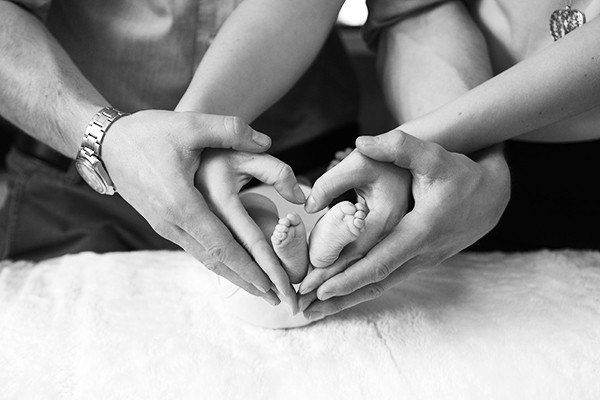
Dr. Schiller adds, “Personally, I believe that every life is valuable, which is why I think it is absolutely important that we offer this option. But ultimately it is the woman – the mother – who has to walk through it. There are many for whom this is the right thing to do, and who are grateful to accept our offer of support. But sometimes there are those who say, ‘I just can’t do it.’”
Johannes, too, is clear-eyed about this, and notes that in Anna’s case, the final decision lay with his wife. “I am infinitely grateful to Doris for her motherly love, and unendingly happy that she wanted to let Anna live. It’s the greatest, most precious gift she could ever give me.”
Today Doris and Johannes have a second child, Marlene. When asked about her older sister, the two-and-a-half-year-old responds with “Anna!” as if it were the most natural thing in the world. For her, Anna’s story is not a tragic secret. Nor is it one for her parents. Rather, it is a quiet reminder of how vulnerable – and therefore how precious – every life is. Beyond that, it is a reminder that as humans, our fragility is not a weakness, but rather a great strength that can call forth the ability to love – even when we have to let go.
[.smalltext] This article first appeared in Plough ’s German edition as “Wo Leben mit Tod Beginnt,” October 14, 2025. Translated by Chris Zimmerman. [.smalltext]