Essay
Those Hideous Stewards of Beauty
The gargoyles and grotesques on Notre-Dame Cathedral look down and see themselves in us.
January 9, 2026
Try 3 months of unlimited access. Start your FREE TRIAL today. Cancel anytime.
START FREE TRIAL NOW
[.small-caps] “Why was I not made of stone like thee?” [.small-caps]
—Quasimodo in Victor Hugo’s The Hunchback of Notre-Dame
[.article__paragraph--cap] [.small-caps] I moved to Paris [.small-caps] three years ago. My French is still bad, but I have grown familiar with this city. It is strange to call a place home that is so romanticized in the minds of so many. When I first arrived, I did not know what to expect, but I, like so many others, had read of Paris from different eras. So it was a bit surreal, when I first saw Notre-Dame, to witness the rebuilding of it instead of the timeless imagery I had seen in films, video games, and even the animated Disney feature, The Hunchback of Notre Dame . On those first visits, I was greeted with scaffolding, a large metal barrier blocking the front façade, and cranes towering over the church towers. The front of the church peeked out from behind it, looking impressive, but almost as a memory of what it once was, and a promise of what it might become again. That was a few years ago; since then, I have walked by it many times, noting the changes each time. Initially I watched very carefully, noting each minor shift, feeling like I alone was able to witness the transformation in whole.[.article__paragraph--cap]
It has recently been “finished” and the barriers have been removed. Replacing them are large lines of people waiting to visit. Along the sides and toward the back are still a few cranes, providing a means to finish the “minor” details that need to be resolved, but for all intents and purposes, the church has been rebuilt. It was strange, for me, to finally enter this church after so many months of seeing it closed.
My first visit was attending Mass. Not the inaugural Mass, but a regular Sunday service. I was struggling to follow the French readings and homily. But Mass is Mass, so it was familiar all the same. I focused on trying to understand the service, but kept losing that battle to the people shuffling along the sides photographing the architecture and the ushers trying in vain to keep them moving along and outside the rope to respect the divine. Two Italian women, when the usher was not looking, ducked under the ropes, sat next to us, and took some selfies before shuffling off with the rest of the tourists.
[.imgcaption] Photograph by Adam / Flickr. [.smalltext] Used by permission. [.smalltext] [.imgcaption]
On some level, I understand. Inside the great church there is a sense of grandeur, of great beauty, history, and stories older than our parents and their parents. To be a part of that, even for a moment, is incredibly appealing. After witnessing the interior, I had to reconsider the exterior. The white stone, the vaulted arches, the spires, all these elements we assign to a style of architecture we call “the Gothic.” All pointing up toward heaven. And, of course, there are the gargoyles.
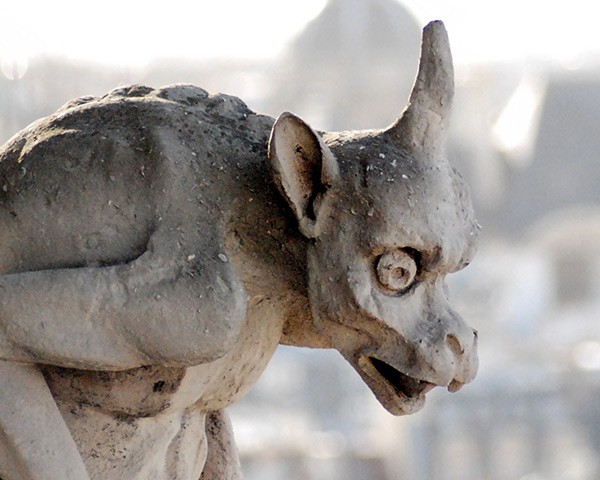
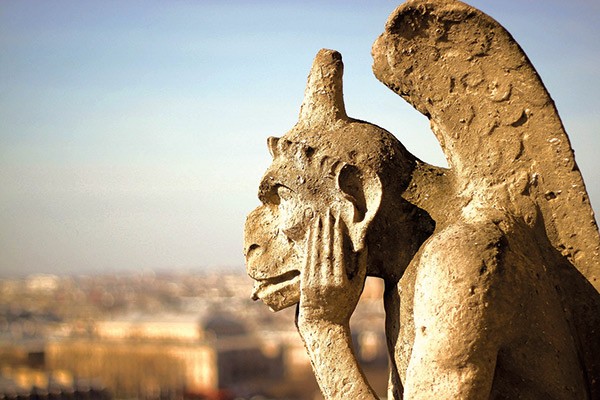
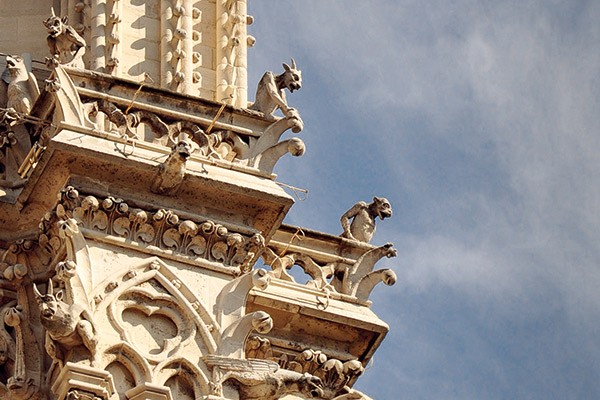
Along the church at the edges of our perception as we walk by are creatures, grinning, snarling growling, contemplating our existence, staring at us, observing our movements. They may not be the first thing a person notices, but they are always there in our minds and perceptions. They have become synonymous with Notre-Dame and the concept of Gothic architecture itself.
They stand in contrast with the majesty and beauty of the cathedral, and deliberately so. Notably, Saint Bernard of Clairvaux was not a fan. He wrote, “What is the meaning of these unclean monkeys, these strange savage lions, and monsters? To what purpose are here placed these creatures, half beast, half man, or these spotted tigers?”
In one sense the purpose is straightforward. “Gargoyle” stems from the French word gargouille , which translates to “throat or gullet.” Some have said the word is meant to mimic the gurgling sound they make when the water pours forth. In other words, the original responsibility of the gargoyle was to prevent rain from accumulating in pools on the roof, thereby reducing water damage. Many churches still possess gargoyles that function this way. However, some do not. Although we still refer to these snarling, laughing creatures as gargoyles, the technical name for them is “grotesques.” There is no definitive answer to Saint Bernard’s question. We do not know why these creatures were placed there.
Some say they exist as a reminder of the evils of the world (hence their facing outward from the church); in Barcelona I was told one of the gargoyles even points to where a brothel used to be in the old city. Others say they exist as “preachers in stone” designed to teach the illiterate of the ugliness of sin and that true beauty is found in God alone. The contrast of the grotesques occupying the same space as the divine appealed to Victor Hugo, who would write his famous novel about the church that watches all, and a lonely bellringer who longed to be a part of Parisian life.
Victor Hugo was fascinated with the grotesques. For him, their value was not just in their being “preachers in stone” for the uneducated. He argued that their ugliness and their horrifying faces were what made them valuable. Only by witnessing and walking under their terrible grins and fearsome gaze can we truly appreciate the beauty and divinity of the sublime.
[.article__paragraph--cap] [.small-caps] The word “grotesque” [.small-caps] has had many definitions over the years, initially referring to ornamentation that was more supernatural and imaginative as a flourish. (This was common in the Renaissance.) The term evolved and was used somewhat pejoratively to label these flourishes as something absurd and uncouth. There is a common thread through all this. It is a term used to discuss distorted, hybrid things. Later definitions included ugliness as another primary aspect of this term.[.article__paragraph--cap]
Years before he would write The Hunchback of Notre-Dame , Hugo wrote a play about Oliver Cromwell. The play is very long and features an immense cast, and as a result has been underperformed. What makes the play notable, however, is the preface, where Hugo writes what could be considered a manifesto for the entire Romantic movement. In the preface, Hugo discusses and emphasizes the importance of the grotesque and how it relates to the sublime.
[.blockquote] The universal beauty which the ancients solemnly laid upon everything is not without monotony; the same impression repeated again and again may prove fatiguing at last. Sublime upon sublime scarcely presents a contrast, and we need a little rest from everything, even the beautiful. On the other hand, the grotesque seems to be a halting-place, a mean term, a starting-point whence one rises toward the beautiful with a fresher and keener perception. [.blockquote]
Years later, Hugo published his story of a lonely hunchback living atop the great cathedral with the grotesques as his only companions. In the present, the importance of the grotesques remains as they gaze upon the city, observing the rich, the poor, and everyone in between going about their business. Their grins might be taken as a type of sardonic judgment, but there is another way to see it. From their lofty perch, the grotesques look down and see themselves in us. The ugliness we carry, both that within us and that imposed upon us by a world of judgments. And they understand these things do not define us. Just as they do not define them.
[.imgcaption] Photograph by Justin Mier / Flickr. [.smalltext] Used by permission. [.smalltext] [.imgcaption]
We do not like to imagine ourselves as monsters or ugly twisted things, but this is the nature of sin, and none of us is spared from its influence. We are all subject to the warping distortions it imposes on our minds and souls. Only through this understanding can we even hope to embrace the possibility of a form without ugliness. Hugo writes, “What we call the ugly, on the contrary, is a detail of a great whole which eludes us, and which is in harmony, not with man but with all creation.”
Maybe it is my love of monsters, but I wish to see the world as the grotesques do. They do not seek out the ugly as we do. They do not examine themselves in the mirror. They do not lament their body shape. They do not bemoan the state of their clothes or nitpick flaws. They also do not impose this on others. Instead, their gaze is turned outward, toward creation. There is something serene and beautiful about this. They do not need to look within the church. We do. They see a beauty in the world that we cannot.
I am new to Paris, but have come to know and love the city as a resident. The people within the church and without, the visitors and the natives, are all grotesques. Beyond the ancient churches, you might encounter a woman singing opera for some change, or a man asleep in his own piss in the Métro. These are all the same, and it can be argued that their existence is in harmony, and if that understanding fails to be grasped, it is easier (but harder on the ego) to realize that fault lies within us rather than in them. Yes, some of these encounters are more ideal than others. I will not say which ones are preferable, but I will say that it is only through all these encounters that true beauty can be realized.
Beauty is not a matter of taste, nor is it a matter of aesthetics. It is a means by which we attempt to grasp at the sublime. It is a textured reality that exists in a feverish dream that was previously only understood by madmen and poets. Art, like humanity, cannot recreate or capture the sublime. However, what it can do is remind us that within us is the spark of divinity.
The only way to see this is to see it as a grotesque does. If one cannot adopt this outlook, then one must acknowledge, even begrudgingly, its necessity. The contrast of our everyday lives is what provides us with the inspiration to improve, to create, to love, even if there are times when it is difficult and we would rather not.
I want to return to the hypothetical man sleeping on the Métro I mentioned earlier. (I have witnessed real men doing this, but out of dignity and respect, let us imagine a hypothetical man.) Perhaps, in that moment, in the corner of a subway car, filling the rest of the car with a nauseating smell, he has found peace and possibly even joy that he cannot find in his waking hours? We will never know what this imaginary, but real in theory, man dreams or why he is sleeping in a subway car. But as we move away from the puddle of his efforts that glides across the floor, fearful of being made a participant in his decisions, we can spare a moment to contemplate the beauty of a person who has found a fleeting moment of peace, and even wish him well before changing cars at the next stop. In this way, we can see him as a grotesque might.
[.imgcaption] Photograph by Ajith / Flickr. [.smalltext] Used by permission. [.smalltext] [.imgcaption]
No one can blame us for recoiling or looking away. But after that initial recoil, some reflection is required. The contrast of a man in need finding peace for a moment and our discomfort presents an opportunity to contemplate beauty. Standing there (or sitting, if you are lucky enough to find a seat on the Métro), maybe it is our failure to see as the grotesques do that causes us to look away. Our own distortion bars us from appreciating the artisan that is God, and marveling at his works even when we cannot fully understand their place or situation in the grand design.
If we are questioning beauty, there is also a question about what precisely is ugly here. We do not know this imagined man’s situation. There might be a desire to create a narrative of an otherwise saintly man who has fallen on hard times, but maintains his virtue despite the physical lapse of control. There would be many who would witness this and conjure up an image of this as an assault on upright society, those who wear fine clothes and can control their bladders. Such narratives exist about many in our society, urine or no urine. That which is different from us can be distorted to embody all sorts of fears or even potential threats to our persons, our children, and our loved ones. There are many who do this.
If beauty is to be true and good, then it must be for everyone. It must be difficult, or complicated, or coarse, or hard to perceive. It must be worth struggling for. And it must exist in all of us, regardless of our initial reactions. If we cannot see this, the fault is in ourselves. We have failed to take the central lesson from those “preachers in stone.”
It is difficult, and it takes time and patience, and it may very well turn out that the grotesques of Notre-Dame will change before I do, but to see Paris, to see all of creation as a grotesque does, feels like a noble endeavor. As my teachers lean over the edges of the cathedral, protecting the church by drenching this complicated earth in water from the heavens, perhaps they are not reminding me of the sins outside of the faith, but the ones within. As I pass by that famous church on the Seine, I contemplate this, looking up into the Paris rain.