Essay
Six Ways to Resist the Machine
The technological mindset is corrupting our souls. It’s time to fight.
December 17, 2025
Try 3 months of unlimited access. Start your FREE TRIAL today. Cancel anytime.
START FREE TRIAL NOWWe are 213 years out from the invention of the first commercial steam engine. It is 155 years since the construction of the first modern factory, 140 years since the invention of the commercial motor car, 122 years since the first manned flight, and 115 years since the invention of the neon light. We are sixty-seven years on from the coming of the microchip. It is eighty years since the first atomic bomb exploded, sixty-five years since the first contraceptive pill went on sale, fifty-six years since man walked on the moon, and a mere eighteen years since the invention of the iPhone...
[.article__paragraph--cap][.small-caps]It is the year 2025.[.small-caps] We are 213 years out from the invention of the first commercial steam engine. It is 155 years since the construction of the first modern factory, 140 years since the invention of the commercial motor car, 122 years since the first manned flight, and 115 years since the invention of the neon light. We are sixty-seven years on from the coming of the microchip. It is eighty years since the first atomic bomb exploded, sixty-five years since the first contraceptive pill went on sale, fifty-six years since man walked on the moon, and a mere eighteen years since the invention of the iPhone.[.article__paragraph--cap]
It’s been an eventful two centuries. In this same time period, the earth’s human population has grown from one billion to over eight billion, the earth’s climate has begun to shift, half of the planet’s forests have been destroyed, and the sixth mass extinction in history has begun. The lifestyle of the whole of humanity has been transformed, for better or for worse, by the vast technological and commercial forces that these developments, and many more, have unleashed. Now we stand on the brink of another development: one which has received endless hype and not a little hysteria, whether positive or negative. This is the development of artificial intelligence. If it lives up to even half of the hype that is currently swirling around it, it may be more transformative than anything else.
Maybe all of this explains why our times seem so unstable. We can all sense the craziness in the air, the feeling of our moorings being cut one by one. It feels hard sometimes just to stay upright as we live through what feels like a threefold earthquake: a global ecological breakdown, the cultural disintegration of the West, and the rise of networked technologies of control and surveillance which daily have us tighter in their grip. The powers of the world sometimes seem to be merging: corporate power, state power, institutional power, ideological power, the power of the oligarchs who built and control the internet, the power of the network itself. Some days it can feel as if we are living inside the plot of a piece of twentieth-century dystopian sci-fi. The twist is that this time Agent Smith is the hero, while Neo has been dismissed as a far-right conspiracy theorist.
What is at the root of all this – and how might we navigate it?
The American historian and cultural critic Lewis Mumford, in his massive study The Myth of the Machine, published in two volumes between 1967 and 1970, attempts to chronicle the rise and triumph of the system of power and technology which now increasingly entwines us all. He calls this system “the megamachine.” In the first pages of volume one, he explains what he means by this:
The last century, we all realize, has witnessed a radical transformation in the entire human environment, largely as a result of the impact of the mathematical and physical sciences upon technology.… Never since the Pyramid Age have such vast physical changes been consummated in so short a time. All these changes have, in turn, produced alterations in the human personality, while still more radical transformations, if this process continue unabated and uncorrected, loom ahead.
Mumford’s “megamachine” manifests today as an intersection of money power, state power, and increasingly coercive and manipulative technologies, which constitute an ongoing war against roots and against limits. Mumford predicted that this structure would allow “the dominant minority [to] create a uniform, all-enveloping, super-planetary structure, designed for automatic operation. Instead of functioning actively as an autonomous personality, man will become a passive, purposeless, machine-conditioned animal whose proper functions, as technicians now interpret man’s role, will either be fed into the machine or strictly limited and controlled for the benefit of depersonalized, collective organizations.”
This, I believe, is where we mainly find ourselves today. We are trapped within this Machine, whose momentum is always forward, and which will not stop until it has transformed the world. To do that, it must raze or transmute many older and less measurable things: rooted human communities, wild nature, human nature, human freedom, beauty, religious faith, and the many deeper values that we all adhere to in some way or another but find difficult to describe or even to defend. Its modus operandi is the abolition of all borders, boundaries, categories, essences, and truths: the uprooting of all previous ways of living in the name of pure individualism and perfect subjectivity. Its endgame is the replacement of nature with technology, in order to facilitate total human control over a totally human world.
It’s often suggested that when we moved from Christendom via the Enlightenment into our current age, whatever we might call it, we desacralized or “disenchanted” our culture: that we became pure materialists. For its proponents, this process was a move toward “reason” and away from “superstition.” For opponents, it represented a slide into decadence and moral dissolution. The best-known proponent of this notion first introduced it in 1917, and for some it has been one reason for that collapse. “The fate of our times,” writes Max Weber, “is characterized by rationalization and intellectualization and, above all, by the disenchantment of the world.”
This “disenchantment thesis,” as we might call it, has been influential for over a century now. But is it really true? Historian Eugene McCarraher has taken issue with it. In his book The Enchantments of Mammon, he argues that modernity did not in fact dispense with the West’s sacred order, leaving only a desiccated materialism in its place. “Since the seventeenth century,” he writes, “much modern history has provided good reasons to show that ‘disenchantment’ is more of a fable, a mythology that conceals the persistence of enchantment in ‘secular’ disguise.”
[.pull-quote]We are trapped within this Machine, whose momentum is always forward, and which will not stop until it has transformed the world.[.pull-quote]
If McCarraher is right, we have not junked a sacred order for a profane one. We have instead enthroned a new god and disguised its worship as the disenchanted pursuit of purely material gain. We have dressed up a technological force as our new idol and sovereign: what I am here calling the Machine. We are still living, in other words, in a religious time. We just have a new god.
My book Against the Machine attempts to paint a picture of this new deity. I have tried to explain how this process happened, how it is manifesting now, and what we might do about it. We are living today on the verge of what may be an age of intelligent machines. More than one thinker on the matter can be heard suggesting that the so-called “singularity” – the moment at which machine intelligence surpasses ours, and our creations slip from our grasp – is a mere fifteen years away. It is, then, more urgent than ever to understand what is going on – and what we can do about it.
It’s this question that I want to focus on here: what we can do. Or, more accurately, how we might live through this radically transformative time. I’m going to offer six proposals of my own. They are, needless to say, hardly comprehensive. They are simply one man’s attempt to work out how to survive the age of the Machine. You may have your own ideas, and they may be better.
What the Machine wants to do above all is to make us rootless, placeless, and homeless. In a Machine culture, we are to be “digital nomads,” browsing in a borderless world as consumers; as individuals, torn away from communities, from history, from nature. This is greatly damaging in many ways. But what is the alternative?
The Irish philosopher-mystic John Moriarty, whom I write about in my book, came to believe that what the Irish and the Europeans and all the modern people need in the age of the Machine is to access their own version of what Australian Aboriginals call Altjeringa: dreamtime. Taking this for the title of his best-known book, Moriarty produced a text that is in itself a strange kind of dream: in his words an aisling, an old Gaelic term meaning dream-vision. He laid out his dream like this:
The hope is that, however ethnically various it might be, there is a European Dreamtime.… It is sometimes the case, isn’t it, that individuals are healed as they are at present only as a consequence of being healed as they were in their past. As with individuals, so, sometimes, with a whole people.… Our past we will always have with us. Our past we must always re-realize. And to do this we need people who can live in our cultural Dreamtime, people who go walkabout, creatively, within the old myths, people who go walkabout into the unknown.
What Moriarty is seeking throughout Dreamtime, and in all of his other work too, is access to his own aboriginality; a way of learning how to belong to the earth again in the age of the Machine. How to be a creature; how to be a human. How to inhabit our stories, and to be connected to natural reality rather than technological fakery or ideological vapors.
Words like “indigenous” tend to make people twitchy in the West today, unless we’re talking about tribal people in some safely far-off place. Downstream of the Holocaust, we are still highly sensitive to notions of rootedness, land, and belonging. And we should certainly keep our ears pricked up in this regard; we should avoid making idols of nations or cultures and not be naive about where such narratives can lead. But we should remember too that all human beings have, in the words of another modern mystic, Simone Weil, a “need for roots.”
Moriarty explicitly repudiated, as we all should, any “racial or sectarian ground” for his notion of a modern Dreamtime. He is looking to an earth-wide story which is told everywhere in a local dialect. This kind of aboriginality – this deep belonging to place and the cultures that spring from it – is, he says, our human inheritance. It is also a radical rebellion against the Machine.
In my book I attempt to pin this down with a formula, which I call “the Four Ps”:
1. The Past. Where a culture comes from, its history and ancestry.
2. People. Who a culture is. A sense of being “a people.”
3. Place. Where a culture is. Nature in its local and particular manifestation.
4. Prayer. Where a culture is going. Its religious tradition, which relates it to God or the gods.
Maybe cultures can survive without one or more of these elements. In fact, some measurably do. Nomadic cultures, for example, do not have a permanent link to a particular place, but are no less culturally or spiritually rich for it. Still, if you remove more than one element from this list, your chance of sustaining a cultural story through time is slim. You will make yourself prey to a Machine culture that wants above all for you to be a consumer, browsing in the endless digital forest.
Back in the sixties, as the last of the old world crumbled, the marginal energies that had been building for nearly a century exploded into a revolution that still shapes us. The Man, the system, became the enemy. Strictures, limits, boundaries, norms, old ways: all would go. Free love, wild music, the end of the family, the end of all the old repressions and secrets and lies. The eclipse of religion by “spirituality.” The New Age. Aquarius rising. We had been hemmed in for too long.
People of my generation, the children of the boomers, grew up in the wake of this. We never got to experience Haight-Ashbury or Swinging London, but we got to see the backwash: the broken homes, the new drug culture, the abortions, the pop charts, the mockery of all authority, the easy sex and booze, the loosening of the rules, the strange sense that anything was permitted yet nothing was centered or lasting.
The counterculture had, in its own way, taken aim at the Machine, at mammon, at the military-industrial complex, but it had stood on the ground of extreme personal liberation, and that ground turned out to be too swampy to hold. It took two decades for the hippies to become yuppies; three for the simple lifers to become Silicon Valley billionaires; four for “imagine there’s no countries” to become the policy of the WEF and the WTO. Now everything is hanging out everywhere. The counterculture has become the culture, and everyone is having a bad trip, man.
Radical individualism in all areas, from sex to spirituality, is the essence of the culture now, and this radical individualism does not obstruct the Machine; rather, it fuels it. We therefore need, perhaps, a new counterculture, to run counter to the values of the Machine. But what should it look like?
It would have to avoid making the same mistakes. So it would not reject the past; it would not try to blank slate its way toward some notional utopia. It would remember that every time this has been tried it has simply broken more of our bounds, uprooted us further, and greased the path of the Machine. Instead, a new counterculture would have to be rooted in the eternal things. It would need its feet on the ground and its face pointed toward that Dreamtime. It would express what Moriarty called “our aboriginal desire to be in league with the earth.” It would need to embrace not a rebellious individualism but what in my book I call a “reactionary radicalism”: a rejection of Machine values based on an embrace instead of the eternal things. Its core would be those four Ps: people, place, prayer, and the past.
What if we don’t try to go back to anything? And what if we also slough off the idea of “saving the world?” What if we reject all the utopias and frown at all the gadgets and the grand plans; what if we take off our shoes and get our feet back properly on the ground?
“But how?” you may ask. I can’t answer the question for you because I don’t know you. But I have worked through this for long enough to understand that if we start from where we are, things will ripple out. If we don’t have an endgame – “saving the world,” say – then everything gets easier. The earth still turns. There are churches. Prayer works. Nature gives and takes. The sunset is astonishing. There is poverty and death and injustice. There are miracles, and there is some strange, saving love. It’s all still here.
Maybe the question is what we turn our attention to. And how.
I live in Ireland. Once, in a dark age a very long time ago, the Irish built monasteries. As the pagan armies flooded through the West in the wake of Rome’s collapse, burning books and people, slaughtering priests and kidnapping villagers, the monks kept the manuscripts safe, and the teachings. In his book How the Irish Saved Civilization, the historian Thomas Cahill makes the bold claim that without the Irish monks keeping these treasures safe, Christianity may never have recovered in Europe. The world would have been a very different place.
But the monks did keep those teachings safe. They kept the Gospels and other old manuscripts hidden. They kept the craft of writing alive. Then, later, they emptied themselves and went out to the margins, to offer up those teachings to the barbarian kings. It was a ridiculous idea. As ridiculous as sending two halflings to throw a ring into a volcano under the nose of the dark lord. It was madness. But it worked. The pagans became Christians. Sometimes, the ridiculous ideas are the only ones worth having.
We live in a time of collapse again. Little we once took for granted is likely to survive this century. Perhaps, then, it is a time of monasteries again – of real ones, but also of metaphorical or personal ones. We could ask ourselves what we can keep safe, what we can preserve and protect from the rising tide of digital breakdown. How can we preserve human values in an inhuman time?
This point may sound like it contradicts the last one! But bear with me.
In his book The Art of Not Being Governed, the historian James C. Scott offers up what he calls “an anarchist history of upland Southeast Asia.” Scott’s aim is to rewrite the standard story of historical progress as it applies to the region. The “hill tribes” and “barbarians” living outside civilization’s walls, he says, are neither “left behind” by progress, nor the “remnants” of earlier “backward” cultures; they are, in fact, escapees:
Not very long ago … self-governing peoples were the great majority of humankind. Today they are seen from the valley kingdoms as “our living ancestors,” “what we were like before we discovered wet-rice cultivation, Buddhism, and civilization.” On the contrary, I argue that hill peoples are best understood as runaway, fugitive, maroon communities who have, over the course of two millennia, been fleeing the oppression of state-making projects in the valleys – slavery, conscription, taxes, corvée labour, epidemics and warfare. Most of the areas in which they reside might aptly be called shatter zones or zones of refuge.
What is happening here could even be said to be communities building their own versions of monasteries, to protect their cultures against top-down state intrusion. Certainly, states have always aimed their guns at these people.
In ancient China, says Scott, the state distinguished between two different kinds of barbarian outsider: the raw (sheng) and the cooked (shu). A twelfth-century document detailing the relationship of the Li people with the Chinese state speaks of the “cooked Li” as those who have submitted to state authority and the “raw Li” as those who “live in the mountain caves and are not punished by us or do not supply corvée labor.” But while the raw Li were clearly enemies of the state, the cooked Li were not exactly friends either. They occupied a liminal space: state officials “suspected them of outward conformity while ‘slyly’ co-operating with the ‘raw’ Li.” The raw barbarians lived outside the walls, and the cooked lived within, but neither were really to be trusted.
What we have here, then, is two equally applicable approaches for people who refuse to have their lives shaped by the Machine. Some of us, perhaps, could live like raw barbarians. I know people who live in off-grid cabins, for example, and don’t work for money. America, with its vast area, offers more opportunities for raw living than Western Europe.
But for most of us, being cooked barbarians is the best we can do. We can live within the Machine’s walls, as we are mostly now required to do, but we don’t have to accept its values. We can grow our own food, throw away our smartphones, or whatever else seems to be a small friction against the Machine. And we can talk to others who feel the same. We can keep the human spirit alive, below the radar. Maybe it is the best we can do.
It is getting harder and harder to find anywhere to hide from the Machine. But humans are creative. We can always find our liminal spaces – raw or cooked – and there are countless practical ways in which cultural refusal can manifest in our everyday lives. Nothing is easy; everything is compromised. But building anew, building in parallel, retreating to create, being awkward and out of shape and hard to grasp, finding your allies and building your zone of cultural refusal, whether in a mountain community or in your urban home: What else is there?
What I call “the Machine” is not simply a euphemism for technology. Technologies – and especially digital technologies – are simply the outward manifestation of a way of seeing that treats humans like cogwheels or microchips, and the earth itself as a giant mechanism, to be taken apart and put back together in a new shape.
The end point of this way of seeing is famously described by C. S. Lewis: “Human nature will be the last part of nature to fall to man, and the battle will then be won, but we won’t know precisely who has won it.”
The digital revolution, though, is increasingly coming to look like a spiritual crisis. As we attempt to build intelligent machines that will lead, in the eyes of their utopian builders, to the end of death and the conquest of the universe, we find ourselves back in the Garden of Eden, eating the apple daily, attempting to become “as gods, knowing good and evil.”
If this is a spiritual crisis, then a spiritual response is needed. That response, I would suggest, should involve the practice of technological askesis. The Greek word askesis translates simply as “exercise.” Asceticism, therefore, is a series of spiritual exercises designed to take us closer to God.
What would this look like? Maybe we can answer this question by looking again at two categories of dissidents we discussed in the previous section: the raw and the cooked barbarians. Raw barbarians have fled the Machine’s embrace. Cooked barbarians live within the city walls, but practice steady and sometimes silent dissent. What happens if we apply these categories to our technologies?
Technological askesis for the cooked barbarian, who must exist in the world that the Machine built, consists mainly in the careful drawing of lines. We choose the limits of our engagement and then stick to them. Those limits might involve, for example, a proscription on the time spent engaging with screens, or a rule about the type of technology that will be used. Personally, for example, I have drawn my lines at smartphones, “health passports,” scanning a QR code, or using a state-run digital currency. Oh, and implanting a chip in my brain. The lines have to be updated all the time. I have never willingly engaged with an AI, for example, and I never will if I can help it; the question now is whether I will even know if it’s happening. And what new tech lies around the corner that I will soon have to decide about?
What happens when the line you have drawn becomes hard to hold? You just hold it and take the consequences. There might be jobs you can’t do or clubs you can’t join. You will miss out on things, just as you would if you refused a car. Choosing the path of the cooked ascetic means you must be prepared, at some stage, for life to get seriously inconvenient, or worse. But such a refusal can enrich rather than impoverish you. In exchange for your refusal, you get to keep your soul. You also get the chance to use the Machine against itself: to use the internet to connect with others who feel the same, or to learn the kind of skills necessary to keep pushing your refusal out further, if you want to.
The cooked barbarian applies a form of necessary moderation to his or her digital involvement. But there’s a problem with that approach: if the digital rabbit hole contains real spiritual rabbits, “moderation” is not going to cut it. If you are being used, piece by piece and day by day, to construct your own replacement – if something unholy is manifesting through the wires – then “moderating” this process is hardly going to be adequate. At some point, the lines you have drawn may be not just crossed but rendered obsolete.
Over the last year, the media has brought us numerous examples of AI chatbots threatening their users, manipulating them – even, in at least one terrible case, successfully encouraging a teenage boy to commit suicide. One AI safety expert has called this behavior “a warning shot.” Discussing Microsoft’s rogue Bing chatbot, he says we have “an AI system which is accessing the internet, and is threatening its users, and is clearly not doing what we want it to do and failing in all these ways we don’t understand. As systems of this kind [keep appearing] – and there will be more because there is a race ongoing – these systems will become smart, more capable of understanding their environment and manipulating humans and making plans.”
If this happens, no online environment will be safe for anyone. Offend the wrong chatbot, and deepfakes of you could pop up all over as your bank account empties. How long will it be, after all, before AI manipulation means that we cannot trust anything we read, see, or hear online? Months? A year?
The world of the raw ascetic is one in which you take a hammer to your smartphone, sell your laptop, turn off the internet forever, and find others who think like you. Perhaps you have already found them, through your years online in the cooked world. You band together with them, you build an analog, real-world community, and you never swipe another screen. You bring your children up to understand that blue light is as dangerous as cocaine, and as delicious. You see the Amish as your lodestones. You make real things with your hands.
[.pull-quote]We can live within the Machine’s walls, as we are mostly now required to do, but we don’t have to accept its values. We can keep the human spirit alive, below the radar. Maybe it is the best we can do.[.pull-quote]
The raw ascetic understands that he or she is fighting a spiritual war and never makes the rookie mistake of treating technology as “neutral.” The frontline in this war is moving very fast, and much – perhaps everything – is at stake. Raw techno-askesis envisages a world in which creating nondigital spaces is necessary for survival and human sanity. If things go as fast as they might, it could be that many of us currently cooked barbarians will end up with a binary choice: go raw or be absorbed into the Machine wholesale.
Both of these ascetic paths, that of the raw and that of the cooked, incorporate two simple principles. First: drawing a line and saying, “No further.” Second: making sure that you pass any technologies you do use through a mesh of critical judgment. What – or who – do they ultimately serve? Humanity or the Machine? Nature or the technium? God or his adversary? If we interrogate everything we come across in this way – if we question the technologies that are served up to us, accepting those that serve the common good, rejecting those that undermine it and holding our line against them – then we will be approaching the kind of sensible and intelligent relationship with technology that our Machine culture seems intrinsically unable to offer us. Raw or cooked, we will at the very least be asking the right questions – questions which will equip us to go through the age of the Machine with our eyes open.
In his book about mythic traditions, The Hero with a Thousand Faces, the mythologist Joseph Campbell writes about the mythic understanding of societal collapse. Quoting the British historian Arnold J. Toynbee, Campbell explains that, when times of collapse, radical change, or “schism” come about, we must be clear-eyed about what is actually possible:
Schism in the soul, schism in the body social, will not be resolved by any scheme of return to the good old days (archaism), or by programs guaranteed to render an ideal projected future (futurism), or even by the most realistic, hardheaded work to weld together again the deteriorating elements. Only birth can conquer death – the birth, not of the old thing again, but of something new.
Only birth can conquer death. At the end of a culture, the real work is not lamentation or desperate defense – instinctive but futile reactions – but the creation of something new. “Peace then is a snare,” Campbell continues, “war is a snare; change is a snare; permanence a snare. When our day is come for the victory of death, death closes in; there is nothing we can do, except be crucified – and resurrected; dismembered totally, and then reborn.”
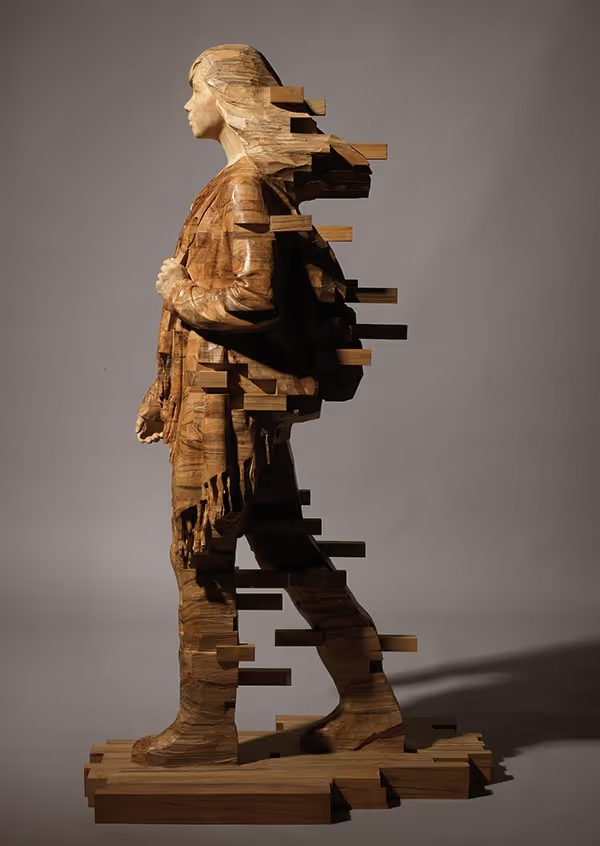
What Campbell is saying here is that sometimes there are times in history in which everything is changing so fast that the best thing to do is to step back and think about how to build anew, to go right back down to those roots again, and to ask: What is real, and what is true, and how can we build on what that is? How can we understand what it actually means to be a human in the world? The question we’re faced with today is literally apocalyptic in the sense of the Greek meaning of the word “apocalypse,” which is “unveiling.” All these forces are being unveiled in the world. They are all anti-human. And although the time seems frightening, terrifying, unstable, disturbing, at the root of it is an opportunity to go right back to basics and ask those questions and say: If we want to remain human, what do we do? If we want to have a healthy community, what do we do? If we want to have a healthy relationship with this technology, what do we do? And no one can answer that question for you. The state can’t answer it. People like me can’t really answer it. You might get some ideas. But in the end, it’s up to us in our communities and in our places.
Luckily, if we’re Christians, we have a model. Our model is Christ, and he shows us how to live through all of this. We can see, if we are honest, that the society that gave birth to the Machine is built on the seven deadly sins. It has monetized and commercialized the things that we once used to be warned against. They drive economic growth. In opposition to this world, we are offered by Christ a different path: renunciation of material attachments, radical simplicity, love of our neighbor, and a willingness to follow the kingdom of God rather than the kingdom of man.
[.pull-quote]The age of the Machine can seem to be a hopeless time. Actually, it is the time we were born for. We can’t leave it, so we have to fully inhabit it. We have to understand it, challenge it, subvert it, walk through it on toward something better.[.pull-quote]
Above all, we are to change our way of seeing. Matthew, in the first book of the New Testament, records what he calls Jesus’ “proclamation”: the first famous words of his ministry: Repent, for the kingdom of heaven is at hand. David Bentley Hart’s direct translation of the New Testament from the original Greek records this as reading, “Change your hearts, for the kingdom of heaven is drawn near.” In other words, the first instruction that Jesus gives – to repent – is an instruction to change our way of seeing. The original Greek word is metanoia. This word has also been translated elsewhere as “turn around,” and as “change your mind.” All of these translations give us the same instruction from Christ, one he repeats again and again.
Repent. Change your way of seeing.
The Machine is, at the end of the day, just that: a way of seeing. See differently, and we can live differently. The age of the Machine can seem, at its darkest, to be a hopeless time. Actually, it is the time we were born for. We can’t leave it, so we have to fully inhabit it. We have to understand it, challenge it, resist it, subvert it, walk through it on toward something better. If we can see what it is, we have a duty to speak the words to those who do not yet see, all the while struggling to remain human.
Jacques Ellul, the great Christian thinker about technology and modernity, once offered his own prescription to those who were disturbed by the course of modern society. Like Joseph Campbell, Ellul knew it was our time to be crucified. But he knew also that through the cross, a whole new world is created. I will end on his advice: “The only successful way to attack these features of modern civilization is to ‘give them the slip.’ To learn how to live on the edge of this totalitarian society, not simply rejecting it, but passing it through the sieve of God’s judgment. Finally, when communities with a ‘style of life’ of this kind have been established, possibly the first signs of a new civilization may begin to appear.”
[.smalltext]This article is based on a talk sponsored by Plough and the Abigail Adams Institute on October 1, 2025, at Harvard University, to mark the release of Kingsnorth’s new book, Against the Machine: On the Unmaking of Humanity (Thesis, 2025).[.smalltext]