Personal History
Beckoned by Beauty
How I stumbled into a story much bigger than my own – and found my way to the Bruderhof.
January 7, 2026
Try 3 months of unlimited access. Start your FREE TRIAL today. Cancel anytime.
START FREE TRIAL NOW
[.article__paragraph--cap][.small-caps] Growing up, [.small-caps] there was no better feeling than being immersed in a good story. When a wardrobe opened into Narnia or a letter delivered by an owl changed a little boy’s life, I was swept away into a thrilling adventure. I can still remember my older sister’s teasing as I emerged from my bedroom in tears after Dumbledore died.[.article__paragraph--cap]
In those moments reading, I experienced beauty. It had nothing to do with the way things looked. It was a journey of the heart out of myself and into some larger unity, a transcendent experience that left me with a deep sense of joy, hope, and gratitude. I believe it was this experience that first expressed my unconscious longing to know myself as a child in the family of God.
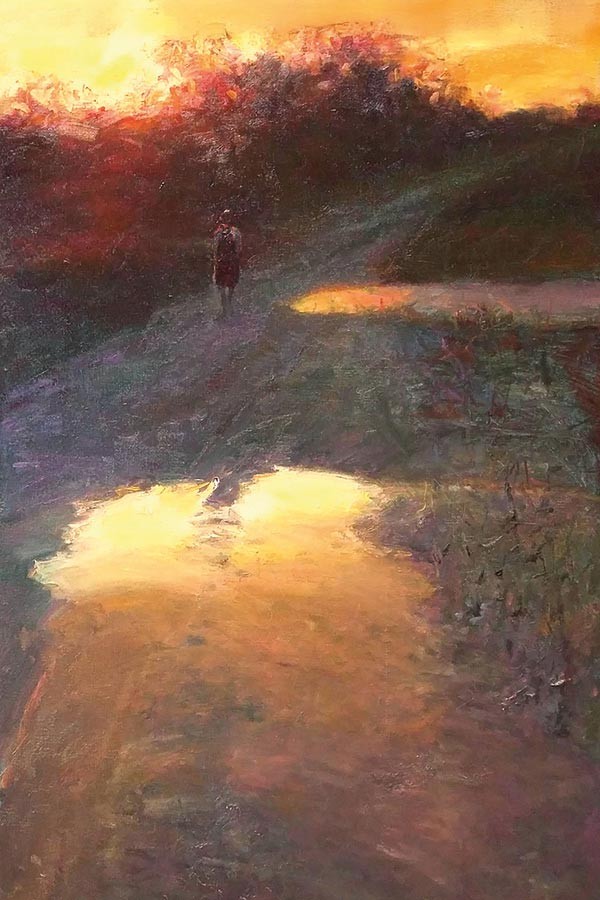
[.imgcaption] Charles Choi, Going Home , oil on canvas, 2018. [.smalltext] All artwork by Charles Choi. Used by permission. [.smalltext][.imgcaption]
But as I got older, these experiences of self-forgetting were few and far between. Most of the time, I was wretchedly self-conscious. I struggled to truly enter the fray of life and felt trapped inside the milieu of my own mind and emotions. By my mid-twenties, I was reasonably successful on paper, with a solid career, romantic relationships, and all the trappings of modern autonomous life. But this polished image belied underlying pain, confusion, and dissatisfaction. I often walked aimlessly around the city, yearning for my life to open up into something greater, like in one of those stories. I never imagined that there was One who saw all of those moments – and intended to offer the very beauty I loved.
In 2018, freshly single and drifting, I was sent by my California employer to a conference in Texas. There, during an idle moment, a young man from England introduced himself. It was a brief and friendly encounter, and I didn’t think much of it. But when I met Ben again at an event later that day, hardly before I could realize it, our surface-skimming conversation had become a deep plunge into uncharted waters.
We were both twenty-seven, broken in different ways, but attuned to beauty, chasing the glimmers we’d encountered in music, books, and fleeting moments of transcendence. Though we met as strangers from different parts of the world, it felt like we weren’t really strangers at all, but two sides of the same coin, connected all along in a solid yet unseen way. I wasn’t looking for marriage or religion, and I certainly wasn’t interested in “Christianity,” but this new connection unsettled what I thought I knew. While Ben, who was raised as an atheist, had come to believe in God and appreciated Christianity intellectually, I had cordoned off my heart from God. Raised marginally Catholic by divorced parents who didn’t follow Jesus, and educated in liberal, secular settings, I considered religion deceptive, flimsy, and unsophisticated.
I didn’t think much at all about God, but I unconsciously hungered for that “scent of a flower we have not found, the echo of a tune we have not heard, news from a country we have never yet visited,” as C. S. Lewis so beautifully describes human longing. When Ben and I met, it was as if that longing in us had been responded to, and we were each given the completely unmerited gift of a partner. The slow realization that seemingly out of the sky had fallen this relationship – where the real me could be seen and loved and called forth – overwhelmed me with awe and gratitude. I couldn’t make sense of it within my existing worldview, and yet the evidence of some sort of intention and design at work was piling up.
Back at our respective homes, separated by an ocean, Ben texted me a verse that had once struck him after being handed a Bible on the streets of London. It was Romans 12:2, and it became the first verse consciously committed to my memory: “Do not conform to the pattern of this world, but be transformed by the renewing of your mind. Then you will be able to test and approve what God’s will is – his good, pleasing, and perfect will.” Unbeknownst to me, that transformation was beginning, the seeds planted for some time. God’s will for us was good, pleasing – beautiful – but I still had no theological framework for understanding it.
One morning not long after, a friend sent me a link to a podcast episode with no further comment. Titled “The Inner Landscape of Beauty,” it featured an interview with John O’Donohue, the late Irish philosopher, poet, and priest. His voice, warm and lilting, spoke of beauty not as surface appeal but as an essential force that beckons us homeward, helping us heal old patterns and find new ground:
[.blockquote] Beauty isn’t all about just nice loveliness, like. Beauty is about more rounded, substantial becoming.… Beauty in that sense is about an emerging fullness, a greater sense of grace and elegance, a deeper sense of depth, and also a kind of homecoming for the enriched memory of your unfolding life. [.blockquote]
Enraptured by both the form and content of his words, I went on to discover Anam Cara , his bestselling book on ancient Celtic spirituality. As I read this book for the first time, teary-eyed and awestruck, sentence after sentence gave language and confirmation to what I was experiencing and opened the vista of my life out into eternity.
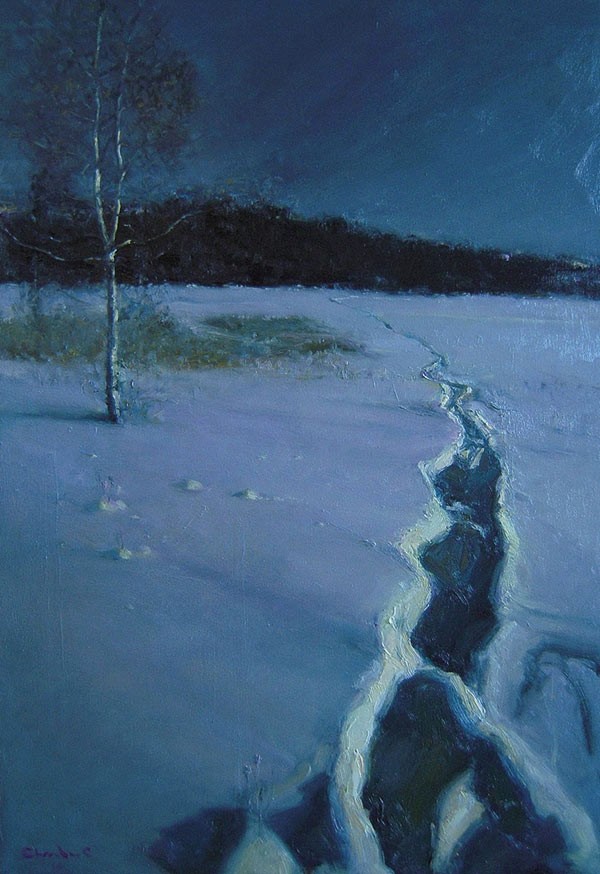
[.imgcaption] Charles Choi, Path , oil on canvas, 2014. [.imgcaption]
Anam cara is Gaelic for “soul friend.” O’Donohue says that encountering this kind of deep soul connection mirrors the nature of God himself – who encounters us through Jesus and invites us to become fully alive through the flow of relationship. He writes:[.blockquote] The anam cara is God’s gift. Friendship is the nature of God. The Christian concept of God as Trinity is the most sublime articulation of otherness and intimacy, an eternal interflow of friendship. Jesus … is the secret anam cara of every individual. In friendship with him, we enter the tender beauty and affection of the Trinity. In the embrace of this eternal friendship, we dare to be free. [.blockquote]
It began to dawn on me that the love unfolding in my life wasn’t just romantic – it was divine invitation. God, the hidden beauty behind all beauty, was beginning to show his face.
Swiss theologian Hans Urs von Balthasar describes beauty as a dynamic event, one that requires a response. This is just how Ben and I encountered it, as marriage and newfound faith combined to set us on a new course together. If we were loved by a God who gave us our deepest longing as a completely free gift at a time when we were nothing but lost little sinners, what did that mean for our lives?
We attempted to discover just that, examining every aspect of how we had lived up until then and rebuilding based on the beautiful revelation of Jesus. We quit jobs, moved cities in search of community, and grappled with our spiritual and psychological wounds. For a long time, it was hard to see outwardly whether we were lost or found. No one around us seemed to understand what we were going through. But keeping faith that we were being lovingly guided was enough to see us through the wilderness day by day.
When Covid hit, we were expecting our first child, living basically hand to mouth, and still spiritually homeless – despite “shopping churches,” including Catholic, Orthodox, and Reformed denominations. During this time, I stumbled upon an essay titled “ The Abyss of Beauty ” by Ian Marcus Corbin in Plough .
[.blockquote] What a strange kind of animal we must be, to feel ourselves perched on the periphery of something, always only almost living. The thing in front of us, just a hair past our reach, seems ideal, if we could get to it. But can we? Does such intimacy exist? Are we delusional to hope so? [.blockquote]
The essay explores how an apprehension of the beautiful can transform a life – or not – and how an individual responds to epiphany. I clicked through the website to the “About Us” page and began to learn about the Bruderhof . At first, the Bruderhof way of life appeared foreign and drab. But when we looked past the exterior, we began to be moved by what we were seeing – things like the inclusion of elderly single people in families, natural and beautiful care at the end of life, a wholesome and safe children’s community. We eagerly watched Laura from the Bruderhof answer questions on YouTube.
[.pull-quote] We were both twenty-seven, broken in different ways, but attuned to beauty, chasing the glimmers we’d encountered in music, books, and fleeting moments of transcendence. [.pull-quote]
Then I found my way to the writings of Eberhard Arnold , the community’s founder. Arnold explains the radical call of Jesus to a way of life – a way of being – that is completely contrary to the ways of the world. It is a life lived according to a sacrificial love that knows no boundaries. In this way only, the powers of evil and darkness are overcome through the gentle power of the spirit of God, which leads people to lay their lives down for their brothers and sisters.
[.blockquote] He who rose to life through the Spirit had a strength that exploded in an utterly new attitude to life: love to brothers and sisters and love to
one’s enemy, the divine justice of the coming kingdom. Through this Spirit, property was abolished in the early church. Material possessions were handed over to the ambassadors for the poor of the church. Through the presence and power of the Spirit and through faith in the Messiah, this band of followers became a brotherhood. (Eberhard Arnold, “Introduction,” The Early Christians ) [.blockquote]
One afternoon after reading Arnold in our California home, I woke my husband from a nap and said through tears, “I think this is it.”
In the fall of 2021, we sold the car we had just bought to finance a visit to the Bruderhof’s Maple Ridge community in New York. We arrived to warm and kind people with strange accents and patterns of speech; we met schoolgirls in plain dresses and bare feet. We were hosted by a family with three children, with whom we had early-morning breakfasts, begun in song and prayer. In the evenings, we’d spend time with them and others, young and old alike, sharing about ourselves and our journey.
The people were genuine, peaceful, at home with themselves. In turn, I felt more at home with myself than ever before. All this despite the fact that I was exhausted and overwhelmed, my nervous system locked in survival mode after spending the past year hustling to make ends meet and becoming a mother to a colicky baby girl.
During this first visit, God moved powerfully in our hearts. We were led, organically and quite by surprise, to unearth long-buried sins and to finally turn outward in trust to others who had already given their lives over to Jesus. Was this experience and way of life beautiful? Undoubtedly yes, but not glittering and attractive. It was beauty hidden in the surrender of self – a form shaped by love.
If you had shown the old me a picture of myself now – in simple dress, no makeup, eyes shining – I wouldn’t have known what to make of it. From the outside, there are stories one could tell about the transformation I’ve undergone: Was I radicalized by meeting my conservative husband? Choosing an alternative lifestyle to escape the world? Believing in a fantasy that helps me sleep better at night? But the real story is harder to photograph. It’s inward. Ongoing.
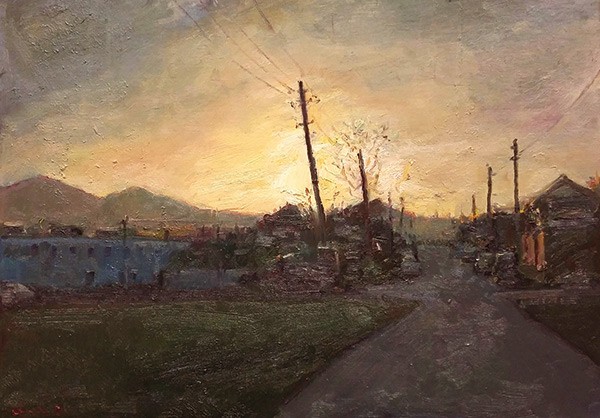
[.imgcaption] Charles Choi, Small Village , oil on canvas, 2016. [.imgcaption]
It’s true that joining this community has been like stepping into another world – not to escape the old one, but to find within it that the kingdom of God is truly at hand. Like the stories I loved as a child, this world insists that hope is stronger than despair, that love binds people together, and that real beauty reflects an inner unity. This way of life isn’t perfect – but through communal meals and shared work, suffering, celebration, and quiet acts of love, I daily hear the echoes of eternity.
This beauty, as I now see it, is not about visual splendor, but about self-giving love. It’s the experience of losing – and then finding – yourself in a story much bigger and better than your own personal narrative. This is a beauty that mirrors the ultimate beauty of Christ. Through offering friendship with Jesus, God didn’t just answer my longing for beauty; he revealed the One who is beautiful. What I once experienced in storybooks – the friendship, the fight, the meaning – was like a light beckoning me to new life in him.
The gospel is not a fairytale. It is the truest story, and its beauty becomes flesh when we dare to live it out – imperfectly, together.