Can Beauty and Justice Meet in Architecture?
An architect feels forced to choose between beauty for the rich and justice for the poor. A tuberculosis sanatorium shows him he doesn’t have to.
December 5, 2025
Try 3 months of unlimited access. Start your FREE TRIAL today. Cancel anytime.
START FREE TRIAL NOW
[.article__paragraph--cap] [.small-caps] “Wait, you’re an architect? [.small-caps] You design buildings? What are you doing here?”[.article__paragraph--cap]
After fifteen years of practicing architecture, I had transitioned to teaching vocational classes in graphic design and architecture at a racially diverse suburban public high school. All this information had been available to my student during the two years he had been in my classes, but he had just begun to pay attention to my story enough to feel an incongruity in it. His tone as he asked the question almost made it sound like he was joking, but I knew him well enough to know he wanted a serious answer.
When adults asked me similar questions about my career change, they seemed to be looking for something heroic, an inspiring narrative that led to what they perceived as an odd step down in status and in remuneration for my work. My friends teaching art classes down the hall didn’t get these kinds of questions. They had entered a field perceived to be impractical, with limited options for professional work and career advancement. Sometimes making art is held up above other kinds of work, uniquely valuable in a mystical way, but ordinary people choosing a career in art is more often seen as vaguely irresponsible, even frivolous. I was teaching many of the same concepts and skills as the art teachers, but design fields are often seen as a more practical pathway to success.
The difference in the ways people responded to these career choices revealed cultural tensions in how we think about beauty and justice and the role they play in our lives. These words, however, are often avoided, having become muddied or restricted in their common use.
In art classrooms, for instance, students learn the skills needed to create images and objects intended to enhance our physical environments. Beauty is the best English word to describe the goal of this work, capturing the way great art grabs and holds our attention by its excellence and awakens in us a desire for more. The term, though, has taken on associations with a saccharine sentimentality that many in the art world would like to avoid, preferring other words that can include our experiences of brokenness in the world.
In its common usage, justice may be connected to fairness, to equity, or to a proper ordering of a society, and it may be brought about by retribution, restoration, redistribution, or even revolution. Paired with the word “criminal,” justice is the application of the appropriate consequence for someone who has harmed another, whereas paired with “social,” justice involves correcting the unfair systems that harm entire classes of people. Both types of justice involve fixing problems among people, righting the wrongs we do to one another in our shared world. My career change was often viewed through this lens, as a stepping down in order to right the wrongs of a system that distributes opportunities unfairly: a step toward justice.
As I noticed the differences in people’s reactions, I was reminded that many consider both the pursuit of justice and the pursuit of beauty to be strange. Whether heroic or frivolous, they occupy places in our imaginations that include only certain kinds of work, certain kinds of people, and certain physical spaces. For justice, we might imagine aid workers going to help malnourished children in Africa, and for beauty we might imagine a concert pianist performing in Carnegie Hall for the kinds of people who can afford the ticket price. These things are separate from one another and, more importantly, separate from the vast majority of our everyday interactions.
To say that these places are imagined is not to say they are only in our minds. In my career as an architect I had seen many ways that false mental images of beauty and justice can cause real harm in people’s lives. For instance, some of my architecture clients, imagining beauty and justice as separate from one another, spent an extraordinary amount of money on visual beauty in their homes with funds gained from businesses that inflict great harm on vulnerable communities. Conversely, I had seen architects congratulating themselves for creating buildings that met the physical needs of struggling people while creating spaces that, in their lack of attention to even the most basic aesthetic care, reminded inhabitants of their lack of value to the community. Separating both beauty and justice from everyday interactions, some people in my life have sought beauty in the arts or battled social injustices professionally while acting callously toward those closest to them. I had fallen into many of these traps myself at various times.
On the other hand, I had also seen people who were doing extraordinary work and yet doubted its value because of our false images of beauty and justice. Their work toward healing the brokenness in ordinary people’s environments and lives felt ineffective or irrelevant because it didn’t change systems of injustice or didn’t meet all our standards of beauty.
By the time I entered the classroom as a high school teacher, I had developed a more connected understanding of beauty and justice, and the practice of architecture itself played a large role in this change. In a time when injustice and ugliness seem to be everywhere, we need renewed energy and creativity for integrating beauty and justice into the lives of people desperately in need of both.
[.article__paragraph--cap] [.small-caps] When I began studying architecture [.small-caps] in college, I wondered how to apply the call to service in my Christian faith to designing the kinds of built spaces that I had come to love, spaces where light and texture and proportion enfolded me and those around me in a transformative sensate experience. Though Jesus has strong words commanding us to provide tangible care for the “the least of these” – the poor and the immigrant in need of food, drink, clothing, or shelter (Matt. 25:34–40) – the culture in which I grew up connected this kind of care to charity rather than justice, things we might feel obligated to do with any excess resources at our disposal. I was beginning to sense their connection to broader injustices and wondering if I should make it central to my work.[.article__paragraph--cap]
In the field of architecture, though, the kind of work that addressed the injustices connected to these kinds of needs, such as low-income housing or community centers in neglected neighborhoods, was relegated to “socially conscious architecture,” a type of work separate from “great architecture,” works of formal or conceptual excellence, usually either important public buildings or homes for the very wealthy. The vast majority of buildings where people lived out their daily lives fit into neither category.
The separation of beauty, justice, and everyday interactions was apparent in my field, yet these things were all important to me. So I entered the field looking for more connected ways to pursue them. As I began to study buildings in more depth from the perspective of a designer, I started to notice that buildings themselves often bring together what our concepts pull apart.
One example is a remarkable tuberculosis sanatorium designed by the Finnish husband and wife team Alvar and Aino Aalto. They had won a competition in 1929 to design a care center for people suffering with the disease, which at the time had no effective pharmacological treatment. Built on top of a hill in a wooded area in southwest Finland and completed in 1933, the Paimio Sanatorium provided the care that was thought to be most effective for healing people with tuberculosis – extensive exposure to daylight and fresh air plus plenty of food and rest in a sterile environment – while removing them from interaction with the broader society to avoid disease transmission. Many patients would spend months or years in sanatoriums, often the final months or years of their lives.
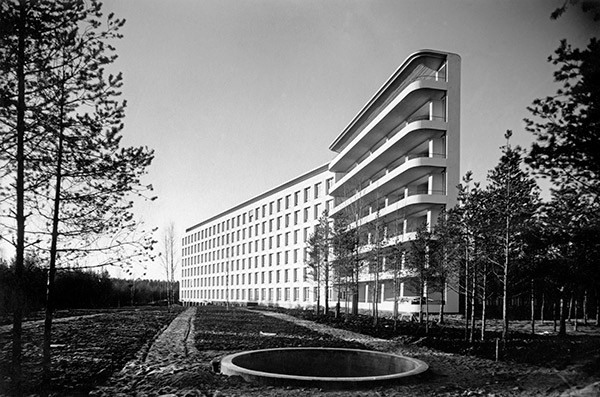
[.imgcaption] Paimio Sanatorium, Exterior to the south, Building A. Water bowl in front, Circa 1932. [.smalltext] Photograph by Alvar or Aino Aalto, Alvar Aalto Foundation. Used by permission. [.smalltext] [.imgcaption]
Today many are becoming more aware of the history of tuberculosis and its contemporary challenges through John Green’s popular book, Everything Is Tuberculosis . Green places the sanatorium era (the period between the discovery that tuberculosis was caused by bacterial infection in the second half of the nineteenth century and the development of effective medications for its treatment in the middle of the twentieth century) in a broader narration of the history of tuberculosis, or “consumption.” He highlights the ways the disease has been thought of in various eras, sometimes as a mark of moral degeneracy among the marginalized, sometimes as a mark of a poetic and sensitive soul among higher social classes, and currently as a disease of the past, or of other parts of the world – an illness always linked to injustice.
The design of the sanatorium Aino and Alvar Aalto developed to address both the disease and its related social inequities called for a complex of linked buildings, including a long, thin seven-story structure with a slight bend to embrace the views and sunlight to the south. A deck along the entire length of the top floor gave patients a place to recline for hours each day, breathing in the healing fresh air. The Aaltos used the palette of architectural materials, forms, and spaces we’ve come to call “modern”: simple white volumes without extraneous ornament; repetitive or asymmetrical forms rather than classical symmetries and hierarchies; and fluid interior spaces made possible by industrial-age structural innovations. The Aaltos took advantage of this new architectural language to address the particular needs of the sanatorium. The repetitive systems of modern design allowed them to organize and unify a large number of rooms for ordinary people in need of treatment. The wealthy could find more luxurious treatment centers elsewhere. Here the rooms were identical and small, with two to a room, yet the building was designed to demonstrate real concern for each person who would receive care there.
Photographs of the exterior of the sanatorium show a large concrete wall with a grid of windows more reminiscent of a factory than a home. The photos fail to communicate the way this wall’s southern exposure and its windows embedded deep into the wall provide every room with access to direct daylight from the south, with less in the summer and more in the winter.
At a smaller scale, the Aaltos designed chairs that used the strength and lightness of bent and laminated wood veneer as a warmer alternative to aluminum frames, while still allowing for mass production. The Paimio Chair, as it has come to be known, is still being manufactured and, at the time of this writing, can be purchased for $6,430. But it was originally developed to put tuberculosis sufferers in an ideal posture for breathing while reclining, employing a playful and tactile form.
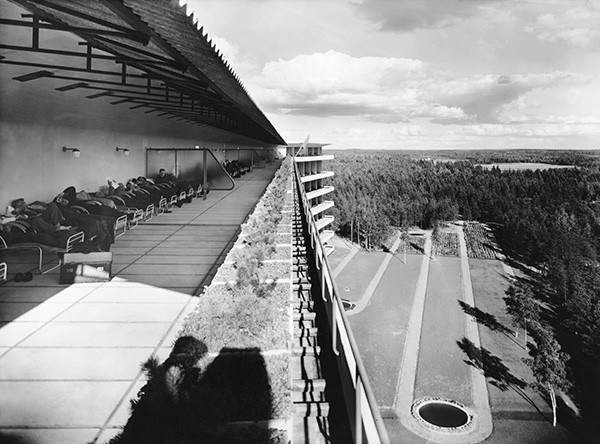
[.imgcaption] Solarium terrace. Garden and paths on right, 1934. [.smalltext] Photograph by Gustaf Welin, Alvar Aalto Foundation. Used by permission. [.smalltext] [.imgcaption]
The washbasins in the patient rooms used an unusual geometry to minimize the sound of splashing water that might disturb a sleeping roommate. Because the design intent was not apparent from looking at it, the Aaltos created a section drawing of the ceramic basin with a diagram of water and sound movement.
One way to look at the Paimio Sanatorium is as a place that bridges great and socially conscious architecture, delivering both beauty and justice. Alvar Aalto is among the pantheon of great modern architects (Aino tends to get ignored), and here he offered his design skills charitably in service to those in need.
But that doesn’t tell the whole story. The current price of the Paimio Chair suggests that people find it beautiful quite apart from its original healing intent. Yet in its original location its form and its healing work were part of a single design expression, giving it a deeper beauty. The washbasin has not gone on to be a fashionable consumer product, its beauty hidden when extracted from the sanatorium, where it served a unique need in the daily lives of tuberculosis patients sharing rooms. And the orientation of the rooms in the sanatorium, providing for optimal daylight for every room, would seem only responsible, not exceptional, if done for building occupants with resources and social standing.
The beauty of the Paimio Sanatorium came from within its movement toward justice. For patients with tuberculosis, the aesthetic excellence of the place was not isolated from the ways their needs were being met in their suffering. They would have experienced care for their needs with all their senses over the course of hours and days and seasons. People whose links to society and health had been broken could experience beauty in small repairs to those links in and through spaces and objects in their environment.
[.article__paragraph--cap] [.small-caps] During my years of practicing [.small-caps] architecture, the projects that came my way did not provide opportunities for either “great architecture” or “socially conscious architecture”: small-town fire stations, multifamily housing, and individual homes with modest budgets. But I had come to realize that these types of spaces, where people live out their everyday lives, provide ample opportunities to create small moments where justice and beauty come together. With my imagination fueled by what I had discovered in buildings like the Paimio Sanatorium, I turned my design attention to architectural moments where the physical needs of those who are often devalued could be cared for with aesthetic abundance.[.article__paragraph--cap]
Along the way, as I was growing in my faith, I began noticing new things about the way the Bible talks about justice. The Hebrew Bible seemed to imagine a justice that is more than fixing problems and righting wrongs:
[.blockquote] Kindness and truth have met,
justice and peace have kissed.
Truth from the earth will spring up,
as justice from the heavens looks down.
(Psalm 85:11–12, Robert Alter translation) [.blockquote]
[.blockquote] But let justice well up like water
And righteousness like a steady stream.
(Amos 5:24, Robert Alter translation) [.blockquote]
This justice is a thing to desire, something ravishing to long for. God’s justice is described as all-encompassing, wrapped up with peace and truth and righteousness and kindness into a whole new configuration of the world.
In English translations of the New Testament, the words “justice” and “righteousness” come from the same Greek word, together describing something we can eagerly wait and hope for (Gal. 5:5) and something we should always seek first, putting aside our worries about our everyday needs (Matt. 6:33). Justice is even something we become in our life together (2 Cor. 5:21) as we are formed into a community that routinely lifts one another up and extends this practice into the lives of our neighbors. The justice of God is beautiful.
[.article__paragraph--cap] [.small-caps] It was after years of seeking [.small-caps] to live with an imagination transformed by this vision of God’s justice that I found myself in a high school classroom being asked by a student why I was there. I wanted to answer his question with all the forthright honesty with which he had asked it, resisting my tendency to overexplain myself in order to justify my choices. I told him the truth: “I think you’re awesome and I want to be here teaching you.” This wasn’t the answer he expected, but he had interacted with me enough to know I meant it.[.article__paragraph--cap]
When I had felt the pull to leave the field of architecture in order to teach teenagers, it was not out of a call to step down in my career; it was because of how much I had enjoyed each opportunity I had been given to work with young men and women as they were transitioning into adulthood. I resisted making the switch for several years, feeling that it would be absurd to abandon all my education, experience, and skills in architecture. When I finally entered a teacher certification program, I was still wondering if this was the right path for me.
During this training, one of my professors stated that in a classroom the teacher creates the environment. She wasn’t talking about desk configurations and bulletin boards; she was explaining how my interactions with students would construct the reality of our time together, either for good or for ill. Through hearing this and through experiencing it when I began teaching, I came to realize that I wasn’t leaving the practice of architecture, I was learning to design the environments people inhabit in a new way.
The conversation with my student about why I chose to be his teacher took place at a time when it was becoming increasingly apparent that many in our society considered him of lesser value than others, or even as a dangerous criminal, because of his race. I hope that my presence and interactions with him told him otherwise. I knew my words and actions couldn’t fix a culture that marks some people as less valuable than others, any more than the innovative porcelain sink at the Paimio Sanatorium could overcome society’s tendency to segregate people with terminal illnesses. Yet I was able to tell him that he was worth my time, and I could create an environment of respect where he could hear and believe my words.
Buildings are expensive and complicated. Few of us will be able to affect our shared physical environments the way an architect can. Those who can should let their decisions and creativity be guided by care for those who are often overlooked or devalued, giving them their share in the aesthetic excess we call beauty. But we can all help create environments of beauty and justice in our everyday interactions. We may even begin to notice the ways we are already creating them, and we can lean into the process more fully. We can also consider placing ourselves in physical environments marked by ugliness and injustice, finding opportunities to restructure the space with and for others, sometimes physically, interpersonally always. If we are ravished by a vision of God’s beautiful justice, we will do this not out of a sense of obligation but out of a deep delight in a new shared life together.