Essay
A Tree by Any Other Name
Befriending your backyard sycamore can change your relationship with the natural world.
January 10, 2026
Try 3 months of unlimited access. Start your FREE TRIAL today. Cancel anytime.
START FREE TRIAL NOW
This summer, for the first time, I began paying attention to trees. It’s odd that I hadn’t previously noticed the wide variety of species that covers 30 percent of the globe. I’ve been birdwatching my whole adult life, and a good place to see a bird is somewhere in a tree. Why had I neglected to appreciate and catalog all the types of trees in the same way I have with birds for twenty years?
Noticing trees started in much the same way as noticing birds: by looking up. There was the tree below the underpass on my nightly walk this summer, its plate-sized leaves fluttering in the humid air. With help from my phone camera and the Trees of Ohio field guide, I learned it was a northern catalpa, also known as the “cigar tree” owing to its long, tubular pods. A neighbor’s front yard featured a tuliptree, which has elegant, heart-shaped leaves and is among the tallest trees in North America. The buckeye was relatively easy to identify, given its smooth brown chestnuts and the preponderance of buckeye paraphernalia in Ohio, where Buckeye season usually refers to football or a decadent peanut butter confection.
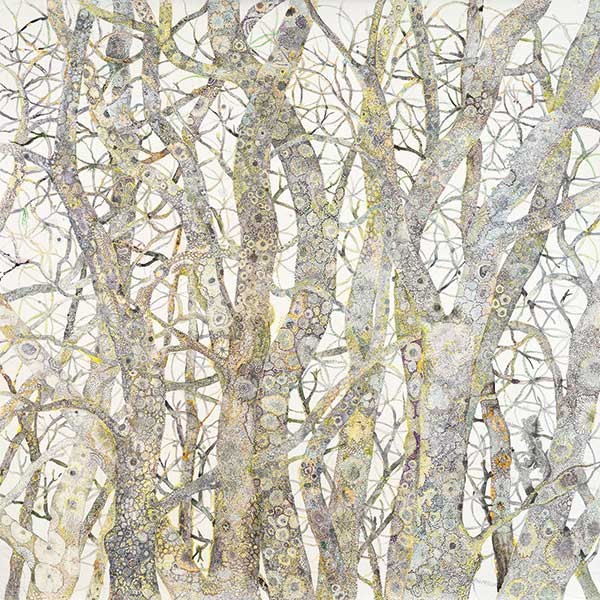
Claire Burbridge, Unified Field 2 , watercolor, pen and ink, and salt crystals on Yupo paper, 2022 (detail). All artwork by Claire Burbridge. Used by permission.
The giant that stands in my front yard made itself known by shedding its bark in clumps one weekend in July. A large piece of that sycamore now adorns my living room mantle. When sycamores shed their bark, they are getting rid of their brittle exterior layer so that the fresh and pliable layer underneath can emerge like a smooth canvas against the sky.
It’s easy for us to ignore trees. Beyond their ubiquity in our parks and backyards, we devalue them because they are so unlike humans. Trees lack a brain and central nervous system. They can’t get up and move (which is what makes birdwatching, by contrast, so fun – like a hunt without the actual hunting). We grow in spurts, while trees grow slowly, sometimes over centuries. They don’t have faces. And their breathing is our converse, taking in carbon dioxide through pores on their leaves and bark before releasing oxygen into the atmosphere.
This last fact, though, helps us to see trees as more than ornamental cover in a world meant mostly for humans. We and other creatures depend on trees in order to breathe clean air. A majority of the world’s animal species live in forests. Deforestation means we are losing the equivalent of twenty-seven soccer fields of forest per minute; as the forests go, so do these species, which causes disruption at every level of the earth’s ecosystem.
Trees have provided innumerable human resources since premodern times, from lumber to food such as fruits and nuts, from medicinal compounds to dyes and fibers and paper. Trees provide natural air conditioning in cities, blocking the heat from being reabsorbed by sidewalks and buildings. “Green space” is also known to ease mental distress and even decrease crime. Plus, trees graciously let us lean up against them to read a book and find rest.
The Overstory , the sprawling 2018 novel by Richard Powers, tells the stories of several people whose lives and fates are bound up with those of trees. A forestry researcher named Patricia Westerford, a character inspired by the real-life scientist Suzanne Simard, stumbles upon a wild discovery: maples that are being attacked by invasive insects are able to send out airborne signals to other maples. In response, the surrounding trees pump out insecticide and thus stave off the insects. To Westerford, this demonstrates that “The biochemical behavior of individual trees may make sense only when we see them as memb ers of a community.”
She labels her paper “Trees Talk to One Another.” They don’t speak in the way people do, of course. But what other than a language do we call a system of signals transmitted and received? Could trees possess intelligence that we are only beginning to understand?
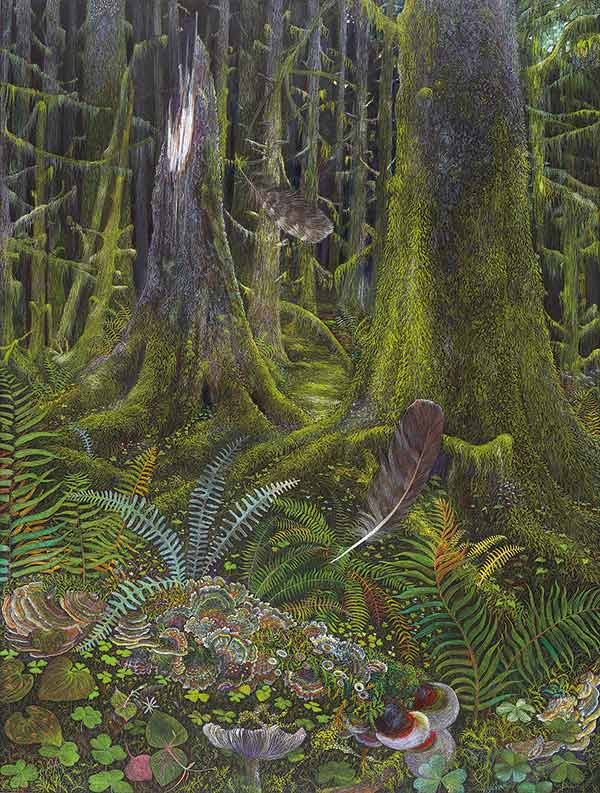
Claire Burbridge, Forest Knoll , colored pencil, 2023.
Westerford is initially ridiculed; to say that trees “speak” is to misunderstand natural processes, critics say, to assign human traits to nonhuman things. Shunned out of her field, she escapes into the forest until years later, when other researchers replicate her finding that trees trade signals and come to each other’s aid, sending chemicals through the air.
Perhaps it’s our modern impulse, the myth that we exist as individuals, that blinds us to the interdependence of other creatures – and to our interdependence with the rest of creation.
It is no wonder that people in the modern era are turning and returning to the natural world for spiritual sustenance. Technology has made our lives easier on many fronts. But it has also trained us to see life as a thing to be manipulated rather than a gift to be received. The internet lures us deeper into a nonmaterial, and thus anti-human, space. Our screentime has fueled mental health decline, loneliness, and outrage cycles that line the pockets of tech CEOs. The astonishing acceleration of AI we see today is only the most recent step in a long series of steps that is heading us further away from the material world, which is to say the home God has given us and calls good.
Our modern longing to reconnect with creation has taken the form of activism, starting with the environmentalist movements of the 1960s and coalescing in various climate change initiatives today. But our hunger for nature can also look more quotidian: watering a houseplant, planting a sapling, or growing vegetables in our backyard. Caring for even a corner of the plant world, we fulfill the ancient command given to humans in the Garden where it all started: to tend, nurture, and protect nonhuman life as God’s representatives on this fragile earth.
The poet and essayist Wendell Berry has been a voice in the wilderness warning about our loss of connection to the living world. In his 1969 essay “A Native Hill,” Berry writes of his relationship to the plot of land in Kentucky where he has rooted himself for many decades:
And so I go to the woods. As I go in under the trees, dependably, almost at once, and by nothing I do, things fall into place. … I feel my life takes its place among the lives – the trees, the annual plants, the animals and birds, the living of all these and the dead – that go and have gone to make the life of the earth. I am less important than I thought, the human race is less important than I thought. I rejoice in that. My mind loses its urgings, senses its nature, and is free.
Berry reminds us that people are only part of the creation – an important part, but also not bestowed with the “main character energy” we usually operate with. Owing to their sheer, immovable size, trees dwarf us in ways that a goldfinch or a ficus plant do not.
Last spring I visited Sequoia National Park in California, home to some of the oldest trees on the planet. Many of the sequoias predate the life of Jesus. I was visiting before peak tourist season, and one afternoon it felt like I had the forest to myself. I stood amazed before the trees, but also intimidated; an average sequoia measures twenty feet in diameter and towers three hundred feet in the air. No wonder the naturalist John Muir called them “King Sequoia” and “the greatest of living things.” Standing next to a massive tree can humble us down to size.
In Genesis, humans are created as the crown of creation after a long line of created beings. Like the plants and animals God created before them, humans are “soil-breathed, soil-dependent creatures animated by divine breath,” says theologian Norman Wirzba . The Hebrew word for human, adam , comes from the word for soil, adamah. Misreadings of the creation mandate have been used to support wanton destruction of forests the world over. But a doctrine of unfettered human expansion has ended up being bad for people too. “We have lived by the assumption that what was good for us would be good for the world. … We have been wrong,” writes Berry.
We must learn to cooperate in its processes, and yield to its limits. But even more important, we must learn to acknowledge that the creation is full of mystery; we will never entirely understand it. We must abandon arrogance and stand in awe.
In other words, our earthly good is bound up with the good of all creation.
J. R. R. Tolkien created a universe where trees, or tree-like beings called Ents, play a crucial role in the battle against evil. In several passages of the Lord of the Rings trilogy, he goes into great detail (some would say too much detail!) about the forests and trees of Middle-earth. At one point, Frodo comes across a mallorn, a type of tree akin to a beech that grows in Lothlorien. As he reaches out to feel its bark, Tolkien writes, “Frodo felt a delight in the wood and the touch of it, neither as forester nor as carpenter; it was the delight of the living tree itself.” The treeness of the tree, rather than its utility, awakened joy, both for the hobbit and his creator. Elsewhere, the destruction of the forests of Middle-earth is attributed to Saruman and his unquenchable hunger for power.
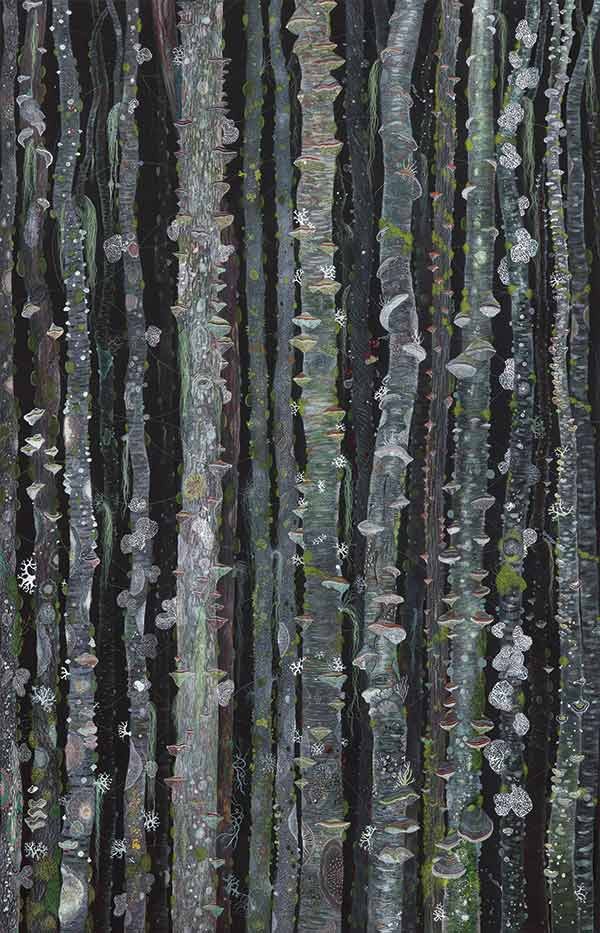
Claire Burbridge, The Nocturnal Life of Trees 2, watercolor, pencil and ink, 2021 (detail).
It is no surprise then that Tolkien loved trees. In a letter from 1955, he writes, “I am … much in love with plants and above all trees, and always have been; and I find human maltreatment of them as hard to bear as some find ill-treatment of animals.” He wrote portions of his epic sitting under the branches of a particular black pine in the Oxford Botanic Garden. In the last known photo of him, he is leaning against the old pine. He named it Laocoon. It was felled in 2014.
I am intrigued by the idea of naming trees in the way Tolkien did his beloved pine. I don’t mean knowing the names of red maples and conifer pines and black oaks and white elms – although learning to identify trees by their attributes would help us care for them (and is fun! says the birdwatcher). Rather, I mean that we could come to delight in the trees in our backyards or neighborhood parks so much that we nickname them in the way we do our pets and even inanimate objects like our cars (Pearl) or our coffee makers (Old Faithful).
Naming the sycamore in my front yard would surely raise some eyebrows. The botanist Robin Wall Kimmerer notes, “English doesn’t give us many tools for incorporating respect for animacy. In English, you are either a human or a thing.” But the Bible gives us language for the breath of life in plants and animals. Listen to Job 12:
But ask the animals, and they will teach you,
Or the birds in the sky, and they will tell you;
Or speak to the earth, and it will teach you,
Or let the fish in the sea inform you.
Which of all these does not know that the hand of the Lord has done this?
In his hand is the life of every creature
And the breath of all mankind.
Listening to creation is part of Job’s pathway to wisdom. Later, God reminds Job that the sea and the stars and every living thing belong to him and are under his dominion. Once Job sees that he is but one small part of a vast, wild creation, he repents and is relieved of the distress from his human affairs.
If you are like me, perhaps you find it uninspiring to pursue a better relationship with the natural world under the banner of “sustainability” or “environmentalism.” Some of our efforts to protect creation, of course, must be scaled up; that can’t be accomplished by one person or community. But it’s hard to have a relationship with an -ism . A better place to start forging a relationship with the living world is by knowing it in our flesh and blood: by watching a mountain sunrise, tasting a freshly picked blackberry, smelling a pine forest, listening to the plaintive hoo s of a great horned owl at dusk, and touching the sturdy bark of the sycamore tree that towers over your apartment. All are sustained by the Lord of life, and all are given for our earthly delight. It may not be long before the sycamore in my front yard becomes a Seymour.