Community Snapshot
The Backwoods Sculptor
Barney Boller, a Bruderhof artist, shapes steel, bronze, clay, and wood.
January 28, 2026
Try 3 months of unlimited access. Start your FREE TRIAL today. Cancel anytime.
START FREE TRIAL NOW
[.article__paragraph--cap] [.small-caps] By his mid-twenties, [.small-caps] Barney Boller was feted as a rising star among wildlife artists – but he walked away just as he was making the big time. It’s a compelling story. Problem is, over two decades later, Barney’s not particularly interested in telling it.[.article__paragraph--cap]
“Don’t make this about me,” he says. “Besides, artistic abilities aren’t something you can take credit for, not if you’re honest about the source of your talents. Just to be allowed to be a part of the process is itself a wonder and a mystery. And when people say your art points back to God, the ultimate artist, that’s an inexpressible joy and blessing. That’s the true heart of an artist, not the other stuff.”
And yet, as he admits, it’s the other stuff that gets you here.
Born the youngest of nine children to Magdalena and Christoph Boller, Barney grew up in a household of creatives, at the New Meadow Run Bruderhof community in southwestern Pennsylvania’s Appalachian Mountains. His father was an accomplished potter, woodworker, and turner, who loved to play German Volkslieder on his battered violin; his mother, a folk artist and kindergarten teacher with a flair for storytelling. His siblings showed an array of talents in arts, crafts, and music. Home was a hive of activity, but there were always chores to do. On Saturdays, while his friends played ball, Barney helped his father split and stack firewood.
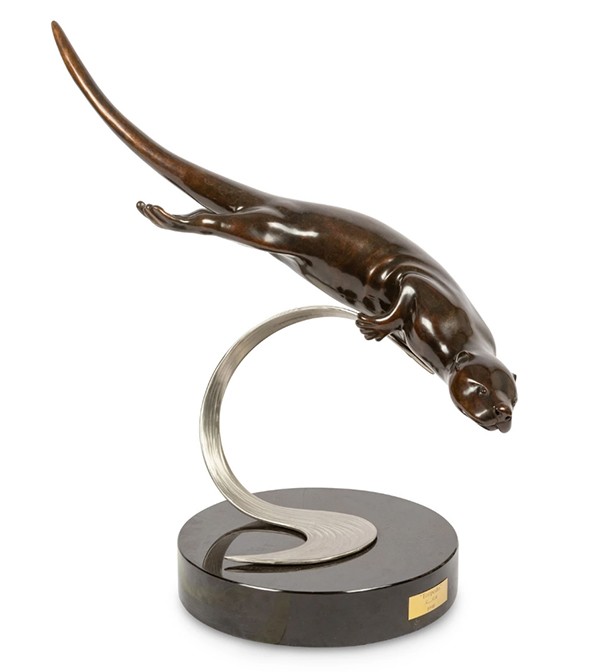
[.imgcaption] Barney Boller, Torpedo , bronze sculpture, 1998. [.smalltext] All photographs courtesy of Barney Boller. [.smalltext] [.imgcaption]
But there was also time for this tall, gangly boy to escape into the woodlands and fields, using his penknife to carve walking sticks or fashion bows and arrows. He trapped squirrels and rabbits, dissecting them to study pelts, sinews, and organs. He tried taxidermy and helped butcher deer, fleshing hides for tanning. In winter, Barney spent hours in his father’s pottery studio, where Christoph produced crockery to give to friends or sell for fundraising. Having grown up in poor conditions in Paraguay, Christoph always looked to help others. (At one point, his pottery sales funded the purchase of several milk cows for a start-up Christian community among the indigenous Aymara of Bolivia’s Altiplano.)
Christoph tried to teach Barney to throw clay, but the boy’s attempts would inevitably gyrate off-kilter, and, as he accelerated the wheel, fly off the throwing bat to land unceremoniously in his lap or on the floor. Abandoning cups and teapots, he modeled designs for crossbow triggers and other inventions.
A rambunctious child, brimming with creative energy, Barney lurched through his school years, but dreamed of becoming a medical surgeon. By the time he finished high school, he’d accepted this was a long shot. He found factory work at the Woodcrest Bruderhof, in Rifton, New York, assembling medical devices, but it was the welding shop that drew his attention. Barney approached the foreman, assuring him he was a good welder. “I wasn’t,” he confesses. But the job was his. “I had to become a production-quality welder overnight. I spent the first week working late, fixing my mistakes when no one was around.”
If the foreman noticed, he didn’t say. Barney stuck with it. “I set my heart on becoming the best welder ever – not just good, but the best,” he remembers. “Arrogant? Sure. But it was also my way of validating my self-worth.”
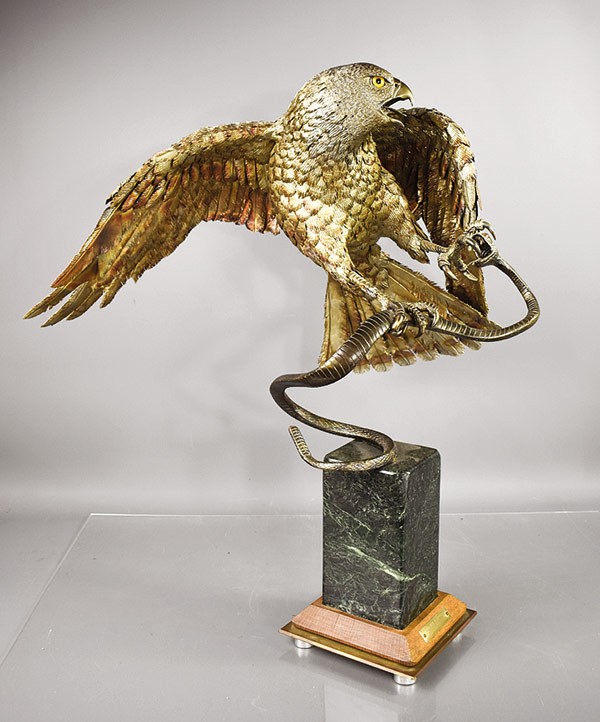
[.imgcaption] Barney Boller, Caught Napping , steel and stainless steel sculpture, 1996. [.imgcaption]
The novelist Norman Maclean, no stranger to the great outdoors or to artistic discipline, learned from his clergyman father that all good things “come by grace and grace comes by art and art does not come easy.”
Under his Speedglas helmet, Barney was learning at least the final part of this maxim. Art does not come easy. But he persevered. He took community college classes in metallurgy, sat state welding exams, and gained certifications, even traveling to England for accreditation. Thoughts of medical school had long faded. Now as head of the company’s welding department, he built a training program and attended trade shows nationwide.
One day, all the test samples he had labored over and displayed vanished. “Probably a buddy of mine got tired of my showoff attitude,” Barney reckons. During a coffee break, he decided to weld not another test piece, but something lifelike. He shaped offcut sheet metal into scales, squeezed square stock into a beak, and created his first welded sculpture: a creature, something like a cross between a griffon and an armadillo.
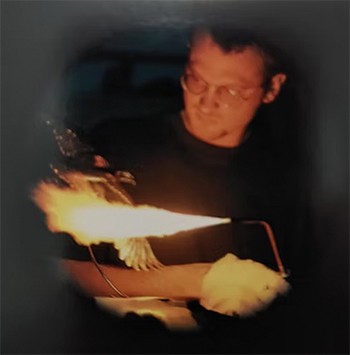
Things accelerated rapidly. A local business owner saw the piece and paid handsomely for it. Barney kept creating. His early efforts produced more whimsical creatures, playful products of his fancy. “Initially, I was focused on showcasing my mastery of the craft of welding, or even pushing the envelope to try to do what was unthinkable or unimaginable,” he says.
Wildlife soon became his theme. He sculpted eagles in full stoop, snipping wing feathers barb by barb, and their quarry – rabbits frozen in flight, in the clutches of terrible talons. Each piece took weeks. “None of it came easy,” he recalls. “But my years in the outdoors and love of birds and animals stood me in good stead. To do justice to God’s creativity, I had to study anatomy and figure out the perfect layout of muscles, hair, or feathers.”
“It was rewarding to discover things I didn’t know I possessed. My technical ability – won through hard work – was just the key to unlocking what was latent within me. Bit by bit, my creative instincts emerged – like coming out of hibernation. I knew I could take no credit for those gifts.”
[.article__paragraph--cap] [.small-caps] When Barney decided [.small-caps] to join the Bruderhof, he knew it meant giving up personal ambition and career pursuits, instead embracing a shared life of service in a common cause. But community is a wonderful environment for the flourishing of talents and gifts, and as Barney’s became obvious, he was offered time and support to pursue his art. His brother Hans became his business manager.[.article__paragraph--cap]
By the late 1990s, Barney had moved on from welded sculptures to making bronze castings of his creations. “This opened a whole new world for me,” Barney explains. “Clay let me loose from the constraints of steel. I discovered the same joy my dad must have felt. A local foundry cast my bronzes, but because of my metalworking skills, I assembled and finished them myself. This gave me the opportunity to experiment with various acid treatments to create distinctive patinas.”
By now, his sculptures were turning heads, winning awards, and gracing museums and private collections internationally. A first-place finish at the Florida Wildlife Exposition. Guest Sculptor honors at the Northeast Wildlife Expo in Providence, Rhode Island. Displays at Watson’s Wildlife Art Gallery, Delaware. Public installations at Benson Sculpture Garden, Colorado. Entry to the permanent collection of the Glasgow Museum of Art, Scotland. Auction sales through Christie’s, London, and Sotheby’s, New York. “It was a total rush,” he admits. “But I also saw how ego can destroy artists. I soon realized fame is not an end in itself. If self-love is your motivation, you’re spelling your own ruin.”
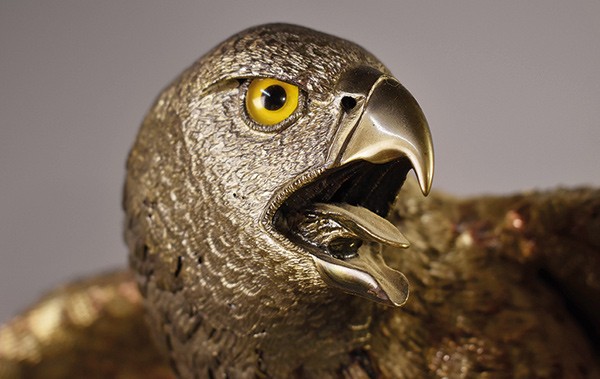
[.imgcaption] Barney Boller, Caught Napping , steel and stainless steel sculpture, 1996 (detail). [.imgcaption]
Marriage and fatherhood shifted his focus. Travel lost its luster; he preferred being home. Rather than accolades, doing his best to honor God’s creation through his artwork became his motivation.
Ten years into sculpting, Barney caught the attention of Joseph A. Hardy III, a billionaire who offered him an eye-watering commission for a series of sculptures – the largest, a pair of twenty-five-foot deer – for his PGA golf course. Barney made a small clay model, Hardy flew to New York, and they shook hands.
Then everything changed. Barney’s father was diagnosed with widespread cancer. Prognosis: weeks, not months. Barney faced a choice: pursue the commission of a lifetime or spend what time his father had left at his side. “I had given my heart and soul to creating artwork,” he says. “But I knew my first allegiance was to do what mattered most – and my father’s days were numbered.” He dropped the deal.
Barney spent the final four months of his father’s life as his caregiver. “Perhaps only he truly understood what it took for me to give up my dreams,” he says. “We bonded in ways I could never have imagined, and I discovered that the value of prioritizing love between father and son far outshone any dream or artistic accomplishment.” From a professional standpoint, “it was a stupid decision, but if I had to go back, I’d make it again.” All good things come by grace.
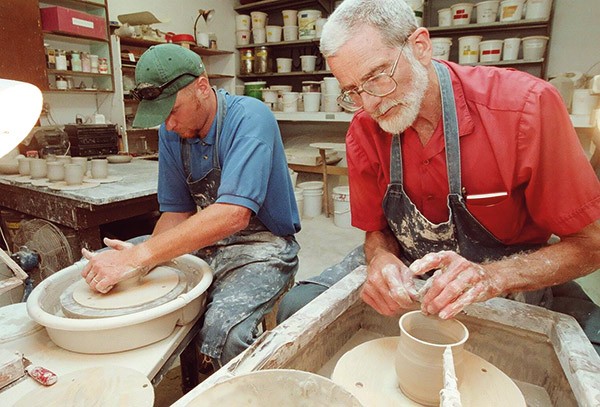
[.imgcaption] Barney working with his father in the pottery studio, 2002. [.imgcaption]
[.article__paragraph--cap] [.small-caps] After his father’s death, [.small-caps] in 2002, Barney and his wife, Rhoda, focused their energies on their growing family. They moved several times, and Barney explored other work, away from steel and bronze.[.article__paragraph--cap]
In 2016, they moved to upstate New York as caretakers for a church camp on several hundred acres of Adirondack Park wilderness. Barney was back among the bears, coyotes, moose, fish, and eagles that had inspired his creative output.
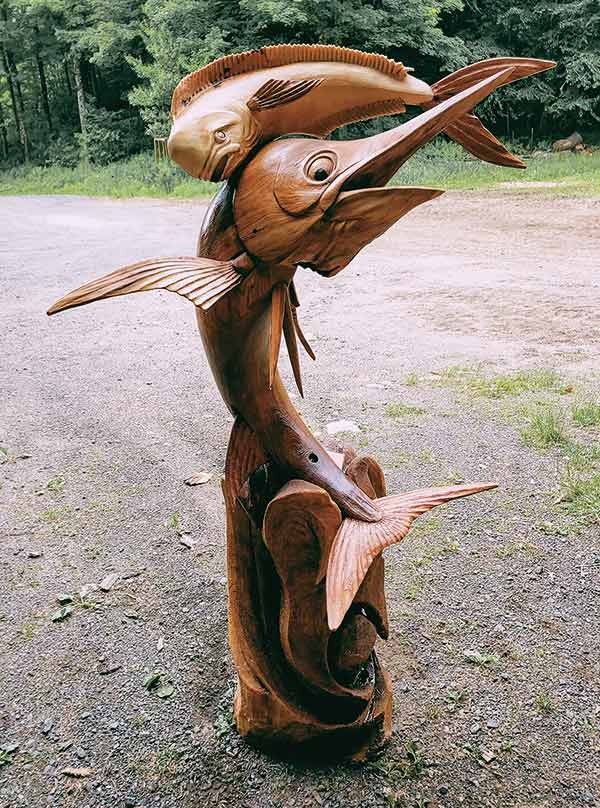
[.imgcaption] Barney Boller, Marlin & Mahi-Mahi , black cherry with white pine base. [.imgcaption]
It was Rhoda who suggested Barney try his hand at chainsaw carving. “She knows that having a creative outlet brings peace into my life,” he says. He sharpened his Stihl. “I’d always considered woodcarving a lesser craft, but I was in for a rude awakening. Unlike adding clay or metal, carving means cutting away. One wrong cut can be impossible to fix. And there’s constant potential for splitting, and weird issues with grain.” But he persisted, choosing to harvest his own cherry and oak instead of traditional soft carving woods, adding fine details with hand tools, developing processes to dry sculptures and prevent splitting.
Today, Barney’s wood carvings are again winning awards. For him, that’s not the point. “To be honest,” he says, “I’ve always considered myself more of a craftsman than an artist. But maybe they’re one and the same, if your heart is in the right place. The possibility of creating in three dimensions what is bubbling up from inside me is what continues to thrill and motivate me,” he adds. “And if my efforts can help others more deeply appreciate the Creator’s inimitable artistry in the beauty of the natural world, then I’m happy.”
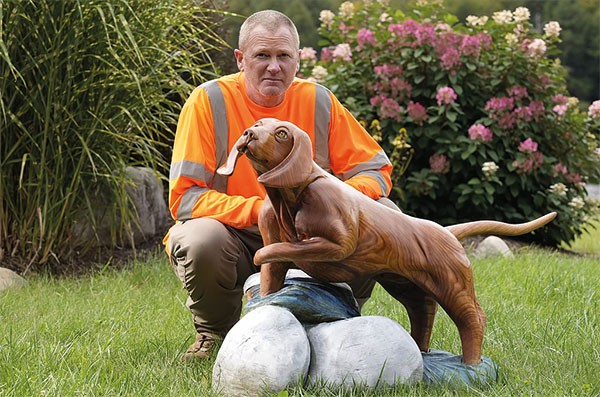
[.imgcaption] Barney Boller poses with Hungarian Vizsla , black cherry. See more of his recent work here . [.imgcaption]