Essay
How Does Beauty Shape the Christian Imagination?
A theologian tells the story of beauty, from Absalom’s hair to English country gardens.
February 6, 2026
Try 3 months of unlimited access. Start your FREE TRIAL today. Cancel anytime.
START FREE TRIAL NOW
[.article__paragraph--leading] Plough ’s Joy Marie Clarkson talks with Ben Quash, a professor of Christianity and the Arts and general editor of The Visual Commentary on Scripture , a project he runs in collaboration with the National Gallery in London. [.article__paragraph--leading]
Plough: How do the Christian scriptures speak about beauty?
Ben Quash: In the Greek of the New Testament, the language of beauty and the language of goodness are often pretty much interchangeable. For example, in Mark 14:6, Jesus says the woman who anoints his feet has done something beautiful. In English it is translated as a “beautiful thing,” but the word in Greek is kalos , which means “good”; literally, Jesus commends her for a “good work.” That’s interesting! The equation of moral or spiritual goodness with beauty is characteristic of the few references in the New Testament to beauty. This closeness between goodness and beauty anticipates later medieval discussions of beauty as a transcendental property of being, something rooted in existence and ultimately in God.
By contrast, in the Old Testament there is a profusion of words for beauty, and part of learning how to manage them is to realize that some are applied primarily to creatures, and some are applied only to God. There are characters who are notable in Old Testament terms for their physical beauty, including the young David, Abigail, and Absalom, although it did the latter no good because his “beautiful” long hair is what caught in a tree and caused his death. So, there’s already an awareness in the Old Testament that the beauty of appearances can also be a perilous thing.
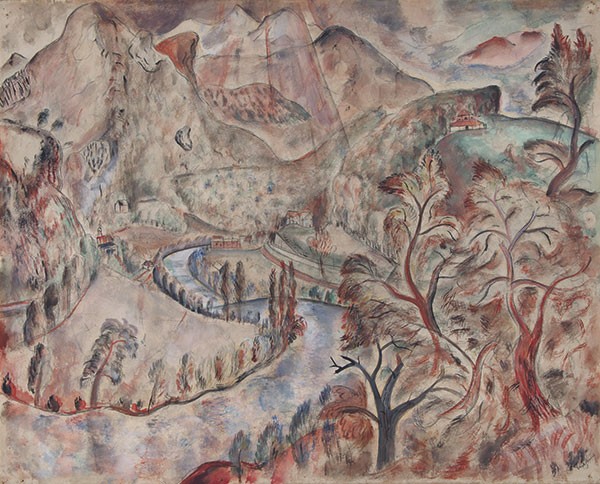
[.imgcaption] David Jones, Montes et Omnes Colles , watercolor and pencil, 1928. [.smalltext] Artwork from The Whitworth, The University of Manchester, Whitworth Art Gallery /Bridgeman Images. Used by permission. [.smalltext][.imgcaption]
Then there’s an idea of integrity as beauty. Job is described as having this quality of integrity. It’s the same word that’s used to describe acceptable sacrifices in the temple. They must be without blemish. In other words, and this is really interesting to me, beauty in that context doesn’t mean something idealized and removed from the ordinary. In the Old Testament terms, this kind of beauty is precisely being what you’re meant to be. So, a lamb without blemish is just a really lamby lamb; not some kind of exceptional lamb, different from all the other lambs, but a lamb with all the right bits in all the right places. And that’s, I think, a nice reminder to our own twenty-first-century culture to question its obsession with standing out, and its search for a beauty that somehow sets you apart from others.
Finally, in Psalm 29, we are invited to worship the Lord in the beauty of holiness. The word there is a different word from that used to describe the beauty of human appearances. It’s the language of splendor. And then there’s the unique language of glory – kabod in Hebrew – which is only used of God.
How does Plato understand beauty, and how does that shape the Christian tradition’s account of beauty?
That’s an evolving debate – especially, actually, when it touches on the arts. But, generally speaking, for Plato, the realest things are the noncorporeal ideal Forms; the material things we encounter in this world are merely shadows of the real. When he’s discussing beauty, he recognizes it as part of the created world, and sees our encounters with it as less than ideal. They’re mediating (in different respects and to different degrees) the ideal beauty of the One. Through beauty we can begin a journey toward the One, but it is only through abandoning the material world that we ascend.
There’s a great deal of this that Christianity will take up and use. The Platonic idea promotes an ascent from attention to the created order around us toward the source of that beauty, and in Christian terms, that source is the Creator, the giver of all life, the one who graces all things with their beauty. The crucial difference between Plato and Christianity is that in Plato the radical transcendence of the ideal Form plays too easily into a dualism: the created world is bad and needs to be escaped, and the spiritual world is good. There might be a mediation going on in our experiences of beauty, and you can make a journey toward the ideal Forms through it. But there’s a sense that the world of material things is denigrated.
[.pull-quote] Traherne talks about the creation as the “frontispiece of eternity”: the front page of a book which is charged with the promise of what lies within. It’s not obscuring; it’s promising. Everywhere he looks, he sees eternity announcing itself. [.pull-quote]
The Christian gospel of the Incarnation, on the contrary, has this powerful affirmation of the material order as God’s chosen language for disclosing his beauty to the world. And that the glorification and the exultation of this created world and of human bodies as part of that created world are absolutely at the center of the gospel. There’s no sense in which you must leave them behind once you climb the ladder of beauty. They’re taken up. The ladder is taken up too. And I think that that’s a very important difference.
How about Aristotle?
There are interesting differences with Aristotle, the other great heavy-hitter in terms of ancient Greek philosophy. For him, a lot of what beauty is about is the coming to fruition, or realization of potential. And that gives him a much more positive approach to the arts. Plato is, perhaps unfairly, often regarded as an uncompromising enemy of the arts because of the last book of The Republic, in which he says that there’s no place for artists in the ideal city because they deceive us, and that imitations are always deceptions because they’re lesser than the true object they’re mimicking.
Aristotle is much more clearly positive about the arts, and I think it’s partly because he sees one of the functions of artists as being to bring the potential of things to realization – unlocking a block of stone’s potential to be a sculpture, for example. He also sees a moral value in artistic representation. To take a literary example, when watching Greek tragedy, we’re presented with, yes, imitations of situations that might be real in human life, but through them we are able to reflect on questions about right action in the world, and they therefore perform an educative function, a pedagogical function which serves the good. And that is part of the actualization of our own potentiality as human creatures toward the good. You can see I’ve already slipped from a discussion of beauty into a discussion of the arts, because even then, they’re constantly weaving in and out of each other.
Who is your favorite theologian of beauty?
Thomas Traherne . It almost brings me to tears when I read Traherne. He was a seventeenth-century poet and the most exquisite writer of prose. An Anglican mystic really, writing remotely in the West of England. Not a great deal is known about him. Many of his works are lost, but some have been found quite recently. He writes in the spirit of the metaphysical poets like John Donne and George Herbert. And beauty runs as a constant thread through his writings. He’s intoxicated by it! It colors the way he sees everything around him in the world. This is in a way that is sort of platonic, but also so affirming of the material world. He talks about the Creation as the “frontispiece of eternity”: it’s that front page of a book which is charged with the promise of what lies within. So, when we look at the world, we’re seeing only the frontispiece, but it’s not obscuring; it’s promising. It’s promising what’s to come. And everywhere he looks, he sees eternity announcing itself. He can meditate ecstatically on the tiniest thing, on a humble fly, and see the respect and glory of its iridescence as already a foretaste of glory. It’s amazing.
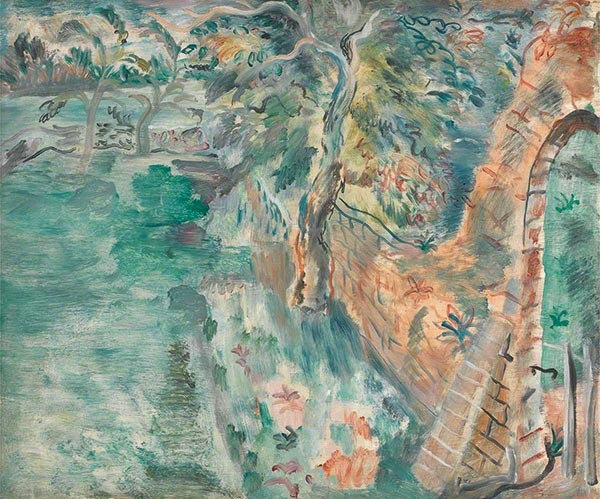
[.imgcaption] David Jones, Walled Garden , oil on board, ca. 1930. [.smalltext] Artwork from Bridgeman Images. Used by permission. [.smalltext][.imgcaption]
I think Traherne’s influence runs through the Romantics to some degree. I feel there’s a Trahernean spirit in Coleridge, whom I love as well, and people like Gerard Manley Hopkins , I suspect. And then it runs into the twentieth century. It’s a tradition I call mystical empiricism. The empiricism bit is looking at the world and its objects, its creatures, with intense attention. Not idealizing them but really looking at them as they are. And it’s mystical because precisely in that close attention to the very particularities of things, you find yourself suddenly feeling yourself to be in touch with ultimacy, with grace, with divine self-communication. These creatures are conduits of God’s presence and purpose, precisely in their unique particularities. Observation of them becomes a sort of mystical form of encounter with the divine. That’s what Hopkins is doing when he looks at the windhover flying or the kingfisher “catching fire.”
David Jones, the poet and painter, is one to whom I would point as one of the great appreciators of beauty in that tradition in the twentieth century. And so much of that is caught up with the natural world, and with attention to it. It’s not one of these intellectual ideas of beauty that you might find in a more anti-materialistic platonic tradition, but the contemplation of particular things in the world, the roses outside your window, the changing leaves outside of mine, that gesture beyond themselves to the real.
Traherne is writing at the time of the birth of modern science. This is where the very first steps toward organized natural science are taking place as a sort of distinct discipline with its own methods. But he’s at that brief moment, that cusp, where there’s no distinction between natural scientific method and praise. It’s like doxological science. It’s science that gives glory. And within the next fifty to one hundred years after Traherne was writing that won’t seem to be a possibility anymore. It’s a door that gets closed. But for Traherne, an encyclopedia can be punctuated with exclamations of praise at every point. You’re kind of mapping the world, learning about the world, and constantly referring it to God in praise. I long for a doxological science. A science that can be the recognition of beauty.
From teaching and working with you, I am inclined to think that your account of beauty is deeply formed by the English landscape. Would you say that’s true?
I draw deeply on the layeredness of long-inhabited place. That sense of, as Gerard Manley Hopkins puts it, a landscape “plotted and pieced,” “fold, fallow and plough”; the layering of long habitation, collective habitation, and the relationships that therefore evolve between human and nonhuman creatures. The soil, the fauna, and the flora play very much into my own instincts about what I find beautiful and from which I draw theological conclusions about the bounty of God and what constitutes a wise life.
The English landscape has been very poorly treated in recent decades. Modern farming techniques are very damaging to it, and the biodiversity of England is far less than it was one hundred years ago. There are real issues that we face, and one can all too easily be overly romantic about it. Nevertheless, in the literary traditions as well as the theological traditions that love the English landscape, I find a complex mutuality of human and nonhuman, built up over centuries, culminating in a compelling account of what beauty is.
One of the theologians from whom I learned a great deal was Dan Hardy, originally an American theologian who then spent most of his academic career in the United Kingdom. He used to contrast the English garden with the campus at the University of Virginia. The latter’s original architecture was very classical and still is, at its core. And he said that was an architecture that spoke of the exclusion of wild nature under the impress of reason. So human reason, as it were, puts wild nature outside, keeps it at a safe distance. You would originally look down the lawn of the University of Virginia campus and nature would be in the distance, while everything would be under rational human control inside the perimeter. And eventually, even that view toward the outside was blocked off by more buildings. And he said, this is a kind of metaphor for a way of relating to nature as wild, dangerous, other, irrational. And beauty was all those nice pediments and columns with their correct spacing.
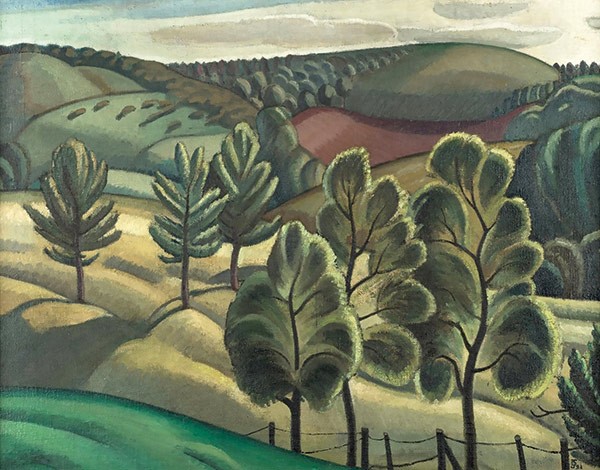
[.imgcaption] David Jones, Landscape in Kent , oil on canvas, 1921. [.smalltext] Artwork copyright © trustees of the David Jones estate / Bridgeman Images. By permission of Amgueddfa Cymru – Museum Wales. [.smalltext][.imgcaption]
By contrast, the English garden is much more reciprocal and messy. Its beauty lies in the fact that there are endless negotiations going on between the plants as they find the right space to get some light and water – but also, the human inhabitants who work with the plants to make them to be their best. These spillages and entanglements suggest a very different relationship with the natural world. And it’s in such relationships that beauty sits. It’s not just a measurable thing that you look at and say, this is a ratio of three to five, this is a beautiful ratio. It’s much more of an intuitive, instinctive sense of how things are hanging together well or not. Those sorts of judgments appeal to me more. They are more organic and properly expressive of a love of the world as it is, rather than making it something it isn’t. So that’s a long way of affirming what you’ve detected in me: I like this kind of organic, messy, interactive, reciprocal beauty. I see that as English beauty.
David Jones has a lovely little essay reflecting on the English garden in the second volume of his writings ( The Dying Gaul , which was published after his death). He thinks there’s something distinctively English about that sort of garden, and he sees precursors of it as well in certain kinds of English painting and tapestry from medieval times, but he thinks there’s a continuous tradition that’s still alive.
Talk of beauty can sometimes seem very abstract or ivory tower, but you make it seem very integral. How does our idea of beauty affect our day-to-day lives?
This takes us back into the language of relationship. A belief in beauty may be awoken in us by what we experience around us, and sustained by ongoing ways of relating to what’s around us. By the same token, faith can be something that often feels very vulnerable to evidence. Hopkins talks about the encroachment of certain kinds of toxic, destructive, wilderness-destroying forces. And Jones similarly laments the uniform nozzles of factory-made bottles. He seeks for the Logos in these things – and in the pylons strutting across the landscape – and cannot find Him.
Hopkins and Jones are aware of this vulnerability. They’re aware that one could say it’s just wishful thinking to believe that beauty is some kind of ultimate thing that the world tells us about. But I think that often – as with faith – to live in it and to live into it is to find confirmations of it. And that changes the way you live. The belief that beauty seeks to speak to us should make us more gently attentive, more patiently attentive, and more optimistically attentive – more hopefully attentive, actually. For hope is more than optimism. It’s a disposition , not a feeling; a disposition that sometimes we need to hold ourselves to. Something we need to actively pursue. That sort of determination will take the form of better relationships, not just with the things we look at (whether artworks or natural objects, the things we might categorize as aesthetic objects), but it will affect the way we relate to each other, and the kinds of communities we make. Because there’s beauty in all relationships. Relationship, in a sense, is beauty. Good relationship is beauty. And that will include the relationship between two notes, or three notes, in a composition. The relationship between two colors in a painting, the proportions of an architectural space. But it extends to other forms of relationship, other kinds of good proportion. In the hierarchies of our social organizations, in the forms of mutual and reciprocal care and the distribution of responsibilities that any human family or society needs, where we seek to play our part in relation to others. When those things work, they are beautiful.
[.smalltext] This interview was conducted on October 2, 2025, and has been edited for length and clarity. [.smalltext]