




Subtotal: $
Checkout
-

Dogs, Deer, Herons, and the Promise of Beauty
-
My Mother’s Hidden Radiance
-
Can a Painting Save You?
-
How Does Beauty Shape the Christian Imagination?
-
Luna of Tasajera
-
Children of Terabithia
-
Six Ways to Resist the Machine
-
A Tree by Any Other Name
-
The Riddle of Beauty in Nature
-
The Art of the Beautiful
-
The Paradox of Beauty
-
Beckoned by Beauty
-
Icon or Idol?
-
Those Hideous Stewards of Beauty
-
Crafting Beauty
-
The Backwoods Sculptor
-
The Gospel Is Public Truth
-
Academia Is Hell, Literally



Patina, Plaster, and Paint
A stonemason who repairs old English churches finds stories written in the stone.
By Andrew Ziminski
January 12, 2026
Next Article:

Explore Other Articles:


0
Comments
0
Comments
Post a Comment
As the commander of the army of God, Michael leads the fight against evil, even in deepest Norfolk, England. For nearly half a millennium the prince of the heavenly hosts has stood guard over the medieval parish of St. Helen’s, Ranworth, ready to take on any enemy that may attempt to cross the threshold into the sacred space of the chancel. Wearing finely painted wings and trousers made of feathers, he steps confidently over the seven-headed Beast of the Apocalypse, his sword raised as he slashes away at its writhing heads. Two of them have already been lopped off, leaving bloody stumps. Saint George also stands on the defeated dragon, wearing a white surcoat and turban-topped helmet, his sword poised, ready to dispatch the Beast.
Scenes like these I remember well as I walk beneath them every day on my way to work. I am a stonemason, specializing in the repair of England’s ancient churches. In the West Country, where I currently work, around 80 percent of the region’s churches are over five hundred years old.
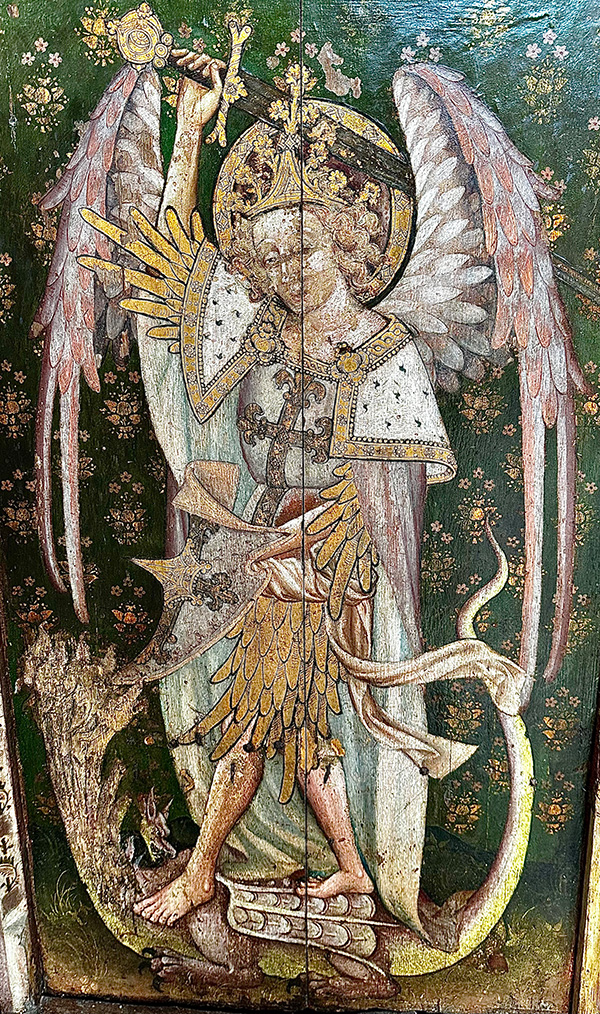
Detail of Michael from the medieval screen at St. Helen’s, Ranworth. Photographs courtesy of the author.
To work in this field requires an appreciation of what one is working on: how the time-worn stones hum with a sometimes intoxicating beauty. Connoisseurship can be in short supply in the winter, when I’m kneeling on a scaffold platform that encloses the heights of a medieval Somersetshire church tower when the rain is coming in horizontally. But even then I feel it, when I look down and see the way the church’s rubble-stone walls had been “buttered over” with thin plaster eight hundred years ago and how it has weathered to the same color as the stone of the walls, that had in turn been so mellowed by time and nature they appear to have grown up out of the soil. Or how the roof has been covered in the district’s beautiful stone slates and how their diminishing courses give the same sort of pleasure in their orderly beauty as a fish’s scales or a bird’s feathers.
Visitors are always interested in what’s happening behind the “Closed for Repairs” sign we’ve hung on the door of the church porch, so we often end up showing them around. I feel that most visitors now come to churches with their heads but not with their hearts: in this time of prevailing secularism, many are surprised to learn that from the time of the first churches in the sixth centuries their purpose has remained the same – to be a place where the faith is taught and the sacraments administered. But the visitors are always interested in what these places can tell us about past generations. Beauty alone only goes so far. It is often the marks left by ordinary parishioners, such as the local carpenter who centuries ago crafted the pews now etched with graffiti both sacred and profane, that leads them to rethink some of the assumptions they entered with.
With old buildings and churches, three characteristics in particular allow us to appreciate them: solidity, usefulness, and beauty. With the medieval churches of the British Isles, I believe that two others are as important: the atmosphere when the walls have soaked up the prayers and thoughts of parishioners both past and present, and the craftwork of past centuries, where it has survived.
It was traditional craftwork and know-how that built the medieval world, and its handmade quality still contains the spirit of the people who put churches together. This craftedness may be considered an indeterminate form of beauty that is manifest in the marks of wear or use, a concept that can be equally assigned to a place, building, landscape, or object. We appreciate it in the undulating wall of an ancient house, or in a “ghost sign” above an old shop, or in damage and repairs vividly reflecting the life of an object, like dueling scars. So it is with my day-to-day work – even though the “golden stain of time,” as John Ruskin put it, can sometimes be difficult to explain to the occasional churchwarden who doesn’t appreciate the importance of a church’s lived-in patina.
For me, the square-sided font at St. Bridget’s, Bridekirk, in Cumbria, sums up these qualities. It was carved in the mid-twelfth century out of a block of volcanic stone so hard that the mason must have really struggled with the tools he had at his disposal. I say “he” as among its rosettes and Celtic strapwork is a self-portrait of the mason carving the font itself. This Norman selfie depicts my forebear mid-strike, a mallet raised in the act of cutting a coiling stem, with the chisel’s tip scrolling across the stone as if it were butter. Above him, in a kind of banner, is an inscription that combines runes and Early English lettering; it reads something like “Richard he me wrought, and to this beauty me brought.”
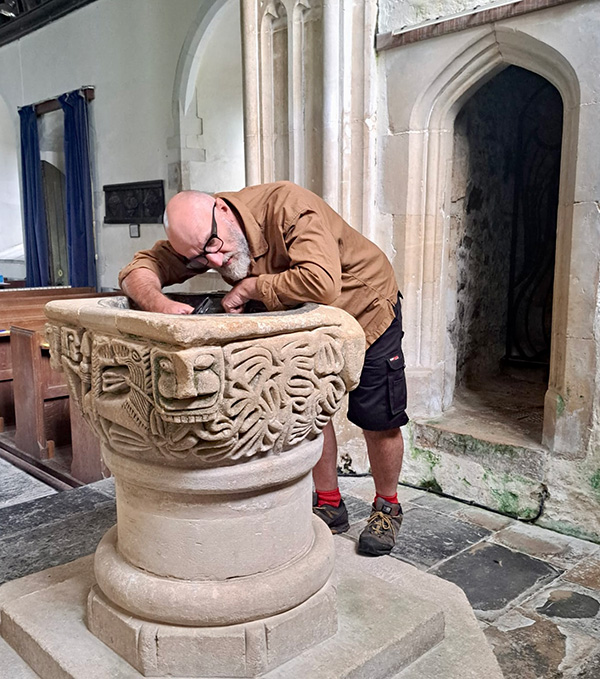
The author surveys an Anglo-Saxon font in St Mary's, Luppitt, Devon.
The church architecture and art of the twelfth century, in what is known as the Norman Era, is often naive and unique. I don’t know if many would find it beautiful. The buildings of that time are unsophisticated, tall and dark inside with thick walls and tiny windows, and have an austere magnificence. This all changed in 1144, with what Abbot Suger and his unknown master mason achieved in the Basilica of Saint-Denis de Paris’s, considered the first Gothic church. Suger thought that radiant light was a manifestation of the Creator, and wanted to engineer ways of allowing new light to shine through larger windows into the space where Norman darkness once prevailed. His master mason responded by drawing together the latest advances of architecture that had been brought from the Arabic world during the Crusades, like the ribbed vault and the pointed arch and window. This new style appreciated that the connection between architecture and its purpose should be manifest to onlookers. Gothic churches weren’t only filled with symbolism. They became symbols themselves.
Heavy Norman columns were replaced by a central shaft of reduced diameter surrounded by bunches of slender columns. The use of the new pointed arch meant that supporting walls no longer needed to be so thick. Stone was replaced by glass; walls with windows became walls of windows, as churches became the physical embodiment of the belief that God could be approached by the beauty and harmony of a building’s structure.
These rib vaults evolved into the fan vault, like the one I worked on at Sherborne Abbey in Dorset: a golden, tree-like canopy that soars over the nave and choir, light streaming in through the high windows to illuminate the arcade. I’ve heard even the most casual onlookers exclaim at the astounding mix of beauty and precise engineering as they step into the nave and look up at what was one of the high-water marks of the Gothic style. At least it went out with a bang. Not long after Sherborne’s fan vault was completed in 1490 the Reformation began. In England, the Reformation didn’t just mean the end of Gothic architecture: across the country, nearly all church art was destroyed.
Before, Britain’s medieval churches would have had a rood screen, dividing the sacred space of the chancel from the people’s space of the nave. Often master works of carpentry and the painters’ arts, the screens would have a carved wooden image of the crucifixion, known as a rood, fixed above them, the focal point of the congregation’s gaze. Over the course of the Reformation, most of England’s thirteen thousand roods were taken down and burned. Today only scraps remain.
Some idea of what was lost can be found in one of the most complete of these remnants: the painted wooden head and foot from a twelfth-century crucifixion at All Hallows, South Cerney, Gloucestershire. As with so much other medieval art, these figures were discovered when a stonemason opened a crack in the church’s wall. The figures that were pulled out were little more than painted shells of gesso, made from chalk mixed with glue obtained from rabbit skins, as beetles had eaten away at the wood. Despite the gauntness of the foot, it is an object of touching beauty. Rendered in pale fleshy tones with a puncture hole where it was pierced by a nail, the angular toes of the crucifix are bent in agony. Christ’s head is so small that it could be held in cupped hands. His eyes are closed, delicate eyelashes rest on prominent cheekbones above a downturned mouth, and a drooping triangular moustache conveys a mysteriously calm repose. His hair is parted at the center and arranged in tight curls. A beard of short, scroll-shaped locks lines his cheeks.
Even as small fragments, the sculpture still possesses great expressive power. When I first saw them at an exhibition at Tate Britain in 2001, I noticed how visitors crossed themselves when they saw the two precious fragments: a glimpse of the rood’s power to move people to devotion in medieval times.
The rarity of devotional images contrasts with the many medieval monuments that will be seen in every old church in wood, stone, and brass. Of all the fine brasses of the fifteenth century, that of Margaret Peyton stands out. Six centuries after her death, it still manages to convey in flat metal plate something of the stern elegance and loveliness she must have had in life. She is to be found at St. Andrew’s at Isleham in Cambridgeshire, wearing a delicate brocade silk dress and an elaborate headdress. It’s easy to imagine her swooshing through her manor house adjacent to St. Andrew’s, where she was the young chatelaine before her life was cut short at the age of just twenty-five in 1480 following the birth of her fourth child. With her dress and headdress, coupled with her slightly swept back pose, she completely outdoes her accompanying husband, who looks at us face on, bareheaded, dressed in plate armor, with his plainly dressed second wife at his other side.
The pattern of Margaret Peyton’s dress resembles a modern-day Liberty print, broken up by folds of vertically scored lines. It reminded me of garments of a similar date and design, depicted in the lower panels of one of the best-preserved medieval artworks in any of Britain’s churches, the rood screen and side altars of St. Helen’s, Ranworth, Norfolk. The screen at Ranworth is best seen on a sunny day so that its exquisite carpentry and painted decoration depicting a crowded array of icon-like saints is naturally illuminated, as it has been for the past six centuries.

The medieval screen at St. Helen’s, Ranworth.
The lower panels of the central section are painted with likenesses of the twelve apostles. Each stands with his head down, engrossed in conversation with his neighbor. Dressed in fine robes, decorated with a lovely golden brocade, and painted in oil, they look more like icons of the Russian or Greek Orthodox tradition, where the images themselves would have been a focus of veneration; this is where the saints’ presence was felt, and it was central to the practice of medieval worship. The passion of the Reformers can be seen in the way the saints’ faces were singled out to be defaced, with the fervor of a gambling addict attacking a scratch card.
Above them a row of slender pointed windows, divided by a central arched opening, rise up to a vaulted canopy, decorated with stylized stenciled flowers. Although their colors have faded from their original yellow and blue to a red ochre, the irises and forget-me-nots could only have been painted from life, having been plucked from the waterways and meadows that surround the church in late springtime.
As there are no aisles dividing the nave, wings spread out from either side of the central screen, demarcating the central walkway with painted panels facing each other within a carved woodwork frame that projects into the nave at a right angle.
It’s here the dashing figures of the two dragon-slaying saints, Saint George and the Archangel Michael stand, painted with an elegance and dynamism that places them among the finest artworks that can be seen in any English church. Each is home to a small side chapel that was little more than an altar table, backed with painted panels. The chapel to the north, created in 1496, was dedicated to Saint Mary and makes the screen a masterpiece of restrained beauty, with four depictions of the Virgin Mary, her sisters, and Saint Margaret, their clothes rich with gold embroidery similar to Margaret Peyton’s. Here, next to panels dedicated to motherhood and childbirth, new mothers would have come for a service of thanksgiving following the birth of their child, lighting a candle in front of the painting of Mary, who is depicted as “Maria Lactans” – the nursing Madonna – as she breastfeeds the infant Jesus. Even though some of the figures have been defaced and much of the paint has flaked away, the composition retains the power to move you. It’s the sort of place where the heart can be caught off guard.
Michael, the churchwarden who first showed me around St. Helen’s, had been the screen’s informal custodian for over fifty years, thanks to his skill at joinery. His own handwork had allowed this wonder to continue glowing “warm still with the life of forgotten men who made them,” as D. H. Lawrence wrote about such things in his poem “Things Men Have Made” (1929).
Michael could remember his wonder as a child when a painting restorer removed the brown varnish from Saint George’s dragon to reveal its original vivid ultramarine color beneath – a moment that, as he put it, must have been as exciting for him as the moment had been for his ancestors when the paint was first applied five hundred years before. Such is the continuity not only in a church’s artworks, features, and furnishings, but in the old families living in a parish: the craft and the faith that built it and, despite everything, endure.

You have ${x} free ${w} remaining.
This is your last free article this month.
We hope you've enjoyed your free articles.
This article is reserved for subscribers.
Already a subscriber? Sign in
Try 3 months of unlimited access. Start your FREE TRIAL today. Cancel anytime.