




Subtotal: $
Checkout
-

One Hundred Years of Gossip
-
How We Feed One Another
-
Monica Ribar Cornell, 1942–2025
-
The Backwoods Sculptor
-
The Gospel Is Public Truth
-
Academia Is Hell, Literally
-
The Science of Revenge
-
Theology and the Mythic Sensibility
-
Can Beauty and Justice Meet in Architecture?
-
Seeing Our Way to Humanity
-
The Transcendental and the Sacramental
-
Patina, Plaster, and Paint
-
Dogs, Deer, Herons, and the Promise of Beauty
-
My Mother’s Hidden Radiance
-
Can a Painting Save You?
-
How Does Beauty Shape the Christian Imagination?
-
Luna of Tasajera
-
Children of Terabithia
-
Six Ways to Resist the Machine
-
A Tree by Any Other Name
-
The Riddle of Beauty in Nature
-
The Art of the Beautiful
-
The Paradox of Beauty
-
Beckoned by Beauty
-
Icon or Idol?
-
Believing in the Last Judgment
-
Those Hideous Stewards of Beauty
-
When Life Begins with Death
-
Six New Poems by Wendell Berry



Crafting Beauty
We asked a poet, a visual artist, and a composer to tell us what role beauty plays in their work.
By Steven Toussaint, Bokani and Joanna Gill
January 17, 2026
Available languages: Deutsch
Next Article:

Explore Other Articles:


0
Comments
0
Comments
Post a Comment
Poetry: Beauty Is an Accusation
Steven Toussaint
“Beauty is an accusation,” wrote Ezra Pound in a 1909 essay about Walt Whitman. This line had managed to elude me until one of my students pointed it out during a recent tutorial. I found myself nodding vigorously, intrigued by the gratuitous italics, assenting to the idea without really knowing why.
After all, the more intuitive definition of beauty would be something like the one offered by Thomas Aquinas: Pulchrum est quod visum placet, or “Beauty is that which pleases when seen.” This seems right, if a little banal. The experience of beauty is the satisfaction taken in something complete, well-formed, and radiant, not the satisfaction demanded by an aggrieved plaintiff and exacted at twenty paces. If beauty is an accusation, who is the accused and who is the accuser?
But such ambiguity does not, for me, diminish the force of Pound’s definition. If anything, my faith has primed me to be unsettled by the forms beauty takes. I have been taught that the beauty of God – which is to say, beauty itself – is only truly revealed in the way Jesus bears himself under trial, judgment, humiliation, and execution. This was clear to me even as a child, shuffling between the stations of the cross on Fridays during Lent. On the other hand, the whole point of the Passion narrative is that Jesus, spotless victim, was falsely accused by the one whom scripture calls “the slanderer,” and Satan, notoriously beautiful, speaks through our mouths.
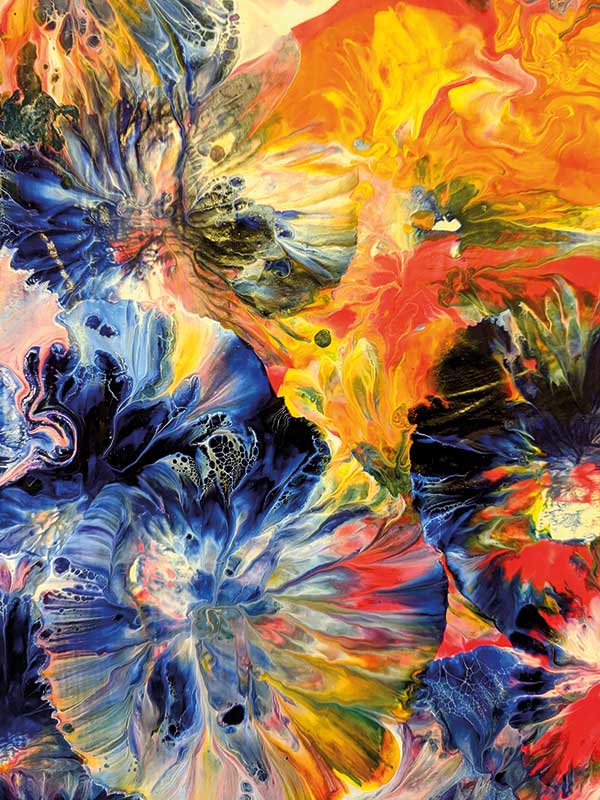
Bokani, Marigold, acrylic on canvas, 2020. Used by permission.
There is a piece of Passiontide performance art situated at this exact moment of inversion between accuser and accused. I first heard the Improperia, or “Reproaches,” sung during the Good Friday liturgy at Little St. Mary’s in Cambridge seven years ago. I remember joining the slow procession up the aisle to kiss the foot of the cross, while the choir, antiphonally positioned in stalls on either side, interrogated us as the voice of Christ: “O my people, what have I done to you? How have I offended you? Answer me.”
My experience of beauty that day, though wedded materially to John Sanders’s musical setting, the shrouded statues in the gloomy fourteenth-century church, and the great, dark crucifix looming, cannot be separated from the words of accusation at its heart. If this is what beauty is, it is threatening rather than consoling, and particular rather than universal. Each of us will have to answer Christ in a different way.
So far, my experience of the “Reproaches” is the closest analogy I have found for what it feels like to write a poem. Most of the time, I am swept up in the inertial drag of my words, surrendering to the constant temptation of reaching into the ragbag of practiced flourishes that I rely on to avoid the genuine agony of trying to find the single most fitting way to resolve a poem, given the form it has occasioned for itself. Every poet has their own vanities and cheats, and I am still discovering mine.
I don’t know if I have ever written a beautiful poem, but I have read many. And when I am writing, it is those voices I hear demanding to be answered. When I let their accusations stand and find a way to reckon with the bullshit and bad faith with which so much of my linguistic life is conducted, I would not say I find the writing pleasurable, but it does feel like justice.
Visual Art: Beauty Is a Free Spirit
Bokani
My studio in East London has large north-facing windows. It’s in this context, bathed in light, that I create with stained glass paint on mirrors. My intention is to bring the viewer into the artwork, jolting them out of the passivity of a spectator by confronting them with themselves rendered through vibrant distortions. I typically choose materials based on what I want to say and to whom. For an exhibition at the National Gallery in Zimbabwe, I chose reed mats – found in every home there, familiar to the audience, and ripe for subversion – presenting a different yet recognizable type of reflection.
I rarely go in with an imagined or drawn sketch, preferring to respond to the material, light, color, and resonance within. In this way, the painting itself begins its work in my imagination. I have not so much pulled the work out of the ether as I have made myself available to receive its emergence. As John O’Donohue says, “Beauty is a free spirit and will not be trapped within the grid of intentionality.”
Once I have the material or object to paint, I begin by pouring color onto the surface. My process involves a lot of experimentation. I typically paint on horizontal surfaces, and I try not to manipulate the paint with a brush, preferring to let gravity do most of the work, occasionally shifting colors around with a partially inflated balloon. By moving the paint, I am on a search, an inquiry made more compelling because I don’t know what I am longing for. You could say I leave a lot of room for grace. When I think I have found it, I leave the painting to dry, looking forward to being surprised by the finished piece upon returning to the studio.
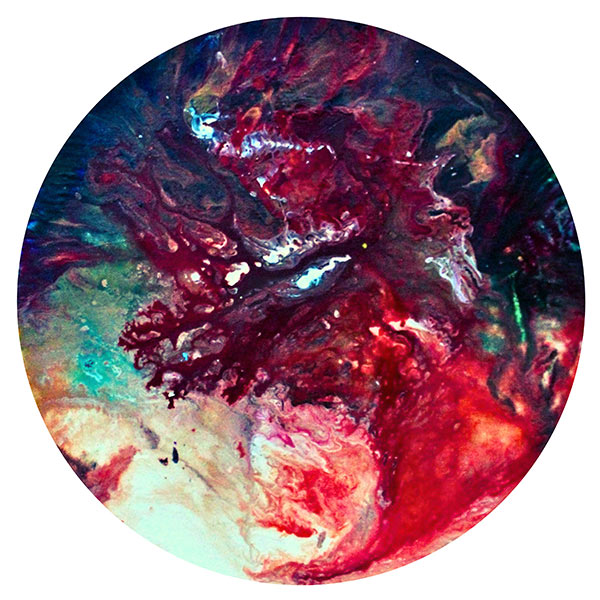
Bokani, Celestial Desert, acrylic on canvas, 2018. Used by permission.
Some in the art world disparage beauty. Interest in beauty and her conspirators – light and color – have often been dismissed as unsophisticated, naive, or unserious. John O’Donohue makes a strong case for resisting beauty’s detractors in his introduction to Divine Beauty: The Invisible Embrace. He writes, “Because our present habit of mind is governed by the calculus of consumerism and busyness, we are less and less frequently available to the exuberance of beauty.” For me, the work is to make myself available to the pouring forth.
John O’Donohue is one of a handful of writers, including bell hooks and Audre Lorde, whose words ricochet off the walls in my studio, interplaying with the background music of sweeping opera or amapiano. As I join this maelstrom, I can lose myself in the painting; the veil between now and not-now, here and not-here, the material and immaterial, falls away. I feel most free in that time when I am at one with it all. The resulting painting seems to appear fully formed in an instant, even after hours of work. This collapse of time and order lends a wildness to my work which I protect fiercely from market forces that require repeatable formats. My regular return to the studio is a journey of discovery sometimes tinctured by surprise and delight, most recently at the golden hour, as my mirror paintings throw around rainbow refractions.
Music: Beauty Is Eternal
Joanna Gill
Music has an innate power to evoke and create emotion. The first time I heard O magnum mysterium, a choral piece by the American composer Morten Lauridsen, I was completely moved to tears. Around three minutes in, the choir sings a phrase that leads to a clustered chord of three adjacent notes. This effect creates a suspension, which is then beautifully resolved into a chord that feels more familiar and comfortable. To me, it sounded heavenly; a glimpse of a place where true peace and harmony lie.
The definition of beauty can mean many different things to different people. Thoughts, feelings, and perceptions about beauty are unique to the individual, but I believe that creating beautiful music offers a new path to the divine and can be used as a tool to connect to a higher purpose and meaning.
Theologian R. T. Kendall once said, “Artists have a vocation to reimagine and re-express the beauty of God to lift our sights and change our vision of reality, which is often not even considered.” True beauty can happen in any moment of sadness, happiness, failure, success, elation, or weariness. It is in these places that the arts can draw out a fresh meaning, open dark rooms, and allow the light to come in.
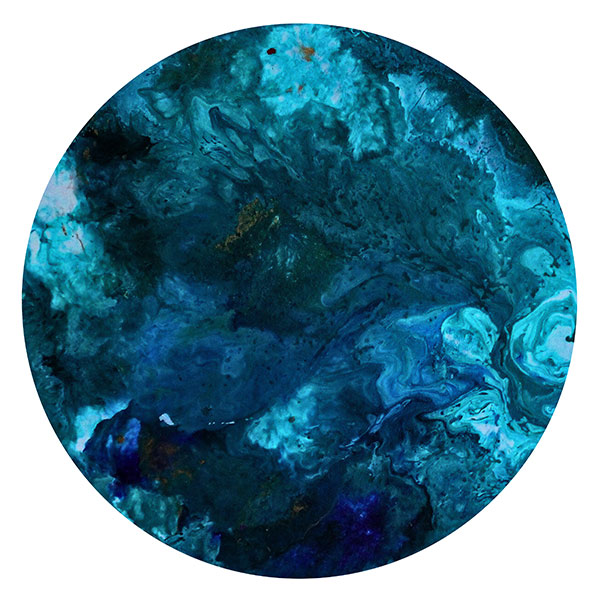
Bokani, Aquarii II, acrylic on canvas, 2018. Used by permission.
On Christmas Day in 2010, my first nephew, Oliver, died of cancer just shy of six months old. I remember experiencing a new level of grief that I had never known before and felt unable to put into words. I sensed a nudge to portray my feelings through music. I took the words my sister-in-law had spoken of her son, “a beautiful baby boy,” and I began to put them to music, which slowly evolved into a new composition: “Safe in the arms of He.” I arranged the lyrics in a contrapuntal fashion, layering the voices over one another in a repetitive manner, offering stillness and peace. The music flows through suspensions and resolutions that highlight the pain, then completes with a major chord presenting a feeling of hope. For me, this composition wasn’t only about expressing grief; it became an exploration into finding light in a place of darkness, finding beauty in a place of pain, and allowing what feels like death to become hope for new life – thus creating a place where pain is not the end, and beauty is eternal.
I believe my vocation as a composer is to create music that brings a touch of that eternal beauty, something that can be glimpsed in this lifetime – not just for a moment of escapism, but to point to hope of the overflowing beauty that is to come in the new heaven.


You have ${x} free ${w} remaining.
This is your last free article this month.
We hope you've enjoyed your free articles.
This article is reserved for subscribers.
Already a subscriber? Sign in
Try 3 months of unlimited access. Start your FREE TRIAL today. Cancel anytime.