Essay
Believing in the Last Judgment
During two papal conclaves, I sat in contemplation below Michelangelo’s masterpiece.
February 7, 2026
Try 3 months of unlimited access. Start your FREE TRIAL today. Cancel anytime.
START FREE TRIAL NOW
[.article__paragraph--cap] [.small-caps] Michelangelo’s enormous The Last Judgment [.small-caps] in the Sistine Chapel in the Vatican is undoubtedly one of the most famous paintings in art history. During the two conclaves I was able to attend (2005 and 2013), I had time to contemplate it. Christ, the judge of the world, is at the center. To his right, the saved ascend to heaven; to his left, the damned are dragged down to hell by devils. Countless visitors to the Vatican Museums stand amazed before this masterpiece every day. Do they believe that it will really be like this one day, heaven and hell? Do I believe – not theoretically but quite soberly – that one day it will be decided for me too: eternal happiness or eternal damnation? Did Michelangelo himself believe what he depicted? Among those damned to hell, he included cardinals of his time. Was this malice on the part of the artist toward the powerful figures of the church?[.article__paragraph--cap]
Fifteen hundred years earlier, someone asked Jesus, “Lord, will only a few people be saved?” What answer did he expect Jesus to give – generalities about the relationship between heaven and hell? Augustine, the great teacher of the church, seems to have seriously believed that only a few people will actually be saved and that consequently, the vast majority will be lost forever. His view hung like a dark cloud over Christianity for a long time. In our day it seems to have lifted. Today, the confidence that the Rhinelanders sing about seems to prevail: “We will all, all go to heaven because we are so good.” Jesus’ words are not a joke. He does not give a general answer, no statistics about heaven and hell. He addresses everyone personally: “Strive with all your might to enter through the narrow gate.” His prediction is harsh and painful: many will not succeed! This leaves all of us, if we entertain the thought at all, with the question: Will I succeed? And: What must I do to make it through the narrow gate?
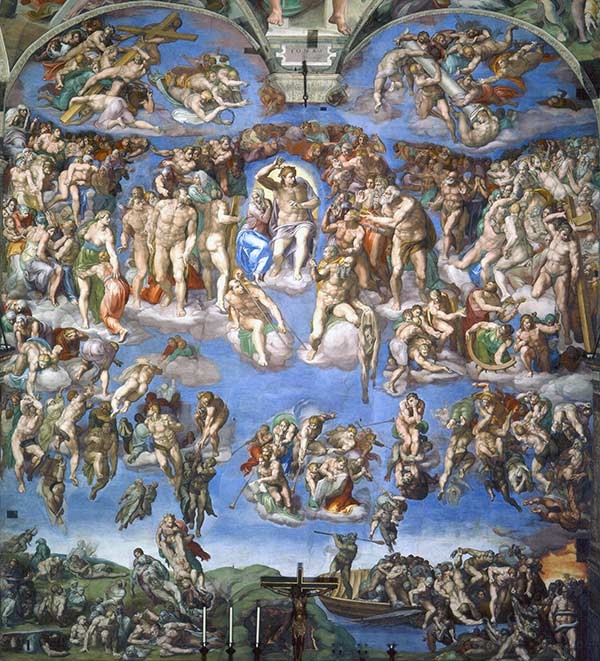
[.imgcaption] Michelangelo, The Last Judgment , fresco, 1536–1541. [.smalltext] Wikipedia (public domain). [.smalltext] [.imgcaption]
I must admit that I find it difficult to accept eternal damnation. Nevertheless, I take Jesus’ clear words about heaven and hell seriously. They are not an invention of Michelangelo. One thought helps me: there are courts on earth. Serious crimes are punished with life imprisonment. My actions have consequences, both good and bad. Fraud is punished, as is murder, with greater or lesser penalties. If I believe in eternal life, why should my actions only have consequences in this life? Jesus speaks of a final closing of the door. There is such a thing as “too late,” not only when we miss a train, but also if we die without having made amends for what we have done wrong. It can torment us for a long time if someone dies before we have asked them for forgiveness. We have missed our chance forever. Jesus makes it clear that our eternity is decided here and now. If so much depends on us, will only very few be saved? Does it depend on whether we make life heaven or hell for each other here on earth? Once, the disciples asked Jesus in alarm, “Who then can be saved?” Jesus’ answer is our only hope: “With man this is impossible, but with God all things are possible.”