Essay
The Moral Beauty of Middlemarch
George Eliot’s masterpiece teaches us to live faithfully a hidden life.
April 7, 2026
Try 3 months of unlimited access. Start your FREE TRIAL today. Cancel anytime.
START FREE TRIAL NOWThe Moral Beauty of Middlemarch
[.article__paragraph--cap][.small-caps]“Worship the Lord[.small-caps] in the beauty of holiness,” says the psalmist (29:2). Many spiritual writers have discoursed on this theme, including, curiously, Jonathan Edwards, better known for terrifying congregations with his famous 1741 sermon on “Sinners in the Hands of an Angry God.” “The moral beauty of God … nothing can withstand,” he writes in his Religious Affections (1746). “All the spiritual beauty of [Christ’s] human nature, consisting in his meekness, lowliness, patience, heavenliness, love to God, love to men, condescension to the mean and vile, and compassion to the miserable, etc. all is summed up in his holiness.”[.article__paragraph--cap]
“Moral beauty” is an arresting phrase. Typically, goodness is commended for its effects rather than for its aspect. Perhaps the scarcity nowadays of such lofty sacred eloquence as Edwards’s, the drabness of much preaching and religious writing compared with earlier periods, when sermons were literary performances and widely published, is part of the general verbal aridity of our age, brought on by the ubiquitous toxic blooms of commercial speech that convert our innermost thoughts into advertising jingles. This is by no means only a loss for believers; the religious imagination is a vital part of a living culture. Ceding it – like so much of contemporary culture – to formula and cliché gradually but inexorably hollows us out.
There are, no doubt, plenty of resources within Christian and other religious traditions from which to relearn heartfelt eloquence. But I’d like to propose a secular exemplar: perhaps the greatest repository of moral beauty in English literature, the voice of the narrator in George Eliot’s Middlemarch.
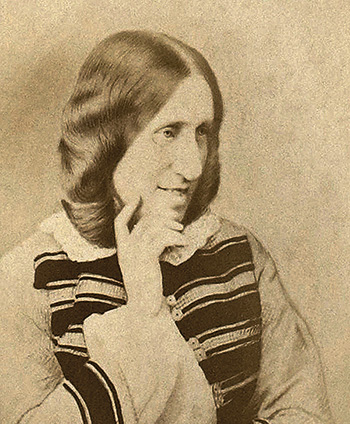
[.imgcaption]John Mayall, George Eliot, photographic portrait (albumen print), 1858. [.smalltext]© Bibliothèque nationale de France. Public domain. Used by permission.[.smalltext][.imgcaption]
George Eliot (1819–1880) was born Marian Evans to an estate manager and his wife in Warwickshire. She was extremely plain, and though this was in some ways unfortunate for her, it was fortunate for posterity: her family considered her unmarriageable, so she received more of an education than most girls at the time. Though painfully rebuffed by her first crush, the then-famous (now largely forgotten) social theorist Herbert Spencer, she eventually found an ideal partner, the writer and editor George Lewes, who worshipped her. Her formal education was patchy, but her intellectual appetites were voracious. When she began as a literary freelancer – writing under a masculine name – she was brilliantly successful. Though a nonbeliever, she was always keenly interested in and sympathetic toward religion, and early in her career translated into English two of the most influential books on Christianity of the nineteenth century: The Life of Jesus by David Friedrich Strauss and The Essence of Christianity by Ludwig Feuerbach. In her late thirties, she began writing novels, producing several masterpieces: Adam Bede, The Mill on the Floss, Felix Holt, Middlemarch, and Daniel Deronda.
Virginia Woolf called Middlemarch “one of the few English novels written for grown-up people.” That may have been, as much as anything, a dig at enormously popular novelists like Walter Scott, Charles Dickens, and H. G. Wells; after all, Jane Austen’s, Thomas Hardy’s, and D. H. Lawrence’s novels are arguably grown-up fare. Middlemarch, though, is a book to grow up with: an ideal moral education for a college student (as in my case, and that of thousands of others) or young adult. Eliot’s running commentary explains, admonishes, predicts, praises, rebukes, and excuses with a wit so gentle and a charity so unfailing that her voice might be said to float like a butterfly and rouse her readers not with a sting but with a light, affectionate nudge.
The central character in Middlemarch is Dorothea Brooke, ardent and idealistic – though the book’s preface introduces us to another youthful idealist, Saint Teresa of Ávila, who set off as a toddler with her even younger brother to convert the Moors. It is a charming story and gives rise to a reflection that will haunt the rest of the book:
[.blockquote]Many Theresas have been born who found for themselves no epic life wherein there was a constant unfolding of far-resonant action; perhaps only a life of mistakes, the offspring of a certain spiritual grandeur ill-matched with the meanness of opportunity; perhaps a tragic failure which found no sacred poet and sank unwept into oblivion.[.blockquote]
The innumerable ways that ideals – especially women’s – can be defeated by circumstance is one of the novel’s most poignant reflections.
In the early nineteenth century, marriage was a foregone conclusion for a rich and beautiful young woman. But instead of accepting the obvious suitor, the rich and handsome owner of the neighboring estate, the unworldly Dorothea decides it is her vocation to marry an elderly clergyman engaged in recondite historico-theological scholarship and to become his helpmeet. Her gradual discovery of his refined selfishness and intellectual sterility is cruelly disappointing. But Edward Casaubon is not a monster nor even an especially bad man. He is merely “the center of his own world” and “liable to think that others were providentially made for him,” a trait that is “not quite alien to us and, like the other mendicant hopes of mortals, claims some of our pity.” This is Eliot’s characteristic tone of reproof: gentle, wry, compassionate, and always insistent that every fault of every character almost certainly has its analog in every reader.
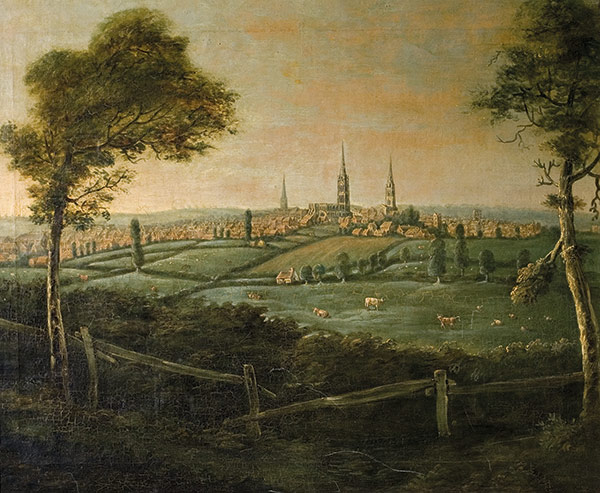
[.imgcaption]Coventry from the East, oil on canvas, ca. 1830. Artist unknown. [.smalltext]© Herbert Art Gallery & Museum, Coventry / Bridgeman Images. Used by permission.[.smalltext][.imgcaption]
Mr. Casaubon has a younger, rather romantic cousin, Will Ladislaw, who is as free-spirited and open-hearted as Casaubon is fearful and insecure. Will’s mere presence in the fictional town of Middlemarch and his eager but innocent friendship with Dorothea become intolerable to her husband, whose pettiness and suspiciousness poison the already strained marriage. Eliot’s judgment of this profoundly unhappy man is a mix of severity and mercy:
[.blockquote]It is an uneasy lot at best, to be what we call highly taught and yet not to enjoy: to be present at this great spectacle of life and never to be liberated from a small hungry shivering self – never to be fully possessed by the glory we behold, never to have our consciousness rapturously transformed into the vividness of a thought, the ardor of a passion, the energy of an action, but always to be scholarly and uninspired, ambitious and timid, scrupulous and dim-sighted.[.blockquote]
That every villain is also a victim, to be pitied as well as blamed – Middlemarch illustrates this Christian commonplace with consummate literary skill.
Chief among the novel’s vast tableau of supporting characters are another pair, Tertius Lydgate and Rosamond Vincy. He is a young physician, new to Middlemarch, intellectually ambitious, and determined to remain free (unmarried) until he has made his mark. She is as beautiful as a nymph but small-minded and self-willed, determined to marry above her station – that is, someone with aristocratic connections, like Lydgate. Selfishness is the cardinal sin in Middlemarch, and Rosamond is the novel’s primary case study, even more than Casaubon.
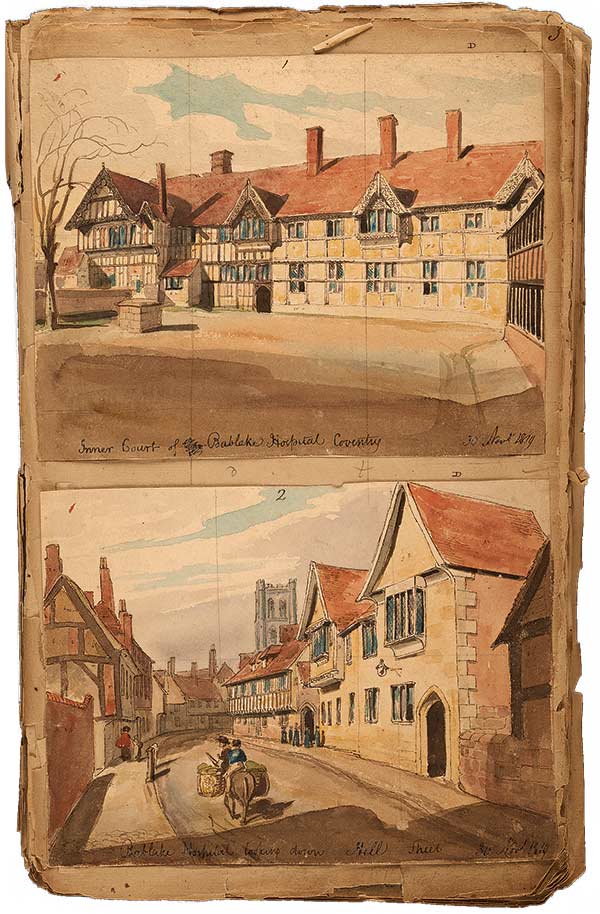
[.imgcaption]William Henry Brooke, Bablake Hospital Coventry, watercolor, 1819. [.smalltext]Image copyright © Herbert Art Gallery & Museum, Coventry / Bridgeman Images. Used by permission.[.smalltext][.imgcaption]
“Sin” is perhaps too strong: selfishness, for Eliot, is above all a matter of occluded vision, an inability to see things from anyone else’s point of view. And that inability, too, may be conditioned by circumstance. Lydgate’s is a comparatively innocent selfishness: he needs very little from other people, and his training and gifts allow him to make his own way. But for Rosamond, there appears to be only one way to rise in the world – to captivate and manipulate. Long before meeting Lydgate, she has honed those skills on her pliable parents. In response to her mother’s plea to be sensible about expenses, “Rosamond, examining some muslin-work, listened in silence, and at the end gave a certain turn of her graceful neck, of which only long experience could teach you that it meant perfect obstinacy.” Her father fared no better:
[.blockquote]Mr. Vincy, blustering as he was, had as little of his own way as if he had been a prime minister: the force of circumstances was easily too much for him, as it is for most pleasure-loving florid men; and the circumstance called Rosamond was particularly forcible by means of that mild persistence which, as we know, enables a white soft living substance to make its way in spite of opposing rock.[.blockquote]
Rosamond is a master at putting other people in the wrong – a poisoned gift, which overcomes Lydgate’s prudent resolution to wait before marrying. The resulting marriage is disastrous. To satisfy Rosamond’s expensive tastes, Lydgate reluctantly puts aside his research and becomes a physician to the rich – a defeated man.
[.blockquote]Rosamond continued to be mild in her temper, inflexible in her judgment, disposed to admonish her husband, and able to frustrate him by stratagem. As the years went on he opposed her less and less, whence Rosamond concluded that he had learned the value of her opinion.… To the last he occasionally let slip a bitter speech which was more memorable than the signs he made of his repentance. He once called her his basil plant; and when she asked for an explanation, said that basil was a plant which had flourished wonderfully on a murdered man’s brains.[.blockquote]
Rosamond is a chilling object lesson in the futility of getting one’s own way at all costs. Dorothea illustrates the opposite lesson: that self-forgetfulness is the royal road, if not to happiness, at least to the depth of feeling that makes life real.
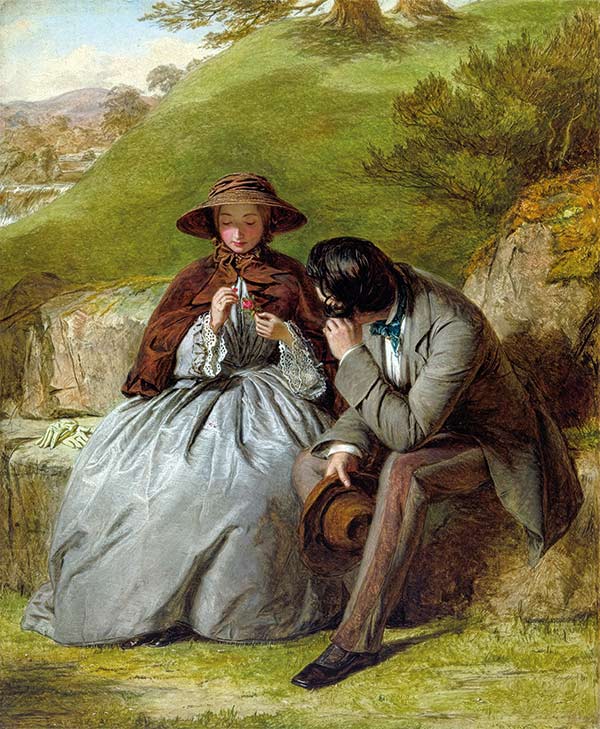
[.imgcaption]William Powell Frith, The Lovers, oil on board, 1855. [.smalltext]The Art Institute of Chicago. Creative Commons Zero.[.smalltext][.imgcaption]
There is one perfectly virtuous resident of Middlemarch: the carpenter, builder, and land agent Caleb Garth. Caleb’s entire ambition is to do good work. For the chance to take on “a bit o’ needful work,” he is apt to forget about negotiating the best possible fee – or any fee – a fault which his long-suffering wife both deplores and smiles at. With touches of religious language, Eliot portrays Garth as a secular saint:
[.blockquote]I think his virtual divinities were good practical schemes, accurate work, and the faithful completion of undertakings: his prince of darkness was a slack workman … he was ready to accept any number of [beliefs about the universe] if they did not obviously interfere with the best land-drainage, solid building, correct measuring, and judicious [drilling].… In fact, he had a reverential soul with a strong practical intelligence.… [H]e was one of those precious men within his own district whom everybody would choose to work for them, because he did his work well, charged very little, and often declined to charge at all.[.blockquote]
[.article__paragraph--cap][.small-caps]Eliot loves all her characters[.small-caps] but doesn’t respect them all equally. There’s none in the vast gallery of Middlemarch that she respects more than Caleb Garth.[.article__paragraph--cap]
It would be a hard world, and a hard-hearted novel, if everyone received exactly what he or she deserved. Fred Vincy, Rosamond’s brother, is also spoiled and selfish, though less conniving. He has wasted his university education, borrowed money (from Garth) that he is unable to pay back, and coasted along on (unfounded, as it turns out) expectations of an inheritance. He is rescued from a life of failure by the love of his childhood sweetheart, Mary Garth, the plain but merry and sensible daughter of Caleb. Unlike the typical modern heroine, Mary repeatedly tells Fred that she cannot love him unconditionally, but only if he will take up some proper work like a self-respecting man – like her father, in fact, for whom Fred eventually winds up working happily and productively.
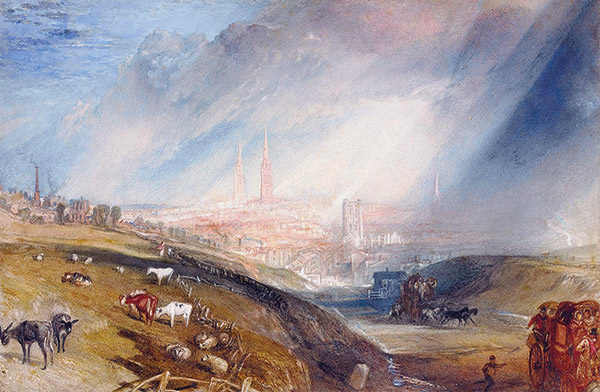
[.imgcaption]J. M. W. Turner, Coventry, Warwickshire, c. 1832. [.smalltext]Artwork from WikiMedia (public domain).[.smalltext][.imgcaption]
For the most part, though, in Middlemarch as in life, character is destiny. Perhaps a more accurate formula would be: character refined by suffering is destiny. Fred’s thoughtlessness must be tempered by the very real prospect of losing Mary. Dorothea’s disregard of the traditional meanings of marriage, making of it instead a pure, disembodied discipleship, teaches her a grudging respect for common sense and a necessary measure of distrust for her enthusiasms.
If there is a master insight in Middlemarch, a touchstone of the novel’s moral wisdom, it is this:
[.blockquote]If we had a keen vision and feeling of all ordinary human life, it would be like hearing the grass grow and the squirrel’s heart beat, and we should die of that roar which lies on the other side of silence. As it is, the quickest of us walk about well wadded with stupidity.[.blockquote]
The most important thing in this famous passage is not the tremendous metaphor – “the roar which lies on the other side of silence” – but the word “stupidity.” In Eliot’s moral philosophy, our original sin is not malice or any other positive evil but our deafness and short-sightedness about the needs and feelings of others. Unwadding our ears – a gradual process, if we are not to be overwhelmed by that roar – can only be the result of chastening experience. Our own pain teaches us to notice the pain of others.
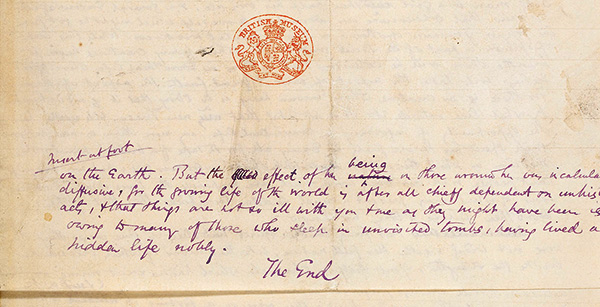
[.imgcaption]Manuscript of Eliot’s oft-quoted last paragraph of Middlemarch, 1872. [.smalltext]Courtesy of The British Library © Jonathan Garnault Ouvry. Used under a CC BY 4.0 licence.[.smalltext][.imgcaption]
At the novel’s close, Casaubon has died, and Dorothea has married Ladislaw. They live in London, where he is taking a small but energetic part in the ferment of English political reform in the 1830s. Tenderly appraising Dorothea’s once-shining hopes, Eliot draws a moral that fits everyone in the novel – and out of it:
[.blockquote]Her full nature … spent itself in channels which had no great name on the earth. But the effect of her being on those around her was incalculably diffusive: for the growing good of the world is partly dependent on unhistoric acts; and that things are not so ill with you and me as they might have been, is half owing to the number who lived faithfully a hidden life, and rest in unvisited tombs.[.blockquote]
“To live faithfully a hidden life” is a beautiful ideal, a conception of holiness, sacred or secular, that is all the finer because it is accessible to every human soul.