Essay
It’s Not All Good, Man
Churches are in decline. How should Christians respond?
March 19, 2026
Try 3 months of unlimited access. Start your FREE TRIAL today. Cancel anytime.
START FREE TRIAL NOW
[.article__paragraph--cap][.small-caps]Decline. Shrinkage.[.small-caps] Becoming less. Becoming smaller. It’s not fun stuff. It doesn’t lift the spirits to say these words, or to read them. And yet this has been the experience of many Christian denominations in Europe and North America over half a century and more.[.article__paragraph--cap]
How ought a theologian respond to this situation? Across the course of my career, I’ve seen two broad strategies from fellow theologians in response to church decline. Both seem to me to be, ultimately, forms of denial.
One approach is to provide a theological diagnosis of what has gone wrong, and then suggest a cure. This approach tries to identify the moment that the key intellectual mistake entered in, perhaps at the beginning of the nineteenth century in the thought of Friedrich Schleiermacher, the “Father of Protestant liberalism.” Some go further back, to the seventeenth and eighteenth century Enlightenment, or earlier still, all the way back to the late Middle Ages and the thought of the Franciscan friar Duns Scotus. Or, on the other hand, it is possible to reason in exactly the reverse direction: maybe the problem lies in church and theology not having kept up sufficiently with intellectual and cultural changes around us, being too tradition-bound, too stuck in the mud. Whichever the diagnosis, the cure then follows. If the error came in with Schleiermacher in the nineteenth century or Kant in the eighteenth or Scotus in the fourteenth, the solution will be some kind of retrieval and re-proclamation of a pattern of thought that came before. If the error lay in a failure to keep up with the modern world, the cure must surely lie in reshaping the Christian message as an answer to the deepest questions of contemporary culture.
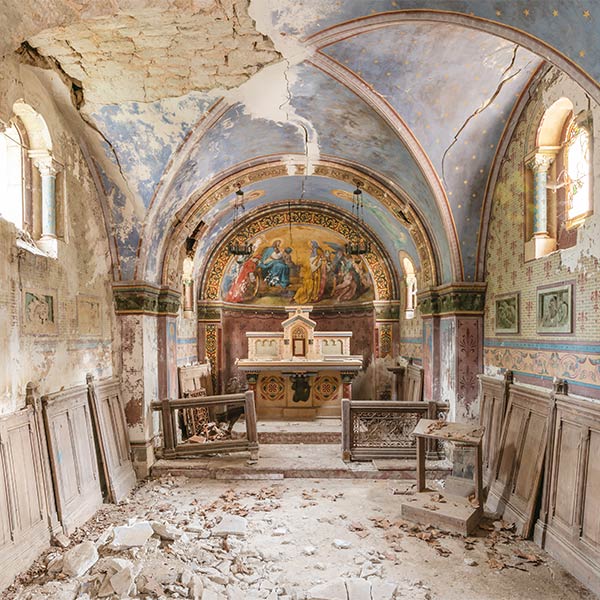
[.imgcaption]Abandoned chapel, Occitanie, France, 2018. [.smalltext]All photography by Romain Veillon. Used by permission.[.smalltext][.imgcaption]
Many of these diagnoses of our problems are fascinating, and they surely have something to contribute. But to think that they point to the answer – that if only we could get our theology right, church decline would be reversed and everything would be wonderful – I have come to believe is a delusion. Theology matters, I am convinced, but I don’t think we theologians are quite so powerful, quite so much at the center of things, that everything depends on where we go right or wrong.
A second broad strategy seeks not diagnosis and cure, but re-evaluation. In my more irreverent moments, inspired by the well-known Bob Odenkirk character, I think of this as the Saul Goodman strategy. As some readers will know, the central character from the Better Call Saul television series derives his name from his own earlier catch phrase, “It’s all good, man.” According to this second theological response, what first appears to be loss is not truly loss at all, but gain. Numbers declining, buildings sold off, Christian belief on the wane? It might seem a bit grim, but if only you know how to look at it, really, it’s all good, man.
Often this is articulated in terms of an escape from Constantinianism. Constantine the Great, the Roman emperor from 306 to 337, converted to Christianity sometime around 312 or 313, and not only legalized the Christian faith but also offered various financial and political advantages to the church. In Eusebius’s classic account of Constantine’s conversion, the emperor had a vision of a cross on the eve of an important (and ultimately successful) battle, together with the phrase “by this sign you shall conquer”: so the cross becomes associated with military might, and the church entangled with imperial power.
Quite a range of theologians argue that what we experience in secularization and church decline is the end of Constantinianism, and therefore to be welcomed: a liberation from political capture. The church is losing what it never should have had: the patronage of power, entanglement with the state, the benefits of establishment. These were corrupting influences. In being stripped of them, the church can be more truly itself, more faithful to Christ. So, indeed, it’s all good, man: apparent loss is, in truth, gain.
Might the recent rise in Christian nationalism call into question the idea that we are moving beyond the Constantinian era of the church’s life? Perhaps. But in any case, there is another difficulty with this story. What is lost, as church membership and church practice diminish, is not just the bad bits. It may be that there is some useful purgation when the churches lose their default position in society, their association with the status quo, their inside track to power. But there are many other things that disappear as churches decline, things that were valuable and precious.

[.imgcaption]Abandoned chapel, Brittany, France, 2021. [.imgcaption]
Let me give a couple of examples. The vagaries of my career as a lay Catholic theologian have led to time spent in recent years with women religious, contemplative nuns and sisters engaged in active ministry, teaching, chaplaincy, spiritual direction, and so on. In particular, through a research project, I enjoyed a close engagement with the Congregation of La Retraite, a religious community with its origins in seventeenth-century Brittany, which is now facing the possibility of its own end. It has been an enriching set of encounters, probably the only part of my working life where I have felt genuinely outside the corporately organized, neoliberal world. The sisters I have met are good listeners, often with a certain quality of presence, often striking me as holy people. Overall, my sense is that they are countercultural in a quiet but very powerful way.
Many such congregations are having to reckon with their own dwindling, and sometimes their approaching end. There is something moving about the calm, clear-eyed, unresentful way the sisters I know navigate this. For the most part, they do so without recrimination or complaint, but also without denying the difficulty and pain that is part of the process. And yet I have the sense that the loss of their communities will be a true loss for both church and society. There is a collective way of being in the world and in the church that is distinctive and valuable, and that simply won’t be available to us – in this particular way, in any case – in the future.
Or think about a parish that ceases to exist. At the time of its closing, perhaps the congregation is very small, very elderly; perhaps if they were to try to cling on, it might be seen as unrealistic, sentimental, nostalgic. But the loss is real. It is real for those who may have lifelong connections to the particular place and the dynamism it once represented, perhaps even memories of their parents raising the funds to build the church. But there is another loss, even if it is never noticed. It is about what will not be there for those who come later, or rather for those who don’t – those who might have had something deep and valuable, a living faith, sparked from what they might have encountered if that parish church had continued as living reality. Of course, in times past, some or many who went to church did so out of convention and habit only. But it is not only the ones who might have developed into merely nominal, merely social, Christians who won’t in the future encounter the church. There are also those for whom faith might have become something real, for whom it would have reshaped their inner landscapes, the way they see the world, their life’s course, who will now perhaps never truly encounter the gospel because of the closing of this and other parishes. One does not have to be preoccupied with hell, anxious over questions of eternal salvation or damnation, to understand such an absence as genuine loss.
Sometimes church diminishment is cast in terms of kenosis, “self-emptying.” The famous hymn Paul quotes in his letter to the Philippians speaks of Christ, who “did not regard equality with God as something to be exploited, but emptied himself, taking on the form of a slave” (Phil. 2:6 7). If self-emptying was the movement Christ made in the Incarnation, surely it must be a good thing for the church as well. I regularly see theologians commending a kenotic church and encouraging us to think of the diminishment we experience in these terms.
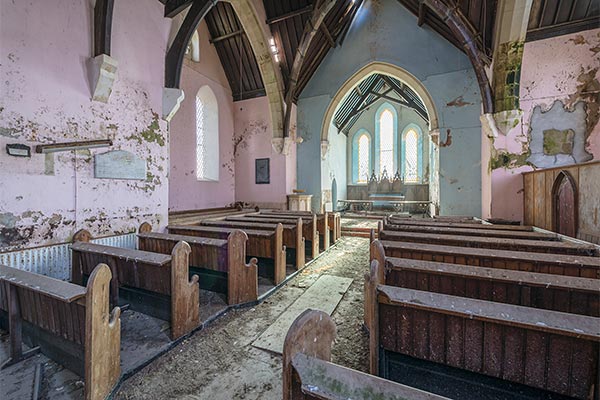
[.imgcaption]Abandoned church, Donegal, Ireland, 2016. [.imgcaption]
For a couple of reasons I find myself suspicious of calls for ecclesial kenosis. True enough, there are forms of wealth and influence the church has had that it never should have. Perhaps it is a good thing when these wither away. But ought we really speak of this loss of outsized privilege and power by analogy with the perfect generosity of the eternal Son of God’s Incarnation? Surely this is a subtle reinforcement of the very arrogance we need to leave behind, a way to cling on, even as we grow weaker, to our grandiosity.
When what is at issue is the loss of power and prestige that never should have been the church’s, the language we need to reach for describes ecclesial purgation, perhaps something like collective repentance or metanoia. On the other hand, when the issue is different, a change that means the church is less able to give witness to the gospel in a particular place or in a particular way, why dress this real loss up in positive clothing, why cast it as imitation of Christ’s Incarnation?
But if we are to reject the Saul Goodman approach – if things are not “all good, man” – what then? Can believing that everything is not in fact all good be compatible with trust in Providence and in the Holy Spirit’s guidance of the church? Indeed, if I am suggesting that we should neither put our trust in diagnosis and cure for ecclesial decline, nor try to redescribe our situation so that we can be easily reconciled with it, what will I propose instead?
[.pull-quote]Can believing that everything is not in fact all good be compatible with trust in Providence and in the Holy Spirit’s guidance of the church?[.pull-quote]
My hunch is that there is some light to be shed on church decline if we think of it as a form of suffering. For some, at least, this must surely be what it is. The church’s shrinking will not be, for most of us, the most acute form of suffering imaginable, the most dramatic or the deepest. But to watch the decay of what one worked to build; to have a sense that things which are close to one’s heart, which most illumine and motivate, matter less and less to others; to see that there has been a failure of transmission, of witness, down the generations, that the institution is getting older, weaker, less relevant, less respected; to see less and less external validation of what seems to one most meaningful – all these things come together to impose a sort of collective suffering, at least to those who remain in churches in the West.
For some years I have been exploring the place of suffering in Christian thought, and I have come to think that we stand between two temptations: a flight from suffering, and an embrace of it. The flight is perhaps the simpler thing to recognize: as a culture we are inclined to associate suffering with failure, to assume that if we make enough scientific, technical, and economic progress, and if we conduct our affairs with sufficient optimism, it is ultimately possible to avoid all suffering. One will be able to be happy and fulfilled, as well as productive, if only one maintains the right attitude, reads the right self-help books, and establishes a good morning routine.
The embrace of suffering is less obvious, but it seems to me also a temptation, particularly within the church. We know that there is something amiss with the secular culture’s flight from suffering, and we have the cross as our central paradigm, where love and suffering both reach a high point. So there can be a temptation to sacralize suffering, to fuse love and suffering, or holiness and suffering, to see suffering as itself the path that leads to God. There’s a subtle difference, but an important one, between enduring the suffering that is sometimes necessary on the path to God, and embracing suffering as the path to God.

[.imgcaption]Abandoned Catholic college, Nouvelle Aquitaine, France, 2015. [.imgcaption]
Yet there is, I think, an alignment between the strategies with which I began and these two temptations. The “diagnose and cure” response to church decline can be a form of flight from suffering. It is difficult to contemplate the fact that the project in which you are involved, the church you love, is on the wane, that the enormously rich, long, fascinating spiritual and intellectual tradition in which you are immersed is increasingly marginal and irrelevant. Perhaps the hunt for the theological moment where it all went wrong, and the theological pivot which will make it all OK, is a way of looking away, of suppressing the pain, of not facing the grimness and difficulty of the moment.
But the Saul Goodman approach, the Constantinian and kenotic themes, are aligned with a potentially dangerous temptation to embrace suffering. The smaller the church gets, the more irrelevant it seems, the more we can rejoice, because the more secretly holy it will turn out to be. If we look through sufficiently spiritual eyes, we will see that loss can be embraced as gain – it’s all good, man.
How else might we go about thinking about decline in our churches? I’d like to propose that reflection on death as we meet it in the lives of ordinary individuals might prove helpful. What is at stake in ecclesial decline is not the death of the church of Christ as such, but there can be an ending for particular communities, particular movements, particular cultures.
When a person dies, sometimes it is his own “fault” – he didn’t exercise enough, she didn’t watch her cholesterol, he didn’t look before he crossed the street. But we all know that death, even early death, is not always the fault of the one who dies. People may die after bringing to a graceful conclusion all their major life projects and longings, fulfilling all the potential that was in them. But we all know that death does not always wait for that moment: often enough, death interrupts a life not yet lived fully, projects that were not completed, potentials that could never be realized.
When some expression of the church – a parish, a youth movement, a tradition of preaching, a religious order – comes to an end, we can say something similar. It might be that someone in leadership has failed to read the world around them well enough, has failed in some other way in handing down a distinctive tradition or vision. But maybe not. It may be no one’s fault, simply a matter of social forces larger than us all. And again, sometimes it may be that an institution, a movement, a religious order, comes to an end at a time when its particular gifts are no longer needed, when they have completed their work. But maybe not. In our current fragmented times, we have more need than ever for the distinctive witness, presence, and attentiveness I have met among Catholic religious sisters. Nevertheless, many of these groups will disappear, at least from Europe and North America.
So I am persuaded that sadness and mourning, together with a bit of gratitude for what once existed, in all its beauty, is sometimes the right response to decline and diminishment. We don’t always need to assign blame or feel responsible for finding a solution.
Alongside the sadness and mourning, there must always be a recognition that loss is not the whole of the story. In some parts of the world, the church is in growth, not decline. Even where it is not growing, new things emerge, new movements, new possibilities, new ways of giving witness. And surely we trust that the grace of God is at work in ways we do not know and cannot imagine outside the boundaries of what we recognize as “church.”
It’s not an either-or. Sadness about what is lost, and recognition of new growth and new possibility are not at odds with one another: we can think and feel two things at once, and one doesn’t cancel the other out in some tidy mathematical equation.
While I am not much of a fan of the Saul Goodman approach, I do feel an attachment to Julian’s. Julian of Norwich famously insists that “all shall be well, and all shall be well, and all manner of thing shall be well.” What’s the difference? Aren’t they just alternate slogans for the same overarching optimism? The difference is in the tense of the verb. Julian is not asking us to think that all is now well, that all manner of things are already as they ought to be in the world we see around us, or in the church we see around us. She is instead transmitting a trust that, beyond anything we can understand or plan for, all shall be well. Her theological vision is deep, beautiful, hopeful, and full of trust, but as I read her, at least, in what it purports to understand, to integrate, and to explain, it is remarkably restrained.
I think this is a proper Christian disposition. It’s not all good, man. It’s sad, dispiriting, and depressing at times to see diminishment in the churches around us. But sadness and bleakness can never be the whole story. We do what we have it in us to do, we appreciate and rejoice in the elements of new growth and possibility we can detect even in the midst of diminishment, and finally, we trust that the Holy Spirit will not abandon the church. We know that its ultimate future, together with the future of all things and all manner of things, does not depend on our own best analyses and strategies.