Essay
The Critique of Religion
Marx called Christianity the opium of the people. What if it isn’t the religion he thought it was?
March 17, 2026
Try 3 months of unlimited access. Start your FREE TRIAL today. Cancel anytime.
START FREE TRIAL NOW
[.article__paragraph--cap][.small-caps]“The critique of religion[.small-caps] is the prerequisite of all critique.”[.article__paragraph--cap]
So wrote Karl Marx in the opening line of his Critique of Hegel’s “Philosophy of Right.” To call into question the existing order of the world, Marx argued, we must call into question those systems of thought which lead us to take that order for granted. As Marx saw it, religion was one such oppressive “ideology”: a set of rules, beliefs, and social conventions upholding the institutions and power structures of the status quo. “Religion” – by which Marx primarily means Christianity – seeks to keep the wealthy wealthy and the poor poor: it tells you that your ultimate value is in some place called “heaven,” so you don’t have to worry about economic inequality or poverty during your time on earth. The Christian Gospels tell us, “blessed are the poor,” “blessed are the meek,” “blessed are the peacemakers”: in other words, Marx opines, the Christian religion teaches that the poor should accept their poverty, the meek should accept their place, and the peacemakers shouldn’t put up a fight against injustice. This is why Marx strikingly calls religion “the opium of the people”: it soothes the pain you experience in the real world by sending you to sleep. To be free from oppression, in Marx’s view, requires that we free ourselves from the illusions keeping us oppressed: that’s why “the critique of religion is the prerequisite of all critique.”
Marx believed that, as society moved from feudalism toward capitalism, religion would inevitably decline. The nearly two centuries since Marx wrote those memorable lines have undoubtedly witnessed a decline in religious belief and practices. Even though there have been reports of renewed interest in religion among younger generations, twenty-first-century Western society has become less religious by almost any metric. One particularly interesting phenomenon emerging from this long decline witnessed in recent years is the emerging social demographic of the “spiritual but not religious”: people who explicitly identify as not belonging to any “religion,” yet who still see themselves as “spiritual.”
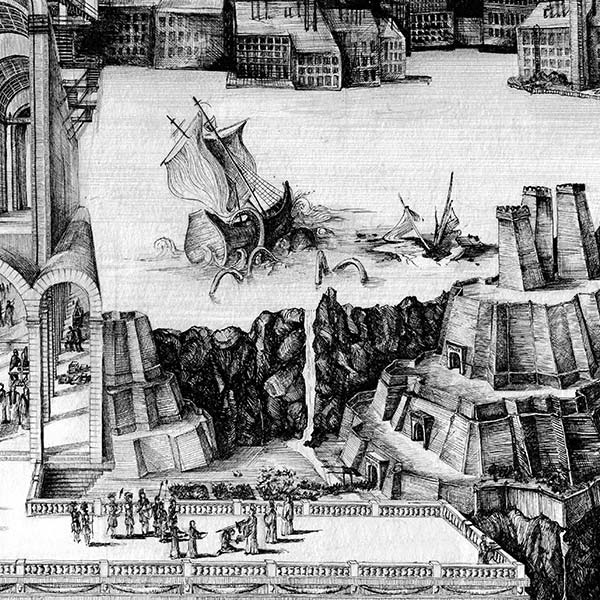
[.imgcaption]Carlijn Kingma, A History of the Utopian Tradition, Chinese ink on paper, 2016 (detail). [.smalltext]Artwork by Carlijn Kingma. Used by permission.[.smalltext][.imgcaption]
But what does it mean to be “spiritual but not religious”? Is such “spirituality” really that different from “religion”? Many scholars argue that it’s not. In their view, the spirituality of the so-called “spiritual but not religious” is often just an eclectic “pick ’n’ mix” of ideas and practices from traditional religions. There are other ways of construing secular or nonreligious spirituality. But in the dominant scholarly view, the “spiritual but not religious” phenomenon is nothing but a kind of individualized, consumerized, even commodified version of traditional religion. In other words, the “spirituality” of the “spiritual but not religious” is a spirituality of capitalism: a peculiar expression of traditional religiosity under the socioeconomic conditions of capitalism, with capitalism replacing religion as late modernity’s principal ideology. Some followers of Marx might even say that what we call capitalism is itself also a kind of religion, operating according to a crypto-theological structure of belief. It is just that, instead of God, we now believe in money.
Where “God” was once held as the source of all value, the “value of all values” by which we evaluate things, this role is now played by money. We no longer find the value and worth of things in God, but in money: a North London house in Highgate (where Marx is buried) is worth more, is more valuable than an East London flat not because it is holier, but because we are told by money that it has a higher price tag. When we speak of “what I am worth” in our everyday speech, we no longer refer to any notion of inherent dignity; rather, “what I am worth” now literally refers to the value of possessions I have or how much I have in the bank.
Consequently, if we regard capitalism as a kind of religion, then, counterintuitively, you could say we’re now actually more religious than ever in our all-encompassing money-driven world. For while in a pre-capitalist traditional religious society, one may privately hold a rejection of religion and deny the existence of God; one cannot reject money or deny its existence or the power it has over our lives. We all – one way or another, whether we call it “religious” or not – believe in money. We not only accept its existence but evaluate the worth of things and people in terms of money. In the old parlance, we no longer put our faith in God, we put it in mammon.
The claim that capitalism is a kind of religion is, of course, not without its problems. Unlike traditional religions, people don’t tend to identify themselves as “capitalists” as they might as Buddhists, Christians, or Muslims. We don’t (usually) find people going into their banks as a place of worship to profess their belief in money. To claim that capitalism is a religion perhaps raises more problems than it answers: If capitalism is a religion, then aren’t many other cultural phenomena also religions? To think of the case at hand, isn’t a Marxist outlook on society – as many critics of Marx have suggested – itself a kind of religion? After all, people are more likely to explicitly and proudly identify themselves as Marxists than to profess to be convicted of free-market ideals. Just as certain religious groups may be identified by the way they dress, we are more likely to see people wearing t-shirts with Marx’s or Che Guevara’s faces on them than Friedrich Hayek’s. Like how many religions have their authoritative texts and canonical scriptures – we can probably find more people devoting time to studying the classic texts of Marx, Engels, and the rest of the Marxian tradition than votaries of Adam Smith’s Wealth of Nations – or even Donald Trump’s The Art of the Deal.
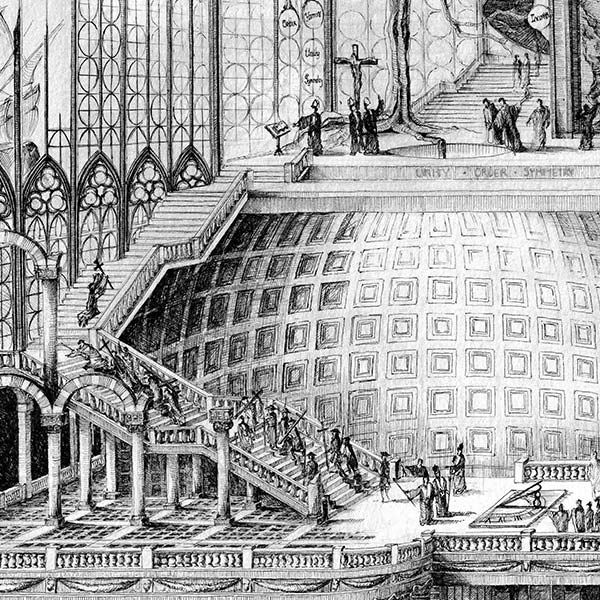
[.imgcaption]Details from Carlijn Kingma, A History of the Utopian Tradition. [.imgcaption]
But even if one admits that Marxism is no less a religious tradition than capitalism, the problem remains: if capitalism is a religion, Marxism is a religion, football is a religion, even Beyoncé is a religion … what isn’t a religion? Is everything a religion? If everything is a religion, might we also say that nothing is religion? Is “religion” a vacuous, even meaningless, term? How do we define “religion”? In fact, is it possible to define “religion” in the first place?
As we’ve seen, Marx based his definition of “religion” on Christianity, and a similarly Christian-centric conception of religion has persisted to this day. This is partly why many among the “spiritual but not religious” demographic in the West often identify themselves with Buddhism, which, as a nontheistic tradition without a Christian-style credal sense of orthodoxy or magisterium, does not appear to them as “religious” – even though there are certain forms of Buddhism that are formally institutionalized state religions in Southeast Asia. Similarly, here we see again why Marxism is sometimes described as a kind of “religion” with its vision of historical progress, culminating in the liberation of alienated workers into an ideal communist society – a narrative bearing a suspicious resemblance to Christian eschatology’s vision of the redemption of an estranged and sinful humanity into the kingdom of God. So, though we may not know what exactly are the essential features which make something a “religion,” to describe any phenomenon as “religious” or as a “religion” is to say that it is something that looks like Christianity. When those who identify as “spiritual but not religious” so vehemently reject “religion,” what they often mean is that they are skeptical of the institutionalism and dogmatism of organized religion associated with Christianity.
After all – “spiritual but not religious” and Christians alike – we often assume that we know what Christianity really is. Some people think of it as an aesthetic style (exemplified by the great artistic achievements of Baroque music, neoclassical architecture, and pre-photography painting); others a great books syllabus (often centered on Thomas Aquinas as the “culmination” of philosophical insights of Plato, Aristotle, Moses, and Jesus); still others a particular voting pattern or even an ethnic identity (most notably expressed in various forms of Christian nationalism). In all these cases and more, Christianity remains a religion – even the religion.
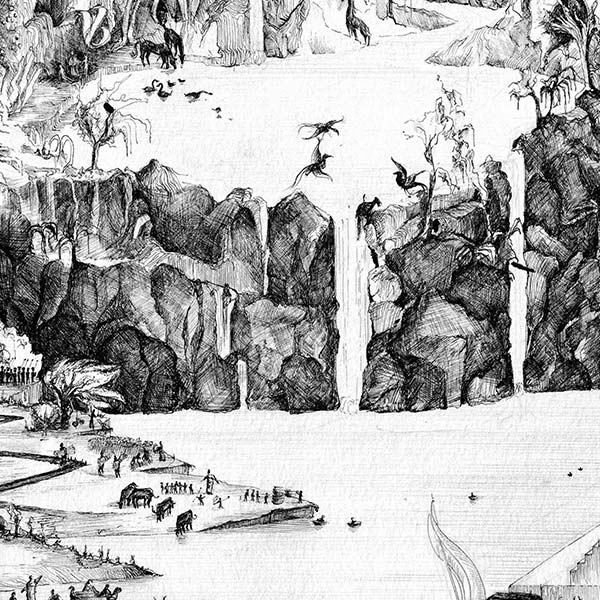
[.imgcaption]Details from Carlijn Kingma, A History of the Utopian Tradition. [.imgcaption]
[.article__paragraph--cap][.small-caps]This quasi-equation[.small-caps] between “Christianity” and “religion” may be helpful for understanding how the contemporary world has come to characterize and understand “religion” as a phenomenon – and why some people opt for “spirituality” instead. It may not be quite as helpful, however, in trying to understand what “Christianity” actually is.[.article__paragraph--cap]
Christianity was not always “the religion.” It was originally a marginal position accused of being a form of atheism for its refusal to take part in worshiping Roman gods and the Roman emperor. Not only was Christianity a marginalized social movement, where Christians, as followers of Christ, were oppressed for deviating from Roman state paganism, it was a way of understanding reality that cut against the prevailing worldviews of the societies within which it first emerged. In other words, from a pagan perspective, Christianity didn’t fit their idea of religion at all.
What Christianity introduced to Western thought was an account of what some scholars have called “post-heroic virtue.” Unlike pre-Christian accounts of moral virtues and ethical ideals, the Christian vision of the good life neither celebrated heroic courage, prudence, and temperance as embodied by soldiers of Aristotelian excellence, nor did it exalt the pursuit of wisdom idealized in the Platonic philosopher who contemplates the good. The Christian moral vision is exemplified not by heroism but, as Christ taught in the Sermon on the Mount, by “the poor in spirit,” “the meek,” “the merciful,” “those who mourn,” the “peacemakers” who “hunger and thirst for righteousness” or “are persecuted because of righteousness.” It is not the hero but the meek and humble – or as Saint Paul teaches, not the wise but those who, to the world, seem foolish – who embody what Christianity understands to be the good life or indeed, the blessed one.
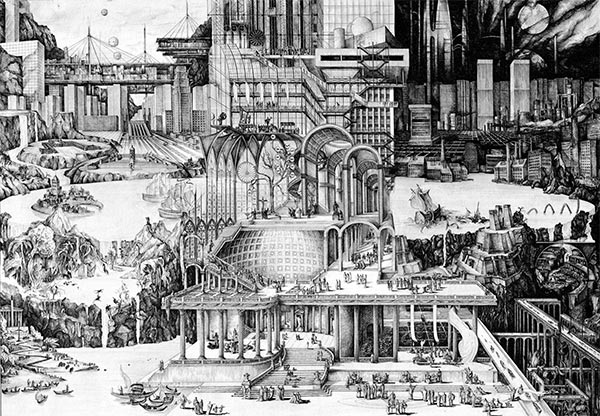
[.imgcaption]Carlijn Kingma, A History of the Utopian Tradition, Chinese ink on paper, 2016.[.imgcaption]
Christianity was in its very origins a “critique of religion” itself, a way of living and thinking which called into question the dominant religious doctrines, moral systems, and the nexus of imperial power by throwing into doubt their assumptions about what it means to be a flourishing human.
The Christian affirmation of meekness or humility is not just a moral command but something that pertains to Christianity’s very understanding of God. The Christian ethical call to “resist the proud and give grace to the humble” (1 Pet. 5:5), as Augustine observes in the Confessions, was exemplified by God in the Incarnation, wherein Jesus Christ, “despite being in the form of God, did not consider equality with God a thing to be grasped, but emptied himself and took on the form of a servant, made in the likeness of human form, humbling himself by becoming obedient to death – even death on a cross” (Phil. 2:6–8).
In the Confessions, Augustine notes that it is this radical emphasis on humility that most profoundly distinguishes Christianity from the philosophical and religious accounts of divinity found in rival worldviews, like that of Platonism. For Augustine, as for much of the Christian theological tradition, God’s exemplification of humility and self-sacrifice in the Incarnation shows us one of the distinctive attributes of God held by Christianity: that God is love (1 John 3:16, 4:8). The Christian tradition holds, unlike Platonism and other rival worldviews, that God created the world out of love, as a free act of gift-giving, and not out of need or necessity. All that exists within the created order, including our very own being, is a gift from God.
True religion, then, is always a response to God – to God’s generous, loving act of gift-giving. As Augustine writes in The City of God: “We offer to God the gifts God has given us, and the gift of ourselves.… This is the worship of God; this is true religion [vera religio]; this is the right kind of devotion; this is the service which is owed to God alone.” True religion, for Augustine, consists not of adherence to particular moral precepts, doctrines, or institutions. Rather, it consists of “the worship of God,” whereby we offer to God the gifts that God has given us, including what Augustine strikingly calls “the gift of ourselves.” At the heart of “religion,” in Augustine’s portrayal, is what we might call existential gratitude: recognizing our existence as a gift given by God, that we are ourselves created as gifts of God, and that we are called to give to God “the gift of ourselves” – the gifts that we are – as an act of thanks-giving.
[.article__paragraph--cap][.small-caps]This ethos of existential gratitude [.small-caps]and thanksgiving is defined by humility: to acknowledge that our very own being as a gift requires us to accept that our existence is not something we deserve or something we are owed.[.article__paragraph--cap]
This isn’t an easy thing to do. In our everyday lives, we often take our existence for granted. This is in part because the gift of existence is not as easy to recognize as other kinds of gifts are. Unlike things that are given to us as gifts at Christmas or birthdays, the gift of existence isn’t something we can see or hear or taste; nor does it have a giver of this gift who is clearly visible to us (as our friends and family are). Yet many who are “spiritual but not religious” or even atheistic may say they are grateful for their existence, as if their existence is a gift given to them, even though they may not believe in a divine gift-giver to whom they feel grateful.
This “spiritual but not religious” attitude of existential gratitude is not about following certain rules or cultural conventions, nor is it about identifying oneself with a particular tribe or social group. It is, rather, as Robert Bellah memorably put it, a “habit of the heart.” And from this kind of gratitude, Christians, perhaps, have something to learn. It’s not just that the rejection of “religion” by the “spiritual but not religious” cautions us against the institutionalization and bureaucratization of Christianity: it challenges, or should challenge, our assumptions about the very nature of “religion” as a way of living and thinking.
Christianity is, as Augustine understood and Marx did not, at once a religion and a critique of religion. It calls into question the ways we have come to take the existing order of the world for granted by calling us to acknowledge that the things we have in this world – including our existence itself – are not possessions that we deserve. We are not to take these things for granted but to take them as gifts granted to us: gifts which invite a response in thanksgiving. Though the critique of religion may be the prerequisite of all critique, the prerequisite of true religion is not critique but the acknowledgment of the gift that we have been given.