Community Snapshot
Singing in Community
At the Bruderhof, music is worship, fellowship, and fun.
April 15, 2026
Try 3 months of unlimited access. Start your FREE TRIAL today. Cancel anytime.
START FREE TRIAL NOW
In conversations with friends who visit Bruderhof communities, the subject of music surfaces frequently – primarily because music itself surfaces frequently here.
In fact, singing has always been an intrinsic part of Bruderhof culture. Today our church is an international network of communities, but it began as a handful of seekers who left private life and moved together to form one household in 1920, in Germany. Our continued musical emphasis has roots in the cultural heritage of those first members. Many came to the community directly from the German Youth Movement, a free-spirited constellation of young people whose interest in “purer” pre-industrial traditions led to the rediscovery of medieval carols and folk songs, and the subsequent compilation of songbooks that became popular across the country.
The German Youth Movement wasn’t organized or cohesive, but was comprised of many small groups of young people who fled urban living with the stated goal of escaping the rigidity of their conventional society. These Wandervögel (“birds of passage”) enjoyed taking guitars and violins up to the top of a hill, building a fire, passing around some bread and cheese, then singing ballads and arguing passionately about philosophy and the truths to be found in music and in the beauty of the natural world. In direct reaction to the stuffy Lutheran piety of the day, many were not prepared to confine truth and beauty to the God preached in the pews. But perhaps unawares, they were encountering the living God as they actively searched for the spirit behind these good things.
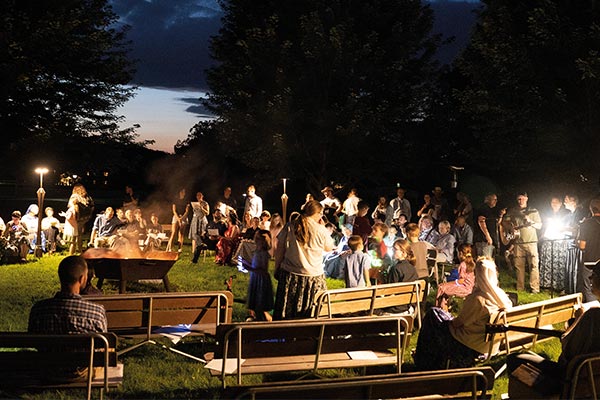
A fireside sing-along at the Plough Writers Weekend, Fox Hill Bruderhof, 2023. Photo by Melinda Barth. Used by permission.
As some of these seekers made their way to a Bruderhof community, there was clearly a strong spiritual current at work – a longing to bring the ideal of brotherhood to expression not only in the practical aspects of daily life, but in music, song, and dance as well, whether at mealtimes, evening gatherings, or seasonal celebrations.
The continuity of that vision is represented in the songs we sing today – for example, our current Christmas hymnal, comprising over three hundred songs, has its origins in these earliest years of our community. Some of the songs are taken from the Bruderhof’s very first collection, Sonnenlieder (“Songs of the Sun”), a 1924 publication. Others were collected from a hand-lettered anthology compiled in 1934.
Singing – whether in family circles, children’s groups, worship meetings, or plays and concerts – has remained an important part of Bruderhof life, especially during Lent and Advent. And as war and political upheaval forced the community to move from country to country, new songs were added to the canon. In England, one of the Bruderhof’s first places of refuge from Nazi Germany, new members brought with them the Oxford Book of Carols, first published in 1928. In the 1950s – the decade the Bruderhof put down its first roots in New York – involvement in the American work camp movement, with its emphasis on international understanding and cooperation, led to the rediscovery of folk tunes from around the globe. Traditional American hymns joined English translations of the Lutheran ones the first generation loved. Later chapters of our communal history brought us the addition of African-American spirituals, melodies from the hollows of Appalachia, and songs learned from South Korea, Zimbabwe, and South Africa.
Of course, during the holidays, there’s always a flurry of rehearsals and performances of plays and pageants, and numerous songs from these productions have found their way into our yearly celebrations, as have choruses from Vivaldi’s Gloria, Handel’s Messiah, and the oratorios by Bach and Saint-Saëns, not to mention the ageless hymns and carols still sung by millions around the world.
As a child, I always decided in Advent that Christmas was my favorite time of year, only to have Easter supplant it every spring. The songs usher a child through Palm Sunday and all of Holy Week, communicating the sacrifice and sorrow of Good Friday as no sermon ever could. But they also welcome the sunrise of Easter morning with the triumph of trumpets. “Christ the Lord Is Risen Today” and “Crown Him with Many Crowns” ring out, intermingled with no less lovely songs composed by Bruderhof members over the years – perhaps an inspired kindergarten teacher might come up with a few simple verses to welcome spring and Eastertide with her students:
All the earth is waking from her winter sleep;
Snow and ice are going, streams and rivers flowing,
Easter now has come again.
Gone are cold and sorrow,
Jesus we will follow,
Let us all together praise our risen Lord.
When kids grow up hearing and then singing these songs, favorite songs become synonymous with their page number. Last Easter morning, when our community gathered to sing the victorious songs of resurrection, I couldn’t help smiling when several children’s voices piped up, “One sixty-three!” at the same time – my own childhood favorite, a poem by Jane Tyson Clement set to music by my husband’s grandmother, composer Marlys Swinger:
The lambs leap in the meadow,
the larks leap in the sky,
And all the bells of heaven ring
because our Lord rides by.
Many of the songs we sing, though, have no great spiritual heft. Communal lunches frequently begin with a cheery song about whatever season we find ourselves in – and whatever the kids might be doing while out in it – sledding, skating, hiking, camping, jumping in leaf piles.

Starting them young. The author’s niece and nephew try out the trap set at a family gathering. Photograph courtesy of Maureen Swinger.
But, in keeping with the Sonnenlieder book of old, it still is the most astonishing mash-up. In the well-worn pages of the Sing Joyfully songbook, affectionately known as “The Blue Book” (because there are also red, green, and even purple anthologies), we have seasonal songs that boast lyrics by William Shakespeare, William Blake, and Thomas Nashe. One of the Blake poems is set to a Russian folk tune. Then there’s a melody borrowed from Mozart, with some lyrics by Aldis Dunbar, and some by a Bruderhof member who doubtless added in another verse because “the song was too short.”
Summer’s in the hills today,
Laughter in the breeze – O listen!
Summer’s in the woods today,
Fluttering the aspen trees.
There are songs to acknowledge the arrival of a new baby:
We thank you, loving God
For every little thing,
But for babies, sweet and small
We thank you most of all.
Also, about twenty different birthday songs to mix it up from the ubiquitous “Happy Birthday to You” chant. Who wouldn’t want to receive such a blessing as this one on their next year of life?
We wish you the glow of the sun by day,
The shine of the stars by night,
On your path, the gleam of the moon’s soft ray,
And the fireflies’ twinkling light.
It’s as if music is its own language, drawn on to announce the seasons, rejoice in whatever needs celebrating (a lot needs celebrating), underscore faith, bear grief together. This undercurrent of music goes beyond the subject matter of the songs themselves. Any given sing-along takes on its own character, often with a surprising, apparently random combination of songs brought into the flow.
Even the songs sung at worship meetings might not always overtly refer to God. In a hark-back to some of the anti-formal-religious sentiments of the 1920s German Youth Movement, many from the great wave of young American families and singles who joined the Bruderhof in the fifties and sixties had stepped away from a denominational church, searching for something to believe in, yet reluctant to use religious language lightly. They brought with them a wealth of songs picked up from summer camps and conferences, or passed along from friends or family.
Thus, at the close of an evening worship meeting, you might hear someone suggest a song that came our way years ago via – of all sources – the Girl Scouts:
Peace I ask of thee, O River,
Peace, peace, peace.
When I learn to live serenely,
Cares will cease.
From the hills I gather courage,
Vision of the day to be,
Strength to lead and faith to follow,
All are given unto me.
While the author probably intended the peace and faith and vision to be generic enough for many beliefs or none – “spiritual but not religious” – here, in a gathering of scripture reading and prayer, the hills that give us courage could be the same ones we lifted our eyes to for help. The river might as well be the one whose streams make glad the city of God.
In a time when the word “music” mostly brings to mind digitized, commercialized, and performative sound – the act of “singing to” – it is still possible to reclaim the earlier, richer understanding of music, “singing with.” Communal singing is so different from performance: the latter delivers an experience to an audience, who encounter the music as receivers, while the former invites participation. It is a circle, balanced, equalizing, full but never finished, sending out sound to beckon outliers to lend their voices for the joy and comfort of it.
This is why it doesn’t really matter to me if we’re singing worship songs or folk songs, or really any other genre. As long as we’re a group of people with common purpose, we are giving thanks for being together, which means we’re also thanking the One who brings us together.
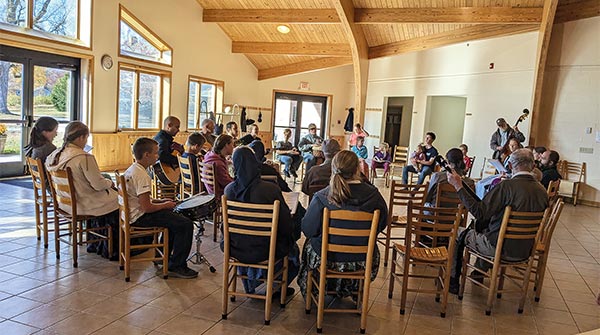
Friends from Honesdale, Pennsylvania, join Fox Hill community members to share favorite folk songs and hymns. Photograph by Maureen Swinger. Used by permission.
You might like to think that cradle immersion in a culture of music would secure the blessings of perfect pitch on ourselves and our posterity. Alas, it does not. It’s true that between the general surround-sound and the various inspired music teachers who strum guitars and introduce age-appropriate songs to the one-year-olds, many kids can warble the treble line of a few hundred songs by the time they reach middle school, and some can figure out harmonizing just by hearing enough of it. But it’s not given to everyone to make like a bird, and that’s fine. One of my favorite uncles, Tony Potts, would happily rumble along in a somewhat tuneless baritone, just obeying the general command of Psalm 100 to “make a joyful noise unto the Lord.” Others who have gifts in nonmusical directions may opt to just listen and appreciate, while still contributing by being part of the circle.
And if someone is suffering or grieving, sometimes there is comfort in being silent within the sound, like a rock that feels the strength of water flowing over and around it.
Growing up on a veritable river of music was not something I was aware of as an appreciable thing until my husband, Jason, and I spent a few years living in a smaller house community. Yes, we were surrounded by as much performative music as we chose to spool up. Yes, we sang a lot together, because the kids were little and we wanted to keep our favorite songs alive, a communicative link to our culture as well as our faith.
A mini-band was OK; we sang to wake ourselves up at breakfast, and drift the children to sleep at night. The sound felt a little thin and lonely around Easter and Christmas. I was more than delighted when friends in our kids’ play group expressed interest in learning some of our repertoire of spring songs for a neighborhood May Day celebration, then happily adopted the Bruderhof’s “lantern walk” tradition in fall, with all its enchanting accompanying songs.
But I was totally unprepared for my response to the daily Bruderhof singing upon our family’s arrival at Fox Hill community a few years later. All those bookless, audience-less, effortless, two-hundred-voice four-part harmonies poured over me; it was like standing under a waterfall.
It did not matter in the least what song was being sung. It was all prayer.