Fiction
Short Story: Sieidi
March 21, 2026
Try 3 months of unlimited access. Start your FREE TRIAL today. Cancel anytime.
START FREE TRIAL NOW
[.article__paragraph--leading]“Worship him, all ye gods.”
—Psalm 97:7[.article__paragraph--leading]
[.article__paragraph--cap][.small-caps]In all the years since,[.small-caps] I’ve never regretted what we did. No one was talking about restitution of artifacts in those days – I don’t think anyone would even have thought about it, not among curators anyway. It wasn’t something I thought about either – I can’t claim to have been ahead of my time, because I didn’t do it of my own accord. I needed a good deal of prompting, and that prompting just came in a particularly strange form. It all began the day I first caught sight of the sieidi, although if I’m honest I had no idea what it was. I had just started working at the National Museum a few weeks earlier, and I was still mostly confined to the basement and the storage areas – the senior curators wouldn’t let me near the actual exhibitions yet.[.article__paragraph--cap]
It was when I was moving some boxes that I caught sight of it, covered in thick gray dust under an air vent. It wasn’t large – about two feet tall – and my first thought was that it was just some old lumber. But it was too peculiar-looking for that. Yes, it was made of wood – but there was a degree of deliberation in its haphazard construction, with smaller sticks carefully lodged in knotholes in the main trunk, which terminated in a flurry of twigs that looked a little like a head of hair. Indeed, the way the bole expanded at the top of the trunk and the sticks shot out from its sides gave it an almost anthropomorphic appearance. Almost, but not quite.
I had seen crude figurines before, and it usually wasn’t hard to sense even an ambiguous depiction of the human form – after all, even very young children can manage to create that. Whatever this was, it wasn’t unskillful; great care had been taken to construct it, yet for some reason it only hinted at the human form – as if pointing to something else. Out of curiosity I moved the boxes a little further. There was a sort of parcel-tag hanging from one of the sticks (we used to put those on some of the larger artifacts in storage) and on it there was just one word: “SIEIDI.” Fortunately there was also an accession number on the back. I recognized sieidi as a Sámi word – not that I knew anything then about Sámi languages, but I had been involved in cataloguing a few Sámi artifacts and it had come up, although I couldn’t remember what it meant. At any rate, I found a pencil in my pocket and scribbled down the accession number before I pushed the boxes back into position.
I was eager to get away from work that afternoon because I had agreed to meet Ella in a café on Karl Johans gate; we had been seeing one another for about three months at that point, and Ella was working for Norwegian Church Aid. I hadn’t met her parents yet, but she had mentioned she had some Sámi heritage – I couldn’t remember whether from a grandparent or great-grandparent, but she knew a little bit about Sámi things. That was more than could be said of most Norwegians in those days – it was before the Alta Dam protests were on our television screens, or anything like that.
I wondered if Ella knew what sieidi meant, so when we were settled in the café I asked her.
“I think I came across a Sámi word today,” I said.
“Oh?” She leaned forward with interest, her long dark hair framing her smiling face as she clutched a cup of herbal tea.
“Yes. S-I-E-I-D-I.” I was worried about mis-
pronouncing it, so I spelled it out letter by letter.
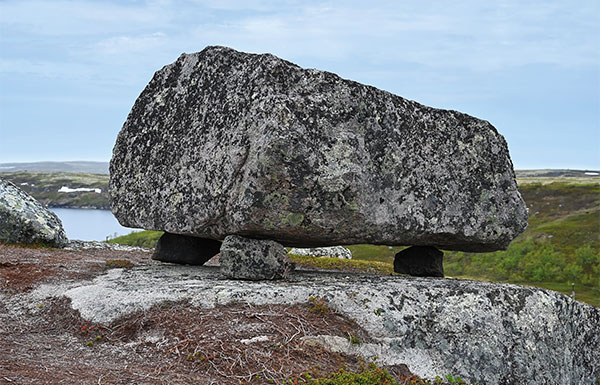
Ella laughed. “Sieidi. It’s a holy thing in Sámi culture. Like a rock or something. A special place in the landscape.”
“Was it your grandmother you said was Sámi?”
“My great-grandmother,” she corrected me. “Honestly, I really don’t know much about Sámi culture. I wish I knew more.”
“Have you ever been – I mean, to Finnmark?”
She shook her head. “No. I’ve never been farther north than Trondheim.”
The conversation passed on to other things. I decided not to mention the strange object I had found behind the boxes. I was confused by what Ella had said about rocks and landscapes. Whatever it was, the thing was clearly not a rock.
However, I had the accession number in my pocket and so, the next day, I consulted the card indexes and found the original catalogue entry for the sieidi:
[.blockquote]Lapp sieidi. Wood. Age unknown. From Sálajok, Finnmark. The crudely anthropomorphic figurine was recovered close to a lake from a site of sacrifice by Nils Olavsen in 1921.[.blockquote]
It was a tiny amount of information, but it raised many questions. Clearly, it was possible for a sieidi to be something other than a rock. But where was Sálajok? And what did the catalogue mean by “a site of sacrifice”? What was the sieidi still doing there in 1921, and in what sense was it “recovered”? And who was Nils Olavsen?
This final question was probably the easiest to answer. I had no time to look further that day, but when I had a moment from my duties the following day, I made my way to the small archaeological library inside the National Museum – it smelled of mingled pipe-smoke, yellowing paper, and peeling adhesive tape – and looked up Olavsen in the card index there. After all, if he had been collecting artifacts for the National Museum in the twenties he was probably an archaeologist, and probably wrote something. Sure enough, there was a card for Nils Olavsen with a couple of entries on it: The Earliest Churches of Finnmark (1920) and The Mission of Erasmus Wallund (1922). Given his interest in churches and missions, I wondered if Olavsen (in common with many investigators of Lapland) had been a missionary as well as an antiquarian – and sure enough, when I tracked down the second of his monographs he was pictured in a black-and-white plate, in the ruff of a clergyman, incongruously combined with a then-fashionable thin moustache and stiffly slicked hair.
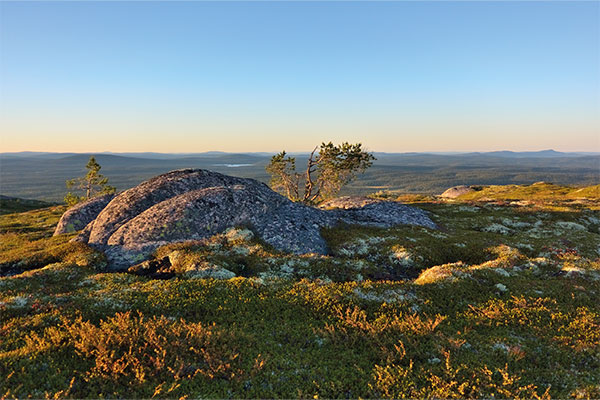
[.imgcaption]A sieidi in Eastern Lapland. [.smalltext]Photograph by Andrey Kokin, CC BYSA 4.0, Wikimedia Commons.[.smalltext][.imgcaption]
There was nothing in either of these books about the sieidi downstairs, but turning to the conclusion of The Mission of Erasmus Wallund, I found a passage that perhaps gave some insight into Olavsen’s religious views:
[.blockquote]The old idolatry that Wallund strove against is very nearly dead among the Lapps, although in a few places a passe-warck is still to be found in some remote place where fresh carcasses of reindeer are offered to the sieidi. Yet the active efforts of the clergy and magistrates in removing those sieidis that can be displaced, such as smaller stones and idols of wood, have greatly reduced the number of such sites of sacrifice while endowing the nation’s museums and centers of learning with valuable artifacts testifying to the unique religion of the Lapps.[.blockquote]
The book continued in this vein, combining a genuine curiosity about Sámi culture on Olavsen’s part with an equally certain belief that its religious and spiritual aspects, at least, were best eradicated and replaced by the light of modern education.
But if the clergyman’s intent had been to bring the sieidi to Oslo for scholars to study it, then it was something of an indictment of his project that the thing was now sitting, forgotten and covered in dust, in the basement of the National Museum fifty years later. The thought made me rather sad; as surely as the hammer of an iconoclast, the cold cataloging hand of the curator robs an artifact of its sacredness.
That night I struggled to get to sleep as the sieidi, a mute witness to a vanished way of life in Finnmark, loomed in my imagination. Between sleep and waking, I imagined dark lakes between snow-covered hills, peculiar rocks and dead trees, mysterious clefts where Sámi in bright-colored clothing butchered reindeer in the hope of success in hunting or fishing. What had we done by taking this thing from another world, and what purpose was served by keeping it where no one would see it – at least, not unless a senior curator decided to dust it off and incorporate it into an exhibition on the Sámi? And that, I reflected, might never happen.
[.article__paragraph--cap][.small-caps]I had been unsure[.small-caps] whether to tell Ella about the sieidi, and in the end it was not so much her passing interest in Sámi things that led me to do so, but rather my own selfish desire to unburden myself of a thought that was troubling me. When I had finished laying out the entire story and my thoughts about the sieidi – we were in a little German restaurant in Gamle Oslo, almost deserted – Ella was silent for a while.[.article__paragraph--cap]
“Yes, there are some sieidis that are like that. Bits of tree and wood. They were the easiest to take away.”
“It seems wrong, somehow, that it was just removed like that. Do you think it was still a site of sacrifice, even as late as the twenties?” I asked her.
She shook her head. “I don’t know. I have heard stories about sacrifices carrying on really late, right up to the War.”
That was all Ella said about it then, although she seemed a little subdued for the rest of the evening. She was like that sometimes; it took her a while to process something difficult, so I didn’t push her on it. We stayed late, and it was getting dark by the time I walked Ella back to the apartment she shared with three other girls. It was in Gamle Oslo too, so it wasn’t far – in one of those old-fashioned blocks, four stories high and painted yellow. In the light of the street lamps, the yellow seemed even more intense. As we reached the block I glanced up and saw a reassuring light on in her apartment.
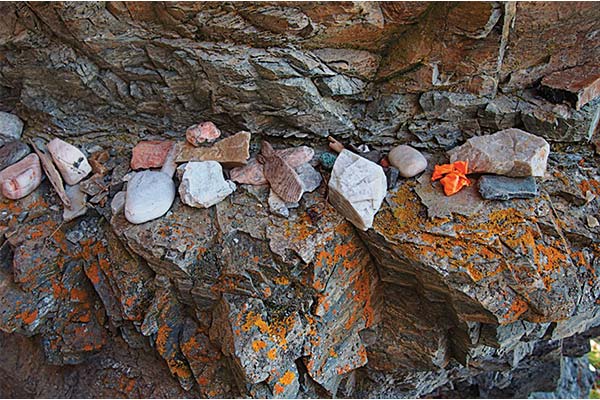
[.imgcaption]Small rocks placed on the Áhkku sieidi rock formation near Alta, Norway. [.smalltext]Photograph by T. Äikäs, mdpi.com. Creative Commons, CC4.0.[.smalltext][.imgcaption]
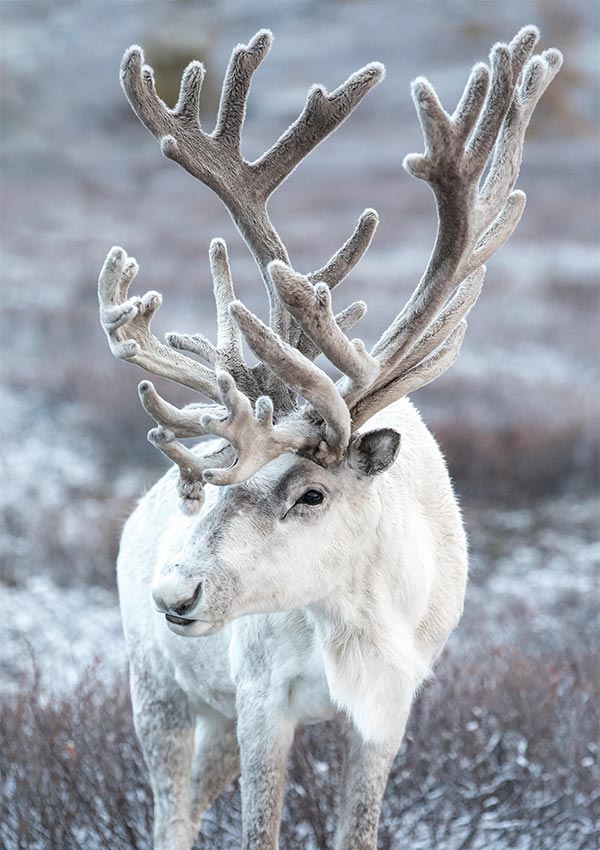
I was wishing Ella goodnight, and about to kiss her on the cheek, when she suddenly pulled away from me. She pointed silently to the end of the street. It had been empty when we turned into it – it wasn’t very long, in fact – but now as I turned back to look in the direction Ella was pointing I saw the unbelievable sight: it was, of all things, a reindeer. The creature was just standing there, its head raised up and looking straight at us, a splendid pair of antlers spread above its head; the streetlamps gave it an almost unearthly halo, and the color of its coat was pure white. I was surprised we hadn’t heard it – the streets here were still mostly cobbled, but the animal was completely silent.
I turned back to Ella; I was smiling at the incongruity of the sight, thinking about how my parents wouldn’t believe me when I told them I’d seen a reindeer on the streets of Oslo. But Ella wasn’t smiling. Her face was as white as the reindeer. When I glanced back, the reindeer was gone, as suddenly as it had come. Ella looked at me – the sight had clearly troubled her deeply – and she muttered one word before she turned to enter her building: “Miyandash.”
[.article__paragraph--cap][.small-caps]I didn’t know what it meant,[.small-caps] of course. In the end, I didn’t mention the reindeer to my mother and father; it felt like something that should stay between Ella and me. I supposed there must be a rational explanation for a reindeer wandering Oslo – I’d seen people in Sámi costumes lead them around at Christmastime to be petted by children. But it seemed so much stranger to see an unaccompanied reindeer wandering the streets of the capital in summer. Clearly it had escaped from somewhere. But there was one detail about the reindeer that seemed especially peculiar, and that was its whiteness. The streetlamps lent everything a yellowish hue, and although one of them had been shining directly onto the reindeer, it had remained a bright white. An optical illusion of some kind, I reflected.[.article__paragraph--cap]
Still, Ella had seemed troubled enough that I rode the tram to Gamle Oslo early the next morning – I didn’t care if I was late for work – and tried to catch her before she left. As it turned out, she was still at home; her housemate Kari let me in, and I found Ella sitting on her bed, gazing toward the window, holding a cup of coffee. She smiled weakly as I came in; I cleared some of the books and clothes off a chair and perched on it.
“That word you said last night,” I said. “That’s another Sámi thing, isn’t it?”
She lowered her eyes. “It’s one of the stories my half-Sámi grandmother told me – she got it from her mother. Miyandash is the holy white reindeer. He’s supposed to be the ancestor of the Sámi people – sometimes a man, sometimes a reindeer, sometimes a sort of hybrid reindeer-man.”
“You think the reindeer was supernatural?”
She shook her head. “Honestly, I don’t know. I don’t know if Miyandash is real. I don’t know if that was him. But I do believe in signs. I don’t think something that strange would happen without a reason. And you saw how that reindeer was still white, even under the streetlamps?”
I nodded. “I noticed that, yes.”
“You know there’s nothing more important to the Sámi than reindeer. First you come across that sieidi, then you tell me about it, then we see an impossible reindeer.” She lifted her eyes to meet mine. “It’s a message, and it’s about the sieidi.”
And then she said it.
“We need to put it back.”
I almost laughed, but I checked myself. “Put it back? Are you serious, Ella? Put it back where?”
“By that lake in Sálajok.”
“Which is where, exactly?”
She turned away, clearly disappointed. “Why do you have to be so cynical? I want to be alone. Please go.”
I left as she asked, but I felt awful. I knew, deep down, that this could be the breaking point of our relationship, that if Ella and I couldn’t agree on this issue, we would get no further as a couple. And I didn’t want that to happen. Like so many young men, I hadn’t yet said it to her because I hadn’t yet realized it, but I loved Ella. There was no getting past that. I had to go along with this, because this – however mad it seemed – was the next step.
I rang her that evening.
“We need to talk about how to put the sieidi back.”
[.article__paragraph--cap][.small-caps]Stealing a forgotten artifact[.small-caps] from storage in the National Museum, if you were a junior curator, wasn’t especially difficult in those days. I had a plan for that. But there were a lot of other things we needed plans for that I had never thought about. Most importantly, we had to find Sálajok on a map. Luckily, there were plenty of these in the National Museum, and I began using all my breaks to pull out and search through endlessly detailed topographical maps of Finnmark. At long last, somewhere between Tromsø and Kautokeino, I came across a Sálajok that was in the vicinity of a lake. I placed tracing paper over that section of the map and carefully copied the entire section in pencil, then marked the area on a copy of a larger-scale map of Finnmark to remove any doubt about the location. Of course, that didn’t mean we knew where the “site of sacrifice” was located – we just had to find the general area of Sálajok and hope we somehow stumbled across it.[.article__paragraph--cap]
And then there was the journey. Neither of us owned a car, and the drive to Sálajok was two thousand kilometers. I knew my father would never let me borrow his car, but in the end Ella reached an agreement with her housemate Kari, a junior doctor who didn’t usually need her car for work. Borrowing the car forced us to choose a date for our departure; and so, at the beginning of June, our plan went into action. We both asked for a week’s leave (and got it, surprisingly enough), and I found a military surplus rucksack that was large enough to comfortably accommodate the sieidi.
[.imgcaption][.smalltext]Photograph by Kertu Saarits/Alamy. Used by permission.[.smalltext][.imgcaption]
The plan for stealing the sieidi was straightforward enough. One of the senior curators had been asking me, for some time, to bring some boxes of old engravings upstairs for cataloging. As he wasn’t my boss, I hadn’t done a great deal about it, but on the day before my leave was due to begin I suddenly took on the task enthusiastically. Finding one of the boxes that contained various long engraved panoramas of old Oslo and other cities, I removed a few of them in order to make a space large enough for the sieidi, and simply carried it upstairs in the box. When I saw that the coast was clear, I took the box into the staff locker room and, in a heart-stopping minute, transferred the sieidi from the box to my rucksack, hoping no one would walk through the door. I then calmly took the box upstairs, followed by the rest of the boxes, and at the end of the day, took the rucksack with its unusual contents to Ella’s flat.
“So – are you ready?”
Ella placed the rucksack carefully in a corner of her bedroom.
“You don’t want to see it?” I asked.
She shook her head. “I still feel bad about taking it. We are stealing from the National Museum, after all. It’s just that I’d feel worse about not trying to put it back.”
“Well,” I said, “I don’t think anyone will miss it. Not for a while, at least. I made sure I removed it from the card index as well, so the only record will be if it’s in a printed catalog somewhere, or a book. But it’s not exactly unusual for an artifact mentioned in an old book to be nowhere to be seen in the museum’s collections. I think it will take years – decades, maybe – for anyone to realize it’s been taken.”
“I hope you’re right. For your sake.”
And then she told me how grateful she was to me; I blushed embarrassedly, made my excuses, and left.
It was Friday evening; our plan was not to leave immediately the next day, but to set off in the early hours of the morning on Sunday, when no one would see us driving off. So it was that we loaded the rucksack with the sieidi into Kari’s orange Kadett very early on Sunday morning, before dawn, and drove to Trondheim. It was a punishing initiation to long-distance driving, for me at least, but after around six hours, we entered the medieval city in the middle of the morning. The bells of Nidaros Cathedral were peeling out for the morning service. Ella had slept for most of the journey; she now said she wanted to go to the service. I wasn’t a believer then, so it didn’t interest me; I loitered in the square outside the great west front of the cathedral, listening to the faint sound of the organ permeating the air around me.
When Ella came out of the cathedral she was smiling.
“You seem happier!” I remarked.
“I prayed about the sieidi, and God told me I’m doing the right thing.”
I knew Ella had felt conflicted about stealing the artifact, and implicating me in the theft.
She continued, “I don’t think what was stolen to begin with can be stolen, if you just want to put it back. And I think the sieidi wants to go back too.”
I laughed. “God must approve of pagan idols, if he wants the sieidi back at the site of sacrifice. Maybe you need to decide if you’re a Lutheran or a Sámi pagan, Ella!”
She shook her head. “I don’t think it’s like that. A sieidi isn’t an idol. That’s what the missionaries called them, but they’re something else.”
Whether God or Miyandash was on our side, or perhaps both, I reflected that we needed all the help we could get if we were going to drive the whole length of Norway. It was Ella’s turn to get us to Mosjøen by nightfall – not that there would be much of a nightfall as we drew ever closer to the land of the midnight sun. We got to the little town, surrounded by densely wooded hills, at around seven o’clock. Ella found a place to park that was secluded enough for us to avoid notice. She had brought drapes to hang over the car windows, although they didn’t do much to block out the sunlight that still lit the sky throughout the night. She curled up on the back seat while I did my best to get to sleep in the tipped-back passenger seat. I drifted off for a short while, but when I woke at four o’clock in the morning, I found it impossible to get back to sleep. I tore off the drape from the windscreen, shifted into the driver’s seat, and began the next leg of the journey (to Narvik) while Ella was still asleep.
It was midday on Monday by the time we reached Narvik, and we were in Tromsø by that evening. We knew another night in the car would leave us too exhausted to drive, so we found a hostel in Tromsø. Even the shared dormitories of a student hostel made a welcome change from a car seat – at least there were blinds to exclude the relentless sun, which now hovered all night on the horizon and refused to set. The hardest part of the journey still lay ahead: the long drive around the fjords of northernmost Finnmark was the only way to avoid crossing the border into Finland to reach Kautokeino.
[.article__paragraph--cap][.small-caps]A day or so later,[.small-caps] Ella and I were struggling up a low but deceptively exhausting rise – almost entirely treeless but for an occasional stunted mountain birch. The hillside was a sea of ground-hugging mountain crowberry and florid matgrass, interspersed with flowers blooming hurriedly in the frenzied subarctic summer that was always over almost as soon as it had begun. But here we were in the midst of it, I with the sieidi in a rucksack on my back as we trudged up and down in search of the lake of Sálajok. I had no illusions that Sálajok would be an actual place as I might have understood it – a village or a settlement. We had little chance of running into any permanent human habitation here, and we had nothing to navigate by but the traced copies of maps I had made in the National Museum and a compass embedded in a walking stick that once belonged to Ella’s grandfather. Our trudge to the top of this latest rise was another attempt to get high enough to catch sight of the lake of Sálajok, which was the only geographical clue we had for locating the “site of sacrifice.” I had lost track of the time – I remained unsure if it was even day or night, as the stubborn sun bathed the low hills in the same golden arctic light regardless of the hour. All I knew was that I was tired, and the rucksack with the sieidi was growing heavier all the time.[.article__paragraph--cap]
“I know we’ll see it from the top here – I know it!” Ella assured me as she strode ahead, walking stick in hand.
[.imgcaption][.smalltext]Alexey Kuznetsov. Adobe Photos.[.smalltext][.imgcaption]
But the slope seemed interminable – one of those hills whose gradient is so gentle (yet so punishing over time) that you never seem to reach the summit. I felt I could go no further – this was a fool’s errand. Of course I had been an idiot to think that I could find one place in a trackless country of proverbial vastness with nothing more than a name on a map. I had begun to think through how I was going to break it to Ella that the task was hopeless – how to talk her down from her seeming blind faith that the spot could be found. And at the back of my mind, always, was the question of whether I had done enough; was trying to return the sieidi enough to fulfill what I owed her? Or would she never forgive me for our collective failure to achieve our aim?
I had just summoned the courage to speak when Ella preempted me with a wild yell.
“There! There!” She was gesticulating toward what I took to be the top of the rise, though it was farther off to our right than I had expected.
“What is it?”
“Can’t you see it?”
And then I did see it – a glimpse of antlers, brilliant white, just above the line of the horizon – before the reindeer stepped into view. Ella was weeping with joy.
“I knew he’d lead us there!”
It was certainly a remarkable sight. I knew reindeer were herd animals, so to encounter a buck on his own like this was already rather unusual – even if I could set aside the remarkable coincidence of his brilliant white color. Perhaps Ella was right. But right or wrong, she had broken into a run for the spot where the reindeer stood, and I could barely keep up with her. When I next looked up there was no reindeer, but Ella’s course was true, and within a few minutes we stood in the right place. It was as if the entire landscape had opened up, like a showman lifting the shutter on a peepshow, and we saw a black lake beneath us in a cleft between two wooded hills that we would never have found without reaching
this position.
Ella was dancing on the hilltop. And then she pulled me close to her, and she kissed me – for the first time since Oslo – and it was as if her exhilaration passed to me in that kiss. I danced too, and whooped and yelled, exhausted as I was. Here was the lake of Sálajok!
[.article__paragraph--cap][.small-caps]Getting to the lake wasn’t easy – [.small-caps]between us and the water lay a labyrinth of dark rocks almost bereft of soil, stained with white and yellow lichen. But we knew where we were going now, and I felt as though I had passed beyond unbelief into a baffling new world of trust where I knew the reindeer would guide us to the place of the sieidi. There was no way to articulate it rationally; as far as I was concerned, the facts had not changed, but for the first time in my life I was living by faith. A wholly new factor was present in my sense of self.[.article__paragraph--cap]
At long last, somehow, we scrambled down rock scree onto the pebbles of the lakeshore. The white reindeer was waiting for us there. He trotted ahead – a long way ahead, it seemed – and we simply followed. The place of sacrifice was where two faces of rock came together – almost like a kiss – leaving a deep cleft sunk into the ground above, and an arch-like aperture below. The reindeer stopped there, then was gone.
I suspected that the place of sacrifice was not the cave-like space below – which seemed empty – but somewhere above us; and sure enough, there were natural steps of a kind leading upward that invited our ascent. Ella reached the top first, and I found her gazing down at the bleached reindeer skulls – ancient now, probably – that still rested in the cleft from the last sacrifices made generations ago, in honor of the sieidi: in honor of the singularity and strangeness of this one place on God’s earth. I understood now that the sieidi was not that place, nor was it the idol that the missionaries thought it was. It was, rather, a waymarker – a sort of bookmark that held this place for anyone who sought it.
It was as I gazed along the bone-strewn sacrificial gash in the rock that I first caught sight of a bright white cross placed in the space where the two faces of rock almost met, as if to join them. Had the cross been placed there by Nils Olavsen, when he removed the sieidi? It hardly looked half a century old if so, and gleamed as if newly painted. In that moment it scarcely mattered; the time had come to return the sieidi; to put the bookmark back between the right pages. I knelt down, undid the rucksack, and, cradling the strange wooden burden, stepped carefully into the cleft as far as I could safely go. By now I had learned to trust that the sieidi would find its own place. Glancing back at Ella, and then at the bright white cross, I let the sieidi go.