Elegy for Sammy Basso
The life of a young man with a rare genetic condition stretches our understanding of what it means to be human.
March 10, 2026
Try 3 months of unlimited access. Start your FREE TRIAL today. Cancel anytime.
START FREE TRIAL NOW
[.intro]“It’s not that I’m ugly. It’s more that most people don’t know how to look at me.”
—Harriet McBryde Johnson, disability activist[.intro]
[.article__paragraph--cap][.small-caps]What is it like to be a very rare person,[.small-caps] one who looks enough like everyone else to be clearly human and at the same time looks like no one most of us have ever seen before? Where are the edges of personhood? What traits of our being merit recognition of our full humanity, with all the claims of care that this entails? Are there physical characteristics that would mark someone as not worthy of acceptance into the human community, as not worthy of life? Most of us, religious or not, hold to the principle that all people are created equal: not the same, but equal in our claim to recognition, equal in our just claim on opportunities to flourish. But those who are very different can find it extraordinarily difficult to be accepted as fully human, difficult to press their claims to the recognition which we all, social creatures that we are, require. The life of a young man named Sammy Basso offers us an occasion to contemplate what it might mean to live on the very edge of the human community.[.article__paragraph--cap]
An extremely rare genetic variation called progeria shaped the human form and function of Sammy Basso. Basso, who died in 2024 at age twenty-eight, was the longest-living person with this enigmatic genetic condition, which causes what looks like rapid aging. Progeria, which occurs in as few as one in eighteen million people, causes degenerative symptoms that resemble natural aging, but within a period of only a few years. Those with this condition develop wrinkled skin, baldness, and cardiac and kidney illnesses at an age where they might otherwise be flourishing adolescents. Although this affliction is genetic, people like Sammy do not inherit such a condition from their parents. Their mutation is de novo – unbidden and spontaneously struck, like an ancient coin forged on an unsteady anvil. So rare is this way of being in the world that his genetic companions number no more than 150, dispersed among the more than eight billion of his fellow humans. Sammy Basso and those who share his condition are literally extra-ordinary. And yet, Sammy was, fully, one of us.

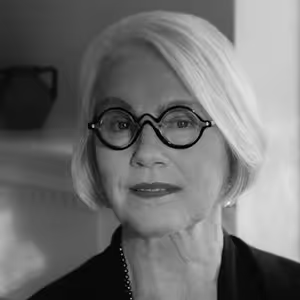
[.imgcaption][.smalltext]Photography by Live Media Publishing Group / Alamy Stock.[.smalltext][.imgcaption]
He was born in Schio, Italy, in 1995, and grew in a small town near Venice. Diagnosed at age two, he nevertheless had as ordinary a childhood as his parents could give him: he attended school, played with friends; later on, he got involved in a theater group. After his high-school graduation, as an adventure, he and his friend Riccardo did a classic road trip in the United States, heading west from Chicago to LA along Route 66. Along the way they stopped at the UFO museum in Roswell, and he pranked a woman there by pretending to be an alien: “I look a little like them,” he told a New York Times reporter.
A devout Catholic, he was also a scientist, graduating with a bachelor of science cum laude in 2018 and a master of science degree in molecular biology in 2021; he contributed to the study of progeria both as research subject and researcher.
He was an eager student, outgoing, moored by a fundamentally sunny nature, with many friends. Photos show him in fashionable Italian clothing and cool glasses, smiling and charming. And he was a perpetual advocate for people with disabilities and illnesses. Three thousand people attended his funeral. His life appears to have been guided more by temperament than disease. “I have lived my life happily,” he affirms in the letter to the world he wrote in anticipation of his death, to be read at his memorial service. “I have lived it as a simple man, with the moments of joy and the difficult moments, with the desire to do well, succeeding sometimes and sometimes failing miserably.”
[.article__paragraph--cap][.small-caps]Rare conditions are often called[.small-caps] orphan diseases, a poetic-sounding category suggesting their marooned existence and enigmatic origins. Those of us with orphan conditions – mine is called syndactyly, my hands and arms being unusually formed – defy the expectations of inheritance, betraying their birthrights. The physician-scientist Francis Collins, long the leader of the Human Genome Project, studied, befriended, and treated Sammy Basso. The more ordinary of us rare ones seldom merit vetted papers in scientific journals. The foreign characteristics that cluster in our bodies comprise the symptoms that express a syndrome, the general takeover of being that a minuscule genetic nip and tuck can yield. In the past, we would have been taken as prodigies, omens from the gods of favor or doom. Perhaps our perplexed parents would have considered us changelings, the faeries’ or gods’ cruel theft of their anticipated lovely baby. With the ascendance of modern science as the interpretive template for all human conditions, rare genetic syndromes sort us into patient communities, to be perceived and studied by professionals. Yet in truth, we belong to exotic tribes whose members few encounter. Orphan diseases at once liberate us from the tedium of normalcy and condemn us to the exhaustion of serving as the perpetually unfamiliar to our fellow humans who bear the characteristics of normality. Sammy Basso and I are cousins, however many times removed.[.article__paragraph--cap]
Those of us with rare genetic arrangements share the experience of never encountering another person shaped just like us. We may resemble immediate family members in our hair or eye color. Perhaps we bear some other familial features. Yet our unexpected features have sometimes gotten us trimmed from the family tree, denied and rejected. In Far from the Tree, the historian Andrew Solomon documents relationships between resemblance and belonging in families, offering a distinction between vertical and horizontal relatedness. Vertical genealogies trace relationships among ancestors and descendants along temporal lines across generations, the sociobiological concatenation of family genealogy. Horizontal relatedness links us to others who resemble us physiologically and whom we may never meet. Sammy Basso and I are horizontally related, shaped by unpredicted genetic resemblances to which our astonished parents did not contribute.
People with our types of disabilities are the unexpected made flesh. Despite our uncommonness, most of us rare people live ordinary lives, getting through our days and years with tedium and joy, like most everybody else. Sammy Basso never understood his genetic condition as an external adversary but rather as the given shape of his being, which he embraced as it was. Many of us with significant disabilities are similarly comfortable in our own bodies and the lives they yield, taking up what is given us with ardor and cheer.
Few of us who live with rare genetic conditions care to sustain the drama of Shakespeare’s furious, hunchbacked Richard III, raging at the fate of being so “rudely stamped.” Many of my friends and I have navigated the intrusive tedium of stares and interrogations about what happened to make us as we are. Those who require devices like white canes or wheelchairs can be fatigued by the attention we prompt. All of us with unusual shapes, gaits, or sensory habits carry the load of daily navigating a world not built with us in mind.
And yet our differences shape our lives in both mundane and noble ways. I knew a man so tormented by the unwanted attention his prosthetic arm drew that he sought harsh climates that demanded year-round long sleeves and bulky jackets. I also once met a man so burdened with his ordinariness that he covered himself from throat to wrist with intricate tattoos. Such an investment in repudiating the anonymity of what the sociologist Erving Goffman called “civil inattention” stunned me. We humans, it seems, can neither bear to be looked at or to be overlooked. Whether cheerful, grateful, or resentful, we are misfits all.
I have been able to gather up enough ordinariness to get through most awkward situations with grace and mutual face-saving. The challenges of living in a world that does not anticipate me, and was not built with me in mind, present occasions for resourcefulness and adaptability. Those among us who cannot find enough shelter in long sleeves, the right job, unusual brilliance, or social competence can remain constant outsiders. Most of us with disabilities that shape us differently from our ordinary fellow humans persist nonetheless. Our families and communities may grieve our forms for a while, but most of us are eventually, often quickly, embraced by the family and fellows tasked with our survival. Once we emerge and call on those around us to respond to and love us, we thrive in response to that recognition and the care it brings.
[.article__paragraph--cap][.small-caps]For the strangely shaped,[.small-caps] public life can be more difficult than family life. People with these genetic conditions – common ones such as Down syndrome or rarer ones such as my form of syndactyly – make up a capacious minority that our fellow humans accommodate through practices mandated by the laws that the civil right and human rights movements fought for. Yet now genetic medicine, prenatal testing, polygenic risk scores, selective testing of embryos, and other treatments and tests aimed at ensuring that babies entering into the human community meet the threshold of acceptable difference are the standards of care, the hallmarks of contemporary scientific medicine. While medical science can indeed improve our lives, we are all subject to a seldom-questioned eugenic regime that mostly clumsily attempts to identify human variations, and to purge the inherent uncertainty from human life. Current standards of genetic and reproductive medicine seem aimed at finding us out before we emerge into our shared community of distinctive, undeniably human, beings.[.article__paragraph--cap]
The alternative to this regime dedicated to rooting out those with genetic differences before they are born by diagnosing them prenatally is a social and material world that honors the legacy of the mid-twentieth-century civil and human rights movements. Along with laws addressing racial and gender inequalities, laws such as the 1990 Americans with Disabilities Act have created policy, regulations, and practices for more just treatment of those with physical and other disabilities. One of the fundamental premises of disability politics is that social justice and equal access should be achieved by changing the shape of the world, not changing the shape of our bodies. Certainly, medical treatment and technology contribute to human flourishing and should be made available equally to all persons: where braces or prosthetics or surgical correction can help, by all means let them be employed. But a capacious justice calls for strengthening the accessibility infrastructure of the built and designed world rather than relying exclusively on medical normalization procedures that may not contribute significantly to our opportunities for making good lives.
That people like Sammy Basso, me, and many of my friends can make good lives is in part possible because the Civil Rights Act of 1964 clarified the fact that under the Constitution there are no tiers of citizenship: every citizen is due full rights and obligations. This clarification paved the way for the Americans with Disabilities Act of 1990. This restructuring of the institutional, legal, and built environment created an identity category called disabled and a protected group called people with disabilities. Like any identity category, disabled endows its bearer with both benefits and harms. Accessible designs can conflict with their users’ varied needs, fail in their promises, or demand expensive and elaborate resources. Yet membership in that sociopolitical community moved us out of the clinics and into the public square – sometimes quite literally. Our newly accessible built world ranges from the humble curb cut to smart prosthetics, inclusive design, and adaptive technologies that make it possible for people with disabilities to participate fully in public life and flourish in our communities.
[.article__paragraph--cap][.small-caps]Sammy Basso’s presence in our world[.small-caps] presents us with an opportunity to consider moral issues as well as the social and ethical questions presented here so far. What does it mean to be made in the image of the invisible God? What does it mean to be created equal, when we are so varied? Any of us born looking or functioning differently confronts such questions daily. We live out the entanglement of ordinary and different – converging and conflicting that affects everyone but may be writ large when simple tasks must be navigated with forethought and planning.[.article__paragraph--cap]
Surely, we share enough similarity across the wide spectrum of human variation to prompt the mutual recognition and reciprocity on which our survival depends. Naturally, we all learn to distinguish between grandmothers and villians, and to sniff out our prospects in everyday life beyond the safe familial nest. Appearance deeply influences how we perceive others. Those who do not look alike may not be treated alike: that is apparently the human way. But philosophers of hospitality suggest other possibilities. Our obligation to one another is to welcome the unbidden.
Perhaps our biologically rare human fellows press us most fully to consider what it means to have a life worth living. Is it worthwhile to be someone like Sammy Basso, someone whose life is circumscribed by the limitations of the flesh, “fastened to a dying animal,” as William Butler Yeats has it in his poem “Sailing to Byzantium”? But of course that condition is true of us all. We are all going to die. The very rare among us wear our mortality on our sleeves, forewarning our able-bodied peers. But then again, so do the very old: aging itself stamps the ablest of bodies with the marks of this inevitable transition.
The philosopher Thomas Nagel prods us to recognize the limits of our subjectivity by asking, “What is it like to be a bat?” His point is that we do not, cannot, know. But we do know what it is like to be a human. And we can recognize the human image in each other, even in those whose forms differ widely from ours and from the human norm. Saint Augustine held that that human image, the one that we share, is in fact the image of God.
In what essential ways are we all similar? What does it mean to be made in the image of God if the bodies that house our spirits differ so radically from one another? The “outsider status” that disability confers, writes the disabled author Nancy Mairs, “and not the disability itself, constitutes the most daunting barrier for most people with physical impairments, because it, even more than flights of steps or elevators without Braille, prevents them from participating fully in the ordinary world, where most of life’s satisfactions dwell.” Can the image of God, whatever it is, be strong enough to reach across the chasm of our differences to gather us into a community of fellows?
The Victorian imagination, with its appreciation for the ornate over the spare, the intricate over the minimal, suggests a way to honor the genetically rare among us. Gerard Manley Hopkins found moral significance in the intricate design of the given world. Hopkins’s sonnet “Pied Beauty” celebrates the world’s great, spotty unevenness: “Glory be to God for dappled things.” The lush imagery and effusive materiality of the poem offer a wondrously contradictory fusion of the sensuous and ascetic. At once frugal and lavish, the poem honors “all things counter, original, spare, strange,” testimonies to the vast, even whimsical, creativity of a God who delights in departing from a weary usual. Hopkins’s God sends prodigies among us, living riddles for us to interpret. Hopkins calls us to be awestruck witnesses of human diversity. Those of us who emerge from the womb strangely formed could be, for someone with vision like that of Hopkins, the heralds of God’s wondrous, gorgeous whimsy.
Hopkins’s testimony of glory of “dappled things” is itself a crazy quilt of alliteration: “fickle, freckled, swift, slow; sweet, sour, adazzle, dim.” Those of us unusually shaped might find affirmation in Hopkins’s delight in what is asymmetrical, unorthodox, oddly proportioned, misfashioned. Our aesthetic is Baroque intricacy or Victorian complexity, not streamlined modernism. Hopkins’s wonder recasts Sammy Basso and me and my friends – dappled by genetic whimsy – into occasions for celebration rather than anguish, abandonment, or hasty normalization. The marvel of our existence and the inexplicable embrace extended to us by the many to whom we belong affirms Hopkins’s ethic of welcome. Nancy Mairs’s bold claim of belonging brings us into the human community by calling on us all “to conceptualize not merely a habitable body but a habitable world: a world that wants me in it.”