Interview
The Church in China Isn’t What You Think
A scholar of Chinese Christianity dispels some common myths.
March 25, 2026
Try 3 months of unlimited access. Start your FREE TRIAL today. Cancel anytime.
START FREE TRIAL NOW
[.article__paragraph--leading]Plough editor Joy Marie Clarkson sat down with Dr. Easten Law of South Korea’s Yonsei University to discuss his research on today’s church in China.[.article__paragraph--leading]
Plough: Tell us about your research.
Easten Law: My research focuses on Christianity in contemporary China, and there’s a very personal reason behind that. I am a second-generation Chinese American, born and raised in the United States. Though I spent many summers in Taiwan, it wasn’t till college that my father took me to the People’s Republic of China (PRC) for the first time, to further expand my cultural identity. After graduating, I spent some time in China teaching, worshiping at unregistered churches – often called house churches – as well as registered churches approved by the government. Experiencing worship and life in these churches raised many questions about what faith and religious life mean in a very different context.
I began my PhD studies with a simple question: How do young adult Chinese Christians practice their faith? That question grew into a broader one about how Chinese Christians negotiate their faith across cultures and borders. I’m eager to explore what the diversity of Chinese Christianity means for Chinese theology and the Chinese church.
Can you give us a beginner’s history of the church in the People’s Republic of China and how these churches are organized and perceived today?
The Chinese Communist Party (CCP) took control of the country in 1949. At first, the government didn’t try to eliminate religion, but aimed to integrate it and create religious institutions that supported their broader communist goals. They established an ecclesial polity called the “Three-Self Patriotic Movement.” “Three-Self” is an aspirational name that signifies a church that is self-governing, self-supporting, and self-propagating. In other words, a church that is free of foreign interference and, thereby, patriotically aligned with the vision of the Chinese government.
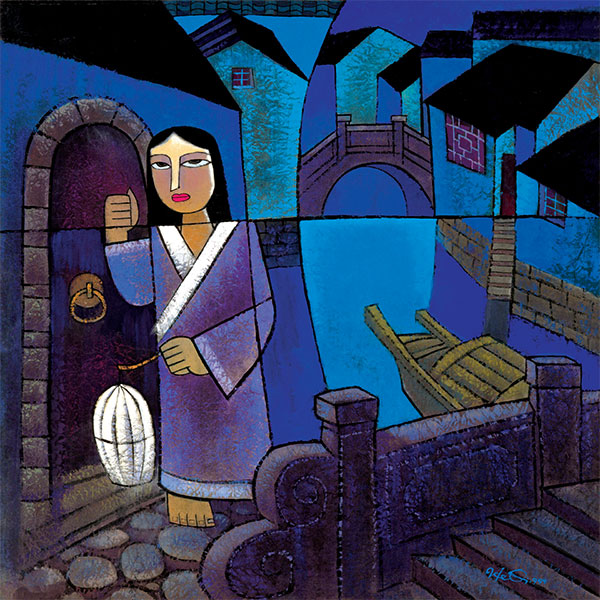
[.imgcaption]James Qi He, Knocking at the Door, Chinese ink on Korean paper, 1999. [.smalltext]All artwork by James Qi He. Used by permission.[.smalltext][.imgcaption]
Of course, many churches refused to register with the Three-Self Church. They became what we now call unregistered or house churches. Generally, churches in China fall into one of two categories: registered or unregistered.
When the CCP decided to create a registered church, they tried to eliminate Western connections: the idea was to establish a Chinese church, not a church rooted in England or Germany or Rome. This is why the Three-Self Church refers to itself as “post-denominational.” However, at the local level, many registered churches are aware of their denominational history. For example, they might know that before the establishment of the PRC, their congregation was Methodist.
The common view in China is that Roman Catholicism and Protestant Christianity are two separate religions because Protestant and Catholic missionaries didn’t get along. As a result, Catholics have their own government-registered organization that is different from the Protestants’.
What are some Western misconceptions about the Chinese church?
One is that the Chinese church is constantly persecuted. When people have this impression, they’re actually thinking about different periods in modern China’s history – the original effort was to consolidate rather than to persecute.
But many churches refused to comply with the Communist Party. Once you reach the Cultural Revolution around the 1970s, you see the Party shift toward trying to eliminate religion. By then, it didn’t matter if a church was registered or not; they sought to end religion altogether. It was a particularly intense and significant moment.
[.pull-quote]There’s an abiding myth that registered churches are just tools of the Communist Party, that they do whatever it demands. I want to clarify that this isn’t true.[.pull-quote]
Interestingly, during the later period of economic reform in the 1980s, when China opened itself to the world, a sense of religious revival also emerged; the party loosened its grip and allowed churches to rebuild. The registered church was rebuilt, and house churches were more public than ever before. Sure, they didn’t own buildings or have signs that said “there’s a church here,” but the government was very open to them continuing to meet.
Even unregistered churches would rent out entire floors of office buildings or hotels, and many nonregistered Christians would gather to worship, while the government turned a blind eye. There was a social understanding that if you kept to yourself and contributed positively to society, it was acceptable. During the 2000s through 2010s, these unregistered house churches became quite visible. They opened Christian bookstores, operated nonprofits to serve communities, and started elder-care centers. Local governments appreciated this because there was a shared belief that churches helped maintain social harmony.
But by 2013, when Xi Jinping stepped into power, we began to see that tightening again. Many unregistered churches are now feeling increased pressure. Not to the same extremes as during the Cultural Revolution, but churches are being shut down, and leaders are being arrested.
Is there a consensus about whether the church is growing? Or how big it is?
The short answer to your question is no; it’s impossible to get an exact number. The official government figures tend to be on the low side; higher estimates suggest around 10 percent of the population is Christian. However, based on my research, I would lean toward a figure in the middle, roughly 5 percent.
Both demographers and scholars of Chinese Christianity currently believe growth is beginning to level off. After China opened up in the nineties and its economy started to flourish, people became wealthier. Along with this, there was a yearning for spiritual fulfillment because the economic boom led to a wild west of trade and capitalism, making morals seem lax, and people sought a spiritual center. During this period, Christianity experienced a significant surge. Interestingly, it’s not just Christianity that grew; people revisited Buddhism, Daoism, and a variety of other spiritualities to find stability. But now we’re seeing a slight flattening in religious growth.
How has the Chinese government responded to Christianity’s growth and this return to religions more broadly?
In response to this return to faith and spirituality, the government has launched a campaign to “Sinicize” religions, to adapt faith traditions to Chinese culture. This is somewhat absurd in some cases: how can you make Daoism, an indigenous Chinese tradition, more Chinese than it already is? When the government talks about Sinicizing religion, they mean making it more communist or socialist. It’s as if they decided, “We’ve allowed religion to flourish, but now it’s time to bring it back in line.” While unregistered churches face traditional persecution – leaders being arrested; churches shut down – registered churches must theologize very carefully, often in dialogue with, and sometimes in strict submission to, what the Party dictates Christian theology should be.
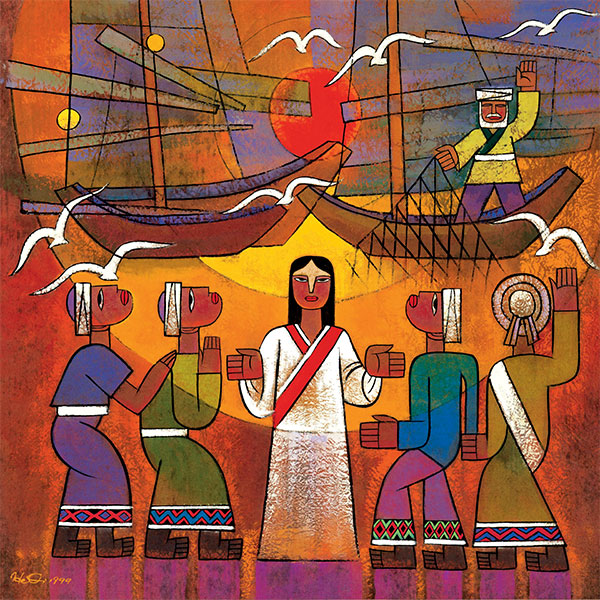
[.imgcaption]James Qi He, Calling Disciples, Chinese ink on Korean paper, 1999. [.imgcaption]
The registered church has always played this game. There’s an abiding myth that registered churches are just tools of the Communist Party, that they do whatever it demands. I want to clarify that this isn’t true. Many in the registered churches are genuine Christians. They simply have a different perspective on church and state, and they choose to navigate this relationship with the Party. They will sign the necessary documents. They will give speeches, such as on the Sinicization of Christianity. But they also take care of their congregations and try to help people walk in faith. Their approach to negotiation with this tightening control is different from that of house churches, which are resisting, hiding, and moving around.
Are there breaking points at which registered churches won’t be able to continue submitting to the Party?
I’m confident that some church leaders are very frustrated, but the reality is that you won’t hear this publicly expressed. It’s simply not possible. China has developed a security system, especially since Covid, that rivals the best in the world. They use surveillance on a level that many countries cannot match. Today, there are cameras everywhere in China, along with facial recognition technology. During Covid, they introduced systems that allowed them to track your location via your phone. This technology has significantly strengthened China’s control over free speech during the past decade. Chinese Christians are very aware that what they say or think could be used against them at any time. It’s a very challenging time for freedom of speech for everyone in the country.
How can a Christian in the West help or pray for the Chinese church?
The good news is that with every wave of tightening or persecution, the Chinese church has learned to adapt and grow in faith – so much so that they don’t rely on the West. They don’t need outside churches to support their spiritual lives; they’ve found ways to support and grow with each other. I would say that one hears about a need for theological education. There’s always a sense that Chinese churches need to train more pastors and teachers.
The Chinese continue to be influential global players in many areas, from building physical infrastructure, where Chinese workers are employed on construction sites worldwide, to education, with students attending top schools. For instance, in the United Kingdom, there are many Chinese residents, especially following events in Hong Kong over the past few years.
One of the best things churches around the world can do, as China globalizes, is to be a witness through their hospitality to Chinese expats and migrants, whether they’re elite Chinese studying or laborers working on highways, and regardless of the political dynamics between their nations. That’s the way to create strong global relationships. The Chinese people are dynamic, negotiating all kinds of questions about faith and spirituality and power – the Chinese people are not the Chinese government. If the church in other parts of the world can truly be hospitable and welcoming, it will mean building relationships with the Chinese people.
How has this sense of the global Chinese church shaped your faith?
When I look at the diversity of Chinese churches around the world, I think about how the Holy Spirit sanctifies us in many ways, including migration and awareness of migration for those who may not experience it directly. Even for someone born and raised in South West England, or someone in the American Midwest, if you go back a few generations, your family did move. We’ve all moved at some point. That awareness of how God is present to us wherever we are – individually and as families, across multiple generations – feels deeply biblical and very formative. I try to embrace this spirituality of migration, the idea that God has been faithful to me and my family across generations and through movement. Through this lens, I find that the whole Bible makes more sense to me.
You can look at the migrations in Genesis, in the books of the prophets, the migration of the church in the New Testament. God is present with those who are moving, and it’s in the moving that we draw closer to God. It’s in the moving that we become more Christlike. This has helped me develop what I call a migratory consciousness. We talk about historical consciousness – migratory consciousness is a part of that, I suppose. Knowing that we have all been migrants, if not physically, then spiritually and emotionally, just moving through seasons of life. And that’s how God shapes us, right? The more we become aware of it, the deeper the Spirit can work in us.
[.smalltext]This interview was conducted on November 18, 2025, and has been edited for length and clarity.[.smalltext]
[.smalltext]About the artist: James Qi He grew up during the Cultural Revolution in China. As a young man, having taken some art lessons, he began painting portraits of Mao Zedong in order to avoid field labor. One day he saw Rafael’s painting of Madonna and Child in an old art magazine. He was drawn immediately to the peace of the scene, and this led to his interest in Christianity. He studied medieval art at the Hamburg Art Institute in Germany and then went on to receive his doctorate in Religious Art from the Nanjing Art Institute in 1992. His particular interest is in depicting biblical stories from a culturally Chinese perspective. His work is a unique blend of medieval European artistic influences and Chinese folk art.[.smalltext]