Essay
Blaise Pascal’s Night of Fire
What’s the difference between a cultural Christian and an actual believer? The great French philosopher's conversion shows us how to distinguish.
March 28, 2026
Try 3 months of unlimited access. Start your FREE TRIAL today. Cancel anytime.
START FREE TRIAL NOW
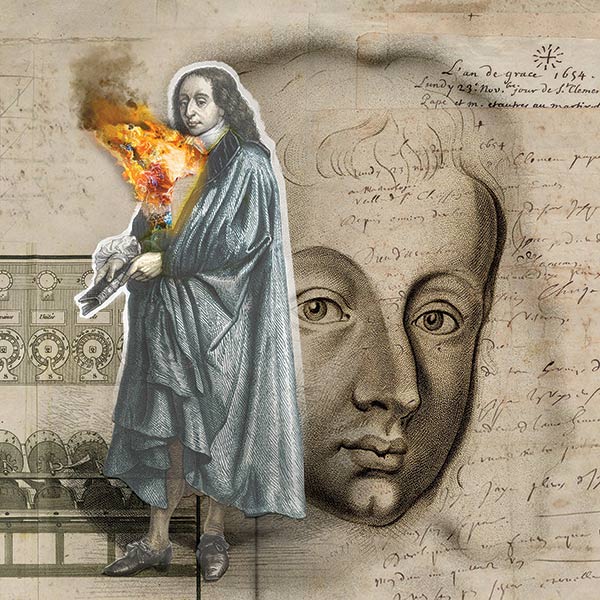
On a cold November night in 1654, a young Frenchman, well known in fashionable circles for his scientific experiments and mathematical genius, sat down to pray in his small apartment in Paris. What happened next surprised him. For about two hours, he had an extraordinary experience of the presence of God, which turned his life around and set him on a new trajectory.
The man was Blaise Pascal. He told no one of this experience, but wrote an account of it which he hid in the lining of his jacket. It was found by chance by a servant preparing his body for burial when he died eight years later. The document became known as the Mémorial and the event as Pascal’s “Night of Fire.”
The term “cultural Christianity” has become prominent recently, notably when the public atheist Richard Dawkins described himself as a “cultural Christian.” He claims to enjoy Christmas carols and church architecture, despite not believing a word of Christian doctrine – recognizing, as he put it, “a distinction between being a believing Christian and being a cultural Christian.”
Before his Night of Fire, Pascal was by no means an atheist like Dawkins, or even a mere cultural Christian. He had a faith, yet it did not penetrate to the core of his soul in the way it did afterward. Looking again at the text of the Mémorial can help us navigate what Christianity might look like in a world after religion: cultural Christianity may be a starting point, a good thing in itself, but must not be confused with real, personal Christian faith. So, in a Western world where Christians have become a minority, what is the difference between what Dawkins calls a cultural Christian and a believing Christian?
The first thing apparent in Pascal’s new intensity of faith is an instinct to pray. His description of his experience begins:
“God of Abraham, God of Isaac,
God of Jacob”—
not of philosophers and scholars.
Certainty, certainty, heartfelt, joy, peace.
God of Jesus Christ.
My God and your God.
The whole account is in the form of a prayer. Pascal’s is an encounter, not with the God of the philosophers, the divine architect of the universe, a God at the end of a logical argument, but the God of Jesus Christ, who, as C. S. Lewis once put it, is “alive, pulling at the other end of the cord, approaching at an infinite speed, the hunter, king, husband.”
Pascal can do nothing other than worship this God who brings him “joy, joy, joy, tears of joy.” His theological mentor was the great Saint Augustine, who taught that faith begins when God’s grace kindles a desire for him within the hearts of human beings, and this is exactly what Pascal experienced. It led him to a life marked till its end by regular patterns of worship and prayer.
One of the crucial differences between the cultural Christian and a believing Christian is the development of the discipline and habit of prayer. A cultural Christian might admire Christian values and ethics, even argue for them in political life, but does not feel the need to embark on the highly personal business of prayer.
Pascal’s Night of Fire was over within two hours. It didn’t last – such experiences never can. Yet he carried the memory of it close to his heart, allowing it to shape his priorities, his use of time, the focus of his attention. For the rest of his days he reoriented himself not so much around his scientific and mathematical explorations but around a life of spiritual devotion. He continued with his scientific work, but it became less central to his identity. Pascal was aware that his scholarship held within it the temptation to pride and the desire for praise, with the spiritual dangers inherent there. Now his focus was on worship.
Such experiences happen to some Christians but not all. I’m not sure I have experienced anything similar, and many Christians I know would say the same. Yet there is another part of Pascal’s encounter that is a mark of all true Christian experience: Pascal describes experiencing his own shame. “I have cut myself off from him, shunned him, denied him, crucified him.”
Amidst the ecstasy of encountering divine love comes this profound sense of inadequacy, of ignominy – not to put too fine a point on it, of sin. Pascal is aware of the abyss within his own soul, the shallowness of his life, the way he has ignored the God on whom his life depends, and how he has wasted God’s gifts.
Some time ago I listened to a conversation between Richard Dawkins and Ayaan Hirsi Ali, a former Muslim fundamentalist turned hardcore atheist. She had recently announced her conversion to Christianity. Dawkins assumed that her conversion was to a genteel cultural Christianity like his, but as she told her story it gradually dawned on him that something deeper had taken place. Hirsi Ali described an episode of prolonged suicidal depression, which no psychological treatment or scientific reasoning had helped. A therapist diagnosed her problem not as mental or physical but spiritual, suggesting she might even try praying. When she did, she began, mysteriously, to encounter the same God that Pascal had.
Dawkins was incredulous that Hirsi Ali had started to believe ridiculous things like the Incarnation, the Virgin Birth, and the Resurrection. Reluctantly, he had to admit that it sounded like she was a proper Christian. The nub of the issue for Dawkins was his objection to the idea of sin. It was, he said, “obvious nonsense…. The idea that humanity is born in sin, and has to be cured of sin by Jesus being crucified … is a morally very unpleasant idea.
Of course it’s unpleasant. Crucifixions were. From the perspective of those who have no sense whatsoever that they need saving, it is distasteful, embarrassing, not the kind of thing that you bring up in Oxford Senior Common Rooms. I too find unpleasant the notion that I am sinful, stubborn, deeply flawed, in desperate need of forgiveness and healing. I would much rather think I am fine as I am. Yet there are many things that are unpleasant but necessary. Like surgery. Or changing dirty diapers. Or having to admit addiction.
And that was ultimately the difference between Dawkins and Hirsi Ali. They were each as clever as the other; they had both read the same books; they knew the same people. Yet Hirsi Ali, like Pascal, had been to a place where she knew she needed help, a help that no human being could provide, whereas Dawkins, it seems, had not.
This is the second factor that marks out real from cultural Christianity. The cultural Christian has little sense of having a spiritual sickness that needs healing, has not looked into the abyss, or owned his part in the darkness of humanity, and has no notion of needing any kind of salvation. True faith involves a searing honesty about the despair that lurks in our own hearts, the self-centeredness that plagues our lives, our society, and our politics. It knows we cannot solve it ourselves.
An immediate outcome of Pascal’s Night of Fire was a new project, which took on a greater significance than his scientific or mathematical work. At the time, as a celebrated figure in Parisian intellectual life, he was surrounded by sophisticated people interested in gambling, hunting, games of tennis, impressing everyone with their witty conversation – nominal Catholics and cultural Christians who, when it got down to it, found God boring. Pascal immediately began to think about how he might persuade them they would find true happiness not in their trivial entertainments but in God himself.
So he started to write what he intended as a great apology for the Christian faith, addressed to these skeptical friends of his, scribbling down ideas that came to him from time to time. Some were just a line, some a few paragraphs, some like longer essays. He never finished his apology. When he died aged just thirty-nine, his friends found the notes he had left behind, eventually publishing them as his “thoughts” – Pascal’s Pensées.
[.pull-quote]True faith involves a searing honesty about the despair that lurks in our own hearts.[.pull-quote]
This desire that others find faith is a third mark of true Christian belief. Lesslie Newbigin, the great scholar of missions, who encountered Western culture afresh when he returned in the 1970s from decades of missionary service in India, used to say that “mission is the test of our faith.” How can you tell whether someone really believes that Christ is the unique son of God, that he died for the sins of the world, that he rose again as a foretaste of the new creation to which the entire world is headed? The crucial test is a willingness to make that belief public. Speaking of the gospel, Newbigin wrote: “We believe that these events are the real clue to the story of every person, for every human life is part of the whole human story and cannot be understood apart from that story. It follows that the test of our real belief is our readiness to share it with all peoples.”
The cultural Christian might see evangelism as a kind of cultural imperialism and shy away from any attempt to share the faith with others. Yet the deeper faith goes into our hearts, the more profound our experience of both joy and shame: the unique combination that the gospel brings to human experience. The more we believe Christianity to be true, the more we will desire that others discover it. Of course, this doesn’t mean that all true Christians are rabid evangelists or apologists, or disrespectful of the wisdom found within other faith traditions; they simply desire that others discover what they have, and they seek sensitively to use whatever gifts they have to commend that faith in public.
The other major impact of the Night of Fire was its inspiration of Pascal’s new desire to serve and to share his life sacrificially with the poor. He began to give away many of his possessions, to live a simpler life, even taking a homeless family into his apartment. He expressed a desire to die among the poor because they were the ones with whom Christ spent his time. “I love poverty because [Christ] loved it,” he wrote. “I love wealth because it affords me the means of helping the needy.” It led him to use his entrepreneurial ingenuity to come up with the first urban public transportation system in Europe, a fleet of coaches envisioned specifically to enable poor people to travel the greater distances required in the expanding city of Paris, at minimal cost.
Alan Kreider’s book The Patient Ferment of the Early Church describes “the improbable rise of Christianity in the Roman Empire.” Kreider shows that for the early Christians, care for the poor was one of the key tests of true faith. Before being baptized, catechumens were asked about their use of money and whether they could show evidence of having supported the poor, especially among the Christian community. One of the factors that marked out Christians from others in the late empire was their willingness to visit the sick and give to the poor in a society where gifts were usually calibrated to win favor and advantage.
[.pull-quote]An instinct to pray, a deep sense of sin, a desire to share the treasure of faith, and sacrificial involvement in the lives of the poor are clear signs of authentic Christian life.[.pull-quote]
Of course, as Tom Holland’s book Dominion has pointed out, the early Christian belief in care for the poor, because each person is made in God’s image, has become secularized by now into a general belief in charitable action, even if the Christian grounding for it has been forgotten. Yet the example of the early Christians, and of Pascal, shows that a mark of true faith is not only financial generosity to the poor but the willingness to build relationships with them. It is a willingness to sacrifice your own wealth or time in a way that sees the purpose of life not as pleasure or consumption but as love. Today, the problem is not so much that the rich don’t give to the poor, but that the rich don’t know the poor. True Christian faith costs. It means involvement in the life of those who struggle at the tough end of an unequal society.
Pascal’s Night of Fire and its impact help us discern what marks out the life of a believing Christian, especially in a post-Christian world. An instinct to pray, a deep sense of sin, a desire for others to discover and share the treasure of faith, and sacrificial involvement in the lives of the poor are clear signs of authentic Christian faith and life.