Lives
The Magnanimity of Dovie Eisner
My friend Dovie proclaimed the value of his own life.
December 15, 2026
Try 3 months of unlimited access. Start your FREE TRIAL today. Cancel anytime.
START FREE TRIAL NOWThe Magnanimity of Dovie Eisner
My friend Dovie proclaimed the value of his own life.
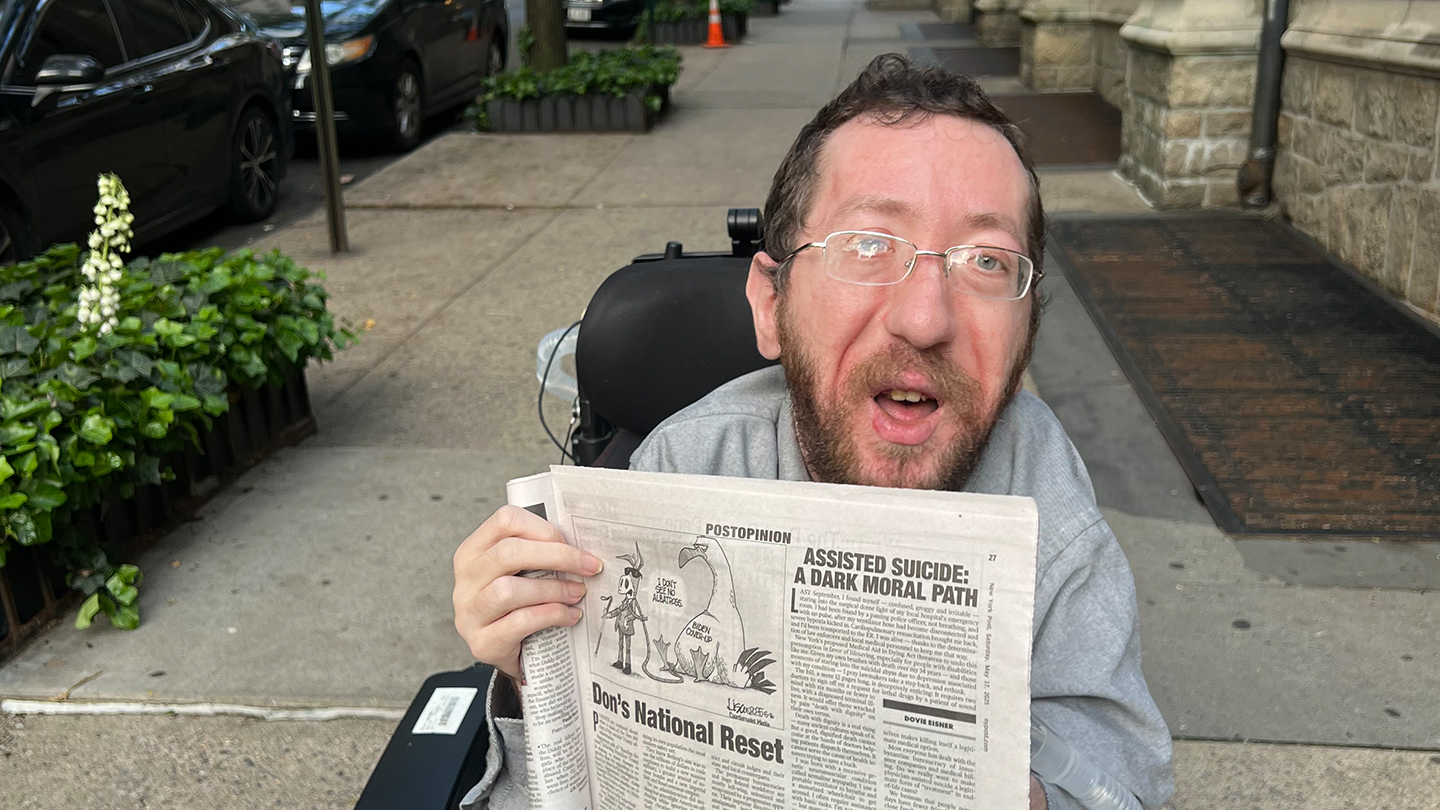
[.article__paragraph--cap][.small-caps]On September 11,[.small-caps] 2026, my friend Dovie Eisner died. He had been in a coma for about a year and a half, after the breathing tube on which he depended was accidentally dislodged.[.article__paragraph--cap]
Dovie was born with a progressive genetic disorder called nemaline myopathy. It meant that he was physically very small and weak, was unable to walk, and had very little muscle tone. By the end of his life, he couldn’t eat, though he could still drink. (He was a huge fan of Woodford Reserve bourbon.)
I first met Dovie at, I think, a movie night – the film was Silence, Dovie’s choice, the 2016 movie based on Shūsaku Endō’s novel of the same name, about Jesuit missionaries in Japan whose faith is tested beyond what can be borne. I was so disturbed by it that I had to leave before the end. I’m not sure where or how I put it together that the guy in the wheelchair was my Twitter buddy with the Teddy Roosevelt avatar (he who had overcome childhood weakness by his commitment to the strenuous life), but one way or another, in the group chats, at miscellaneous theology events, and at his favorite bar in Brooklyn, we became close friends.
He was Jewish, born to a very observant, very loving family – I only met his mother and father after the beginning of his coma, running into them in his hospital room. They were absurdly cheerful, happy to meet their son’s friends, perhaps a little confused by what became a stream of visitors who said they knew him from Twitter, from his writing, from various conferences.
Dovie had converted to Catholicism in 2022, and was typical of an adult convert, that is, slightly “cage stage”: impassioned, very devout, and wildly well-read in his faith. He spent his days writing, reading, messaging and talking on the phone, and swanning around, with the help of Access-a-Ride, to events. I have lost track of the number of people who have said he would talk them through their problems, their theology stresses, their prayer needs, their bad political opinions (he had some bad political opinions of his own). He was a massive extrovert and was massively driven to make a good impact. And he did. I have no idea where he found the time.
On May 16, 2025, he had a byline in the New York Post: a piece opposing New York’s law allowing Medical Assistance in Dying (MAID), which he regarded as a legal development that devalued the lives of people like himself, and tempted the culture toward belief that the disabled or weak might be better off given a tidy death. He texted it to me. He was irritated that the Post had cut a paragraph about his Judaism and his Catholic conversion, a section which had been in the original version of the piece when it was published in the online magazine UnHerd. He sent me that paragraph. It read as follows:
Death with dignity is a real thing – many ancient cultures speak of it. In the Jewish religion in which I was raised, a good death is considered a kiss from God. Dying well is likewise an art in the Catholic faith I adopted as an adult. But a good, dignified death cannot come at the hands of doctors helping patients dispatch themselves. It cannot serve the cause of health insurers trying to save a buck. Still, any opponent of the legalization of physician-assisted suicide has to grapple with the fact that the demand for it is there for a reason.
His anti-MAID activism was, we all thought, just beginning. His piece powerfully claimed the value of his own life. He wrote in the sure and certain hope of the resurrection of the dead. And he wanted to live: he wanted to live as much and as long as possible. That same day, he also sent me and another friend a video tutorial about what to do if his breathing tube was dislodged while we were together. It had happened before; he was worried that it would happen again. The next day, it did. The person he was with knew the protocol and reinserted it, but it had been out for too long. He slipped into a coma.
Dovie’s gallantry, his brilliance, his snark, his faith, and his friendship were infectious and delightful. He held court at the center of a network of friends that represented the best of Jewish and Catholic humanism. He was tender and tough and, refusing to be self-conscious about his disability or regard himself as anything other than an ordinary man, he was a witness to what it means to live as one made in the image of God. (Without – usually – being an asshole, he also managed to somehow pack the spirit of Alexander the Great into the body of a profoundly disabled millennial.)
There is a word that we reach for when describing someone whose soul is large, who expects a great deal of himself and thinks he is due a great deal, who enlarges everyone around him. That word is magnanimous. Dovie Eisner was a magnanimous man.