Monday Provocation
Choosing a Life with More Friction
I spend weekends in the U-Pull-It yard salvaging parts to keep my aging vehicles running. It’s a deliberate choice, and not for convenience.
November 16, 2026
Try 3 months of unlimited access. Start your FREE TRIAL today. Cancel anytime.
START FREE TRIAL NOWChoosing a Life with More Friction
I spend weekends in the U-Pull-It yard salvaging parts to keep my aging vehicles running. It’s a deliberate choice, and not for convenience.
[.smalltext]Photographs courtesy of Brandon Daily.[.smalltext]
[.article__paragraph--cap][.small-caps]Walking into a dealership[.small-caps] to buy a new car is a familiar experience for many. The well-lit, open spaces. The brand-new, shiny cars staged on the floor that make you wonder, “How did they get this car in here anyway?” The fresh scents that give the impression that they originated from an aerosol can, not a Swiss meadow.[.article__paragraph--cap]
The salesman offers you a complimentary latte from a machine with a touchscreen larger than an iPad and invites you to check out the newest features on their medium-duty pickup with a sticker price double that of your first home.
“This one here has the new XYZ package, which is definitely a step up from the base model,” he recounts, as if they don’t both have four wheels and share 90 percent of functionality. $15K upgrade. At least the wheels are chrome, I guess.
He shows you all the new features for the year, including parallel park assist, auto braking, and a tailgate that unfolds like a transformer. “And look! You can operate it with the key fob from fifty feet away!” he exclaims.
You settle into his cubicle while you sign more documents than the Treaty of Versailles. Agreed price (he knocked $200 off of sticker because it’s Tuesday), lending docs (they say an eight-year loan is the new four-year), trade-in agreement (I mean, you did need new brakes and rotors anyway, it wasn’t that bad of a deal), all the warranty agreements (the truck does have thirty different computer modules – you wouldn’t want to have to pay for that if one blows. He assures you it’s a reliable vehicle and such issues aren’t common – but still better get it. Just in case). And finally, the technology agreement (so it can update itself over the airwaves. Oh, and it also might have a camera inside the cab. Maybe? No, probably not yours, just some models – but everyone has to sign it – just sign it!).
You drive the car home with the AC blasting. Your phone is already connected, and you figure out the touch controls (strange that you can work a ten-inch touchscreen mounted to the dash, but it’s illegal to hold your phone). The steering wheel jerks a little as you get too close to the white line: not because of a seized caliper or bad tie-rod, but thanks to sensors and motors connected to the steering shaft. You park it in your driveway. Your buddy comes over and stares at his reflection in the high gloss paint. “Woah. Cool truck, man.” You show him some of the features, not because you’ve had any time to use them, but because you’ve already memorized the salesman pitch which oddly resembles a The Price is Right showcase or an airline stewardess recounting safety information.
Your buddy leaves and you go inside your house. While glancing out of the window, you see you left the tailgate down. You use your key fob to close it remotely. You sit down in your recliner after the long day. A little something in you dies.
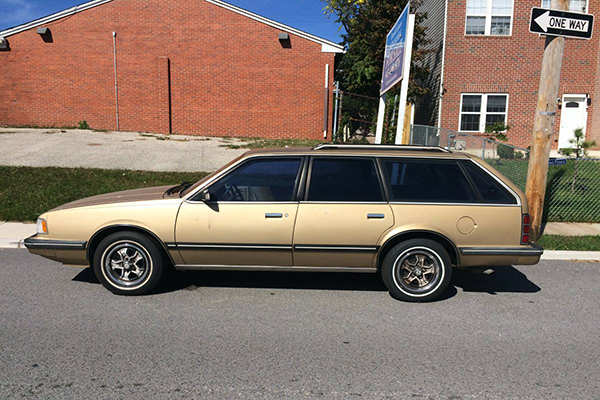
[.article__paragraph--cap][.small-caps]My dad and I[.small-caps] have been slowly rebuilding a 1986 Chevy Celebrity wagon. The kind with the flip up seat in the back that faces the opposite way. This is the third version of this car I have owned (all wagons, which should have been a sign long before I converted that I was destined to be Catholic).[.article__paragraph--cap]
This particular car I picked up in Baltimore off a kid who had just driven it from Southern California, where it had been its whole life until that summer when he crossed the country to move in with his brother. When I bought the car for five hundred dollars (the head gasket had blown at the very end of his trip), he asked me if he could keep the rear license plate, which had thirty years of registration stickers on the corner that stuck out a quarter inch. “Sure man. No problem.” Currently, after years of picking at it in our non-free time, it is nearing completion. It is halfway through a new paint job, the transmission has been rebuilt, the engine has been overhauled, and the seats have been recovered. I don’t know who in their right mind builds a 1986 Celebrity show car but – well, here we are.
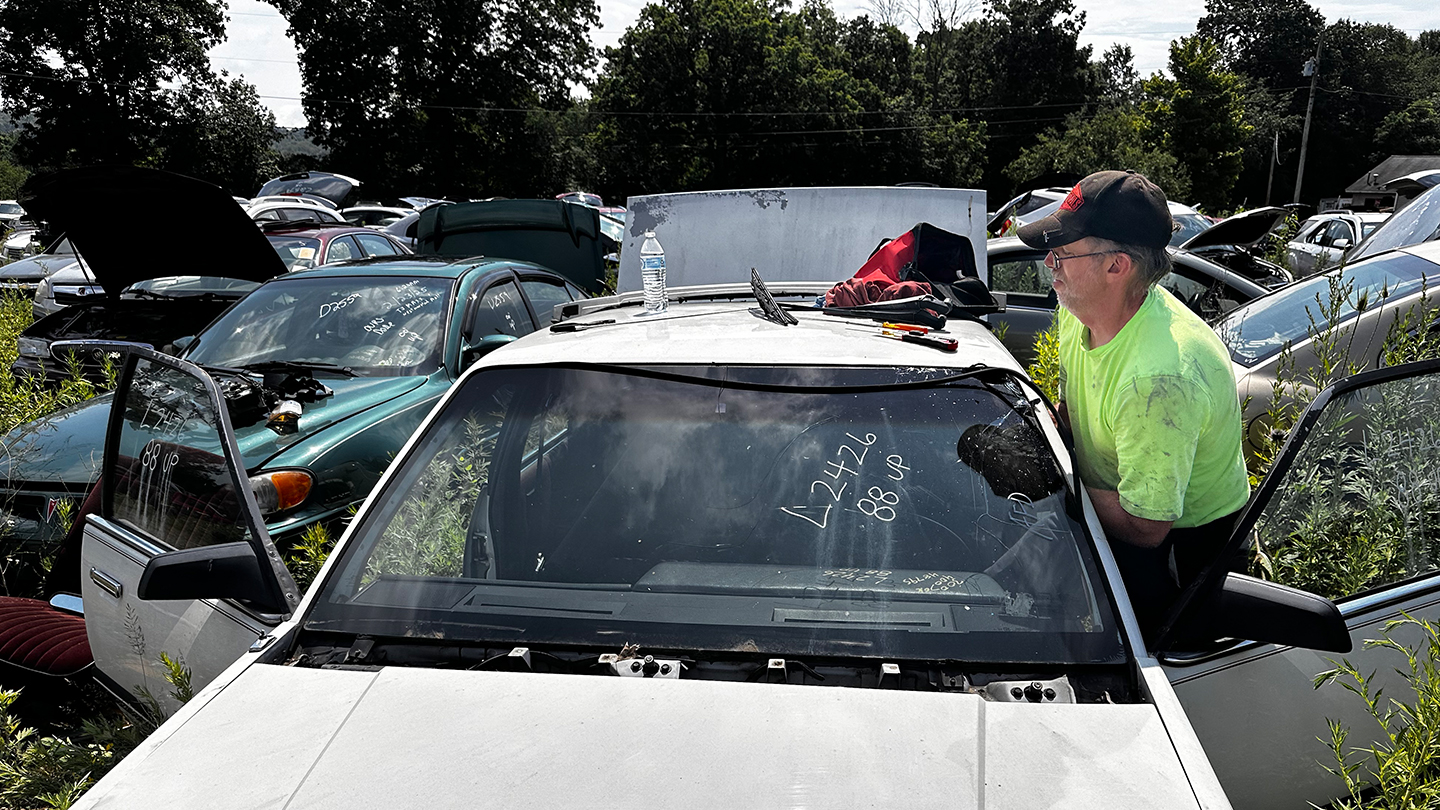
We had to find a new front seat for this car (a bench seat, by the way), so we went to our local U-Pull-It yard. If you’ve never been to a U-Pull-It yard, it’s all in the name: there are rows and rows of parked cars in various conditions and you are allowed to fetch parts off of them but you have to pull it.
If the dealership is overly-lit and dust-free, the U-Pull-It yard is the exact opposite. The front door rubs a little on the cement pad, requiring some effort to pull open, and we find ourselves staring at countless jumper cables, random scissor jacks, and racks of used tires scribbled on with chalk. We walk up to a teller window. Through the haze of smoke, we can barely see the guy behind the glass, ripping heater after heater, who I guarantee has never heard the term HR. There are signs posted everywhere:
You must sign in and out.
You must pay a dollar to enter the yard.
No jacks allowed.
No torches.
No air tools (Thankfully, battery-operated tools have come a long way).
There is no entry past 4 p.m., and you get the impression that any elements of safety stressed here are so the keeper of the yard can go home on time, and not because anyone is worried about your hands and digits. Instead of a coffee machine with more brains than the space shuttle, a pop machine grumbles in the corner – the kind with the row of big plastic buttons that anyone born after 2010 would only recognize from the set props in Stranger Things.
We tell the guy what we’re looking for. He says that the GM section is off to the right and that you should be able to find some A-body cars over there. Maybe row four or five.
We walk the rows of cars and, sure enough, we find a white Celebrity – an ’89 – that actually is pretty clean. It looks like it has under fifty thousand miles. I wonder why this car is here? We open the door, and luckily the interior is in great shape. It is red, and my seats are tan, but I’m having it recovered anyway. This is the front seat I need for my car. We unbolt it from the floor, snake the seat belts out from between the cushions, pull the seat out, and set it on the cart (the yard does provide two courtesy carts, first come, first serve). While we’re working, a younger guy comes over to me and asks to borrow a tool. It sounds like he’s trying to remove a master cylinder or ABS module or something but he broke his own torx bit. I say, “Sure” and hand him a bit and driver. He returns it minutes later and shakes my hand. “Thanks!”
On our way out, a guy stops me to ask if I would help him get a bench seat out of a ’90s-era Chevy truck to replace his current one. Says he’ll give me ten dollars. I grab a ratchet and socket, which we pass back and forth to each other as we loosen the bolts on either side, and we drag this seat out. He hands me a wrinkly ten dollars.
As we leave, we talk with the teller, whose only levels of friendliness sit on the unfriendly side of the scale. We show him what we have, and he rings us up (cash preferred, obviously).
We load up and head down the road with our sacred treasures.
[.article__paragraph--cap][.small-caps]Why do I recount[.small-caps] these two stories? I actually don’t care that much if you go to a dealership and buy a new car. I don’t really expect that you always show up to events in a ’73 Monte Carlo or an ’86 Celebrity or a ’75 Cadillac like my dad and I often do. I don’t expect you to spend every weekend in a U-Pull-It yard. I juxtapose these two stories because they highlight two different economies and two different ways of being in the world – two different orientations and assumptions about how the world should come to us.[.article__paragraph--cap]
The world of the dealership (and most of our modern world) works off the assumption that any obstacle or friction should be minimized. It offers automatic high beams, automatic climate control, automatic braking, automatic lane guidance, and automatic thinking. You swipe a screen to change the radio or cabin temperature or interior lighting or level of happiness (coming in the next update). It promises to cancel all outside noise and to dampen all potholes. What is the Good Life here? A life with as little friction as possible.
At face value, the removal of obstacles seems like a worthy goal. Who wants more friction on a Monday? But with the removal of all resistance comes the removal of all distinction as well. When the GPS now gives us turn-by-turn directions, we lose the ability to read and understand a map or remember the terrain. When the weather app tells us when it is going to rain, we lose the ability to read the clouds and trees. If we do not cultivate the ability to see and know distinctions in the world, we forfeit skill. While technology has diminished the need for specialized skills, it has also stripped away the distinctions that give life meaning. Sure, we can travel less painstakingly than the ancient Phoenicians or be alerted to storms more easily than a sixteenth-century Portuguese sailor, but they inhabited worlds drenched with signs and meanings while ours becomes flat and muted.
In their book All Things Shining, Hubert Dreyfus and Sean Kelly warn against a modern life drained of meaning:
The march of technology presents a grave danger. The danger lies not in particular technological advances or technological gadgets, but in the understanding of ourselves and of what we can aspire to that a technological way of life encourages. To aspire to a life that requires no skill to live it well is to embrace the flattened world of contemporary nihilism. The appropriate response to this danger is not to reject technology per se, but to accept individual technological advances while preserving the poietic practices that resist a technological way of life.
If the dealership embodies the seamless, flattened modern world, the U-Pull-It yard posits the opposite: a world of resistance to reckon with and overcome, a world that requires competence to navigate. It reminds us that behind all the panels of gorilla glass and fancy electronics, there are real bolts, real bearings, and real sheet metal ready for the taking for those with enough grit and gumption to go get them. It requires its customers to have some idea of the parts they need, some idea of where they are located, on what years of cars, and what tools they might need to remove them. It requires a touch that can tell when a bolt is about to break loose or break off. It requires skill and a grip – not a swipe. In the paradigm of the U-Pull-It yard, technology and human agency can indeed live together.
To remain human, to remain creatures capable of navigating meaningful distinctions in the world, we must resist the technological way of life and reject its languid uniformity. Personally, I resist the modern car, an example of overcomplicated tech that has flattened out the experience of driving and car ownership. The options for automation in our daily lives are endless, and the temptation to offload all resistance, all obstacles, and all thinking is very real. Ultimately, each of us has to decide for ourselves what ground we will not cede. Resisting the creep of automation is often deemed backward and the term Luddite isn’t typically used as high praise. But mechanic and political philosopher Matthew Crawford has argued that, maybe, it’s not a label we should despise: “I think we need to rehabilitate the term ‘Luddite’ as someone with a clear-sighted grasp of the political economy that stands behind automation and has enough spirit to make a claim on his own behalf for his livelihood and way of life.”
At the end of his essay “Feminism, the Body, and the Machine,” Wendell Berry wrestles with this same question:
If we are ever again to have a world fit and pleasant for little children, we are surely going to have to draw the line where it is not easily drawn. We are going to have to learn to give up things that we have learned (in only a few years, after all) to “need.” I am not an optimist; I am afraid that I won’t live long enough to escape my bondage to the machines. Nevertheless, on every day left to me I will search my mind and circumstances for the means of escape. And I am not without hope. I knew a man who, in the age of chainsaws, went right on cutting his wood with a handsaw and an axe. He was a healthier and a saner man than I am. I shall let his memory trouble my thoughts.
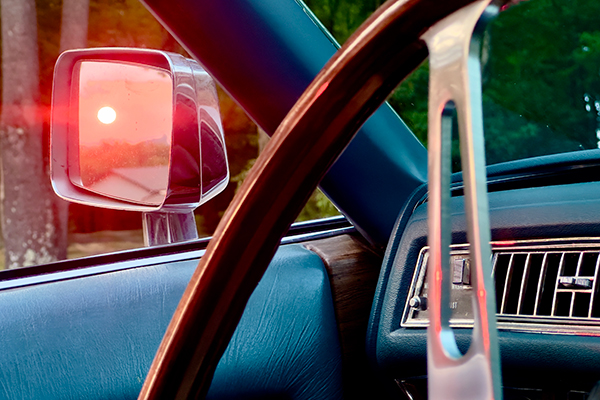
I, like Berry, own a chainsaw. Unlike Berry, I typed this essay on a computer. But in an age of autonomous cars, I will take real, hydraulic brake feedback in my boot, real mercury in my temp gauge, a real accelerator pedal connected by cable to a butterfly on the carb, and real static on the radio, and I will keep a firm grip on my steering wheel made of real wood.