Essay
You Can Still Be a Pioneer
As rural America empties out, what’s stopping you from buying a family farm and raising a houseful of children?
November 2, 2026
Try 3 months of unlimited access. Start your FREE TRIAL today. Cancel anytime.
START FREE TRIAL NOWYou Can Still Be a Pioneer
As rural America empties out, what’s stopping you from buying a family farm and raising a houseful of children?
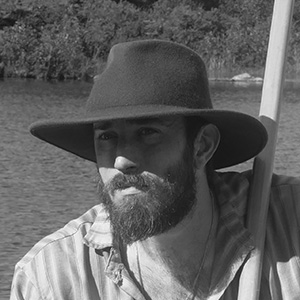
[.smalltext]All photographs courtesy of A. M. Hickman.[.smalltext]
[.article__paragraph--cap][.small-caps]The corpse of a porcupine[.small-caps] has rotted on the roadside, its needles mixed with cigarette butts and drink cups and flecks of ruined tires in the sand. Needles and butts, bones and litter – the highway dust has coated the fine feminine fronds of the Queen Anne’s Lace flowers that swoon like drunken ladies with the wind off every passing truck.[.article__paragraph--cap]
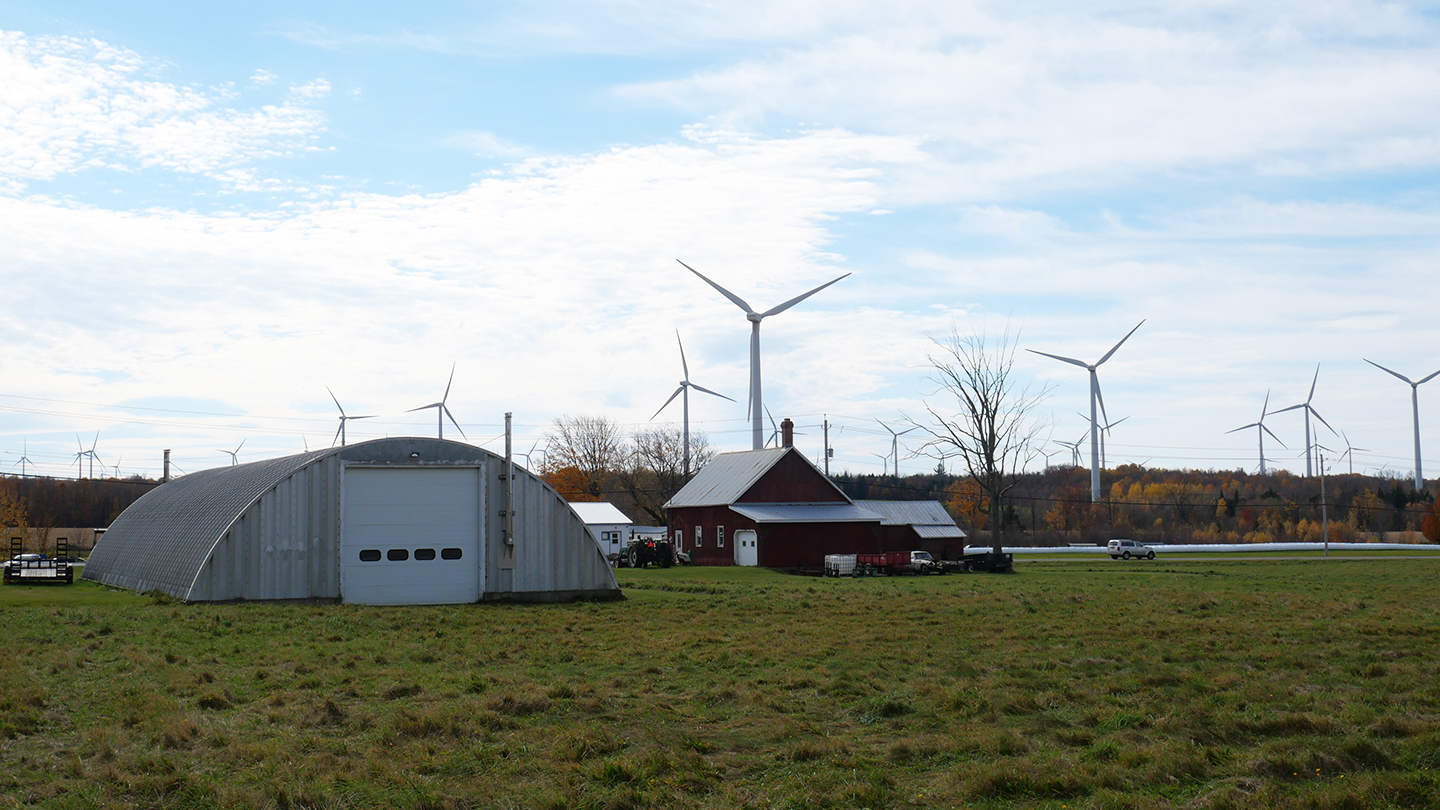
Above them, the windmills glower like great monuments to evil alien gods. There in the distance, under great big bright billowing clouds of a type one only sees in the North Country of New York State, it looks as if foreign pagans have erected sharp and fluttering instruments, perhaps to tickle the bellies of imperceptible entities that float above in the sky, perhaps to signal to one another, or to the aliens, that another stretch of a forgotten heartland has been conquered again.
They spin and spin and spin forever, blinking in the darkness by the low-slung frozen Milky Way, glistening in rainbow rainfall, chopping up the fading light of a North Country sunrise with metronomic precision – yet the signature of its cadence is not musical in the slightest. One can only pull over to stare on in awe at the grave and stymying evil of these masses of composite plastic and fiberglass, watching them blot out the sun every three-quarters of a second.
It is there that the stench of the rotten porcupine hits the nose like a blessing, for it comes as a most pungent reminder of the reality that we are not in some dark pagan analogue to purgatory – we are, in fact, in a living, bleeding, stinking world of swamps and spruces and swinging cornstalks that bend in the bright and happy winds. Whatever they are, those windmills are not forever, and the places to which they send their sizzling electric charges will one day subside into the land again while the North Country ice storms nonetheless persist.
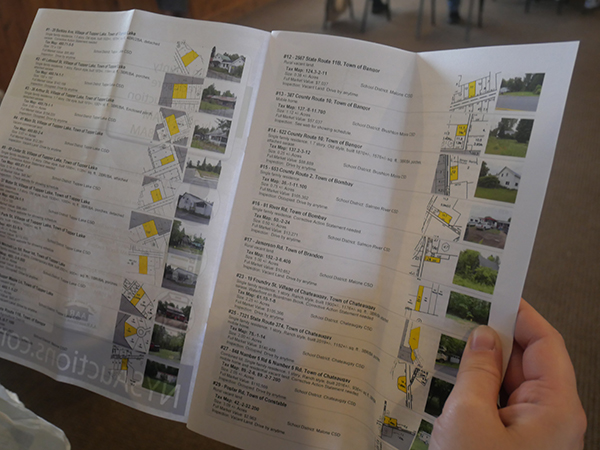
It is along this highway that Mo’s Pub sits in Malone, New York. Even the name of the town of Malone strikes as an artifact of desolation, for it nearly sounds like an old man murmuring the words “I’m alone,” spoken such that it is not intended to be heard by anybody but himself. Malone again, I’m alone again, and I’m alone again at Mo’s Pub in Malone. It’s there that the Franklin County Tax Foreclosure auction takes place annually – and on that night, somber or joyous an occasion depending upon who you ask, both those soon to be evicted from and those anxious to buy decrepit old North Country properties sit and drink in silence, waiting for the bidding to begin.
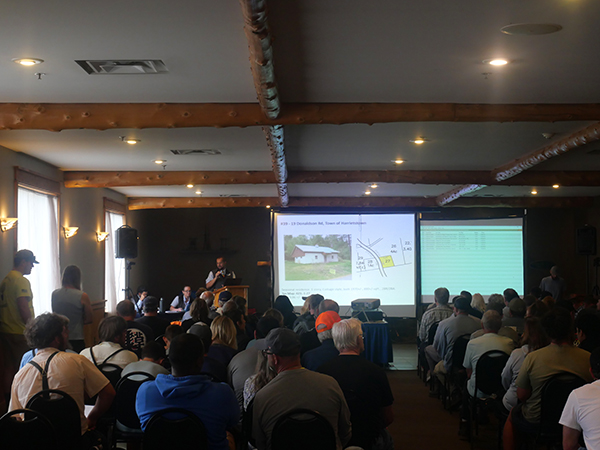
Outside, the airbrakes of the logging trucks thud in the distance. Men are here on their UTVs, their ATVs, or have come in SUVs and other acronymic vessels of gas-guzzling horsepower. They suck on cigarettes, or on little plugs of “chaw,” spitting downward to avoid the wind yet nonetheless spraying their camouflage pantaloons with tobacco juice and ash. Their wives stare at the barroom television with dour expressions, hoping to strike out on the pull-tab lottery.
Rough men – faces contoured like old caricatures and troll dolls. Great big red noses, red hands, chapped lips, sausage fingers, overalls. Now men in suits arrive, not a one of them rough. It’s as if the presiding judge of the court has entered the chamber, all rise at the bar, draining their glasses with an aura of reverence and even awe, stumbling towards what is about to happen.
The bidding begins, but what the auctioneer is saying is inaudible for the stories on the faces of all present are so much the louder than he. Retired firefighters from New Jersey have swung up into the parking lot in Audis and BMWs; and big-shots with Vermont plates – always the Vermont plates – have come around to dabble in another investment. Ladies with names like Doris and Agnes and Delilah perch like lizards by the half-opened window of the meeting-hall, chain-smoking, drinking Busch Light, listening intently to hear whether their brothers and boyfriends might manage to outbid the out-of-staters on the homes they already live in.
Outside, the porcupine’s needles scatter still further in the wind, and the stench of its rotten flesh mixes with the cigarette smoke and bar cleaner as the auctioneer babbles and anxious eyes watch every movement from his lips.
[.article__paragraph--cap][.small-caps]Bleak though it could seem[.small-caps] from these vignettes this is my home. This is the place where I cannot help but cast my bucket down. Though I grew up two counties south, down in Tug Hill country – where the winters are actually worse – I came north as if by magnetism, or by gravity, or by Providence. I could not help it, for the moment it was introduced to me it entered my veins like some strong, fearsome drug that cannot be easily quit.[.article__paragraph--cap]
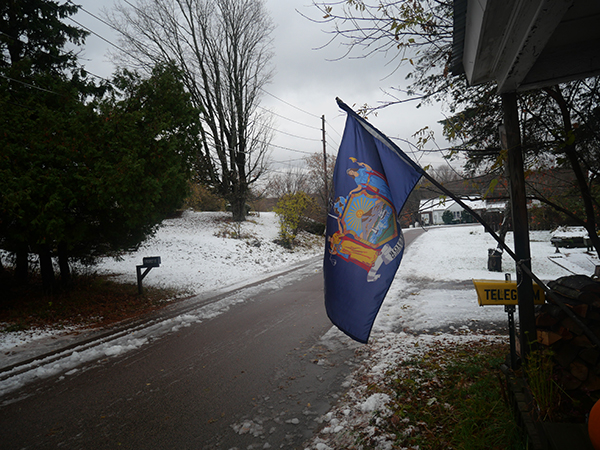
Harsh winds over piles of slush – squalid deer camps where piss-pants drunks lounge in feverish, empty-eyed repose; blowdown at the roadside, floodwater and winterkill and hundred-proof, this is a forgotten place where a man can hide and where a man can breathe. For after all the long dark days of winter, which is but half the year, and after months of overcast and nights of doddering madness under piercing arrays of icy stars – the world warms up again and cuddles up to a fellow, gives him his reward for all he has endured. And just by the time he’s sunburnt red and jolly and has let his guard down again, the frost comes back to keep him in check, like a hard and stiff-eyed master.
Some men need such masters lording over them lest they should be taken with laying down in easy places, and with all that that may entail. I am one such man and it is for this reason that I cannot leave.
But that is only me. Bigger than my own love for this place, I will call it what it is though the term I use may be ugly: it is a power vacuum. An old world recedes there; the agents of commerce finger the landscape only distantly and with an indifferent hand – maternity wards close, land falls fallow, timber lots don’t get thinned, maple sap pipe rusts, and downtowns fall into a zombielike state.
What is the future here?
Perhaps it is a land so fearsome and forgotten that none dare to answer that question for themselves. Even the locals seldom offer much of anything like an answer. They move away in large numbers, they contracept away the future children who’d populate the schools and parks, and a large percentage of the remaining few who do live here are either geriatric or ravaged by drug use. Judging by the details in the brickwork of their village downtowns and the audaciously-built railroads in the bush, this place did have “mojo” at one time – but these days, the mojo is gone, the vigor and vitality is draining, and the future is unknown.
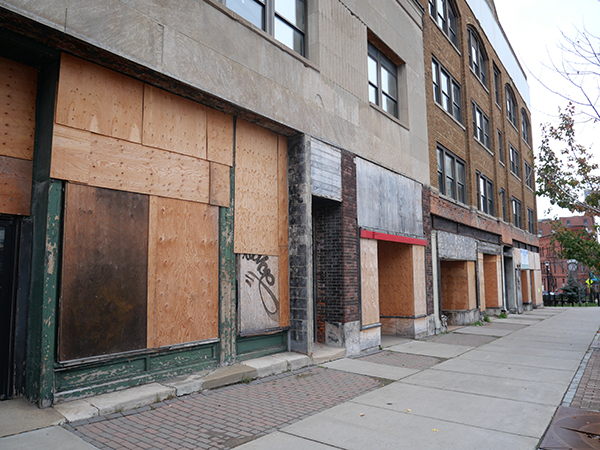
True enough, there are a fair few who attempt to stake their claim, however disreputable their ambitions. The New York State Office of Renewable Energy Siting thrusts their plans for solar arrays into the hands of aging farmers and defeated, milquetoast town councils, using money-grubbing investors to cover the land in panels that’ll be buried in snow for half the year. In a climate nearly as overcast as Western Washington state, that this is some sort of grift or corruption is baldly obvious to any of us who live up here.
Or there are the Airbnb people – the ones who buy up tracts of worthless wetlands and goat-slope, plunking down awful little “pods” for bourgeois rusticators to vacation in. They buy and build and buy and build but so often, few bother with coming. For after all, from points south, there are a million diversions far more suitable for tourists than here. Why drive through the Catskills, Berkshires, Green Mountains, Taconics, and Adirondacks to get to this vast, featureless plain along the border? Why pass up on Lake Placid and Saratoga and Lake George so that you can vacation here? Unless you have a great interest in stalking illegal immigrants on the US-Canada border, or are bigly enthusiastic about rusted metal, dilapidated barns, or Stewart’s gas stations with nose-ring-wearing, marijuana-vaping cashiers, why bother with such a place as this?
And so it is plainly obvious that what the various “investor” types have proposed is dubious at best. At worst, what they do is a mockery, a tax write-off, a dark joke. Often, it is a joke told at Mo’s in Malone, where the dirt-poor owners of tax foreclosed trailer-homes anxiously pray that they won’t be out-bid by slick-haired city people who came up from away and sure as heck won’t stay for winter.
Sometimes, the punchline to the joke involves the Sheriff serving you with a notice to vacate – and then, after struggling to rent a motel room, looking out the window to see the workmen covering productive family farmland in solar panels.
[.article__paragraph--cap][.small-caps]Yet let us take the[.small-caps] ten-thousand-foot view of all this. Let us not get bogged down in the details of the here-and-now but let us contemplate the possibilities etched into this landscape and its future.[.article__paragraph--cap]
What would Ghengis Khan think of it? What would Saint Isaac Jogues think of it? Is it mission territory? A realm of conquest? A demographical hiccup to be remedied? Is it a giant, gorgeous, heavenly invitation to all who would wish to carry the old mantle of the pioneers? Perhaps it is all of these and more.
For if the old world of the North Country is now receding, so be it. If the U-Hauls are all loaded up for the trip to Florida, if the crematoria of the funeral homes contain the only flame that never seems to go out in these towns – so be it. What will happen next is only a question of who may or may not have the vision, the vigor, the energy, and the staying power to arrive here and to burrow in, to dig their heels in, and to stay.
All it takes is a few good men, a few thousand dollars for the land, and a few large families with many children to come and take what is lying in wait for the taking.
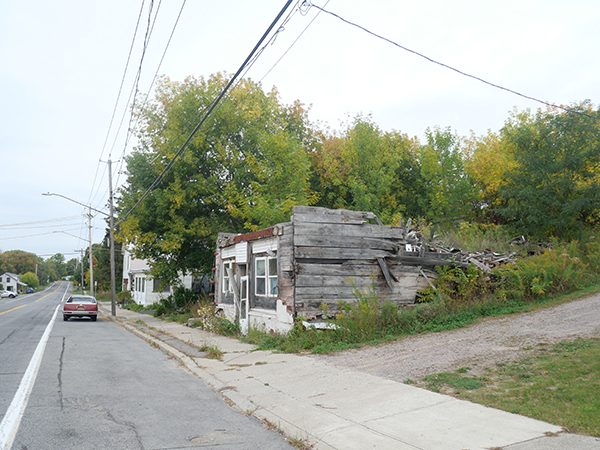
Already, the Amish and Mennonites are happy to do it – and they are thriving. Already, they’ve brought back thousands of acres of fallow and abandoned farmland back into productive use. They’ve saved countless barns and farmhouses. They singlehandedly prop up the shockingly extensive rural county public transportation services. They build their own grocery stores and have their own doctors; they convince local officials to widen highway shoulders to make room for horse-and-buggies – in short, they came, they saw, and they conquered.
They conquered not by the sword, of course, nor by the wiles of so-called “economic development,” nor by governmental graft – they conquered simply by saying “yes” to a land about which lately, nearly everybody has been saying “no” to. And when it came time to have babies, they said “yes” again, until their farms were full of children who’d inherit this place, and so it is that so much of it will ultimately be theirs to keep.
This type of thing isn’t just for the Amish. It’s for everybody in America. It’s a thing we can all do, a thing we can all begin doing immediately. At a time when everybody’s fed up with high rents, giant mortgages, big fat debt payments, traffic-choked highways, city crime, and an abject lack of community – it’s really just about as simple as this.
All the places that are easy to say “yes” to are already spoken for, of course. They’re priced accordingly. To pay that price, you’ve got to work for wages until you’re blue in the face.
If you’re lucky, after all that, you might get to take a discount vacation somewhere like where I live. And when you do, you might sit down at Mo’s Pub in Malone and lean over next to me, saying “man, I’m jealous you guys get to live in such a beautiful place.” I hear such things from discount vacationers fairly regularly, in fact.
It’s at that point that I’ll say: “why, the tax foreclosure auction’s gonna be here next month, if you’d like to be neighbors.”
And if a fellow would say “yes” to such a proposition he’d quick find himself living mortgage-free, dirt-cheap, his own man, rarely encumbered by a nine-to-five job, liable to cruise down to Mo’s for a pint here and there. He could have a whack of kids and plant a cabbage patch, or start sugaring the maples on his back fifty. In time, he’d even learn to love the winters – so long as he bought himself a snowmobile.
What America needs, far as I can tell, is real people saying “yes” to the parts of the country that everybody’s saying “no” to.
That might be right where you grew up, it might be elsewhere, but wherever it is, I pray you find it soon. I pray that it’s dirt-cheap. I pray that it’s a little lawless and rough. I pray that you don’t wind up with a big mortgage. Because if all of it pans out just right, you’ll be able to really make the most of your front porch, and have a sit, and breathe that fine American air that one can only really taste out in the hinterlands of this great country.
After all, do Americans not still pine for a frontier? Do we not crave a fresh canvas, an open slot, a “free space” on the map on which to dream and to build? It’s in such places where the story may not be over yet; where that old frontier ethos may still flourish and thrive. There may be a future here for those who are bold enough to seize it. Lord knows it’s there to love and to call home – if you want it, that is.