Essay
The People We Refuse to Forget
A patchwork of small organizations works to uphold the dignity of those society overlooks.
November 18, 2026
Try 3 months of unlimited access. Start your FREE TRIAL today. Cancel anytime.
START FREE TRIAL NOWThe People We Refuse to Forget
A patchwork of small organizations works to uphold the dignity of those society overlooks.
[.article__paragraph--cap][.small-caps]Three days[.small-caps] after her 32-year-old daughter, Anna, died of anorexia, Linda Znachko stood at a podium in front of dozens of people and several news cameras to honor the lives of nine men she’d never met.[.article__paragraph--cap]
It wasn’t easy to put aside personal grief, but she’d committed to hosting a ceremony that would recognize these men, murdered thirty years earlier in a recently uncovered cold case in the nearby Indianapolis suburbs.
Znachko was there on behalf of her organization, He Knows Your Name. The organization and the ceremony that day symbolized the Christian truth that all people are made in God’s image and infinitely valuable, regardless of their circumstances: whether a young woman who suffered a mental health tragedy or a young man whose life was cut short by violence, each deserves dignity and recognition in death.
He Knows Your Name (HKYN) aims to bring such honor especially to individuals the world tends to forget about. Sometimes that’s a stillborn baby whose body is abandoned at the hospital, often nameless and without anyone to bury him or purchase a gravestone for his resting place. Sometimes, it’s the unclaimed dead – older people who die alone at home or friendless in sterile hospital rooms. Sometimes, it’s a murder victim the world would rather not think about any further.
“The Lord so clearly just pressed on my heart … they’re all children of God,” said Znachko, who founded the organization in 2009. “You take care of babies, and you take care of [unclaimed adults], and anyone else God calls us to.” HKYN has provided dozens of dedications, memorials, and gravestones every year in Hamilton County, Indiana. They do not discriminate in who can be honored: An eighty-five-year-old homeless man unclaimed in death is equal in value to a twenty-four-week-old stillborn baby abandoned at the hospital, said Znachko.
In Isaiah 56, God promises that he will give his children “an everlasting name that will endure forever,” specifically calling out outcasts and those with no earthly legacy or family line to have “a memorial and a name better than sons and daughters.” We derive our worth not from our utility, age, or social standing, but from the Creator alone. It’s why Znachko does what she does. She’s the first person the local coroner’s office calls when an infant is found dead in the forest or abandoned in a trash can, or when a family leaves a stillborn baby’s body at the hospital never to claim it for burial. In the last fifteen years, she has named, adopted, and buried sixty-four children. She’s also become close friends – almost family – with staff in the coroner’s office and local authorities who deal with these kinds of cases.
Znachko often hears from people who want to get involved, and as HKYN is a small, local nonprofit, she usually directs people to prayerfully consider asking God what he might want them to do in their own locality. Across the nation, a patchwork of other small organizations also works to uphold the dignity of those society overlooks, each in their own way, rooted in their own communities.
Many of these focus on infant loss, because miscarried and stillborn babies are perhaps the most overlooked of all – lives that rarely receive the dignity and care they deserve. According to the CDC, there are 21,000 stillborn babies each year and between 75,000 to 1 million miscarriages (under twenty weeks) annually.
Prior to recent years, even mothers who birthed full-term stillborn babies were sent home from the hospital with little guidance, care, or compassion around the loss of their children. Still today, few norms exist regarding how to handle the body, memorial, or honoring of a stillborn or miscarried child.
For this reason, it’s common for people to brush off a pre-birth death in the womb as less tragic than post-birth, but this perspective ignores the truth that we’re created at conception with an eternal plan and purpose, something parents know and desperately want to express in the face of loss.
Rachel’s Gift, an organization out of McDonough, Georgia, helps them do this. The organization partners with hospitals and seeks to insulate families with hope via long-term bereavement support that recognizes their child’s name, existence, and contribution to the world just by nature of their creation. Inside partner hospitals, Rachel’s Gift trains hospital staff to ensure they communicate effectively and compassionately with loss families and are able to interact with empathy and professionalism.
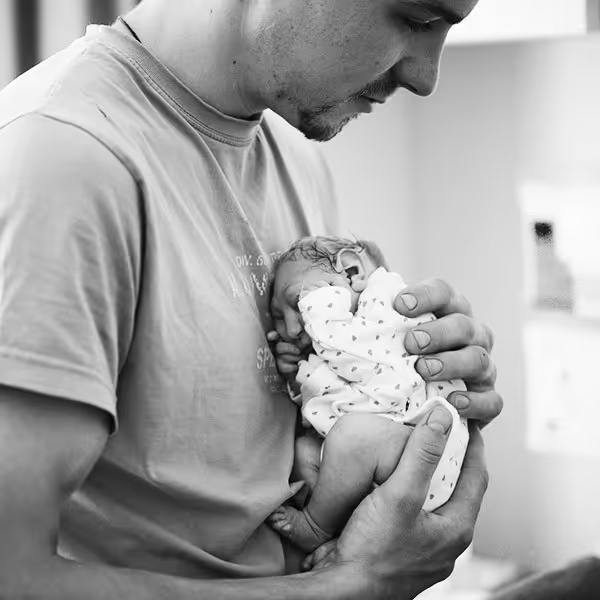
They create functional gift boxes for each grieving family; each box contains items for immediate use, such as tiny, hand-knitted caps and blankets for baby and instructions on how and why families may want to obtain footprint stamps, photographs, and other keepsakes only possible to make while the baby’s body is still with them.
Laura Lance, director of marketing at Rachel’s Gift, said that in their grief, many families don’t consider preserving these kinds of memories with their babies at first. Depending on what stage of pregnancy the baby is born in, seeing, swaddling, and sharing time with one’s child can be even more traumatic.
“A lot of times when babies are born early, their skin is sticky, and so by touching them, it can pull skin away,” Lance told me. “We show parents how to put the baby in a saline bath where they can feel his or her skin without that.”
Lance said families often regret not taking photos or creating other mementos. Rachel’s Gift helps educate parents on options for honoring their babies’ bodies and spending time with their babies – up to several days, if the hospital has a Cuddle Cot (a temperature controlled bassinet built for that purpose).
“We even talk about – if the baby isn’t necessarily presentable – how to wrap the baby properly so the families can still hold him or her without seeing anything that would be difficult, so they can still have that connection and memory,” said Lance. This sacred preservation of the body in the limited time families have together highlights the meaning and importance of our God-designed natures as embodied beings. Just as Job confessed, “Your hands fashioned and made me” (Job 10:8), so too did God knit this child together in the womb – and that creative genius, even in the form of a deceased body, is worth uplifting.
In honoring the body, parents can express their love tangibly through touching, holding, washing, and anointing – mirroring the very acts of devotion Joseph of Arimathea and Nicodemus performed when they wrapped Christ’s body in linen and spices (John 19:39–40). Such handling has been the norm throughout history, with preparation for burial seen as an act of profound love and reverence. It is only in the last century or so that we have lost this directly personal, bodily work with our loved ones. Prior to the professionalized modern death industry, people couldn’t avoid participating in preparing the body, building the coffin, digging the grave, and preparing the home for visitation. There were traditional prayers, days-long vigils, and elaborate rituals intended to tend to a grieving family and properly honor the dead.
“We are now distant from that, and our own sense of mortality – and our connection with those who have died – is not as strong as it used to be,” said Rice. This shift strips away the human need to recognize our own mortality, the ancient Christian recognition that would “teach us to number our days, that we may gain a heart of wisdom” (Psalm 90:12).
[.article__paragraph--cap][.small-caps]Any Christian burial,[.small-caps] which speaks to the hope that, as the apostle Paul writes, what is “sown in dishonor” will be “raised in glory” (1 Corinthians 15:42–44), is predicated on the belief that our bodies, created by God, will one day be raised, made whole and perfect forever. That’s the core idea that drives Steve Rice, founder of North Carolina’s The Society of St. Joseph of Arimathea. With the help of this Milwaukee-based organization, families can receive free burial for miscarried or stillborn children, including coverage for the cost of cremation if desired. Rice said many families don’t understand that hospitals have no dignified way of handling deceased bodies. “In almost every scenario, it’s just incineration along with other medical waste,” he told me.[.article__paragraph--cap]
St. Joseph works with families dealing with death in every scenario, from fetal demise to spontaneous miscarriage and even, rarely, elective abortion. Rice doesn’t pry into families’ choices, but he finds it interesting when mothers of an aborted baby request a burial. Like He Knows Your Name, St. Joseph holds public funerals for babies – often in afternoons just after church services at St. Timothy’s Episcopal Church, where Rice serves. Churchgoers often attend services. Rice sees his work as an extension of Christian virtue across the spectrum of life, saying, “If we are comfortable ignoring the dead – comfortable denying burials to a segment of our population, denying their humanity, their personhood – then we’re very vulnerable to starting to view others as less than human.” This connects to how we treat the elderly, mentally ill, and unhoused, he says: “If we can conveniently overlook or discard a segment of the population, where does that end? By honoring that life, we begin paying attention to those who have not yet died.”
Little Angel Gowns, a group created by a NICU nurse who noticed a need, works with a nationwide network of volunteer seamstresses to offer, free of charge, tiny hand-crafted burial gowns and tuxedos made from used wedding dresses and suits for stillborn infants. Similarly, The Still Remembered Project collects and distributes items such as blankets, hats, and socks that have been hand-sewn or created by a group of volunteers that include many bereaved mothers and grandmothers. Teeny Tears, another organization, provides mini flannel diapers, micro-blankets, and hats to hospitals, funeral homes, and allied bereavement groups.
These nonprofits couldn’t exist without the streams of volunteers who show up, teeming with the desire to do something in honor of their lost children.
“People want to remember their babies. They want you to bring it up. They want you to say their name ... this is a way for them to remember and honor their babies,” said Lance from Rachel’s Gift.
A homeless man’s God-given personhood can never be truly taken away, even when society strips him of his name and reduces him to a county tag number, or reduces a stillborn to a medical code. But to know and say their names aloud is a profound act of obedient recognition of their place as sacred, created beings in the world. For the babies without names, to give them one – as well as a funeral – declares, “You are not a statistic; you are a soul for whom Christ died.”
These acts of love demonstrate the upside-down truth of the Gospel – that our worth isn’t earned but inherent.