Personal History
The Face Speaks
As a Bosnian child fleeing Sarajevo in 1992, I struggled to see humanity on the other side of the genocide.
December 15, 2026
Try 3 months of unlimited access. Start your FREE TRIAL today. Cancel anytime.
START FREE TRIAL NOWThe Face Speaks
As a Bosnian child fleeing Sarajevo in 1992, I struggled to see humanity on the other side of the genocide.
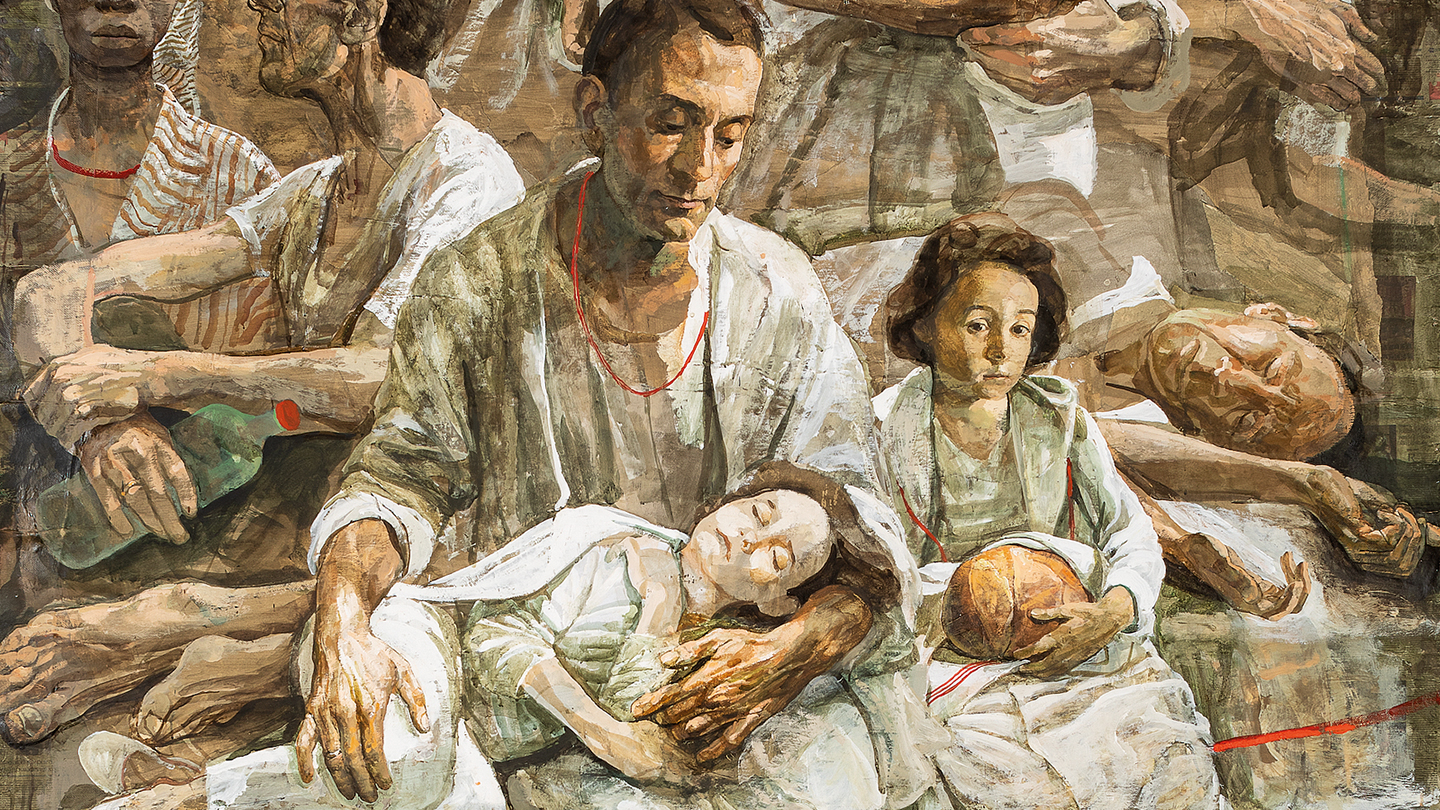
[.article__paragraph--cap][.small-caps]I sat on a suitcase,[.small-caps] picking the skin on my thumb. I thought I could control the habit, but I went too far, and the skin started to bleed.[.article__paragraph--cap]
“Stop picking already!” said my mother.
I looked at her in shame, trying to hide the fact that my thumb was now covered in blood. My two-year-old cousin looked at me in his usual curiosity, blissfully unaware of the situation’s gravity. My mother – his aunt – was his caretaker now because his mother had been killed by a mortar shell.
I went back to mindless people-watching. Hundreds of women and children were pacing around an old gymnasium, all gathered to leave war-torn Bosnia. The buses arrived, their loud diesel exhausts indifferent to humanity. We were all bound for Czechoslovakia (as it was known in 1992) – refugees seeking a place for the winter. December was almost upon us, and winters in Sarajevo are brutal.
Communism was dead (in theory, at least) in Czechoslovakia, and the Czech government had kindly offered to take in Bosnian women and children for a short period of time, until the war was over. We all expected to be back in three months. I never imagined that sitting in that old gymnasium waiting to be ushered into a bus would be the end of one life, and the beginning of another, for a thirteen-year-old Bosnian girl. I certainly never thought it would be the last time I would see my father alive.
The Bosnian War began in April of 1992. One morning changed everything. As I was getting ready to go to school, I realized my father was not at home. My mother was nagging me to get dressed quickly, and in the midst of it, my father came back.
“School is closed,” he said. “They’ve barricaded the city.”
This was the beginning of the Siege of Sarajevo, which lasted 1,425 days. Sometimes the war in Bosnia is reduced to words like “conflict” or “civil war,” but as with anything of that magnitude, it wasn’t that simple. In fact, it was a genocide of Bosnian Muslims, many of whom were my close family members. The genocide of over eight thousand Muslim men and boys in Srebrenica is just one instance that ended in the numerous mass graves that were (and are) scattered throughout small towns and villages of Bosnia. My uncle was found in one of those mass graves, shot point blank with others, his body pushed in and covered up with dirt.
The war in Bosnia would make the news around the world. Bosnia-Herzegovina was once part of the Socialist Republic of Yugoslavia, which began to dissolve in 1991 when other republics in the union began declaring their independence. For Bosnia-Herzegovina, however, declaring independence also sparked a war. Wars tend to be strange but this one was even stranger. Neighbors turned on neighbors. While much of the population was Muslim (Bosniak), a large percentage was also made up of Orthodox Christian Serbs, a smaller percentage was Catholic Croats, and there were a few Sephardic Jews. Despite this, it would be a grave mistake to say that religion was the cause of the war. Rather, the hatred of the other overtook religion and used it for its own purposes.
[.article__paragraph--cap][.small-caps]There were eleven[.small-caps] buses waiting to be filled with women and children. Some people were eerily calm. Deep silence was preferable to weeping. Others shouted out of desperation, pushing through the crowd to secure a seat on the bus. Even though we were on the official list, this didn’t guarantee a departure. Socialist bureaucracy never worked, and coupled with war, it became a disaster that even Kafka would find difficult to understand.[.article__paragraph--cap]
I tried to stay close to my mother. I dragged my father’s suitcase, which he often used on business trips and family vacations to the Adriatic coast. I was frustrated as memories of the sea flooded my mind. The azure blue, the smell of pine trees, the burning sand, and even the fear of swimming presented itself as beautiful at the most absurd moment.
Memory is fragile, but there are some memories that we hold on to more firmly than others. We replay these favored memories over and over again in our minds, both willingly and unwillingly, desperately seeking a resolution of the past that never comes. Vladimir Nabokov writes that the reason why we hold on to a memory is because “it is all a matter of love: the more you love a memory, the stronger and stranger it is.” All these years later, I am still not sure whether the memory of seeing my father for the last time is something I love or don’t want to remember. It’s an exercise in self-contradiction: we hold on to painful things because they give us access to something that was beautiful.
Most war survivors think of life in relation to war. In other words, any good memory that I may have of my childhood is always followed by the immediate memory of loss. This loss is embedded in everyday existence as well. On some level, like beauty, it’s ineffable. Its mystery is not something to be solved. Rather, it’s a mystery that propels our human movement toward an encounter with God and the other.
My body felt weightless even as I was dragging the suitcase. It felt as if I didn’t really exist in time and place. The people around me only made matters worse. Mass confusion was erupting; people were trying to get into the buses despite the fact that they were not on the original list, displacing those of us who were. Desire for survival was kicking in as I tried to move through the madding crowd. My father was nearby.
“You have to hurry … there’s no time … this is our only chance,” he said.
His words flowed one into another, one long gentle directive. I tried to hug my father before we boarded the bus, but the crowd kept pushing against me. I didn’t want to lose the suitcase, and as I moved through the mass of humanity I had no control over my direction. I was tumbling into the unknown.
I made it into the bus but there were no free seats left. As long as I could stand and maintain a small amount of strength, I would be fine. I could see my father outside the bus, standing stoically, his face burdened with deep sadness. I didn’t know then that in almost four years I would immigrate to the United States, speak to my father on the phone and, barely a month after my arrival in America, that he would die alone in Sarajevo.
“Don’t cry now,” my mother said. “If you do, we’ll just turn around and we won’t go.”
I held my tears in. I sat on the suitcase and the bus began to move. A young woman was breastfeeding her newborn child. She held on to her green tespih (prayer beads) and whispered the same prayer over and over again.
Several checkpoints were awaiting us, and there was no guarantee that we would pass. Horrific images of impending death were running through my exhausted mind. A man dressed in a Serb military uniform came into the bus. He was looking over the list, and was on friendly terms with the bus driver. Does this mean the driver cannot protect us?
“Give me the list,” demanded the uniformed man. The bus driver complied. Is he scared, just like me? Has he done this before? Does he know it will all end well? Perhaps he doesn’t care at all. I indulged every possible negative scenario that was floating through my mind.
“Are all of them Muslims?” asked the soldier. He didn’t wait for an answer. Instead, he turned toward all of us, gazing gleefully, as if he was satisfied after a good meal and a nice cigarette. You could tell he was a low man on the military totem pole, but little dictators are often the worst kind. He embodied a genocidal bureaucracy.
I tried not to look at his face, as if I were Perseus dodging Medusa. At the time, I wasn’t curious about who he was. Now, I wonder: Was he a stranger or a neighbor? During the war, in many instances, Bosniaks found out that their attackers and murderers were indeed their neighbors. How can we possibly reconcile such a strange reality? More importantly, how does this reality inform the commandment, “You shall love your neighbor as yourself?” Can we really love someone who wants our destruction, unwilling to enter into dialogue?
Hatred is a powerful emotion and can become a state of being as well. My grandmother once told me that we should refrain from engaging in hatred not necessarily for the sake of the person whom we perceive to be “worthy” of it, but because to hate someone else stains our souls as well. A life filled with hatred is a life filled with nihilism that drives us away from God. In The House of the Dead, Dostoyevsky writes, “Whoever has experienced the power and the unrestrained ability to humiliate another human being automatically loses his own sensations. Tyranny is a habit, it has its own organic life, it develops finally into a disease. … The return of the human dignity, repentance, and regeneration becomes almost impossible.” To be nihilistic is easy, but to truly see the possibility of being is what unfolds our true humanity.
At the core of this possibility is a face-to-face encounter. Should I have looked deeper into the face of the uniformed man on the bus? Would I have seen anything resembling a human being, or only a monster? I only vaguely remember his face, but can still recall the sound of his dismissive voice loud and clear, existing side by side with the young mother’s whispered prayer to God.
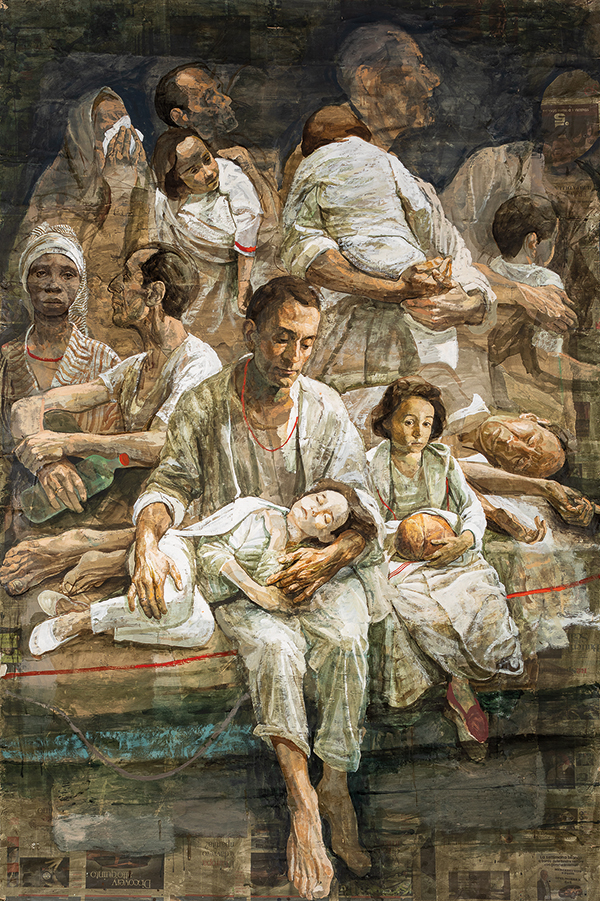
The philosopher Emmanuel Levinas understood the significance of the face-to-face encounter. He says we must go beyond the physicality of the face and comprehend that it is beyond being. What this means is that the face itself is an immediate call to ethics. Another human being is in our presence, and in this moment this person initiates, by the very virtue of his or her being, an I-Thou relation. He or she is the other, but this relationship cannot be reduced to language. It doesn’t exist “in number or in concept,” Levinas writes. We are essentially responsible for the other and we cannot look away. Levinas tells us that “face and discourse are tied. The face speaks. It speaks, it is in this that it renders possible and begins all discourse. … It is a discourse, and more exactly, response or responsibility which is this authentic relationship.”
In the human face, we see the dignity and humanity of the other, and are called to the commandment, “You shall not kill.” But what happens when the face is not recognized, and when the discourse that Levinas mentions is far beyond reach? We can still maintain our dignity and personal sovereignty, and no amount of darkness can take that away.
Still, justice must have its rightful place in society. What happens concurrently must include our engagement with the other. This is not to say that seeing the humanity in another’s face is easy. On the contrary, it is a difficult existential act indeed. The problem is not whether we are able to do it at all times, but whether we are even willing to try.
My journey from Sarajevo to Prague would end up taking several days. Somehow we managed to go through all the checkpoints. I couldn’t have possibly known that I would end up in America. Returning to my homeland would never be the same. Any life “before the war” is in some undefined space, no longer accessible. The door is closed and locked. The past persists, and we stubbornly hold on to it because of present or imagined future darkness. Stubbornly and out of spite, I must defend the persistence of memory. It’s not nostalgia. It’s hope. It’s knowledge of the world that is no longer with me, but its images are a reminder that the possibility of being is at the core of our humanity. This possibility is a resounding yes to life and an affirmation of our inherent human dignity.