Essay
Talking to Strangers at the Museum
Two Bruegel paintings in Naples led me to become a famous pizza expert.
December 15, 2026
Try 3 months of unlimited access. Start your FREE TRIAL today. Cancel anytime.
START FREE TRIAL NOWTalking to Strangers at the Museum
Two Bruegel paintings in Naples led me to become a famous pizza expert.
[.article__paragraph--cap][.small-caps]Like a shirttail relative[.small-caps] inheriting a neglected castle, I had Naples’s Capodimonte Museum nearly to myself when I arrived at opening time. Cheerily salmon-colored and flanked with palm trees on the outside – an old palace I could envision standing in Haiti, Veracruz, or in a kitschy attempted re-creation near Miami – it was dark and quiet inside. The automatic lights didn’t snap on until I was a few steps into a gallery. The only sounds came from the two other early visitors, Frenchmen with the bearing of old friends who chattered avidly but discreetly as they drew close to the portraits and religious scenes of the Farnese collection. No wayfinding signs or interpretive materials ingratiated or cajoled me from the walls. The spell was eventually broken by a rambunctious school group exploring the royal apartments at the opposite corner of the building, but for an hour, gallery after gallery opened itself to me as an Arcadian retreat from the world.[.article__paragraph--cap]
Exploring a museum has typically been a solitary pastime for me. And while I enjoy being out in a bustling, anonymous crowd, in a museum I tend to see other people as a hindrance to whatever I’m trying to experience. Here no friends or children needed their varying levels of interest negotiated. I allowed myself the luxury of self-paced aesthetic absorption. My only external marker came from those two French art-lovers moving just as deliberately as I was, now a little ahead, now behind, all through the centuries.
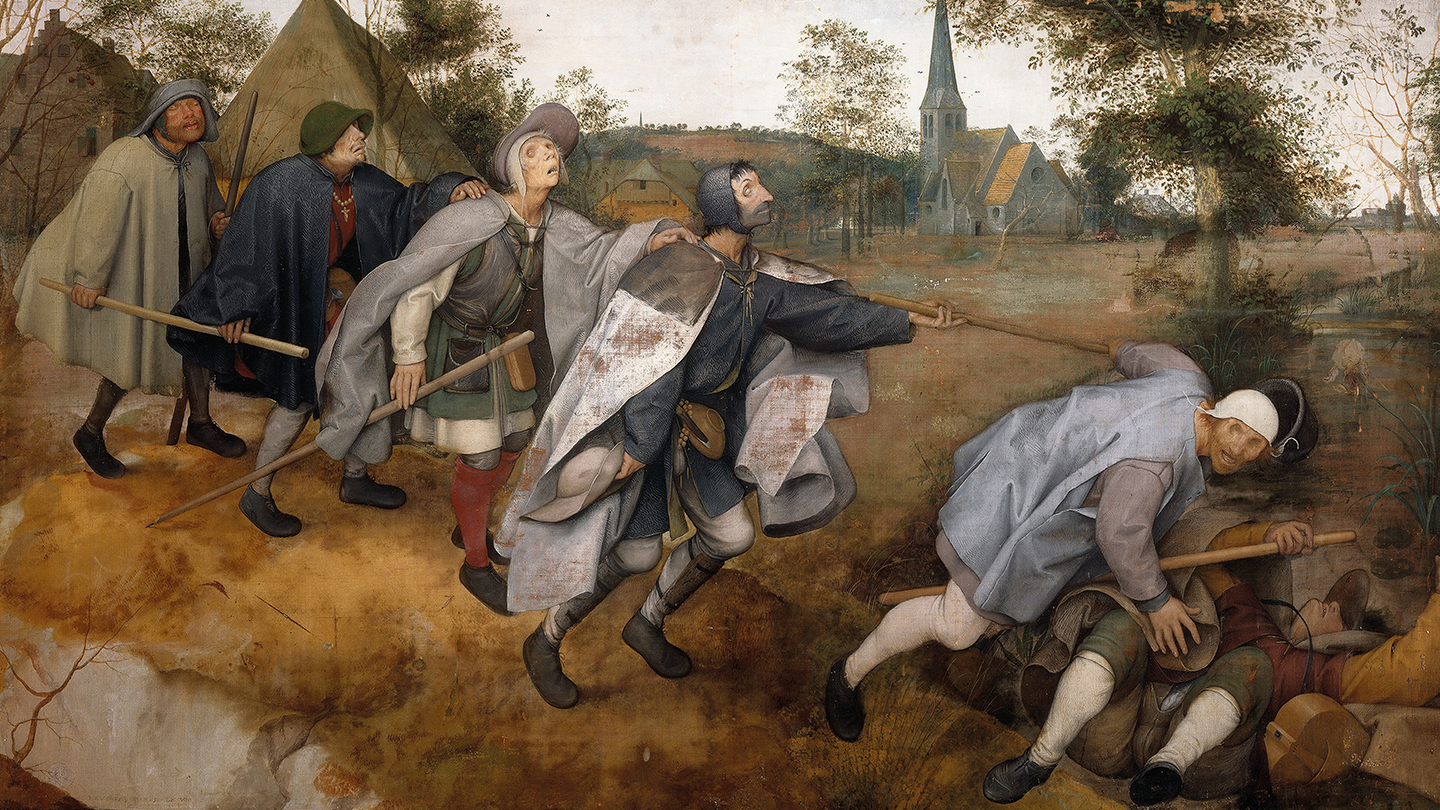
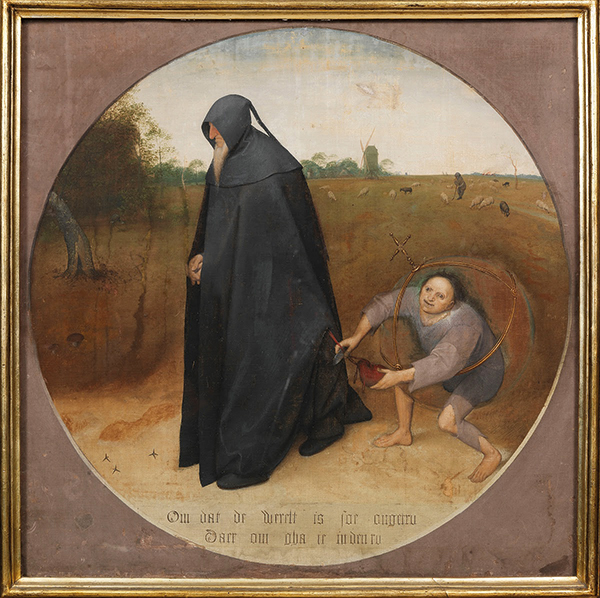
At the dead end of the route through the collection, just ahead of a barrier set up for remaking the next gallery, I found what I’d come for: The Parable of the Blind and The Misanthrope, both painted by Pieter Bruegel the Elder in 1568. The first of these is the more famous of the two. I never forgot the small reproduction I’d seen of it decades before, when I knew nothing of the artist or of art at all. Bruegel, who would die the year following, rendered the saying of Jesus about the Pharisees – “they are blind guides of the blind. And if one blind person guides another, both will fall into a pit”– in a dramatic visual narrative. Six men are walking together on a sharp downward diagonal line in the foreground, connected by hands on shoulders or an extended walking stick. The first has already fallen, the second is on his way down, and the remaining four seem fated to follow. A church (a relatively rare identifiable place in Bruegel’s work: the still-extant Saint Anna’s Church in Sint-Anna-Pede outside Brussels) stands ambivalently in the background, breaking up the field in the gap between the two falling and four trailing men.
To the right hung The Misanthrope, a less beloved and more obscure scene than the stringent Parable of the Blind. It, too, renders a proverbial saying in a literal narrative that both reveals and exceeds its meaning. A man dressed in long black mourning clothes, his face deep in his hood, walks away from the center toward the viewer. Behind him is a pastoral scene with a windmill, a cluster of low buildings, and a shepherd tending a flock of black and white sheep. Before his feet are caltrops, which he seems not to have noticed, and just to the right, a figure in raggedy clothes, enclosed in a transparent sphere with a cross extending to our left, is snatching a red heart-shaped purse from the man’s garments. At the bottom, possibly in a later hand, the proverb is written in Dutch: “Because the world is so untrue / I go about always in rue [or sorrow, or mourning].” The irony is immediately apparent. The misanthrope, so cynical and self-protecting, is in fact walking heedless through the world’s dangers. He wishes to keep his own heart (and, both literally and in the terms Jesus sets in the Sermon on the Mount, his treasure) safe from the world’s faithlessness, but in his self-absorption he is being robbed of precisely the thing he seeks to hide.
I had come a long way to see these two paintings; I was still very much jet-lagged, and perhaps for that reason I felt a completely unexampled catharsis when I was finally in the room with them. The unsparing honesty – now comic, now tragic, now ironic – of Bruegel’s vision, his lack of concession to any special pleading on behalf of sentiment or even religious belief, never detracts from what a later age would call the humanity of his subjects. There are painters who surpass Bruegel in technique, but I find few who can match his recessive yet penetrating sensibility. He’s the only painter who reminds me of Shakespeare.
I stood close. I stood back, taking in the gallery as a whole. I took each in turn, sat down, and stood up again.
[.article__paragraph--cap][.small-caps]Then the Frenchmen[.small-caps] reached the gallery. They browsed with a languor onto which I, in my helpless Yankeedom, could only project an aristocratic discernment. One of them stopped in front of the Bruegels for a few extra beats. I could not restrain myself. In my barbaric high-school French, I told him, “I came to Naples to see these two paintings.” He turned to me, cocked his head, furrowed a bit – more aristocratic discernment, no doubt – then asked why. I explained, as best I could, that I was on a sabbatical journey visiting as many paintings by Pieter Bruegel the Elder as I could. “Are you writing a book?” he asked. “Someone already did,” I answered – a book I discovered only a week before I left – but perhaps I would make something of it. With that, we were suddenly compatriots. He had traveled Europe writing about the death’s-head motif in painting, though that, too, had had a recent treatment. And he, like me, was not an artist or art historian by training. He was a doctor who had retired to Naples from France but had continued to practice. We, and then his companion, another doctor who was visiting from France, were off to the races in a mix of French and, increasingly, English about the paintings, their details, and the rest of Bruegel père’s work. When they moved on, we wished each other happy viewing. I stayed behind with my quarry, then set out to cover the rest of the museum.[.article__paragraph--cap]
The next level was even more of a maze, and while I loved the half-decayed altarpieces and fleshy Neapolitan canvases, I found myself going in circles as I tried to leave. When I finally did, I arrived at a contemporary exhibit on the first level just as the Frenchmen got there. We lingered over the photographs and talked about travels and about Naples. Eventually the first one, who was more comfortable in English, told me that he was having some friends over to try an unfamiliar pizzeria and asked if I would like to join them. Having no plans in Naples beyond the Capodimonte and no connections whatever, I had no reason except a subtle impulse of anxiety to decline. So I accepted. We exchanged numbers and parted ways again.
[.article__paragraph--cap][.small-caps]When, after five hours[.small-caps] and another spell with the Bruegels, I emerged from the Capodimonte, I had just enough time to tour the nearby catacombs and to take in the National Archaeological Museum at a nearly undignified trot before boarding the train toward my new friend’s apartment. I had not yet gotten my phone reception to work, so I could send no apologies for tardiness, though I was still just about on time as I reached the bus stop that would take me the rest of the way to the seaside Posillipo district. But the bus mulishly refused to show up. The day’s drizzle intensified to a heavy rain. I surrendered to my fate and woke up a taxi driver dozing outside the train station. He was gracious about my scarce Italian and made a valiant effort at English. He got me there a mere twenty minutes behind schedule.[.article__paragraph--cap]
“Dueholm!” my host called out in aristocratically discerning surprise. His entrance was two flights down from the street, and if I had any expectations that my inferiority complex vis-à-vis educated Europeans would relax, his apartment upended them in a moment. It overlooked the sea, though it wasn’t visible this late, and it was stocked with very old and impressive pieces, including a wooden kitchen door that could have once been barred against Vikings. The other French gentleman from the morning was there, along with a Neapolitan couple. An awkward linguistic triangle was formed, with Italian, French, and English unevenly distributed between the five of us. But they wanted to know about my quest, and I did my best to oblige. They explained that the pizzeria we were to visit that night had been made famous by an Italian-American television chef, whose name no one could recall but who had declared it the best pizza in Naples. Since then, it was so crowded that one needed a reservation.
We squeezed into the Neapolitans’ car and drove a few rainy kilometers to the restaurant. It was, as promised, packed to the edges, and we were kept waiting for a while after our arrival. My French host explained that they were telling the house to make room for me, because I was a famous pizza expert from New York City. Concerned that this claim might be put to the conversational rack, I quickly texted a New York friend for the names of pizza places, but since I still had no reception, they never reached him.
The ploy must have worked because they did seat us, five to a four-top, and after some more negotiating in Italian that I couldn’t follow, it was explained that for the visiting pizza dignitary, there would be no ordering from the menu. The Neapolitan wife was allowed her choice, but the rest of us would be given the house’s selection of its four favorite pizzas. By now, English was the dominant language, but when the bottle of red wine arrived, my French ceased its retreat on the subjects of Zohran Mamdani and the legendary site of the Sybil of Cumae, a short train ride away.
The first pizza, a classic margherita which I took a moment to examine in what I felt was a connoisseurish manner, was indeed the best pizza I’d ever had. The tomatoes, I was told, were a special variety from the volcanic soil around Vesuvius. The next two pizzas were, if possible, even better. But the last was an aggressively puffy fried pizza, something more like a calzone in the United States. I couldn’t imagine ordering it for myself, but having come this far under false pretenses, I had to go the rest of the way. Filled with ricotta and a kind of ham you supposedly can’t get outside of Campania, it was transcendent. I was stuffed, but they pushed the last piece on me – real guest; ersatz expert – and I despaired as I ate it to know it would be gone.
But by then it was late and the time change and poor sleep of transatlantic travel were insisting upon themselves. We rode cheerily back to Posillipo, where the Frenchmen debarked, and the Neapolitans graciously drove me all the way to my hotel. “Naples is the most beautiful city in the world,” the husband said to me when I related my transit woes, quoting a sociologist whose name he could not remember, “if you can live aesthetically.” They dropped me off with a firm offer to take me and my family around Pompeii and Herculaneum whenever I should return.
Only a few hours before, I’d been nervous about this encounter. I had been given no reason to mistrust the sincerity and good faith of the people who invited me out on first acquaintance, but the suspicion that one is always living and moving in a dangerous and unreliable world is a deep habit. Even in middle age, the residue of growing up in the “don’t talk to strangers” era, with its implied misanthropy, must be inside of me somewhere. Naples itself, with its seedy reputation, its tang of maritime menace, and its haphazard transit, encourages it. On that level of spiritual and psychological habit, it would have been simpler to decline the invitation or stand them up. Of course, on a different level of socialization, where avoiding offense is the cardinal rule, it was simpler to go with the flow. Yielding to that impulse transformed my whole encounter with Naples.
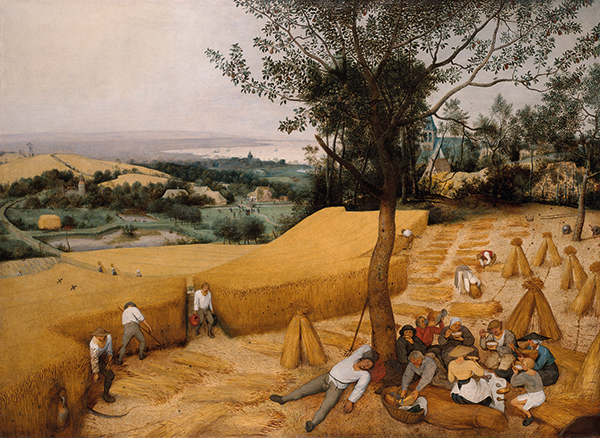
And I came to reconsider my other chance conversations in museums. When he found out I was from Texas, the man selling audio guides at a museum in Vienna had told me about living in Austin and being invited onto Willie Nelson’s tour bus (“I felt bad for Willie that he couldn’t afford his own cigarettes”). A befuddled fellow tourist at the Art Institute of Chicago had asked, of everyone and no one, at the threshold of the Contemporary galleries, “What’s the difference between Modern art and Contemporary art?” I started to blurt out “World War II,” then thought better of it and gave a different bad answer: “Modern art is weird stuff painted normal. Contemporary art is normal stuff painted weird.” When we ran into each other later, he told me with guileless surprise that this had been really helpful. And at the Met in New York, in front of Bruegel’s The Harvesters, a man had asked me out of the blue what I saw in it. For the first time in my years of obsession with that painting, I tried then to actually explain the peculiar fusion of brutal ordinariness and tender dignity that drew me to it in the first place. He told me, for his part, that he liked it but was more drawn to the moderns, a particular fan of Modigliani, so whenever I see a painting or sculpture by that artist, I think of that guy. The museum may invite the aesthetic hermit, but it becomes what it may be – its treasures open themselves in new ways – only when the hermit talks to strangers in whatever language is available, about whatever objects of our attention and love are in front of us.
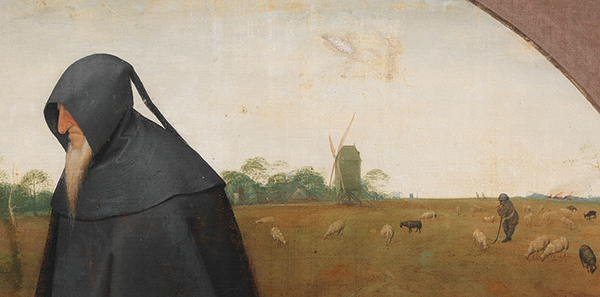
Looking at my photos and notes on The Misanthrope again, I paid more attention to the pastoral elements in the background. There’s a mill – my chance companion had reminded me of the French word, moulin – and sheep with a shepherd. They aren’t there to be picturesque or fill out the composition. A mill suggests the wheel of fortune and recursion, the impersonal forces that grind humanity up whatever we do. But the flock suggests, perhaps, the world of social life the misanthrope has turned away from. It is never wise to reduce Bruegel to a moralist with a lesson to teach. The irony of The Misanthrope, like that of many of his scenes, is fundamental. But that irony has a direction. Alone or with companions, the world will steal your heart, the painting said to me. Wherever you go, there you are, and the world is with you. You’ll flee it only to end up in its grasp. But at least the sheep have each other and a shepherd. Whatever safety, whatever joy, whatever insight can be had in this life, it’s back there, in community, not in the foregrounded journey into imagined solitude.
The next day I found myself in a café at the top of a castle that overlooks the city. An American family of four was speaking at the table next to me. “Where are you here from?” I asked them. “Dallas,” they answered. “I’m here from Dallas too,” I said. We talked about our different suburbs and how the young children had found Naples. I told them the story of my previous evening. When they heard about the pizza, their ears almost visibly pricked up. “We need a place to eat tonight. Where was this?” I showed them on my phone. “You should definitely go. Make a reservation,” I urged them. “And if you do go, please, please tell the host that you met a famous pizza expert from New York City today who told you it was the best pizza he’d ever had.”