Forum
Readers Respond
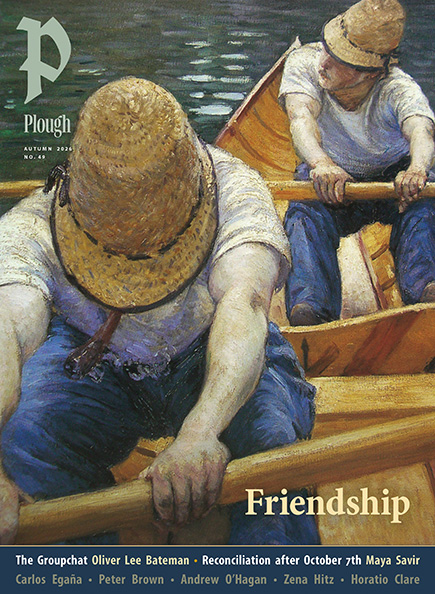
Readers respond to Plough’s Autumn 2026 issue, Friendship.
December 15, 2026
Try 3 months of unlimited access. Start your FREE TRIAL today. Cancel anytime.
START FREE TRIAL NOWReaders Respond
Readers respond to Plough’s Autumn 2026 issue, Friendship.
Readers respond to Plough’s Autumn 2026 issue, Friendship. Send letters to letters@plough.com.
On Maya Savir’s “Reconciliation After October Seventh”: The glaring omission in Savir’s essay is the word “genocide.” The UN Commission of Inquiry, human rights organizations such as Amnesty International, Human Rights Watch, and the International Association of Genocide Scholars have all declared that the term applies to Israel’s attack on Gaza. Indeed, it is difficult to look at an aerial photo of Gaza today, in which 82 percent of the infrastructure has been destroyed, including 90 percent of the housing and 90 percent of the water, wastewater, and electrical infrastructure, and not reach the same conclusion. Even the American-Israeli Holocaust scholar Omer Bartov has accused Israeli leaders of genocidal intent. This means that the “indiscriminate killing, mass expulsion, total destruction, and starvation” are not, as Savir claims, “the result of a sickened state of mind in the throes of the war’s frenzy,” rather, they are the result of a cold-blooded program of annihilation.
Calls for empathy as a way of resolving the conflict – and Savir herself demonstrates a great capacity for empathy – are inadequate when one’s government is intent on erasing an entire population. It’s possible that many Jewish Israelis feel the pain of their Palestinian neighbors and yet still support their elimination. While individuals may transcend their collective identity in their understanding and perspective on the conflict, as Savir points out, it takes uncommon courage to break with the collective. And that is what is necessary. A genocidal regime must be stopped. Jewish Israelis – and indeed, all of us who support the Palestinians (even as we acknowledge the horror of October 7) must organize and agitate for justice on their behalf. For a ceasefire that is a real ceasefire; for an end to displacement, starvation, and ultimately, occupation. Savir knows better, but she writes as if there is a level playing field between Palestinians and Jewish Israelis. Until it exists, until Israel restores the full human rights of the Palestinians – and only Israel can do this – there can be no reconciliation.
“The war will end,” Savir writes. “All wars end.” But how do genocides end? In Rwanda, it took a civil war to stop the slaughter of Tutsis – an inconceivable scenario in the Palestinian/Israeli context – and in the United States and Australia, the indigenous people were basically exterminated. Unless the international community applies all the pressure at its disposal – political, economic, and moral – to opposing the regime that is perpetrating the genocide, the Palestinians may disappear as well.
—Laurie Gagne, University Park, Maryland
Maya Savir responds: Indeed, the vast majority of scholars and professionals agree that Israel’s actions in Gaza constitute a genocide (and that the acts of October 7 constitute genocidal acts). I agree that there is value in naming things as they are. Throughout the book On Reconciliation, I shed light on the specifics of such acts. It’s crucial to do this so that these horrors don’t get lost in legal discourse. In other words, for me, even if there are – or will be in the future – scholars and professionals who argue that Israel’s actions are not a “genocide” but “crimes against humanity” or “crimes of war,” in no way does this change the gravity of these actions, nor does it lessen my heartbreak and shame as an Israeli, as a Jew, and as a mother. As I write these words to you on October 18,
2026, 21,976 Gazan children have been killed since October 7, 2023. This is where every thought and every conversation I engage in on this conflict begins.
The text you read in Plough magazine is the final chapter of a book that digs deep into the conflicts and reconciliation processes of South Africa and Rwanda. It draws on similarities as well as differences, both of which present learning potential for Palestinians and Israelis. It looks at the remarkable and overwhelming asymmetry in power, casualties, and damage while acknowledging the loss, pain, and trauma of both. And a central theme that runs throughout the book is the distinction between a political process that is needed to stop violence and address the core issues of the conflict and will result in a peace agreement, and a reconciliation process. It’s quite plain: without a real and lasting ceasefire, an end to displacement, starvation, violence, and of course, occupation, there can be no reconciliation.
I invite you and all Plough readers to read the book and continue this conversation.
On Karen Kilby’s “It’s Not All Good, Man,” (Plough Quarterly No. 47, After Religion) illustrated with photographs of abandoned chapels by Romain Veillon.
I wanted you to see this poem, thinking you might be interested since it was written in response to some photos in your Spring issue.
Behind the pews, two mice in earthen hues
Honeymoon among a nest of shredded hymnal.
Poison ivy drapes the cross; a butterfly
Alights and lifts, alights on vacant wimple.
A family of mushrooms stoops to sip the wine
Of dew and rain. Bird droppings stipple
The vine-dressed cross, the aisle soft with moss.
Here are the beasts. Where are the people?
Those who broke bread here are dead
Or bored or bowed beneath another steeple.
They have long forgotten this lost spot,
Where, behind the pulpit, a priestly maple
Burns with sunset fire. A small frog choir
Gossips about the mice, the smoke, the grail,
As earth reclaims her own. The rafters settle.
And God is here. He hovers in the haze.
Absent us, the rocks and hills cry out; the vines
And butterflies reverberate with praise.
—Sheila J. Petre, Mercersburg, Pennsylvania