Insight
Praying to See Patients
Two doctors introduce On Service, a new pocket-sized prayer book of the clinical hours.
December 15, 2026
Try 3 months of unlimited access. Start your FREE TRIAL today. Cancel anytime.
START FREE TRIAL NOWPraying to See Patients
Two doctors introduce On Service, a new pocket-sized prayer book of the clinical hours.
[.small-caps]Abraham M. Nussbaum: I realized[.small-caps] how empty my pockets had become while squatting at the foot of a hospital bed.
The patient above me had just received his first dose of a medication that reconnects divided parts of the brain. Under its influence, repressed memories resurface, and moods heighten into elation. Before the first dose, Damian looked apprehensive but still. Two minutes later, he was shifting and squirming against the plastic arms of the hospital bed. Two minutes more, and he was working his cotton T-shirt over his head, revealing a torso scarred by abuse in his home country and thinned by depression in this country. He breathed deeply, then tried to force pain out, first as an exhaled breath, then by tightening his knuckles against each other. His fingers blanched, then his forearms. His lips quivered, but no words came out. Watching his efforts, I felt, for some brief moment, as though I was keeping watch at something so separate from my regular work that it was holy.
By regulation, I was required to stay in the room for at least fifteen minutes. I looked around for my usual anchors. There were vital signs displayed on a digital monitor, clinical signs and symptoms to observe, students and residents to supervise, but I wanted something beyond regulation, some way to hold on to the holiness of the moment.
I put a hand to my pocket and found my smartphone. I navigated to a list of online prayers. I started on the rosary. I made it through the agony and was headed for the scourging, but alerts, beeps, and dings thinned my attention until I lost sight of what was holy about the work.
[.small-caps]I was a late adopter[.small-caps] of the smartphone. My wife and I went through medical training together, and the experience of carrying pagers left us incredulous that anyone would pay for the privilege of having one’s attention divided by a device. We held out a decade longer than our friends, but today, we navigate work and home with smartphones in our pockets.
I find myself, after a fashion, missing pagers. Their alerts were simple, a tinny tune announcing a colorless string of numbers and letters, but I can’t bring them back. Digital technologies do not coexist; they displace each other.
What can coexist are pocketbooks, the little five-inch paperbacks that generations of physicians carried to guide them through the clinical training years. Every day as a medical student, Sanford’s reminded me which antibiotics to use when I cared for the infected, and Maxwell’s taught me how to write doctor’s orders. They guided me on rounds, as I examined patients, administered treatments, and wiped away tears. They distilled the knowledge of leading physicians so I could carry it with me.
Today, medical knowledge is dispersed instead of distilled, available everywhere and nowhere at the same time. When I see patients now, what I need is the wisdom of those senior physicians referenced in the titles of those pocketbooks. Where are Drs. Maxwell and Sanford when you need them?
[.small-caps]The medication[.small-caps] we administered to Damian can lead to the dissolution of ego and self-perception. It can excavate traumas and leave patients feeling like laboring mothers groaning over a new creation. Initially, Damian closed his eyes and clenched his fists. Then, he began to cry for his missing mother, left behind in his home country.
Doctors still call our work seeing patients, even though many of us confess we typically struggle to see our patients in their fullness. When I meet people as patients, too often I see them as a collection of parts available for my examination and treatment. What I need are means to see anew.
Two years ago, I felt a growing need for the kind of beauty that might renew the habits of modern medicine. I remembered how I used to carry a compact morning and evening prayer book and, after that, a small copy of the Rule of Saint Benedict, which divided the rule into daily portions so you could read it through three times in a year as it pressed its message upon you: the monastery is a schoolhouse for service. When the phone took over my pocket, I stopped carrying either.
[.small-caps]I am not alone[.small-caps] in missing pocketbooks. Small blank notebooks, like the Field Notes series, have grown in popularity over the past decade. I often see students and interns carrying them around the hospital. When I attend meetings, I increasingly see people who once used their computers now turning to Moleskines to record their notes. I take the small renaissance of these pocketbooks as an unconscious collective act of resistance to totalizing technologies, an analog reclamation of attention.
I resolved that if I wanted to reclaim more of my own attention, I ought to join their resistance. I shared my resolution with a friend, Brewer Eberly, and we set about creating On Service, a pocket-sized prayer book of the clinical hours. Together we wrote and gathered prayers for each of the events of a clinical day and night, trying to tether medical work to the labor of the church – to recognize the hospital as another schoolhouse of service. We scoured digital archives for engravings and line prints and symbols that spoke to what we saw at the bedsides of the sick. We took inspiration from friends, fellow artists, and Benedict’s dictum: Ora et Labora.
Brewer and I sought out pictures from across the Christian tradition, because the care of the ill, especially the indigent ill, is not the work of any one clinician, but the work of the church, the community called to care for the least among us. We need reminders of that community, so we can see patients in their fullness. We found it in the art of those who came before us.
[.small-caps]The fifteen minutes[.small-caps] were up. The resident physician, for whom Spanish was a native tongue as it was for Damian, remained on the floor across from me, watching Damian with a surprising intensity. Resident physicians are typically pressed into impatience by the mismatch between their narrow experience and the expansive needs of patients. But still, he stayed, shuffling the printed pages enumerating his clinical chores, waiting to see if Damian would change.
Damian’s vital signs settled, his breathing slowed. I returned to my phone, pressing on through the sorrowful mysteries of the rosary, even as the digital interruptions continued.
[.small-caps]We are called[.small-caps] to see Christ in the sick, but we need new tools in every age to help us do so, tools that remind us we are never alone when we are working with patients. When we go on service and begin a period of clinical time, we are keeping watch with a patient like Damian, in company with all who came before us and will come after us in this work and prayer.
[.small-caps]Brewer Eberly: I have always[.small-caps] been uncomfortable praying with patients. I wish I could say this is because I approach prayer with holy fear. Instead, when a patient asks me to pray with him or her, I feel compelled into silence – to retreat and wait for the Word to give me word. But I also find myself reaching out for something more specific, for guidance on what to say when no one knows what to say.
I long ago gave up on pocketbooks. My clinic desk drawer is a graveyard of the small guides known to all practitioners. I was trained as a physician at the cusp of what the poet Seamus Heaney might have called a “great sea-change” – from flipping through the pocket-sized Maxwell’s at the beginning of medical training to scrolling on my pocket-sized phone by the end of it. I became one of those Moleskine users Abraham describes (though with a love for the gridded Yamamoto Ro-Biki, I must say). I had also become moved by projects such as Every Moment Holy, which were taking up the work of finding words for the wordless.
If the next “sea-change” is artificial intelligence, then our book is a small attempt to help the faithful who practice medicine endure by offering something AI cannot – silence and prayer. We are pleased to share five pages from On Service, the book Abraham and I have made to help us keep watch with patients like Damian.
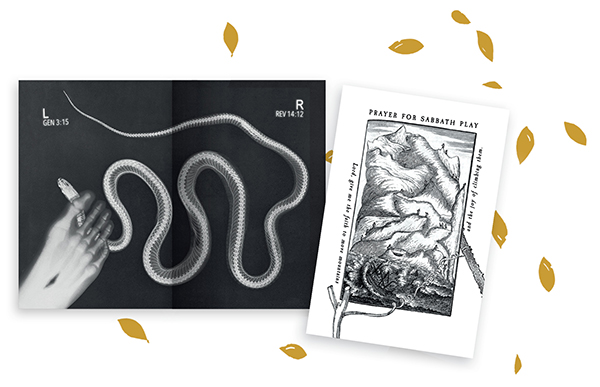
We wanted a page spanning the whole arc of the good news, from the protoevangelium of Genesis 3:15 (“He will crush your head and you will strike his heel”) to the words of perseverance given in Revelation 14:12 (“This calls for patient endurance on the part of the people of God who keep his commands and remain faithful to Jesus”). Both the “Aesculapian snake” and the foot in the illustration above come from Josef Maria Eder and Eduard Valenta, Versuche über Photographie mittelst der Röntgen’schen Strahlen (Experiments in Photography by Means of X-Rays), one of the first series of X-rays ever produced. The foot is in fact a left foot that has been flipped, from an anonymous “17-year-old youth.” The early church father Irenaeus imagined Adam and Eve in the garden of Eden as teenagers, but this image is also meant to represent the foot of Christ, the second Adam. To symbolize this, I created a wound on the foot, “pierced for our transgressions” (Isa. 53:5).
I nicknamed this two-page spread “Footstriker’s Hemolysis” after a type of anemia seen in patients, often marathon runners, who use their feet more than usual. Patients can grow anemic from literally crushing their own blood cells underfoot. We hope this visual gives new ways to consider how Jesus was “crushed for our iniquities” while we pray for “patient endurance.”
I was once praying with a group of friends who had good reason to cry out to God for the faith to move mountains. My dear friend Thomas Sieberhagen, a theologian and missionary, had recently moved to a beautiful place with high mountain ranges. He quipped in prayer that he wanted to climb those mountains too. Thomas also loves the Sabbath.
For many Christians, practicing the Sabbath is complicated, and Thomas’s prayer inspired me to create a page for clinicians with Sabbath in mind – not as another “life-hack” or spiritual checkbox but as an invitation to play and delight. I set to work looking for unusual images of mountains and fell in love with this picture of a salt mine – reminiscent of a place of potentially punishing and industrial work but also of Abraham Joshua Heschel’s description of Sabbath as a “palace in time,” which rises above the never-ending waves of our present priorities that threaten to dash the little ships of our projects.
The wood and vine traversing the page is “A Caught Tendril of Bryonia dioica, Spirally Contracted in Reversed Directions,” from Darwin’s “On the Movements and Habits of Climbing Plants” in James Bell Pettigrew’s 1908 collection Design in Nature. Pettigrew’s careful study of spirals in creation led to the discovery of how the muscles of the heart work. To my eye, these plants bring the whimsy of two walking staffs, which escape the bounds of the page, but they also speak to the turning of our hearts in community. Working in medicine can sometimes feel like being “spirally contracted in reversed directions,” and so we need calls to climb and play – ideally with friends – to find the heart of our work.
This page also has one of the Easter eggs we’ve hidden throughout the book, in this case, “three figures walking in a line” by Mexican political printmaker José Guadalupe Posada. These figures became a little comfort to me while designing On Service – a reminder that Abraham and I are but two pilgrims, always following another.
Abraham found Viktor Tischler’s Die Auferweckung des Lazarus while searching for a suitable representation of Jesus raising Lazarus from the dead. Tischler was an Austrian Jew who produced this drawing in the aftermath of World War I, only a few years before leaving for Paris as the future darkened for European Jews. Here is light shining out in thick darkness – the kind of art we would do well to leave alone and let speak for itself. If we were to match words to this image, we knew they needed to be from someone with a similar eye for light and shadow. We thought of the words from Wendell Berry, who closes his poem “Manifesto: The Mad Farmer Liberation Front” with the invitation-command, “Practice resurrection.” The text rises up toward Jesus Christ, who answers, “I am the resurrection” (John 11:25).
While catching up with a med school classmate, Abraham visited the Tate Modern. There, he found a copy of Wyndham Lewis’s avant-garde manifesto. Published in June 1914, before World War I broke out, Lewis’s screed divided the world into what he wanted to “BLAST” (curse or reject) and “BLESS” (celebrate or praise). Blessing the sea, industry, and mechanical energy, Lewis celebrated ports as vital machines. Abraham immediately thought of the hospital as a vital place, like Lewis’s ports, but for human care instead of industrial machinery. Reading Lewis’s manifesto against itself, Abraham snapped a picture and sent it to me. The pastiche and prayers came quickly.
We call out such a vital place elsewhere in On Service by invoking Saint Basil’s description of the first hospital, described as a “new city” because it was a new work of the Holy Spirit. For the remarque in the top left, we settled on the detail from a woodcut by Félix Vallotton as a way to personalize our encounters with tenderness.
When Abraham was growing up, he lived a few blocks from a local bookbinder and artist, Jim Trissel. One year, Jim and his wife, Carol Neel, letterpressed a book of the hours called The Cycle of the Day. Each hour of the monastic day began with a colophon of an unconventional timepiece: Matins began with a drawing of the rock arrangements of Stonehenge. Sext opened with flowers blooming at different hours of the day in Linnaeus’s garden. Vigil bore “a moon as full as mercy,” in Abraham’s lovely ekphrasis.
The book was on display at the college where the Trissels worked together, and the images stayed in Abraham’s mind. A few years later, the college sold prints of the colophons, and Abraham has kept one or another above every one of his writing desks since. When he reached out to Jim’s widow and daughter for permission to turn a few of his colophons into pages for On Service, Carol wrote back, “Of course. Bless you.” We took three pieces from Trissel’s masterpiece and reimagined the colophons.
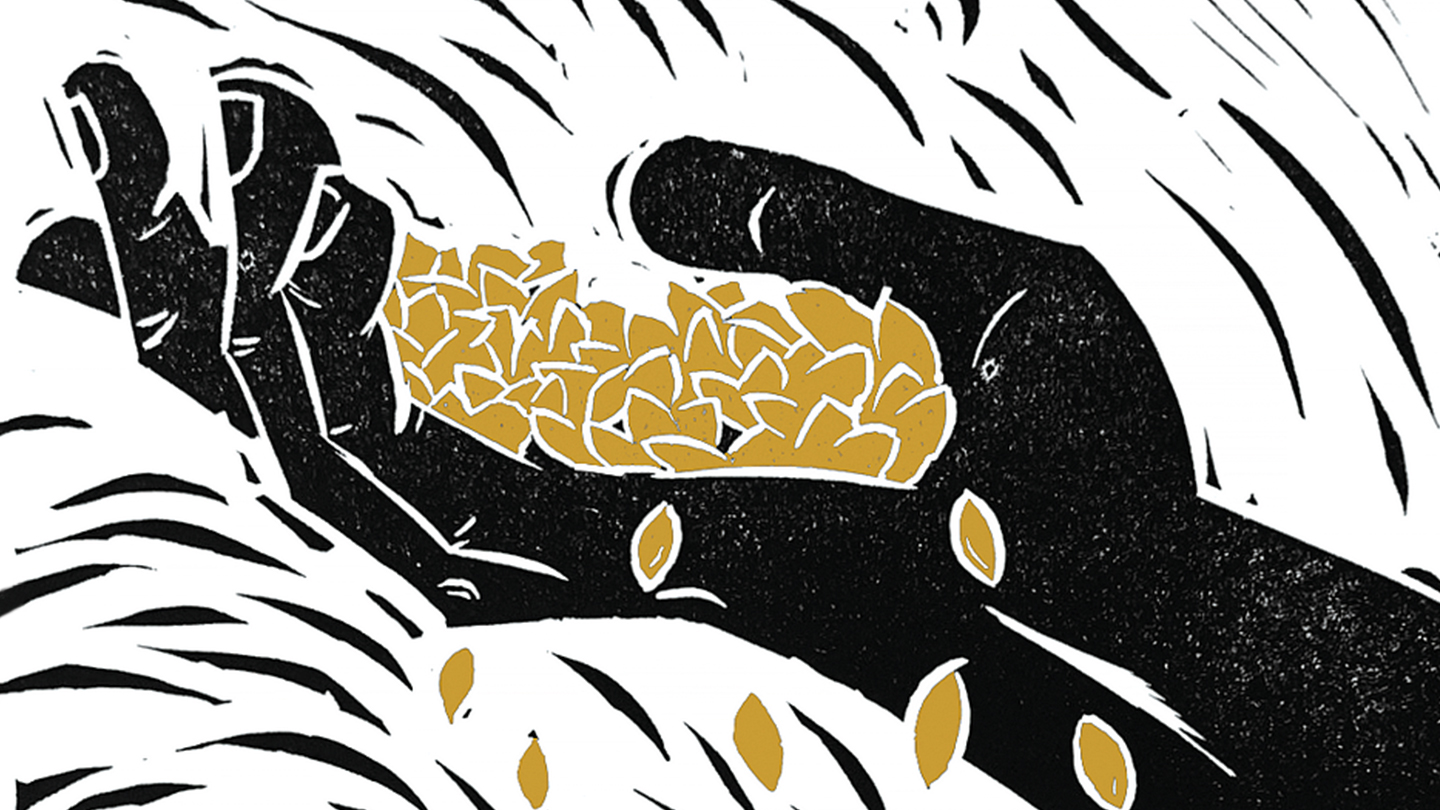
The prayer, like many of the pages of On Service, is written to disrupt but also to delight. In this case, the layout forces readers to move their eyes upward to complete the prayer, embodying – if even in this small way – an act of hope. As readers will discover, we have also scattered “seeds” from the cover of On Service throughout the book, including on this page. We hope these seeds leave what James K. A. Smith called “craters of the gospel” in the hearts on which they land.

[.small-caps]Wendell Berry wrote,[.small-caps] “Pray for the little songs that wake and move.” We have tried to listen to such songs before praying some of our own. I will be no less nervous praying with On Service at hand. What I have found is the unexpected gift of more easily thinking in prayer – tasting that great mystery of prayer “without ceasing” (1 Thess. 5:17). Making On Service has been like living in a little song that wakes and moves. I can arise thinking about a patient and find it already a kind of prayer, tipped into communion with God. And the songs are still inspiring new pages.
Daily clinical tasks – chart review, drawing blood – have become occasions for reimagination, reframing, and redemption. Moments like the one Abraham describes with Damian have become occasions to attend to what is holy about caring for the sick. Even the most frustrating clinical realities – calling insurers, interacting with administrators – have become occasions for mercy and repentance. Virgil said “by practice and pondering” we might “slowly forge many an art.” I would add to that “in every situation, by prayer and petition, with thanksgiving” (Phil. 4:6). Such is the spirit in which we want to go on service.