Family and Friends
Philosopher Farmers, Unite
What’s the idea behind Plough’s summer internship?
December 15, 2026
Try 3 months of unlimited access. Start your FREE TRIAL today. Cancel anytime.
START FREE TRIAL NOWPhilosopher Farmers, Unite
What’s the idea behind Plough’s summer internship?

[.article__paragraph--cap][.small-caps]In a scene[.small-caps] in Goethe’s Faust, the play’s eponymous hero stands beside the demon Mephistopheles in a witch’s cave. In front of them, an ape stirs a bubbling cauldron. Faust has asked Mephistopheles to “take away full thirty years from my existence” to give him back his youth. But on being offered the witch’s potion, he protests, questioning whether “Nature [or] some noble mind” has “discovered some remedy, some balsam” for old age. The demon answers, telling Faust that “there is a natural way to make you young.”[.article__paragraph--cap]
Go out in a field
And start right in to work: dig, hoe,
Keep your thoughts and yourself
in that field,
Eat the food you raise . . .
Be willing to manure the field
you harvest.
And that’s the best way – take it
from me! –
To go on being young at eighty.
Faust rejects this solution: “Oh, but to live spade in hand – / I’m not used to it, I couldn’t stand it. / So narrow a life would not suit me.” To this, replies Mephistopheles, “Well then, we still must have the witch.”
It is an intriguing scene and one that might have something to say to the current crop of longevity-obsessed Fausts in Silicon Valley. Similarly, the contrast that Mephistopheles draws between a benefit won honestly through the sweat of the brow and a goetic potion that gives youth to those who drink it offers an interesting critique of an artificial intelligence that replaces hard-earned knowledge with a computer-generated summary. But if we take this scene at face value, what are we to make of Faust’s rejection of farm work, his disdain for the parochialism of the field? Clearly, he sees his life of intellectual labor as urbane and broad-minded in contrast – a life that provides all the curiosities and distractions that an intelligent man could ever want. This is a familiar attitude.
To maintain a strict divide between white-collar and blue-collar work, to look down on working people as uninterested in the life of the mind, to assume that so-called intellectuals are freer because they don’t have to get their hands dirty – all of this is part of a similarly reductive view of life and work that is quite common in contemporary life.
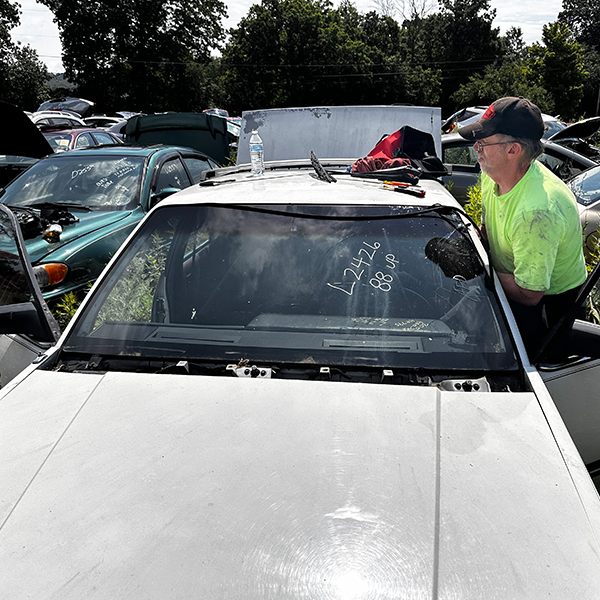
But at Plough, we’ve always rejected this division between manual work and intellectual work that restricts a person from practicing both farming and medicine (for example). The name of our magazine hints at our agricultural interests, but the name is more than just an empty reference. For the last few years, we have offered a month-long summer internship for a cohort of several university students that gives them the opportunity to learn not just the skills of magazine journalism but also the principles of regenerative agriculture. Interns take part in a wide variety of publishing tasks – copyediting, proofreading, fact checking – in the mornings, and spend their afternoons on the farm, herding cattle, weeding carrots, and picking tomatoes, among many other tasks.
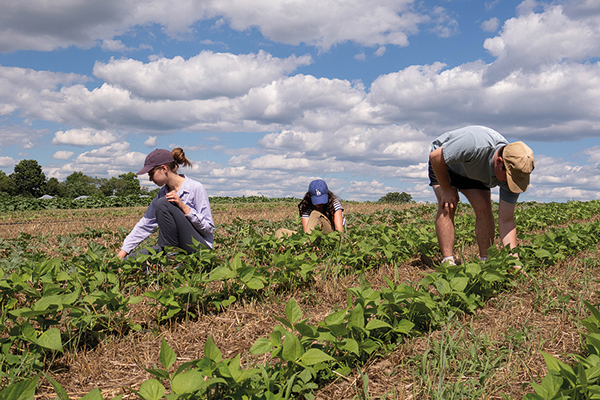
Alongside the work, interns take part in a series of tutorials on topics including reported journalism, developmental editing, and book publishing, and regenerative agriculture tutorials on topics including composting, grassland management, and beekeeping.
This conjoining of intellectual work with manual labor goes back to our magazine’s origins in 1920s Germany. Eberhard Arnold, Plough’s founding editor and the cofounder of the Bruderhof, the community that publishes Plough, once remarked that:
We should be ready to spend several hours each day (provided we are in good health) doing physical work. Intellectuals, in particular, would discover the wholesome effect this has. Daily practical work allows each person’s special light, his or her gift, to be kindled. This spark in each one, though maybe hidden, gives a glimpse of various gifts – possibly in scholarship, music, the use of words, creative art in woodwork, sculpture, or painting. Or simplest and best of all, a nature-loving person may have a particular gift for farm or garden work.
Arnold understood that, alongside the life of the mind, manual work is vital to a flourishing human life and to flourishing human communities. He further emphasized, “Where there is life, people have alert, creative minds and are ready to serve and help one another. This is not mere fantasy about an unattainable future; it is a present reality in a growing community.” This service was central to the Christian community that Arnold had cofounded a few years before he spoke these words.
That community is the same one that is behind Plough to this day. And it is also a part of our summer internship program. Interns take part in community activities: campfires, worship services, volleyball, and many more. The internship is built around this camaraderie that stands in contrast to the individualism and pride that drove Faust to build an edifice to self with the help of Mephistopheles. More than that, it will, we hope, shape the next generation of writers and farmers both intellectually and practically. And it pushes back against the artificial divide between the work of the hands and the work of the mind – because a flourishing person needs both. Learning this, these interns are learning to be young in a way that will last them until they are old, so that they can “go on being young at eighty.”
[.smalltext]Find out more and apply to Plough’s internship program here: plough.com/internship.[.smalltext]