Essay
Frog and Toad Theology
What can Arnold Lobel’s beloved amphibians teach us about friendship with God?
September 9, 2026
Try 3 months of unlimited access. Start your FREE TRIAL today. Cancel anytime.
START FREE TRIAL NOWFrog and Toad Theology
What can Arnold Lobel’s beloved amphibians teach us about friendship with God?
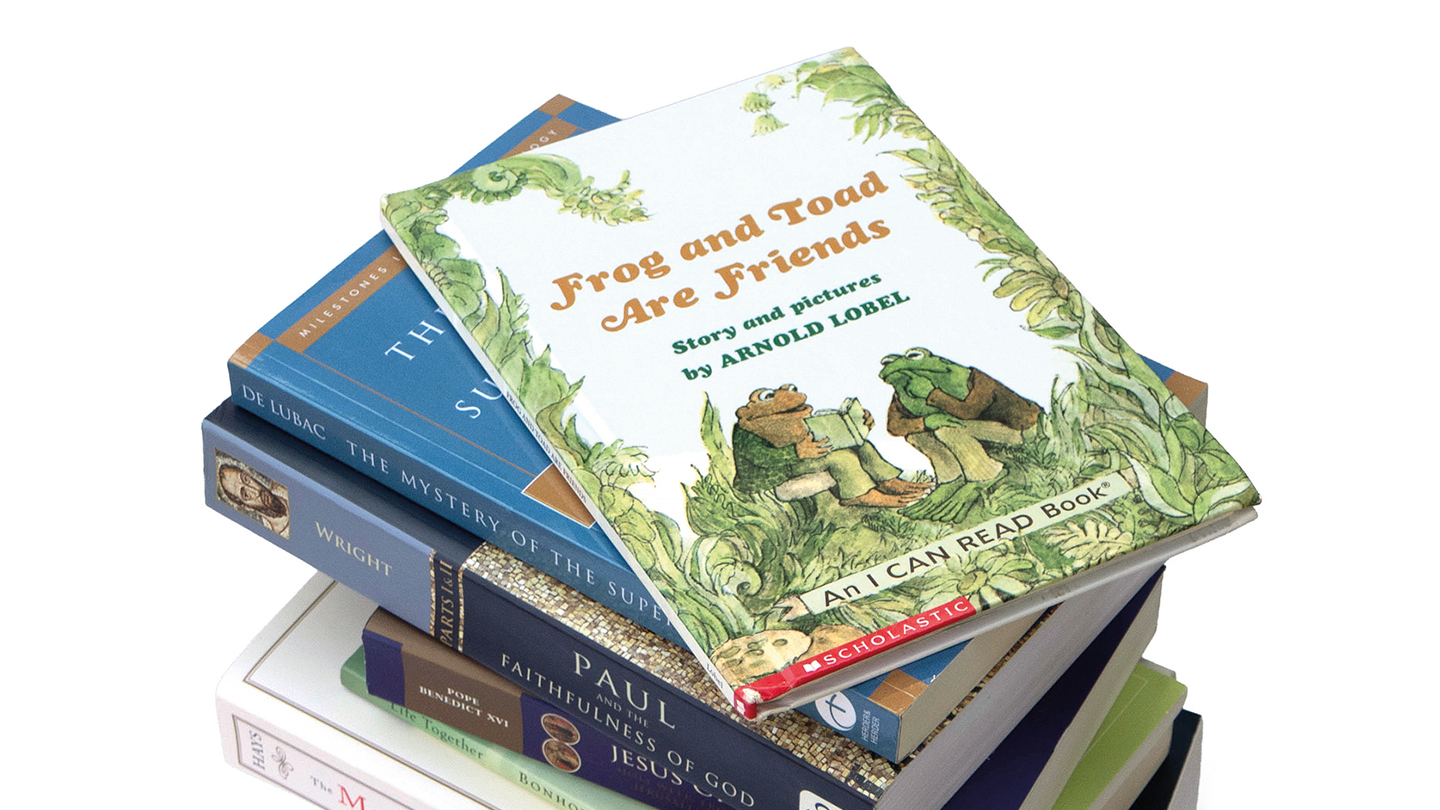
[.smalltext]Photograph courtesy of Jocelyn Maendel.[.smalltext]
[.article__paragraph--cap][.small-caps]Our family[.small-caps] recently underwent a small-scale summertime decluttering. In my daughter’s bin of outgrown books, there were a few I couldn’t bear to part with. These I intercepted before they could be given away. Among the rescued were three slim volumes of Frog and Toad, first introduced to me as a child. They are early readers written and illustrated by Arnold Lobel that describe in spare prose the ordinary adventures of two friends who see each other every day. Frog is the optimist and adventurer, Toad his more serious and bumbling companion.[.article__paragraph--cap]
Rereading the books now, I am struck by the friends’ commitment to each other, evidenced by the (often comical) lengths to which each will go for the other. In one story, after Toad discloses his “sad time of the day,” wherein he awaits the mail but never receives any, Frog dashes home to write Toad a letter and post it with a snail before returning to his friend, whereupon – even after he’s detailed for Toad the contents of his letter – together they wait four days for the letter to arrive. “Toad was very pleased to have it.”
What makes these amphibious stories especially human is that, more often than not, these great lengths are undertaken absent fanfare and in consequence of the personal foibles of one or the other of the friends. For instance, in “A List,” Toad’s determination to stick to his plans winds up demanding much from Frog. Toad makes a to-do list to govern his day. After a strong wind blows the list from his hand, Toad is unable to do anything at all, and so Frog must be the one to chase after the list, “over hills and swamps,” to no avail. Frog then sits at his friend’s side doing nothing until nightfall, when the two of them can finally accomplish the one thing Toad remembers from his list: “Go to sleep.” What this story highlights is not the absurdity of sticking too strictly to a plan, but rather the ease with which a true friend abides our personal absurdities. These friends are with each other through thick and thin. One’s plight is also the other’s.
The stories of Frog and Toad are beloved for their humor, but also, I believe, for reflecting to us truths about the friendships that we cherish, distilled into their simplest elements – things we know from experience but rarely ponder.
[.article__paragraph--cap][.small-caps]Christian thinkers[.small-caps] as diverse as the medieval Dominican friar Thomas Aquinas and the modern Reformed theologian Karl Barth have spoken of our lives in Christ as a kind of friendship with God. Meanwhile others, such as the philosopher and theologian Søren Kierkegaard, have worried that “friendship” is a poor match for the majestic love of God toward his creation. To consider these perspectives, however, we must settle what it means for God and human creatures to be friends at all. It may not be so obvious how human companionship gives us any purchase on the mysterious relationship between the almighty invisible God and you and me. The discontinuity between human relationships and ours with God makes the venturing of analogies fraught from the get-go. As my husband declared wryly to our children, “Your mom is becoming something of an expert in friendships with those who can’t reciprocate in the obvious ways.”[.article__paragraph--cap][#continue] [#continue]
Perhaps Frog and Toad, in their mutual faithfulness despite difficulty, supply as helpful a model of friendship as any. When Barth himself reaches for the defining feature of God’s relationship with us “put … in the simplest way,” he quips, God “does not will to be God without us.” God “does not allow his history to be his and ours ours, but causes them to take place as a common history.” Friendship speaks of a shared life, a life in which the sharing is a good in itself and needs no further justification. Frog sits with Toad till nightfall. Jesus weeps with Mary and Martha at their brother’s tomb.
Friendship with God, if it means anything, points to God’s desire to share life with human partners, a sharing that is initiated in the covenant between God and Israel and enfleshed in the person of Immanuel – God with us. In Christ, God opts to unite his own life with ours, to make the consequences of our lives his own, even to the extremity of the cross. From now on, our plight will be God’s own.
Friendship is a two-way street, however. To show the most extreme kindness to another is not yet to be a friend, since friendship requires reciprocation. Talk of friendship with God implies that God wants something back from us and is humble enough to receive it. God’s demonstration of love toward us in Jesus Christ must result in an ongoing relationship of reciprocity, of give and take, in order to establish a friendship with us.
Barth sees this give and take as a peculiarity of Yahweh’s dealings with human partners from the very start. After all, what kind of God would heed Moses’ intercessions on behalf of Israel or wrestle with Jacob until morning light? The answer is the God who wills to share a common life with us, to be “with us” forevermore in Jesus Christ. This God not only speaks to us but invites us to talk back. The Incarnation – God’s movement toward shared life with us – necessarily has ongoing consequences for our lives in Christ.
Here, we could extrapolate upon the features of friendship to describe conversion, sanctification, and vocation. Above all, however, for Barth, friendship with God is instantiated in prayer. Prayer is that activity by which we share our lives with God, willingly telling God our cares and concerns. It is also that activity by which we share in God’s life – participating in his redemptive purposes for this world by voicing them in prayer. Barth understood Christians, as God’s friends, to have a privileged, albeit provisional, knowledge of God’s purposes and part in their outworking especially in prayer and in prayerful actions. He also understood God to be claimed by our prayers and obliged to respond to them in concrete, if ever new and surprising, ways.
[.article__paragraph--cap][.small-caps]Many wonder,[.small-caps] for good reason, about the point of petitioning an all-knowing, all-powerful, and perfectly good God. Any God who would take our requests into account seems necessarily less than God. Friendship reframes prayer, however. It is not that God relies upon our prayers as a point of reference, or that God passively awaits our petitions. In drawing us to faith, it is prayer to which God draws us, since he wants to give us a share in his own life. The asking and receiving of prayer is a good in itself. God wants us to ask things of God and God wants to respond to us. This, it seems to me, is not unlike Toad’s delight at receiving Frog’s letter after a four-day wait, despite already knowing its contents.[.article__paragraph--cap]