Report
Firing Themselves into the Merciless Fury
Off the coast of Britain, volunteers with the Royal National Lifeboat Institution save lives.
September 18, 2026
Try 3 months of unlimited access. Start your FREE TRIAL today. Cancel anytime.
START FREE TRIAL NOWFiring Themselves into the Merciless Fury
Off the coast of Britain, volunteers with the Royal National Lifeboat Institution save lives.
All photographs by Danny Burrows. [.smalltext]Used by permission.[.smalltext]
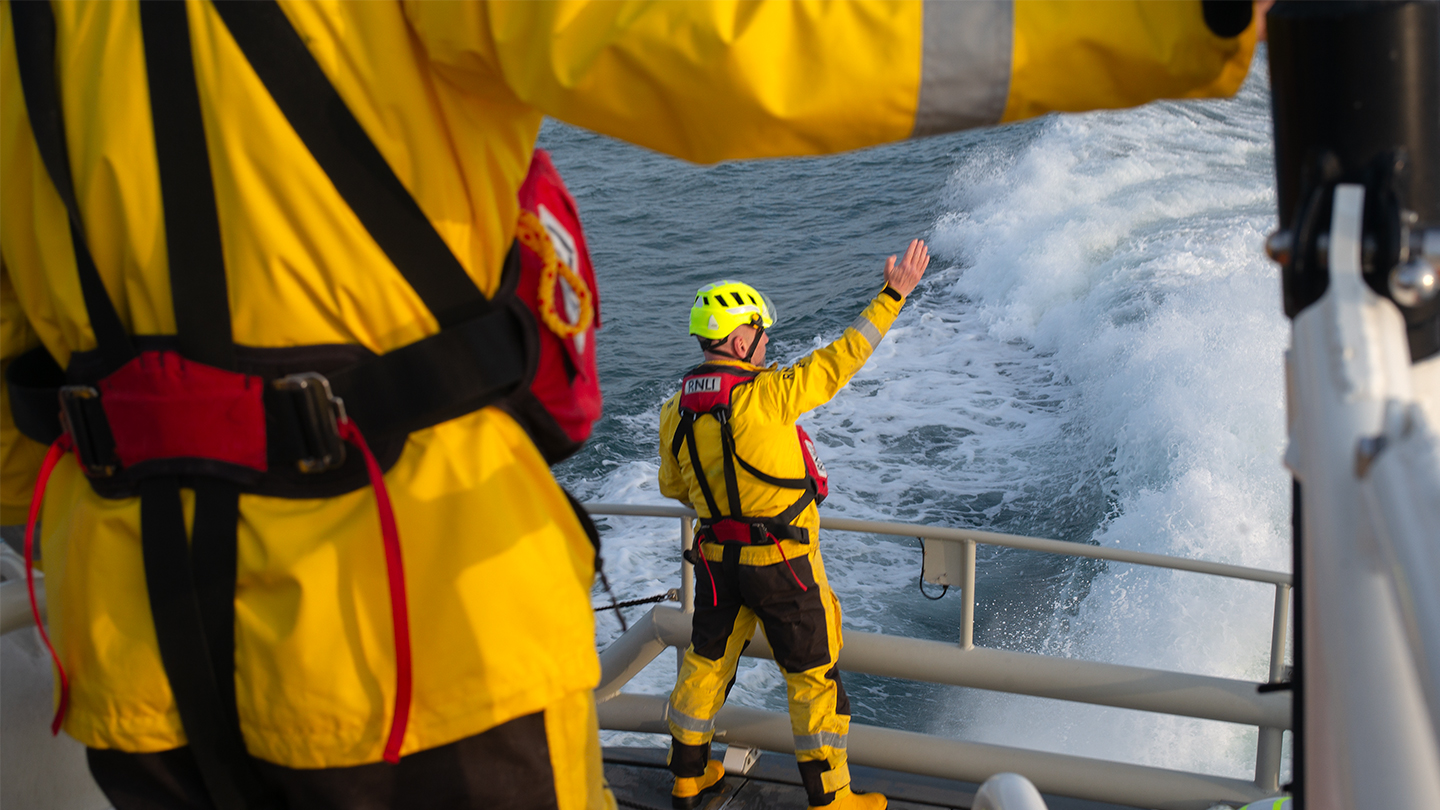
[.article__paragraph--cap][.small-caps]The adrenaline hits[.small-caps] me when the engines start. The helm and the engineer have tested the radio, waggled the rudders, checked all the electrical, mechanical, and navigation systems, and now the helm presses the start buttons. The marine diesels roar into sudden and violent life. The vessel beneath our feet shakes herself and puffs smoke, like a dragon startled from sleep.[.article__paragraph--cap]
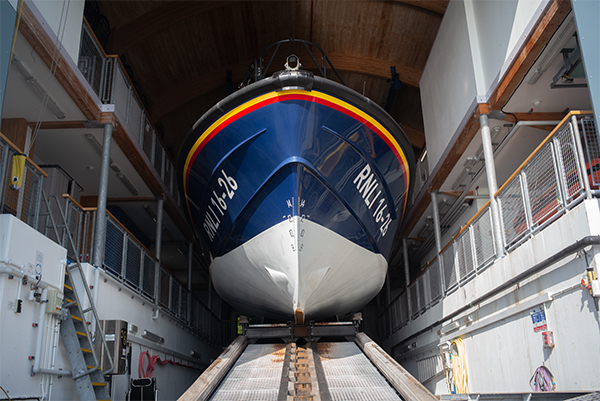
The boat is tilted steeply downward at the top of the slipway, the doors of the station are open, and the sea is waiting at the bottom of the ramp. The crew are all leaning back against the slope of the deck, feigning nonchalance and hanging on tight as the whole lifeboat station seems to shudder, echoing with the mighty cacophony of combustion in the two eighteen-liter, six-cylinder engines. Now an alarm sounds and we are seconds away from launch. Earlier, one of the crew, Jess Goggin, told me about this moment. “Going down the slipway,” she said, “is a feeling on its own.”
We are launching on exercise. No distress call has been received, although we are prepared to answer one at any moment. There has been a lifeboat here at St David’s, on the west coast of Wales, since 1867. The men and women around me, braced for the sliding charge down the ramp into the waves, are the latest in an unbroken line of local people who have stood ready, every night and day, in every weather and state of sea, to go out into whatever may be waiting down there, to save lives and vessels.
In today’s world, dominated by the bottom line, where time and skill and service are always chargeable, it seems a remarkable and beautiful thing that the crew of this boat, like every crew in the Royal National Lifeboat Institution (RNLI), give their efforts, their immense skill, and, in the worst case, their lives, without pay.
The station has a professional captain whose full-time role is salaried by the RNLI, but it takes dozens of people to launch, operate, and recover the Tamar-Class all-weather lifeboat Norah Wortley. All are unpaid. Volunteers they may be, but their conduct, qualifications, and equipment are anything but amateurish. The station boathouse, which contains crew rooms, changing rooms, equipment rooms, a shop, and workshop, cost £14 million. The lifeboat cost £2.7 million. Less than one percent of the institution’s budget comes from government contracts. We are all here because the people of Britain donate at least £71 million a year to the RNLI, and endow the service with around £150 million annually.
Over sixteen meters long and five meters wide, Norah Wortley is “a beast,” as one of her crew members puts it. The boat weighs thirty-two tons and can run at a top speed of twenty-five knots, for 250 nautical miles. She is tough as hell, self-righting should she capsize, and as close to indestructible as her designers could make her. She can rescue 118 people from the sea in a single mission and bring them all safely home. It takes years of training and assessment to crew and captain her.
This bright spring evening on the coast of Wales, the crew will put themselves and the boat through their paces, honing skills that will be tested in dire and terrifying circumstances. I am witnessing the pinnacle of maritime search and rescue: the RNLI was the world’s first national lifeboat service and remains the most advanced, regularly training and assisting the services of other nations.
How this came to be, and why it was and is still a voluntary service, is a remarkable story of idealism, altruism, and courage. Underlying this story are intriguing questions: How is it that a voluntary organization performs as well, if not better, than services provided by the state? Germany, Holland, and Sweden also rely on voluntary lifeboats, but services in the rest of Europe and the United States rely wholly or partly on their governments. Who are the people who crew lifeboats for no financial reward? Why do they do it? And what does the story of the RNLI have to tell us about the relationship between human endeavor and the impulse to serve others, even in the teeth of mortal danger?
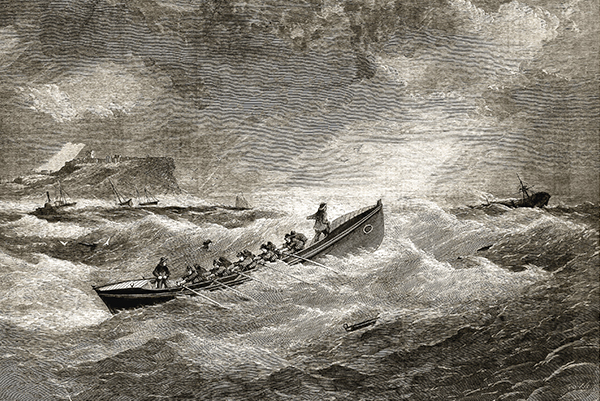
[.small-caps]Like a parable,[.small-caps] the RNLI’s story begins in sin, penury, and misery, before turning into a tale of achievement. William Hillary was the son of a wealthy Yorkshire merchant. He traveled, married a rich woman, blew most of his fortune, and exiled himself to the Isle of Man, humiliated by his wife’s infidelities and his self-induced poverty. He did at least have a baronetcy to show for his spending, having been made Sir William in return for £20,000 he had committed to raising a regiment of infantry and cavalry for the defense of the realm.
Much of the money had been borrowed from friends: his creditors and their agents now pressed him for repayment. The Isle of Man offered a refuge for the bankrupt, lying beyond the jurisdiction of the British Crown and British banks. As safe as it was for debtors, the island was death to many seafarers. Roughly equidistant from Scotland and Ireland, its shores were ringed with wrecks. Sir William Hillary was involved in helping survivors ashore from the foundering HMS Vigilant in 1822, and witnessed the disaster of HMS Racehorse in the same year, when six crew members and three men attempting rescue were drowned. Nothing if not a man of action, he assembled a volunteer crew and led them into battle against the raging seas. There was an idiosyncratic scattering of rescue craft around the British coast, but many poor communities had been more disposed to look on sinking ships as opportunities for plunder and salvage rather than victims to be rescued. Hillary resolved to change this. From 1823 onward he began to set up networks of lifeboats, funded by donations, with the money both paying for the boats and acting as life insurance for the women and children whose men would die while attempting rescues. Over six hundred lifeboat crew members have since given their lives in service.
In 1828 Hillary’s own crew went to the assistance of three ships, rescuing sixty-two people. Meanwhile, his Royal National Institution for the Preservation of Life from Shipwreck took off. Donations came in and lifeboats launched regularly, and effectively. Hillary had found his calling and the British people a cause they still hold dear. It remains one of the most generously funded charities in the country.
In 1854 the service changed its name to the Royal National Lifeboat Institution. There are now 238 RNLI stations around the coasts of Britain and Ireland – the institution transcends politics in the British Isles, with crews in the Republic of Ireland happy to sail under a flag bearing the seal and symbol of the British Crown. This exemption is unique in the vexed political history of the two nations.
From the outset, Hillary was determined that rescuers should pay no heed to nationality, creed, or color. “The people and vessels of every nation, whether in peace or in war, to be equally objects of this Institution; and the efforts to be made, and the recompenses to be given for their rescue, to be in all cases the same as for British subjects and British vessels,” he declared. This is the RNLI’s enduring position, a willful blindness to anything but need and peril which has come through two world wars and the recent small boats crisis in the Channel unchanged.
[.small-caps]Sir William Hillary’s[.small-caps] legacy can be seen in every seaside community of any size in Britain. Where a city, town, or large village abuts the sea, there will be a lifeboat station, the RNLI flag flying bright above it, and a small shop, staffed by volunteers, at its side. There is almost always a viewing window. Peering through it to glimpse the shining orange and blue lifeboat poised and ready on its trailer or slipway is a staple of the British childhood summer holiday by the sea. The particular and powerful attraction of the lifeboats, starts, for many of us, very young.
My family went to Little Haven in Pembrokeshire, Wales, every year and never missed the lifeboat station. Crews then were summoned by maroons, exploding bangers on the top of a firework rocket. The RNLI, being independent of government, launches in response to a request from the Coast Guard, which is an arm of the state. Sometimes we were lucky enough to hear the swish and crack of the maroons and witness a launch, the crew running, pushing their D-class (a souped-up inflatable, the smallest class of RNLI vessel) into the surf, the outboard engine howling, the crew piling in and setting off into the blue distance. The way our parents and other adults talked about the crew and the lifeboat, the way the people of Little Haven turned out to watch them go and wait for them to return, gave the boat and the crew an aura all their own. In towns where there is a lifeboat station, there is a section of one of the local pubs dedicated to the boat and the crew and the history of the RNLI in that region. They are shrines, decked with photos, flags, commemorations, and the stories of rescues.
For all that they are picturesque and beloved of summer visitors, many coastal communities are among the poorest and most deprived. Tour the lifeboat stations of Britain, from Anstruther in Scotland to Ramsgate in Kent, Pwllheli in north Wales, and Portishead in the west of England, and you will find towns where the fishing fleets have long gone, where heavy industry has collapsed and jobs disappeared. Their memorials are derelict warehouses, empty docks, once grand hotels, and dilapidated houses. The consequences are unemployment, crime, and social fracture. But wherever there is a lifeboat station, I also find an unmistakable and defiant feeling of hope. It is a fortunate child indeed who grows up connected to a station and its volunteers and crew. The children of these communities are proud of the lifeboat and its people, and some go on to join them.
Jess Goggin’s father moved to St David’s when she was a child and went to work on the boats that carry tourists and visitors out to the islands, coves, and bays around St David’s Head. Summer holiday weeks were spent with her father. While he was at sea, his daughter hung around the slipway of the lifeboat station, dreaming.
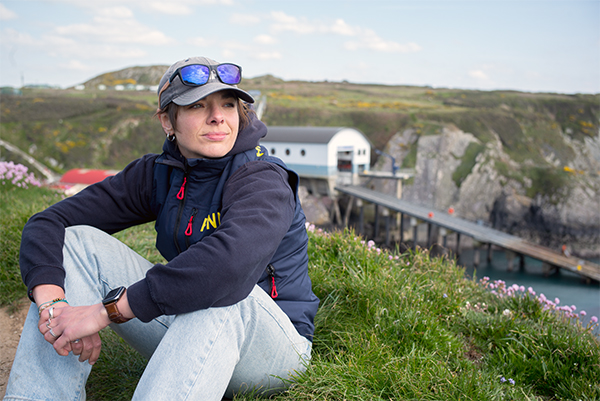
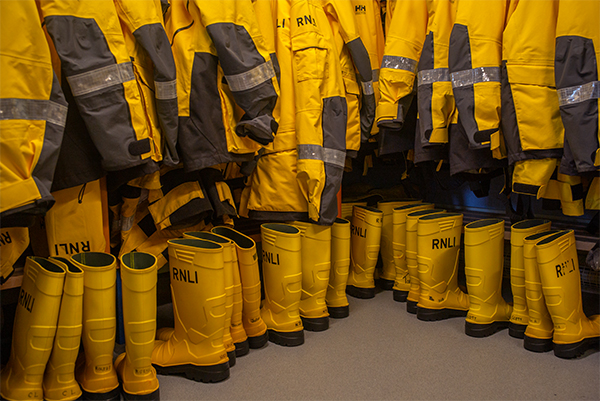
“I spent a lot of time idolizing the lifeboat and its crew,” she says, smiling, as we talk on the clifftop overlooking the bay. “When I was eleven at school, we had to draw a picture of what we wanted to be when we grew up. I’m rubbish at drawing, but I drew a stick man with yellow wellies. I’ve still got that picture.” (Yellow rubber boots are standard RNLI kit.) Four years ago, she decided to leave acting and drama, which she had studied in Cardiff, and move to St David’s, where she found work with the tour boats. “I always dreamed of being a skipper,” she says. She approached the RNLI, a space became available on the crew, and she enrolled.
“This place, I would say, is one of the tougher stretches of coastline,” she says, surveying the wide blue sound, Ramsey Island, and the scatterings of reefs and rocks, many of which are named. The Bitches, the Bishops, and the Clerks have sunk many ships and drowned many sailors. “With the rocks, the tides, and the weather it can get quite chunky. If you can handle a boat around Ramsey Sound, you can do it anywhere.”
In the summer Goggin spends up to fourteen hours a day at work, skippering a powerful RIB – a rigid inflatable boat, a tube on a tough composite hull, of the kind used by the RNLI for inshore rescues. “I just have a real magnetism to the sea,” she explains. “As soon as I step on the boat, off the land, I leave my troubles behind. And I like to go fast.”
That adrenaline hit, that love of speed, thrill, and risk should not be underestimated. At seventeen I joined a lifeboat crew and qualified as an inshore lifeboat coxswain on the Bristol Channel. There really is nothing like the feeling of pushing the throttles down, hearing the engines answer, and feeling the surge of power as the boat’s nose rises and the world begins to race. In a turn the whole boat cants over to one side and the engines roar. Speed over water, especially when you are only a few feet from the surface, feels nothing like speed on land. It is as close as you can get to flying a jet, and there is something in the soul of many of us, certainly lifeboat crews, which leaps in a kind of ecstasy at the hurtling dash of the boat.
“It verges on the feeling of danger,” Goggin says. “You’re in control of it but there is an option to overdo it, not that you ever would. The experience of being at sea is all about being able to predict what’s coming next. It’s a feeling. You can overcomplicate driving a boat and getting in and out of difficult spots, but you need to think about how the boat’s moving, what the sea is doing. A lot of people think I’m mad, but I work with my shoes off. I love to feel the boat through my feet.”
She explains how you handle driving through big waves, powering up the face of the swell, then pulling the throttle back at the top, “so you don’t jump off. You’re trying to find the perfect balance.” To go across a heavy sea, she says, you think like a surfer. “There will be a set of waves, and then in between sets there will be a lull, and that’s when you go across them.”
[.small-caps]Thrill, power, speed,[.small-caps] and the gaining and exercising of skill are clearly part of the lifeboat’s appeal to many of its volunteers. They run alongside the satisfaction gained through a deep knowledge of the sea and the coast, and the specific quirks and conditions of your local patch. There is an ease and confidence about Goggin as she surveys her world, a cool and contained way about her that exudes competence and self-assurance. I notice it in all the crew members I meet, who are wonderfully diverse. Here is a poet and musician, here is an ex-soldier, here is a professional chorister from St David’s Cathedral, and here is Julian Whitewright, maritime archaeologist, recently qualified as a deputy coxswain on the lifeboat, a gentle and deeply knowledgeable man.
“Everyone came here,” he says, “the Vikings, the Romans, Pythias the Greek from Marseille. Ptolemy called it the Cape of the Eight Dangers – we think he was referring to the Pembrokeshire coast as a whole. The Welsh name for the Bitches is Pant yr Gerit, the bridge of ghosts.” The rocks and islands give the seas here their own idiosyncrasies, which are notorious for catching sailors out. “You would assume that after high water the tide drops. But here it drops by carrying on to the north. So slack water actually comes two hours after high tide. If the wind is from the south and the tide is going out it can get very big.” He describes a coast dotted with the wrecks and relics of ages, from Roman anchors to the skeletons of steamships, the sea’s souvenirs from sailors who read it wrong.
Whitewright relishes being part of a continuity of seafaring and rescuing which stretches back beyond the foundation of the RNLI.
“You’ll see on the back of the Tamar [Norah Wortley’s crew use “the Tamar,” her class, as a shorthand for the boat] there is a massive axe. That axe descends from over a hundred years ago, when we needed an axe to cut down the masts of foundering ships.”
Since the Covid-19 pandemic, the lifeboat crew say, they have seen an upsurge in public interest in the sea, but not in corresponding knowledge or caution. “You can buy a kayak or a paddleboard for a hundred quid in a sports shop and go to sea without knowing anything else,” says Will Chant, the coxswain of the lifeboat and the captain of the station. Quiet-voiced, Chant wears his responsibility with an ease and modesty that seem to amplify his authority. A natural leader, certainly at sea, is rarely the biggest or loudest or most imposing person in the room.
In 2022, sixteen paddleboarders arrived in St David’s. Chant and Whitewright shake their heads as they describe men and boys setting out at slack water, no wind and a flat calm, for Ramsey Island. “They were having a lovely time,” Whitewright grins. “They were half an hour off the tide turning. If they hadn’t been spotted by a tour boat …”
Rescue came just in time. “Quite a few stations are busier than ever,” Chant says. “One weekend we had both boats out on separate jobs twice.” Alongside the Norah Wortley, St David’s station also has a small, fast D-class lifeboat, which can operate in shallows and narrows the bigger boat cannot reach. Part of Chant’s job is ensuring he has enough volunteers within a fifteen-minute drive of the station to allow him to crew, launch, and recover both lifeboats at once.
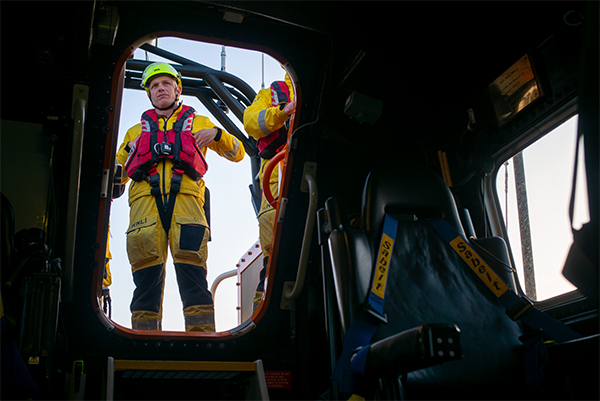
Chant gives me a tour of the Norah Wortley. Her main control cabin resembles the cockpit of an Airbus crossed with Darth Vader’s TIE Fighter: chunky black seats with serious straps and suspension systems to cushion the crew as she smashes through monster waves – it’s no use arriving on the scene of a rescue with your crew battered to pieces. State-of-the-art information management technology allow the cox and engineer to monitor and control her mechanical and electrical systems, along with radios and radar. The engine room is spotless, the cleanest and most modern I have seen. In her hold is a large cabin for survivors. The RNLI has disposed its resources, Chant explains, so that should a ferry run into trouble between Ireland and Wales a fleet of these boats, launched from a dozen stations, with a capacity of over a hundred casualties each, could handle the operation without any naval or civilian help. “We can bring everybody home,” says Chant quietly, and the phrase sticks with me. Bringing everybody home is what the men and women of this institution have trained and practiced and fought to do, and done, for over two hundred years.
[.small-caps]A lifeboat station[.small-caps] has never been just about the men and women who crew the vessel. Entire communities support them. Volunteering often runs in families. Will Chant followed his father into the RNLI, and his brother, Mike, a well-known singer and musician in St David’s, will be aboard today as well, as engineer. Some of the most moving stories of the RNLI involve entire villages. In 1899 the Lynmouth lifeboat was trapped in her harbor by adverse winds and waves, but a sailing ship in trouble in the Bristol Channel needed help. Over a hundred men and women harnessed eighteen horses and lugged the boat up and then down two of the steepest gradients in England, Countisbury and Porlock Hill, in order to launch her, knocking down walls and widening roads as they went. In February 1936 Atlantic swells were breaking over the Ballycotton Lifeboat Station in County Cork even as the lifeboat launched. Waves smashed over the boat for the next forty-nine hours as they searched for survivors.
The last boat lost in service was the Penlee lifeboat in Cornwall, in 1981. Even after giant rollers had carried the boat up on top of the foundering container ship she had come to assist, the crew went in for a second attempt, a decision described by a helicopter pilot who witnessed their efforts as “the greatest act of courage I am ever likely to see.” All aboard were lost. The awful and humbling aspect is that they must have known they were likely never to return when they set out. The coxswain, Trevelyan Richards, refused to take two members of the same family.
As I watch the crew assemble for their briefing before this evening’s exercise, it strikes me that it is like attending a family gathering, a family that stretches back and forward in time, united by pride in skill and service, unpaid professionalism, and a deep faith in and admiration for each other.
[.small-caps]Faith is a powerful part[.small-caps] of this story, and this crew. Chris Limbert is a warmly smiling man, a professional chorister and musician at St David’s Cathedral. He moved here from York and was immediately struck by the links between the town, the cathedral, and the lifeboat, which he joined six years ago.
“Seven members of the cathedral were lifeboat crew when I arrived. We have a cross on the altar, the Lifesavers’ Cross, carved by Nick Barthorpe, one of the volunteers, out of timber from the old lifeboat station,” he tells me. Limbert is now a helm on the small D-class, a member of the team on the Tamar, and the veteran of several rescues.
“I am sure there are many people on the crew who would say they are of no faith,” he says, “but being on the crew is an incredibly Christian act. It’s a very Christian thing to do; it’s living for love of other people.”
Limbert favors the tiny D-class over the mighty Tamar. “It’s a rarity on this crew! But I much prefer the ability to cut between the waves rather than punch through them.” He says there is a sense of launching into the unknown when they go “out on a shout” – RNLI slang for a rescue. “You don’t know what you are going to find.” He quotes the King James Version of Psalm 71: “In thee, O Lord, do I put my trust: let me never be put to confusion. Deliver me in thy righteousness, and cause me to escape: incline thine ear unto me, and save me.”
[.small-caps]Twenty minutes[.small-caps] before we are due to launch the crew room fills with men and women, from the young to the late middle-aged, all gossiping, chatting, and laughing, in an atmosphere of suppressed excitement. Coxswain Will Chant discusses plans with Julian Whitewright, who will helm the boat this evening. There is a short pause, and then Chant says, “Right, then …” He does not raise his voice at all. But the whole room has been keeping a surreptitious eye on him, I realize, because the second he speaks every one of us falls silent. It is a remarkable demonstration of authority so lightly worn it is all but invisible until required.
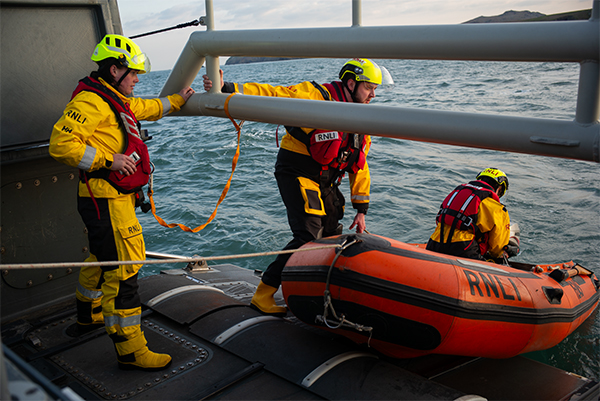
Chant reads out the names of the crew who are going out. He notes that high tide is 6.7 meters this evening, and the wind is forecast to come from the southeast and rise to a force six later. “We’ll practice man overboard drills and launching and recovering the daughter boat.” The daughter boat is a small speedboat carried in a compartment at the stern of the Norah Wortley, used for landing on shallow shores where the Tamar would run aground. “We’ll stay in the sound for the duration, so that if we get a call we can put someone ashore if necessary.” This refers to photographer Danny Burrows and me. If we get a shout and they need the space, we will make way. “Any questions?”
There are none. We calmly don waterproofs, helmets, and lifejackets and soon we are aboard the sloping boat. Response time is perhaps the key metric in the lifeboat service. The crew of the fastest station, Tower, beneath Waterloo Bridge on the River Thames in the heart of London, can get their boat away in around ninety seconds. The Thames is so dangerous, and the station so busy – the busiest in Britain – that it is staffed around the clock by crew who sleep in their gear, lifejacket and helmets to hand. “It’s taken me a long time to slow down when the bell goes,” one of that crew told me when I spent time with them. “Slow is smooth, smooth is fast.”
Concentration, precision, and economy of movement when your heart is hammering is quite a trick, but just now all I have to do is hold on. The engines roar, the alarm wails, and Julian Whitewright at the helm gives the signal. We are moving, the whole boathouse slipping by at increasing speed. Now we are out into the evening air, the cliffs sliding by as we plunge faster, racing down the slipway and now, with a sensation that is half a sucking embrace and half collision, we hit the water, the nose dips in, and then, with an exhilarating surge, we porpoise up, the boat leaps forward and we’re off, surging out across the glittering sea.
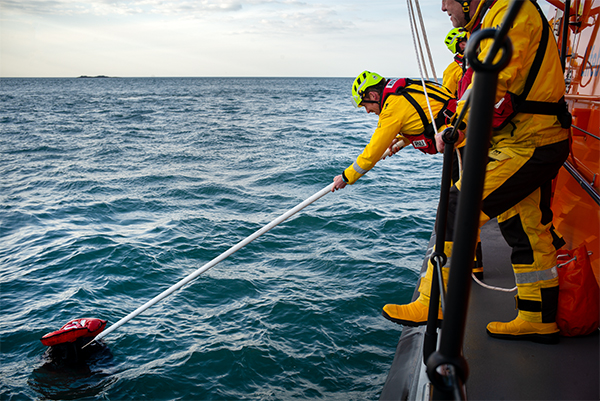
[.small-caps]Jess Goggin was right:[.small-caps] it is indeed a feeling on its own. I have wanted to experience it ever since I was a small boy and first saw the St David’s lifeboat station, and now I want to whoop. The Tamar is mighty powerful; she throws up a huge and boiling wake as the coast behind us diminishes. Out in the sound we throw “Dead Fred” the dummy overboard and rehearse retrieving him, maneuvering the boat alongside him and deploying the winch. Goggin steers with ease. Later, Whitewright lets me have a go. The boat handles wonderfully, the perfect balance of power and buoyancy. Spotting an opportunity to put on speed, I punch the throttles down. She roars and rises to them.
Using the bow thruster, bringing her alongside the dummy is simple, especially with the evening sea in such a gentle mood. Mike Chant appears through the hatch. “I heard you trying to break my engines!” he grins. Never mind volunteering: right now I would happily pay to join this boat and crew.
We launch and recover the daughter boat and complete our drills. Too soon for me, we return to the station, turn the boat to face the sea, attach lines, and are winched backward up the slipway. We wash the boat down and refuel. Soon she is ready to go again. When the seas are high, reversing, attaching, and winching up the slipway is impossible, so in anything over a force seven from the northwest, from which the station is unprotected by cliffs or islands, the lifeboat takes shelter in a bay or harbor along the coast until it is safe to return.
Mike Chant has been out on a great many shouts. Some of them must have been terrifying. “Is it ever too rough to launch?” I ask him.
“Oh, no,” he says. “We always go. We’ll go in a twelve” – a hurricane.
I ask him about fear. The thought of plunging down that slipway into a gale, the cabin battened down, strapped into your seat in a boat made suddenly tiny and vulnerable by the swells, is terrifying to me. I have been in big seas and storms on container ships, and there is nothing in nature more quailing of the spirit, more violent or more desolate than the sea in a murderous fury. The thought of these gentle, modest people firing themselves out into the worst it can conjure, determined to help others, not knowing quite how or when they will return, humbles me.
Mike answers thoughtfully. “You trust the boat and the crew,” he says. “When you go out in horrible weather, you think, ‘I’ll just get through this now, and I’ll do what I can to help the others, the crew and the casualties.’ You look after the boat first, because without the boat you haven’t got anything, then the crew. So if someone’s in trouble we get to them, and help them, and then we think about how we’re going to get back.”
One other line stays with me. Earlier, I had pushed Jess Goggin about the voluntary aspect, giving so much of her time and life. “Does it make a difference that you are not paid?” I asked.
She said, “I think it has a purity to it. When you do something like this for nothing, it’s pure, isn’t it?”
Sir William Hillary would have been proud to hear it, and would have agreed entirely. His motto, and that of the RNLI, is: “With courage, nothing is impossible.” And that is what I found in these men and women who are both ordinary people like the rest of us and also something a little more: the bearers of pure courage.