Book Excerpt
Seeking a Surer Way
Edith Stein, a philosophy-professor-turned-nun, found a faith mighty enough to face down the evils of her day.
September 10, 2026
Try 3 months of unlimited access. Start your FREE TRIAL today. Cancel anytime.
START FREE TRIAL NOWSeeking a Surer Way
Edith Stein, a philosophy-professor-turned-nun, found a faith mighty enough to face down the evils of her day.
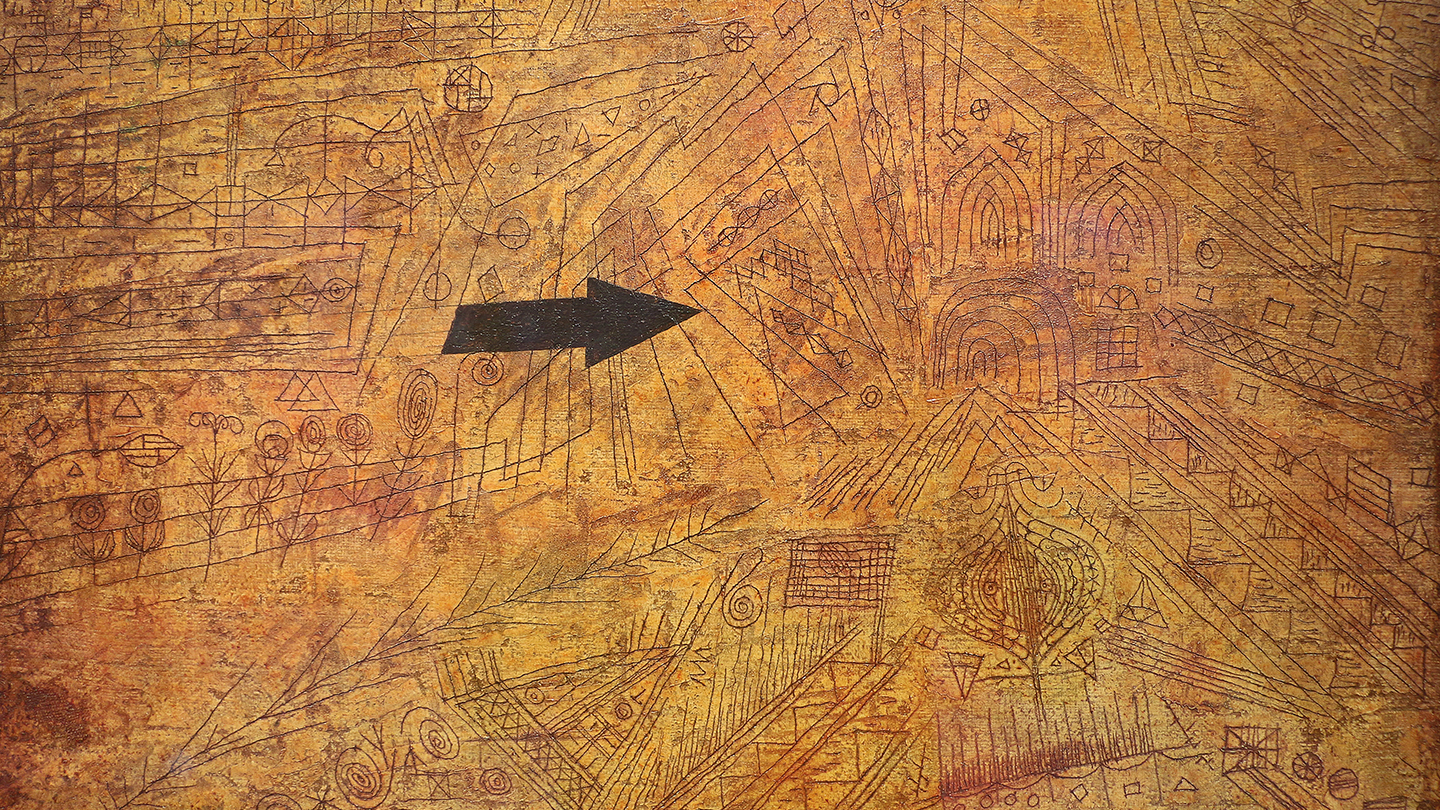
Paul Klee, Freccia in Giardino, oil and acrylic on linen, 1929 (detail). [.smalltext]Image from Wikimedia (public domain).[.smalltext]
[.article__paragraph--cap][.small-caps]Why read Edith Stein[.small-caps] today? She herself tells us why: “What is, then, the great sickness of our time and people? There is an inner disunion, a complete deficiency of set convictions and strong principles, an aimless drifting. Therefore, the great mass of humanity seeks an anesthetic in ever new, ever more refined delights. Those who wish to maintain a sober level of life, in order to protect themselves from contemporary turmoil, frequently annihilate this level by one-sided professional work; but even they cannot do anything to escape the turmoil.”[.article__paragraph--cap]
We members of “the great mass of humanity” – or at least a narrower group, the global middle class and those who aspire to it – find ourselves caught between addiction to pleasure and addiction to work. What clear goal organizes our lives? We live by media-driven trends and technological fads. We drift in the consumer markets. We are borne along on streams of public opinion whose basis in reality is questionable. Our attention is bought and sold by large companies unconcerned about our well-being or our contact with truth.
Why is the drifting painful? In part, because our own happiness depends on deep truths; unless those truths find us and we them, neither “refined delights” nor work can console us. Our desire for goodness and for real community is muffled and suppressed. Our modern media display in detail war, famine, and large-scale displacement. Yet our love and pity meet the obstacle of our own powerlessness. Our hearts long for a way of life that is steadfast and strong as well as ingenious and effective in the face of suffering.
Our governments are meant to effect the work of repair, but instead of a humane order we find a struggle between raw loci of power, none of which has any right to prevail over another. At one time, an appeal to ethical principles might have been offered as a fig leaf over naked self-interest. Now the mask has fallen away. The turmoil of these struggles for power is not an abstraction but bears real suffering in its wake: the suffering of those whose paths to a decent life have been erased, the suffering of the prisoner, the suffering of the migrant. Without strong common principles to cling to, we hide from the pain by pursuing the “refined delights” of artisanal cocktails or fine dining, mountain climbing or elaborately designed games.
Alternately – and here Stein has cut straight to my own heart – we bury ourselves in work, hoping there to find the seriousness that has been set adrift by the chaos of social life. Yet work does not give us strength nor saving grace. Our strength can come only from God. Stein continues:
Only whole human beings … are immune to the contemporary sickness: such beings are steadfast on eternal first principles, unperturbed in their views and in their actions by the changing modes of thoughts, follies, and depravities surrounding them. Every such individual is like a pillar to which many can fasten themselves, thereby attaining a firm footing.
Those anchored in Jesus Christ can provide a hitching post for others. Eternal first principles, as Stein puts it, are our only hope.
[.article__paragraph--cap][.small-caps]I first encountered[.small-caps] Edith Stein, or Saint Teresa Benedicta of the Cross, while preparing for baptism – along with the rites of confirmation and first communion – in the Roman Catholic Church. I was thirty-two. It is traditional to receive one’s confirmation with an appeal to a patron saint. I struggled to choose one. My godmother, a math professor, found Saint Teresa Benedicta and passed on some of her writings. My godmother’s thinking was obvious: I, like Stein, was a philosophy professor with a Jewish background.[.article__paragraph--cap]
I found Stein’s writing formidable and difficult to like. Much of it bears the stamp of the German academic world that educated her. The voice is passive, the language abstract, the aim scientific. Even her spiritual writing, while profound, is sometimes austere and impersonal. She keeps her own heart hidden. But stay with her long enough, and you will be rewarded.
By the obstacles she presents to her readers, Stein resembles the great Carmelite sister Thérèse of Lisieux, who was canonized during Stein’s lifetime. Thérèse’s writing bears the stamp of a French bourgeoise soaked in sentimentality. Its profound truths lie behind a veil of saccharine sweetness. Yet Thérèse is a fearsome saint; once her teaching is understood, it can inspire something like terror and awe at the holy strength and brilliance of this young woman. The theologian Hans Urs von Balthasar compares the fierceness of Thérèse to that of Saint Paul: two saints with whom a personal encounter might inspire holy dread.
Stein, too, is a saint who can inspire such holy dread. Her natural strength and accomplishments contribute to the effect. Stein’s mother was a powerful business owner; Stein herself was a suffragette and a successful academic at a time when women were generally excluded from collegiate halls. Her embrace of humility, first as a Catholic, and then as a nun, must have been hard won. Her divine strength, given by grace, hides behind her formidable natural character. Once glimpsed, however, the strength of the nun and martyr dwarfs the merely human strength on which she relied in her early life, and whose vestige remains on her writing. The philosophy student who could not find employment because of her gender needed fierce human strength; the woman who chose to enter the Carmelites and, later, faced the death camps could only have done so by divine grace.

As I have spent more time with Stein’s writing, I have found that what appears cold and impersonal at first turns out to be passionately universal. Under the veil of academic and monastic austerity is a heart burning with love and tenderness. Stein’s philosophical bent gives her spiritual writing a powerful objectivity and breadth of scope that a personal memoir might miss.
Stein’s last work, The Science of the Cross, was left open on her desk when she was arrested and taken to Auschwitz. Its writing is contemporary with the memoir of Etty Hillesum, a young Dutch Jewish woman who met the same fate. From Hillesum we can learn what it might feel like, from one day to the next, to face such a death and choose to offer it to God. By a strange coincidence, Hillesum was a volunteer at the transit camp of Westerbork when the transport carrying Stein passed through, though as far as we know the two never met. Hillesum’s letters describe the effect the transport of Catholic priests and religious had on those in the camp. Another witness reported seeing Stein at the camp, consoling parents and helping to look after their small children.
By contrast to Hillesum, we learn little of Stein’s experiences from her writing. In her last writings, she reaches into the teachings of the great Carmelite reformer Saint John of the Cross. The “science of the cross” – a deceptively academic-sounding phrase – turns out to be a living seed, not a “science” or a body of true statements in the least. The cross is not a mere image or historical event. It is alive, growing and working through the hearts of the faithful:
[The cross is] a living, real, and effective truth. It is buried in the soul like a seed that takes root there, making a distinct impression on the soul, determining what it does and omits, and by shining outwardly is recognized in this very doing and omitting.
Here again, the philosophical language veils a concrete reality. Christians walk in the shadow of the cross; Christian saints display this cross in their lives. Consider Stein’s own “doing and omitting.” When fired from her post in 1933 for her Jewish background, she did not emigrate to a lucrative teaching career in the United States. Instead, she became a Carmelite nun in the country that was seeking to bind and corner her. She was not reckless; when her community and her life were threatened, she emigrated to a convent in the Netherlands. When the Gestapo pursued her even there, she chose to suffer and die along with many thousands of others.
The shape of Stein’s life is cruciform, and she tells us why: the seed of grace planted in her heart grew and gave her the capacity to sacrifice as Christ did.
[.article__paragraph--cap][.small-caps]As the world around[.small-caps] her turned from brutality and repression into the flames of war, she posed a question to her Carmelite sisters – and perhaps to her own suffragette heart that sought strength in action: “The world is in flames. Are you impelled to put them out?”[.article__paragraph--cap]
Our own age is an age of problem-solving. We seek data-driven solutions to famine, war, illness, and corruption. As I write, these solutions are being unveiled as spectacular failures. War has spread rather than contracted. Famine and disease are on the upswing. Governments abandon the semblance of principle and do as they please against whatever enemies they choose to pursue.
Addressing her sisters in the convent days after the German and Soviet invasions of Poland, Stein appeals to the natural desire to aid the wounded and console the dying. Yet, Stein says, the faithful observance of their vows, the humble life of prayer and service in community, is more than sufficient. By union with Christ, “you are omnipresent as he is. … You can be at all fronts, wherever there is grief, in the power of the cross.”
Writing of the value of a woman in ordinary life, she points out that “everywhere she meets with a human being, she will find opportunity to sustain, to counsel, to help.” She sees in the most ordinary circumstances of life a canvas on which the cross of Christ can bring salvation. Our role is not dramatic on its face. The drama is the divine action. We need only to pray, serve, and suffer with fidelity.
We can read Stein’s words and imagine what she does not describe for us: the crucifixion of her own ambition. But her advice is also perceptive and prudent. Our role is not to govern the world, but to love one another. Such love is humble, small, and often invisible, and yet the health of the world hinges on it.
[.article__paragraph--cap][.small-caps]Edith Stein began[.small-caps] her adulthood as a philosopher, a seeker of wisdom and understanding. Edmund Husserl, her teacher, sought to steer philosophy back to the encounter with truth that modern scientific thought had obscured. Such intellectual work must seem a long way from God, and certainly the furthest thing from the humble acts of service Stein was seen doing up until her last moments.[.article__paragraph--cap]
Stein the philosopher saw the simple Christian argument as if it were addressed to her personally: philosophy strives for wisdom, but we cannot achieve wisdom by our own powers. Christ is wisdom, as Paul preaches in the First Letter to the Corinthians. Faith in Christ is offered to everyone, and in fact seems to come more readily to the humble than to philosophy professors. The perfect fulfillment of the search for wisdom is the sight of God in the afterlife.
Stein leaves it to us to draw out the scandal presented by her own life. She began her pursuit of wisdom as a favored student of Edmund Husserl, arguably the greatest philosopher of his time. She concluded it after spending some years behind the walls of a convent, following a simple rule of work and prayer, and then submitting to the grotesque humiliation of industrial-scale murder.
Wisdom is not to be found in the halls of power nor in the halls of scholarship. It is found, by the reception of grace, in the depths of the human heart. There, through the action of the living and almighty cross of Christ, we find the scope for action we have always longed for. We walk in the footsteps of an executed criminal. Through that execution, sufficient light and grace have been poured out to illuminate all the darkness of our world. Because Christ died for us, the care of a small child can be a wedge of grace sufficient to smash the structure of mass murder.
As the long Carmelite tradition famously teaches, the light of Christ sometimes comes to us in the form of thick darkness. God lovingly weans us from our dependence on dramatic displays of divine power and on palpable consolations. He leads us on to greater and greater leaps into the dark. Christ tells doubting Thomas that those who do not see and still believe are more blessed. The invitation for the Christian is not to turn away from darkness but to face it, with courage and with a heart overflowing with love.
I grew up in the 1970s, when the memory of the Holocaust was still fresh. My grandmother fled Europe with her family in the 1930s. Her own grandmother was murdered in Poland with other members of our family. The death camps were, for my generation, the image of the pinnacle of human evil. The spirit under which we were taught about the camps and their ruling regime was one of humility: born in different circumstances, we might have been the perpetrators. I could never have imagined, in my pre-Christian life, that someone might have been capable of facing down the death camps. Who could look at them squarely and say to God, “Not my will, but thine be done”?
It is easy to see why I would have found this hard to imagine, as strength of this kind is not humanly given. It is, rather, the culmination of a life lived in open and willing dependence on grace. As we face the darkness of our own age, there is no more fitting companion than the philosophy-professor-turned-nun who looked the deepest evil in the eye and leaped, trusting all to the God who made the heavens and the earth.
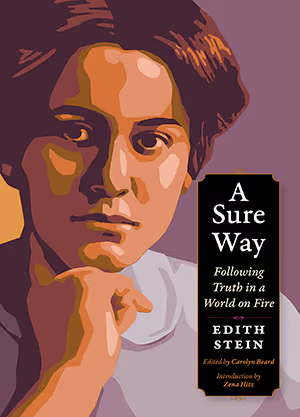
[.smalltext]This article is excerpted from the introduction to A Sure Way: Following Truth in a World on Fire (Plough, 2026).[.smalltext]