Interview
Augustine’s Friendship for Freedom
From the social club to the monastery, Saint Augustine’s friendships shaped him.
September 25, 2026
Try 3 months of unlimited access. Start your FREE TRIAL today. Cancel anytime.
START FREE TRIAL NOWAugustine’s Friendship for Freedom
From the social club to the monastery, Saint Augustine’s friendships shaped him.
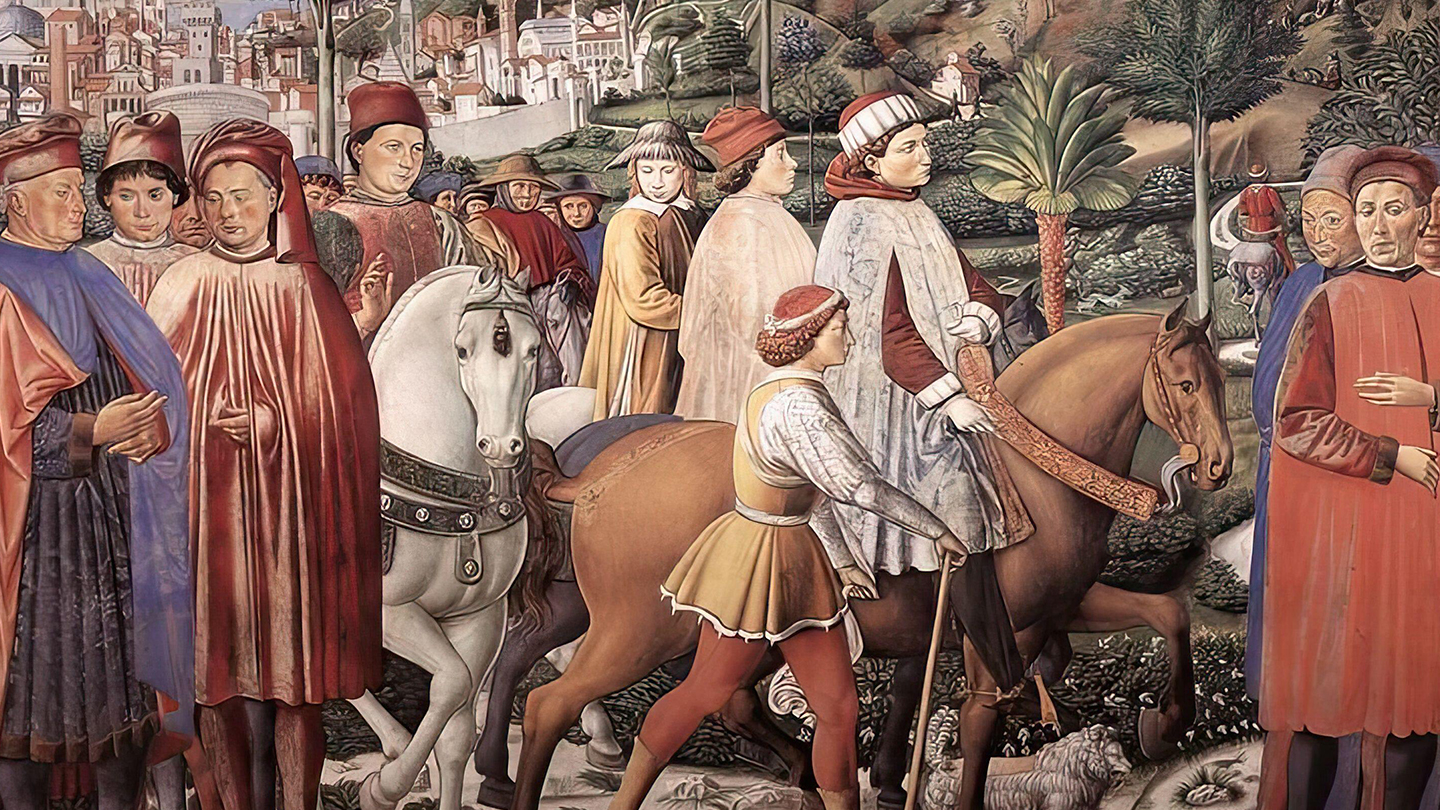
Benozzo Gozzoli, Saint Augustine Departing for Milan, fresco, 1464–65. [.smalltext]Artwork photograph by Carlo Bollo / Alamy.[.smalltext]
Margarita Mooney Clayton: Nearly sixty years after the publication of your biography of Augustine of Hippo, I would like to ask you a few questions about Augustine and friendship. What new insights have you had about Augustine since then?
Peter Brown: One of the duties and the joys of a historian of Christianity has been the scholarly endeavor to correct the tendency to see the leading figures of the church in isolation. We want to place them back in the busy world of their own times and to glimpse other faces that are usually hidden in the shadows cast by the great lights of their age.
Of these outstanding figures, none has proved more exciting than Saint Augustine, bishop of Hippo (modern Annaba, Algeria). Augustine was a prodigious writer (best known for his Confessions and The City of God), but he wrote an abundance of lesser works. Hitherto unknown letters and sermons by the great man himself continue (as recently as this year) to be discovered in the depths of libraries throughout Europe.
The application of digitalization to medieval manuscripts since 1980 has led to a surge in our knowledge of Augustine as bishop of Hippo. To take one vivid example: Who would have expected that in AD 428 – only two years before his death, when he was already a sick man – Augustine would have led his congregation in a bid to put an end to the slave trade through the port of Hippo? The draft of the appeal written by Augustine on this occasion is one of his noblest works. Yet it was totally unknown to scholars until its discovery in 1975 and publication in 1981!
The barbarians are resisted when the Roman army is in good condition for fear that Romans will be held in barbarian captivity. But who resists these [slave] traders who are found everywhere, who traffic, not in animals but in human beings, not in barbarians but in Romans from the provinces? … Who will resist in the name of Roman freedom?
And the old bishop, Augustine, went down to the docks to hear the story of a terrified young girl, who described how the slave drivers had closed in around her farm in the distant hills. These letters jolt our memory. They remind us of what it was like to be a bishop in the last days of Roman Africa. What enabled Augustine to bear up under such strain? The answer may well be: a zest for human company expressed in the ancient language of spiritual friendship.
Augustine’s theology is often thought of as stern, focusing on conversion, original sin, need for grace, mercy. Do we see anywhere in Augustine’s writings or sermons that friendship among humans can be a channel of grace, an experience of God’s glory? How do ancient understandings of friendship differ from ours?
Historians may need to remind themselves that, in the ancient world, friendship was a charged issue. Society was thought of as held together by a web of non-negotiable relationships: bonds of kinship, bonds of village and city, bonds of patronage, and (most rigid of all) bonds of slavery. To opt for friendship was to opt for a moment of freedom in a life ruled by iron obligations.
It was the privilege of friends to reject the hypocrisy, lies, and flattery that went with the grand illusion of conventional society in favor of candor, intimacy, and mutual transparency.
Nobody has described this happy state better than Augustine himself when remembering his life among friends in his hometown Thagaste (Souk Ahras, Algeria) in the 370s.
There were other things which occupied my mind in the company of my friends: to make conversation, to share a joke, to perform mutual acts of kindness, to read together well-written books, to disagree without animosity. … These and other signs come from the heart … acting as fuel to set our minds on fire and out of many to forge unity.
This seems like a timeless scene of adolescence. Yet the historian can add a new detail: at just this time, Augustine and many of his friends were Manichees – followers of Mani, a Gnostic prophet whose version of “true” Christianity had spread within a century from Iraq to Carthage.
Letters by Manichees, recently discovered in southern Egypt, show religious communities held together by intense bonds of spiritual friendship. They were “Sons and Daughters of the Light Mind”; they hoped “to see each other in fully transparent freedom and with a smiling face.” By consorting with the Manichees “as fellow Companions of the Light” (as he seems to have done) Augustine plainly added an esoteric religious dimension to the traditional cult of friendship in the ancient world.
How did Augustine’s experience of friendship evolve during his pre-Christian life and his life as a Christian and a bishop?
The next decades of Augustine’s life included significant changes of location in the course of a brilliant career – to Rome (in 383), to Milan (in 384), back to Africa via Rome (in 388) and eventually to Hippo as bishop (in 395). Looking back on the stormy period of his life during which he wrote his Confessions (beginning in 397), there appeared to him to be one clear thread in the midst of so many false starts, failed experiments, and inner landslides. The Confessions are the story of a group – not of Augustine alone but of himself and his friends as they sought some way of living together as friends bound by a single love. The forms of togetherness varied – from a countercultural, almost subversive existence as a Manichee in Carthage and Rome, to something like a social club within sight of the Alps outside Milan, and finally to a low-profile building in the bishop’s garden in the seaport of Hippo that came to be called The Monastery (then a recent buzzword taken from the Greek). But the aim of each of these experiments was the same: to find a space for Augustine and a group of like-minded Christians to worship and to serve the boundless beauty of their God.
What do we know about friendships in the context of Augustine’s monastic life?
For all their many difficulties over time, Augustine’s monastery and its adjacent convent were especially close to Augustine’s heart. Not only did he write a Rule for them both that is a model of good sense, and according to which he himself lived, he also saw the monastery as a microcosm of the church and as the place where the diffuse love of the Christian community as a whole was focused into a single bright point. Here, if anywhere, and also among all good Christian men and women, married and unmarried, the vision of God toward which they all strained came near – or so he hoped, and kept on hoping.
Would you have any closing words from Augustine?
Sometime around 420, not far from the brutal crisis of the slave trade in Hippo, in a world rendered less and less stable by barbarian raids and a church embittered by the Pelagian controversy, we can hear him preaching an evening sermon. As the congregation – monks, nuns, and laity alike – trooped out of the brightly lit basilica into the dark, he reminded them:
I sense that your feelings have been drawn upwards with me to heaven. But now I will put away the copy of the Gospel. You will go home, each your own way. … It was good for us to be bathed in that common Light. It was good that we rejoiced. It was good that we have exulted together. But, as we now walk away from each other, as we go each to our own home, may we not walk away from our shared God.
May that be so!
[.smalltext]This interview was conducted on July 6, 2026, and has been edited for length and clarity.[.smalltext]