Personal History
Friendship after Prison
Karen and Naomi met as a professor and an incarcerated student. What has their connection taught them?
October 10, 2026
Try 3 months of unlimited access. Start your FREE TRIAL today. Cancel anytime.
START FREE TRIAL NOWFriendship after Prison
Karen and Naomi met as a professor and an incarcerated student. What has their connection taught them?

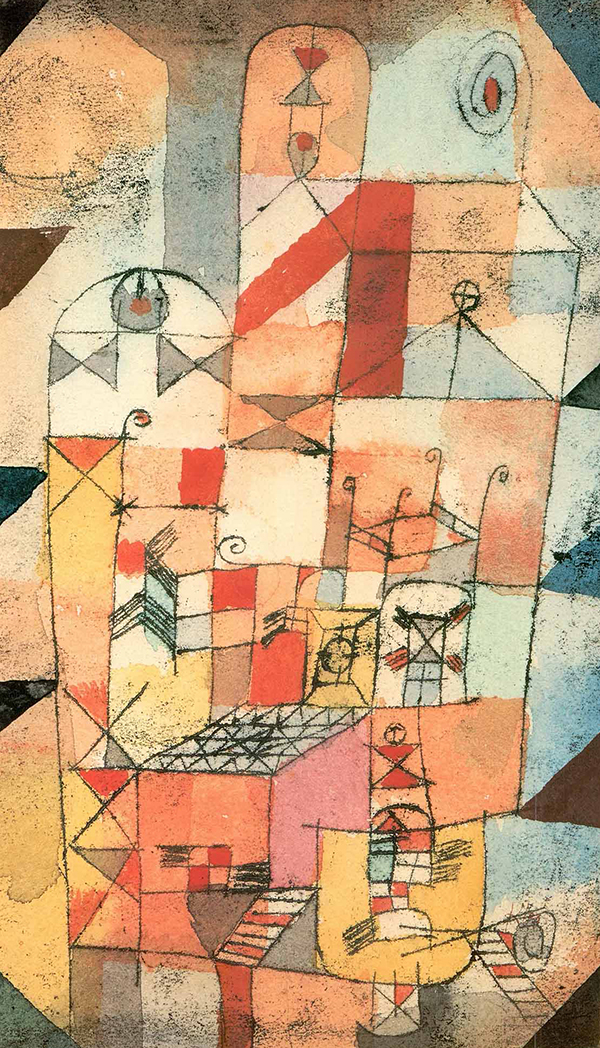
Paul Klee, The Way to the Citadel, oil and gouache on cloth, 1937. [.smalltext]Wikimedia Commons (public domain).[.smalltext]
[.article__paragraph--cap][.small-caps]“Before starting,[.small-caps] I just want to ask the both of you a question. What is your understanding of what friendship is?” I am meant to be conducting this interview between two unlikely friends, but Naomi (not her real name) cannot help but take control. Her impulse to direct situations, define terms, and offer clarity is engrained in her as a former lawyer. Nothing has changed this aspect of her training and personality. Not even prison.[.article__paragraph--cap]
“I’ve not spent a lot of time on the philosophy of friendship,” answers Karen Kilby, the Bede Professor of Catholic Theology at Durham University, with typical academic reticence. “Aristotle has a particular definition of friendship and Aquinas has friendship essential to the goal of the Christian life. But I haven’t really got my own formulation.”
I ask Naomi if she has a definition in mind. She says she doesn’t, but offers a few aspects of friendship: presence, flourishing, comfort, vulnerability, and then with some finality: “At the end of the day, I think friendship is a grace of God.”
We’ve gathered to talk about Karen and Naomi’s friendship, which began while Naomi was a prisoner on remand. In the British penal system, a prisoner on remand is normally someone who has been charged but is awaiting trial or sentencing. In Naomi’s case, there had not even been a formal accusation or indictment, but only allegations of an offense. She had been sitting in prison in this situation for more than nine years when she first met Karen.
“It was a time of my life that was very, very bad,” says Naomi, who understandably struggled with despair. “But I used to receive the Tablet magazine because a donor provided the subscription for me in prison. And in the magazine I saw this ad for Durham University’s distance-learning master’s program in Catholic theology.”
She describes what happened next in almost mystic terms:
Something came to me, something I cannot explain, that said write to them. I wrote a handwritten letter explaining my situation and why I wanted to be in the program, my personal circumstances. I wasn’t expecting any answer because it was not the first time I wrote to an organization to do distance-learning studies. Prisons have educational programs for people who have been convicted of a crime, but not for prisoners on remand. But two weeks later I received a letter from Karen. I was over the moon. I couldn’t believe it was real. I would not say that I lost hope, but I doubted hope.
When Karen received the letter, her mind went straight to practicalities. Considering the amount of preparation it would take, she proposed to begin Naomi’s studies the following year. But the prison chaplain with whom Karen had been put in touch confided that Naomi’s mental health was in a delicate state. So Karen set to work to make it possible for Naomi to begin her studies at once.This challenge proved to be more than bureaucratic. Even as someone on the outside, Karen’s own first interactions with the prison system were scary and disorienting. She dreamed that she, too, was imprisoned and surrounded by distrust. But the path became clearer once she was in direct contact with Naomi. They set up a working relationship where Karen would send the study materials to the prison and then they would speak once a week on the phone, supervised.
“I could really tell I was in the hands of a lawyer,” says Karen, “because Naomi would take over each of our half-hour conversations. She would have a plan. She would give me some corrections: you’ve got a typo here, you’ve got an inconsistency there. And she was always very positive. I was beginning to doubt this story about her mental health.” Naomi was in fact trying to make things easier for Karen, and also showing the kind of caution that any prisoner would in front of a member of staff.
It was more difficult than Karen realized for Naomi to access the materials she sent, but Naomi never let on. She was determined to make the best of the situation and learn all she could.
“It was not just an academic exercise for me,” says Naomi:
I was questioning absolutely everything – justice and suffering and faith. Karen didn’t know that at that time I’d been in prison for nine years. She didn’t realize how much space this was giving me to reflect on my experiences, to understand what was happening to me. I was shocked by the amount of time Karen invested in preparing the materials, sending me books, the conversations once a week.
In the course of their study, Naomi was particularly taken by the theme of human dignity in Catholic social teaching. As Karen recalls, “The experience of being treated as having no dignity was such a strong feature of her time in prison, and reflecting on the difference between ‘not having dignity’ and ‘being treated in such a way that one’s dignity is obscured’ became very important to her.” Naomi was also heartened to learn of the Catholic teaching about the possibility of salvation for those outside the church. And she took a special interest in Karl Rahner’s transcendental anthropology. Naomi even began to imagine the possibility of someday embarking on a PhD.
Karen recalls a conversation with her head of department during this time. “He said, ‘What did she do?’ And I said, ‘You know, I don’t know.’ I didn’t really think it was my place to ask what you would do to be in prison for nine years.”
Both women are very clear that they were not friends at this point: they were student and teacher. But it was through this relationship that a mutual trust was established between them.
[.article__paragraph--cap][.small-caps]Three months[.small-caps] into the program, Naomi was unexpectedly released. Of course this was good news, but life outside prison wasn’t easy. In prison she’d had a routine, a community of people to share meals with. But outside, one day bled into the next, and Naomi struggled to explain the traumas she had experienced, the way jingling sounds brought vivid memories of the keys on the prison guards’ belts, of being locked inside, of having no privacy. And many things had changed in the decade she had been in prison: technology had insinuated itself into every area of life. She struggled to sign in to websites and download apps for everything. “The day after I was discharged, I went to the supermarket. It was almost Christmas. I got a panic attack because the supermarket was full of people, and people were moving so fast. Everything in prison was so slow. I left without getting anything.”[.article__paragraph--cap]
But there was one thing that promised consistency: the theology program. In ordinary circumstances, Durham hosts residentials for its distance students; an annual forty-eight-hour intensive on campus that provides them with the opportunity to meet and learn in person with lecturers and fellow students. While this had not been an option for Naomi in prison, she now became excited about the possibility.
“Finally, I will do this as a normal person,” she thought. But that thought was quickly followed by another one: What would people make of her? How would they react?
On their first Zoom call together, Karen finally saw what Naomi looked like. Naomi could not tell Karen much about her legal situation because of the confidentiality and anonymity conditions set by the court. But she did let Karen know that she had never been formally indicted and had remained on remand throughout. Karen found this almost impossible to believe:
I thought, well, maybe Naomi has mental health issues, maybe she fantasizes. So, I checked with Naomi’s Catholic chaplain. It turns out that I was very naive for being surprised that someone could be in prison for nine years without being formally charged. But most of the world is utterly shocked that in our British prison system, you can be there for nine years without being formally charged. That was a pretty disturbing thing to learn about the country I live in.
The time for the first residential came around. Naomi was nervous about what to say about herself and how she would be received. She didn’t know whether to reveal that she had been to prison.
When everyone met, recalls Naomi, “They were happy and telling jokes. When it was my turn, I introduced myself and mentioned my professional background. I said I had spent time in prison on remand with no conviction, sentence, or indictment, and that I could not comment on the case. There was a brief silence. I added that I was pleased to be there and hoped everything would be OK.”
Naomi’s fellow students applauded her for being there. The atmosphere changed. “Over the break, one of the students approached and asked if he could talk to me. And I thought Oh no! My heart began to race. I was literally in a corner. But then he shared with me that his son was in prison. We had a long conversation. It was painful, to be honest, because I was able to see his suffering and the suffering of his family, and it was a mirror of my own family’s suffering.”
[.pull-quote]“How often does Jesus say, ‘Do not be afraid’? Maybe that’s a message that Christians need to hear in relation to prisoners and ex-prisoners.” —Karen Kilby[.pull-quote]
Karen and Naomi kept up their weekly calls, now on Zoom, and found themselves venturing beyond their course of study.
“I would be listening to what was going on in Naomi’s life, which was mostly really, really hard,” Karen says. In time, Karen started to open up about her own life too.
It was at this point their relationship began to be something more than merely teacher and student, something more reciprocal. And it began with Karen’s dogs.“We already had a dog with separation anxiety,” says Karen, “and then we heard about this young puppy that needed to be adopted. So, we said ‘OK, we’ll try to foster the puppy for a week and see whether the older dog likes him. And if so, we can keep him.’ My theory was just to throw the dogs together and hope they’d sort themselves out. But the older dog was terribly stressed by the puppy.”
As it turned out, Naomi had been a dog owner and had gone through similar difficulties. She saw an opportunity to be helpful. “In this very lawyer-like manner, Naomi sent me a page-and-a-half brief on how to think about the dogs: this is what’s going on for the older dog, this is how you can facilitate the older dog to get used to the younger dog,” Karen recalls. Thanks to her voluminous, concrete advice, “I credit Naomi with the success of fostering this second dog, and that the dogs are now great playmates.”
It was a moment of reversal. Karen had seen herself as inhabiting a support role for Naomi, but now Naomi was solving a problem in her life. A door to friendship opened. And their connection opened doors to other friendships too.
“It’s very difficult to rebuild a life after prison,” says Naomi. “I lost 95 percent of my friends. But I made new friends through Karen. New friends through the master’s program. And I think the fact that I had a relationship with Karen gave them peace to talk to me without fear. And that was a big release to me. I could be honest, but I didn’t need to explain everything.”

Naomi also maintains friendships with people she’d met in prison, though those relationships were of a different sort: “It is a friendship of survival, not of flourishing.” Now on the outside, like her, they are all grappling with the stigma of incarceration. “People don’t realize that, yes, there are many people who have to be in prison. But there are also people who should not be there. Or people who are offenders but may also be the victim of offense as well.”
I observe that Karen’s openness to Naomi must have made the other students feel more comfortable to pursue a friendship with her. Naomi agrees, but Karen seems not to have considered this. She is touched by my observation, and a little surprised: “I knew I was making introductions and I had thought the great thing about people studying theology is they’re coming from all different experiences, but they share the same passionate interest. But I guess if you can exhibit that you’re not fearful, that people don’t need to be afraid, that makes it easier.”
I ask them both what advice they would give to someone who wants to offer friendship to someone who has been in prison.
In terms of the gospel, Karen muses, “How often does Jesus say, ‘Do not be afraid’? Maybe that’s a message Christians need to hear in relation to prisoners and ex-prisoners. That message may be the first step toward treating people better.”
“I was in prison, and I am out, and I understand the way society sees me differently because of that. There must be a building of trust,” says Naomi. “The main priority of the prison system is restorative: the restoration of justice to the victims. And the second thing is protection of the public. But you cannot get restoration and you cannot get protection if there is no rehabilitation of prisoners.” Rehabilitation, she continues, is “about change of attitude. And you need community for that. Prisoners need to experience friendship, be treated with respect; they have to see that this is the way you live in a community, these are the consequences when you break trust and relationships.”
I observe that such a relationship of trust seems to exist between Naomi and Karen.
“Karen always makes me feel comfortable,” says Naomi, glowing. “She’s a very easy person to talk to. She’s a very good listener. She’s open to experiences. When I talk to her, there is something in her face, in her eyes, that helps me always know from my heart that whatever she tells me comes from the right place.”