Editorial
A Friend for Life
Without friends, says Aristotle, no one would choose to live.
September 7, 2026
Try 3 months of unlimited access. Start your FREE TRIAL today. Cancel anytime.
START FREE TRIAL NOWA Friend for Life
Without friends, says Aristotle, no one would choose to live.
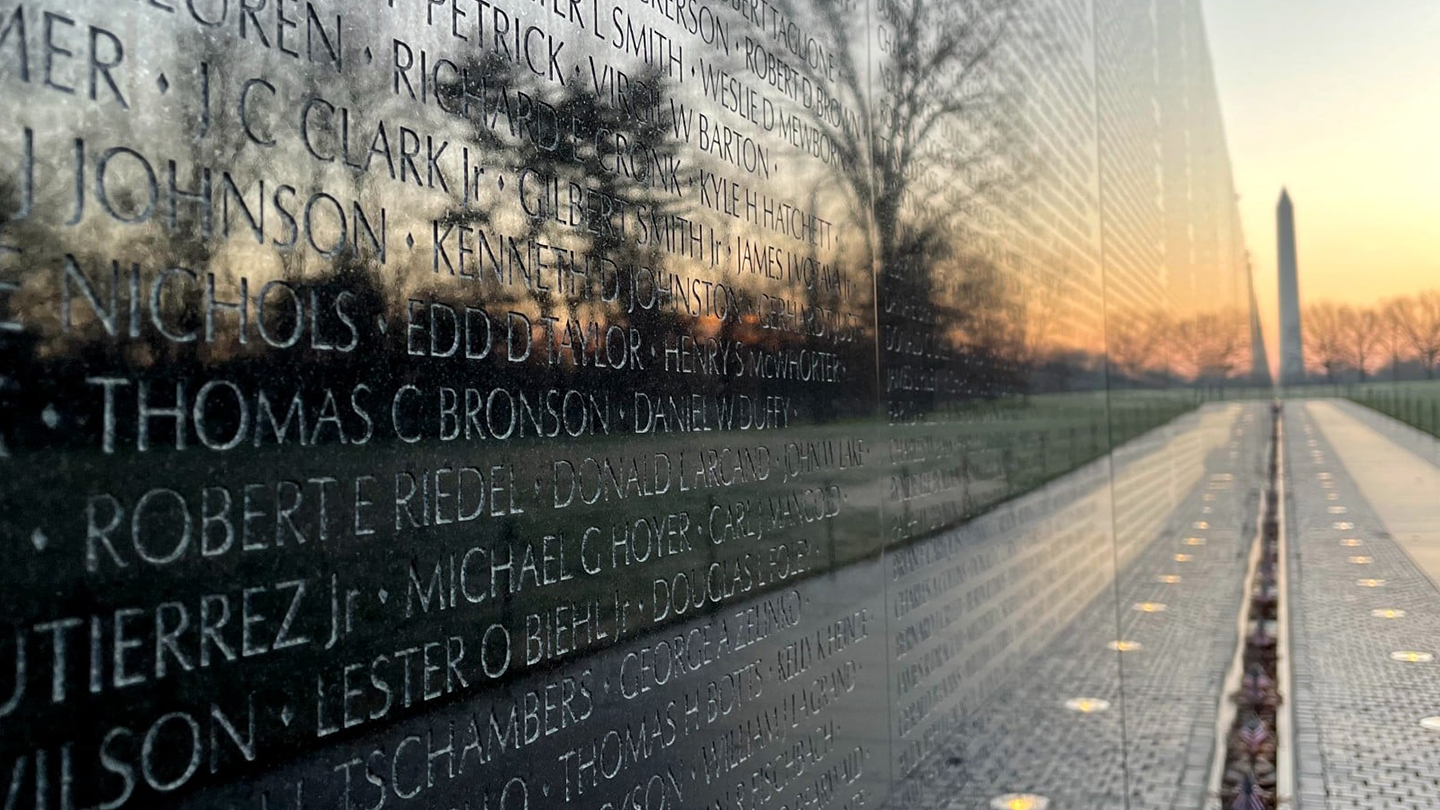
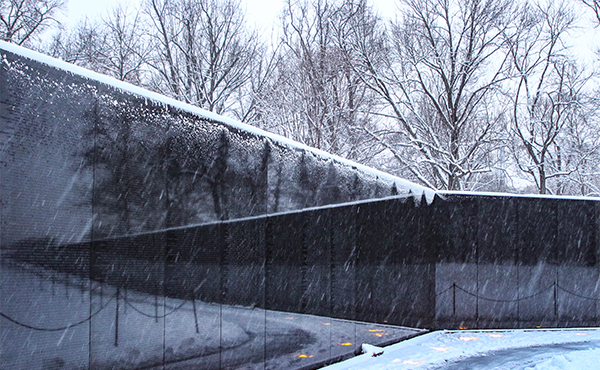
Vietnam Veterans Memorial in Washington, DC. [.smalltext]Photograph from National Park Service, Wikimedia (public domain).[.smalltext]
[.article__paragraph--cap][.small-caps]Lee Sledzianowski[.small-caps] first showed up at our house unannounced in February 1990. He was a forty-year-old carpenter we’d never met before, with a mustache, ponytail, and ancient Dodge van. He asked to talk to the father of Dorothy, my ten-year-old sister. He had just been released after a year in county jail.[.article__paragraph--cap]
My dad wasn’t home, so Lee got back in his van. It broke down where he’d parked. My dad found him walking on the highway a few miles south when he set out to track the suspicious visitor. He offered Lee a lift back to his house, and on the way they talked. It turned out they were both born in the same year and had both grown up within miles of each other in the Hudson Valley.
Lee told my dad he had come for just one reason: he needed to thank my sister for saving his life. While he’d been locked up, his wife had divorced him and secured a no-contact order for their daughter and son. Over Christmas he’d been on suicide watch. That year our church sent holiday cookie boxes to the inmates, each with a handwritten card (security protocols were laxer then). On Christmas Eve, the box Lee received happened to be the one with a hand-drawn card from my sister: “Dear Friend, here is a Christmas greeting for you. I hope you have a nice Christmas. Love from Dorothy.”
Lee always said afterward that card made him believe in angels, though he didn’t believe in much else: “Somebody in this world cares for me still.” He must have asked the guards where the package came from and got the address of the Bruderhof community where we lived. He determined that when he got out, he would try to find the girl’s father to express his thanks.
They kept in touch. Soon it became obvious to us kids that my dad and Lee were friends, despite apparently having little in common. My dad loved literature, classical music, and Bob Dylan. In his twenties, he’d taken lifelong vows as a member of the Bruderhof, and was now a father of eight, responsible for the community’s financial oversight. During the Vietnam War, he’d written a defense of pacifism as a student at the Rochester Institute of Technology, and that still reflected his views.
Lee, by contrast, had volunteered to serve in Vietnam right out of high school. He completed twenty-four months there, mostly driving convoy. Many stereotypes of the rural white working class fit him well; my brothers soon found that a surefire way to get a rise out of him was to mention Al Sharpton. He had no ties to civic or religious life in any form, had never held a job longer than two years since the military, and liked the Doors and Led Zeppelin. Now he had lost his family, his savings, and all but a few friends, as well as most of his teeth.
Lee’s embarrassment about this last point became obvious when my dad started inviting him to dinner. Lee would bring ice cream but refused to come to the table, eating apart on the sofa. Then he and my dad would step out for a cigarette. If other people dropped by, Lee made a quick exit.
I was in ninth grade and the oldest sibling. I made clear my objections to the new regular in our house, who didn’t fit in with my idea of the kind of family we were. My dad didn’t argue, but kept telling Lee he was welcome.
Some months in, when Dorothy’s sixth-grade class was studying Asia, her teacher asked my dad to invite Lee to come speak about the landscape and wildlife of Vietnam. The lesson did not go as planned. As my dad later wrote:
He first flatly refused; he couldn’t stand the thought of being in a room full of children. But later he agreed, and began telling about the beautiful seashores, the jungles, and the strange animals.
Then it was almost as if his mind jumped to another track without his noticing. He began to tell about the war. He told about driving a truck along a dirt road, and coming upon the site of a Vietcong ambush of an American convoy. The trucks were still burning, and the drivers who had been crucified were still hanging on crosses at the side of the road.[#continue] [#continue]
Lee told the children: “Never, never join the military. If you hear that it’s good to fight for freedom and protect democracy, don’t believe it. The Vietnamese didn’t want us there. They only wanted to be left in peace to work their farms and raise their children. I was scared all the time that I would die in an ambush or mortar attack, and I began to hate every Vietnamese person I saw. I killed an old man who never would have harmed me, and I killed other people, and now I can never forgive myself, the rest of my life.”
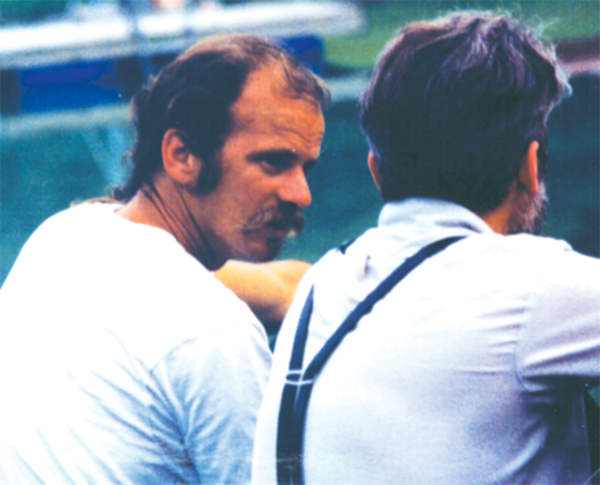
My dad felt terrible about the effect Lee’s outburst might have had on the students. But when he contacted the other parents to apologize, they were reassuring: what had impressed the kids, they said, was Lee’s honesty and great remorse.
Over time, my parents learned more about Lee’s tours in Vietnam, and about his severe PTSD, which caused nightmares, jumpiness, and phobia of crowds. I always assumed, and still guess, that his war experiences must have contributed to his crime and estrangement from his family. I never asked him why he went to prison, and still don’t know. Around us, he was unfailingly gentle, treating my mother and sisters with old-fashioned courtesy.
Late at night Lee would call my dad to come over when his memories were overwhelming him. The first few times, I remember sitting up after midnight waiting for his safe return. When triggered, Lee was suddenly back in Vietnam: the smell of burning human flesh, the screams of the soldier to whom he’d given a lift on the day when his truck was struck by rockets (“I never even asked him his name”). Lee had been blown out of the cab without serious injury, the other man had been trapped inside.
“I should have died in Vietnam instead of living the thousands of deaths that I have,” he sometimes said. He told my dad that during the war, he’d had a Vietnamese wife, Chi, and a daughter, Le, both now dead. The horrors of war, and the ways he had failed both his Vietnamese family and his American children, were ever present to him. “I can never forgive myself,” he would repeat, and no words could comfort him.
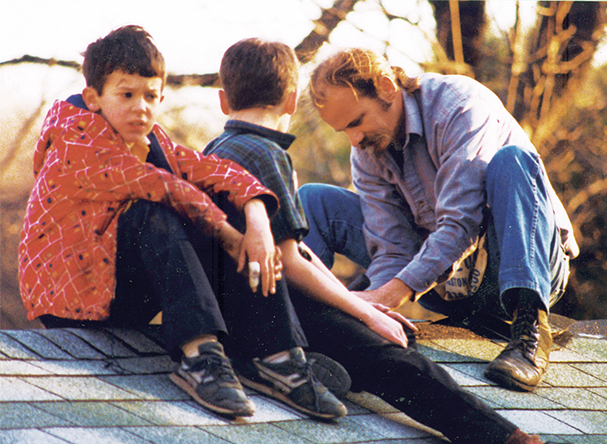
[.article__paragraph--cap][.small-caps]Within a year,[.small-caps] Lee had become like a semi-resident uncle, joining us for family dinner twice a week as well as for birthdays, Christmas, and family reunions. For several years, he lived on the Bruderhof’s grounds in a cannabis-scented apartment decorated with a POW/MIA flag where my brothers and I would spend evenings watching his well-worn VHS tapes of Cheech & Chong films and, repeatedly, Apocalypse Now.[.article__paragraph--cap]
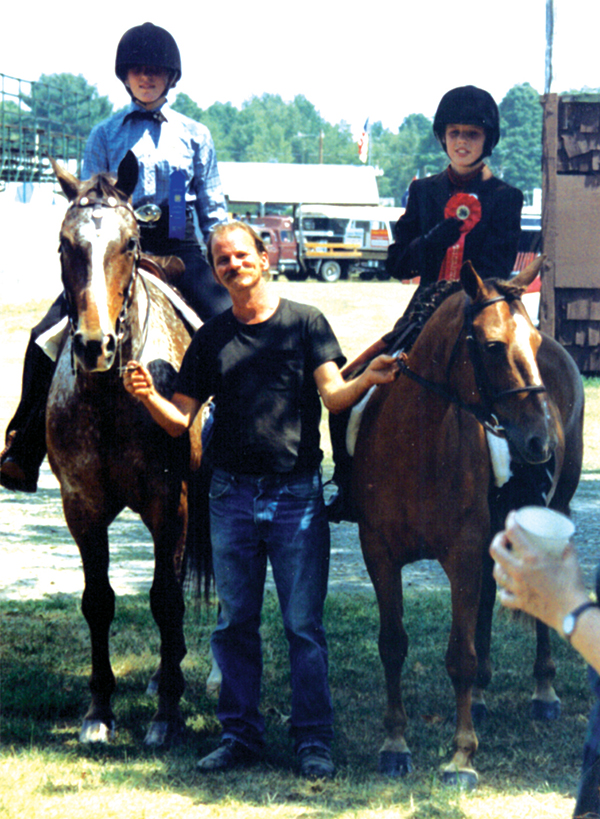
He gradually became an informal member of our community too. He worked construction and landscaping jobs, using most of his money after living expenses for giving: a stream of presents and cut flowers for people in the community, $100 tips for tired diner waitresses at the end of their shifts. One of Lee’s passions was for horses (“I can talk to them and they won’t judge me”); his own children had competed at Western-style show riding. To the community’s kids, he donated riding lessons, a riding ring he personally constructed, and, over time, two Appaloosas and a quarter horse.
[.pull-quote]Jesus’ generosity explodes the philosophers’ careful boundaries around friendship, extending it to the virtuous and unvirtuous alike.[.pull-quote]
As the years went on, Lee’s friendships branched out to other Bruderhof families, but his anchor relationship remained with my dad. A family with eight kids will go through hard times, and then Lee always stepped up, on several occasions in ways we can never repay. It remained a friendship across difference. Readers of C. S. Lewis’ s Four Loves might assume intellectual friendships to be the highest form of friendship, but this was not that, even though Lee read more widely than you might have guessed (he loved Tolkien). Both men found ways to meet each other halfway. Lee came to our school concerts and learned a grudging appreciation for Beethoven; my dad got into stock car racing.
Truth-telling went both ways. Lee didn’t hesitate to take my dad to task if he disagreed with his decisions about us kids or disapproved of this or that new Bruderhof venture. My dad, for his part, was often kept busy helping Lee keep his rough edges socially tolerable. There were periods of estrangement, yet each time the underlying loyalty won out. Both were committed to the core habits of friendship: going out of one’s way for the other, taking risks for the other, and, at least weekly but usually more often, spending time together. “He’s the kind of person you can talk to,” my dad would say.
[.article__paragraph--cap][.small-caps]Friendship, writes Aristotle,[.small-caps] is “most necessary for our life.” The quote comes from the Nicomachean Ethics, which the philosopher is thought to have written for his son, devoting one fifth of the work to the theme of friendship. Many points in the text remind me of my dad and Lee. For Aristotle, the stakes are high: “Without friends, no one would choose to live, even if he had all the other goods.”[.article__paragraph--cap]
If friendship is existentially important, what does it involve? In the Ethics, it consists “more in loving than being loved.” The friend is “another self”; friends share “one soul.” Friends “mold” one another toward virtue by the practice of “mutual correction.” A true friend wishes good things for his friends for their own sake, not for his own benefit. He will labor for them, and at need, he will die for them.
Nor is this just a matter of emotions. The unity of friends extends to economics: “What friends have, they have in common.” This gives rise to a communal way of life: “What friends find most choiceworthy is living together. For friendship is community, and we are related to our friend as we are related to ourselves.”
To affirm this highest kind of friendship, for Aristotle, need not mean devaluing more casual relationships – in contemporary terms, our next-door neighbors, business friends, fishing buddies, workout partners, or friendly acquaintances. Such relationships have their own place in a good life. (Aristotle classes them as friendships of utility or pleasure.) But the highest kind of friendship is the only one without which “no one would choose to live.”
It’s a bracing vision. Of course, it’s an idealization – how many are fortunate enough to have this kind of friend? Such friendships may be the exception, now as in the past. But at a moment when many fear a decline in friendship, perhaps the very thing we need is an ideal to aspire to.
For the critics: yes, Aristotle’s portrait of friendship is largely restricted to males of a certain class and education. It can be enhanced, and has been. Christian writers such as Augustine and Aquinas who inherited the pagan philosophical tradition sought to remedy its elitism. Crucially, they centered friendship on shared communion with God rather than on a privileged circle’s claim to virtue. This made possible what Aristotle thought well-nigh impossible, friendship across divides of cultural or social identity.
In a purified form of Aristotle’s vision, the New Testament presents the church as the place where the friendship that the Greeks dreamed of becomes reality. The Book of Acts echoes Aristotle in describing the first believers after Pentecost as being of “one soul” (Acts 4:32). As if taking their hint from the Ethics, these companions form a community of life in which they “were together and had all things in common” (Acts 2:44) and “no one said that any of the things that belonged to him was his own” (Acts 4:32).
There are other echoes. In Matthew 18, Jesus mandates direct speaking among his followers, just as Aristotle had called for mutual correction among friends. Parrhesia, the “frankness of speech” characteristic of friends as opposed to flatterers, is a favorite word of both the philosophers and John the Evangelist. Friends aren’t of “one mind” just automatically; they arrive there by speaking truth to each other.
That’s why the unanimity of friendship is a lifelong work. It comes in flashes, yet is all the more precious for being struggled for rather than taken for granted. Cicero articulates the goal in his much-quoted summary of friendship, drawing perhaps indirectly on Aristotle: “Friendship is nothing other than the unanimity between people about all things human and divine, with goodwill and love.” His definition is uncannily similar to Paul’s exhortation to the Philippian Christians: they are to be “of the same mind, having the same love, being in full accord and of one mind” (Phil. 2:2).
What makes these resemblances striking is that the New Testament writers are notably reticent about using the words friend or friendship. When speaking of the bond among believers, they much prefer to rely on metaphors of kinship – brother, sister, daughter, son. The great exception appears in the fifteenth chapter of the Gospel of John, where Jesus offers friendship to his disciples:
This is my commandment, that you love one another as I have loved you. Greater love has no one than this, that someone lay down his life for his friends. You are my friends if you do what I command you. No longer do I call you servants, for the servant does not know what his master is doing; but I have called you friends, for all that I have heard from my Father I have made known to you. (John 15:12–15)
Like Aristotle, Jesus defines friendship as including the willingness to die a noble death to save a friend, just as the heroic friends of Greek myth had been ready to do. The biblical scholar Gail O’Day notes that read in isolation, Jesus’ words about this “could be a friendship maxim from any philosophical treatise on friendship.” The great difference is the setting. It is the evening before Golgotha, and what Jesus says here he is about to enact. As O’Day puts it: “Jesus does not merely talk about laying down his life for his friends. His life is an incarnation of this teaching.”
In this scene, Jesus addresses only his closest disciples as friends. These are the men who a few days earlier, on hearing of his plan to return to Judea in response to Lazarus’ death, had in their turn been ready to lay down their lives for him: “So Thomas, called the Twin, said to his fellow disciples, ‘Let us also go, that we may die with him’” (John 11:16).
Yet John’s Gospel hints that Jesus’ circle of friends is wider. As it repeatedly reminds us, the people for whom Jesus was ready to die – those to whom he offered the ultimate gift of friendship – includes the whole world: “The bread that I will give is my flesh, for the life of the world” (John 6:51); “And I, when I am lifted up, will draw all people to myself” (12:32). His generosity explodes the philosophers’ careful boundaries around friendship, extending it to the virtuous and unvirtuous alike.
[.article__paragraph--cap][.small-caps]Lee could never believe[.small-caps] in this offer of friendship. For the sixteen years he was part of our family, he respectfully declined to talk to my dad about faith. To him, maybe, the thought of being forgiven felt like an evasion.[.article__paragraph--cap]
The last time I saw Lee I was on a visit home from Germany in December 2005. My dad invited me to join the two of them for their weekly Saturday morning ritual: meeting up in the parking lot of a Stewart’s gas station for a coffee and a Camel Regular. By that time, Lee had moved out of his Bruderhof apartment and was living in the next town over. He couldn’t work much anymore, debilitated by arthritis in his shoulders.
We leaned up against his Dodge van, decorated with Lakota blankets and dream catchers he’d picked up on a road trip years earlier to the Black Hills. I don’t remember what he and my dad talked about. He probably gave us the latest on his long-running battle with Veterans Affairs, did hilarious impressions of his neighbors, made fun of George W. Bush, and asked after my family and old Bruderhof friends. As my dad always said, he was someone you could talk to.
Four months later, Lee died abruptly of a stroke. The Saturday before, he and my dad had met up as usual. Lee had never been one for shows of affection, even avoiding shaking hands. This time he took my dad’s hand and wouldn’t let go. “My life has been useless,” he said. “But the time I’ve known you has been the best time of my life.”
One of the oldest rules of friendship is to take care of burying, so Lee was laid to rest in the Bruderhof burial ground. Hundreds of people showed up, both from our church and, to my dad’s surprise, from the local area. It seems that on his scant income, Lee had been leading a secret life as a philanthropist to others in the neighborhood who, like him, struggled to get by.
Following the Bruderhof custom at funerals, at the end of the service the men took shovels and filled in the grave. After everyone had gone, Dorothy stayed back with my parents. The earth was mounded high and spilled over the edges. My dad didn’t talk, Dorothy recalls. He found a cinder block, kneeled on the grave, and tamped the dirt down all around to make the sides clean and craftsmanlike.
Among the few possessions Lee left behind were his jungle boots, which my dad gave me. They’re a couple of sizes too small, so they stand on my bookshelf. They remind me of Lee’s and my dad’s accidental friendship, which proved so consequential for both of them. For my dad, because it shaped the childhood of his kids and remains so big a part of what makes him our dad (three of my siblings have named a son in Lee’s honor). For Lee, because it opened up a new chapter of life, one that he put to use laboring for the unacknowledged Friend who, I pray, has long since convinced him he is forgiven.