Personal History
My Conversion Friend
Ian and I met when I was a twenty-year-old agnostic.
September 15, 2026
Try 3 months of unlimited access. Start your FREE TRIAL today. Cancel anytime.
START FREE TRIAL NOWMy Conversion Friend
Ian and I met when I was a twenty-year-old agnostic.

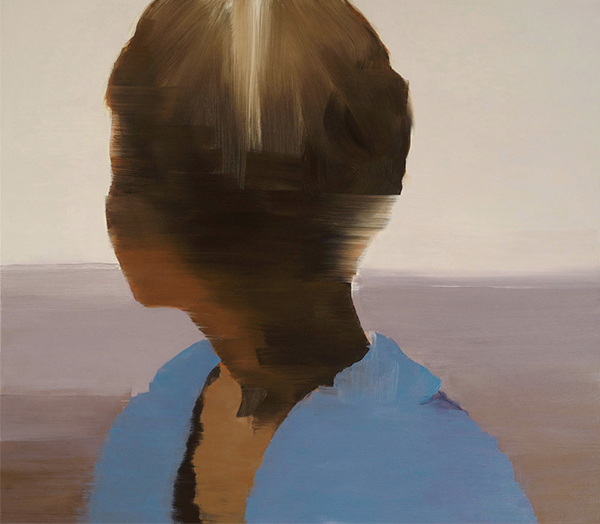
Jarek Puczel, Beloved, oil on canvas, 2014. [.smalltext]Used by permission.[.smalltext]
[.article__paragraph--cap][.small-caps]“Everyone wants to have[.small-caps] the corner suite with the big windows. Unless you’re in the hospital. Then, you want to be given the ugliest, smallest room available,” Ian told me. “Why?” I asked. “It means you are going home soon,” he replied. “No reason to get too comfortable.” It was Ian’s first week back at the hospital after some time away. While we did not know it then, he was about to begin his final round of cancer treatment.[.article__paragraph--cap]
Ian always wanted to spend time with the chaplains. He was Catholic, but he had formed a friendship with a Jewish palliative care specialist named Shalom. During one visit, the only chaplain available was a middle-aged Protestant minister. He entered the room with a Bible in his hand, his eyes darting around, and walked over to us with a slight hunch in his shoulders. Even though he appeared well-intentioned, I remember thinking, “I’m not quite sure if he’s done this before.”
I had grown very protective of Ian. People who are inexperienced with illness can be unintentionally cruel. A nurse at an appointment a few weeks earlier browsed through his patient portal and let out an awkward laugh: “It looks like you’ve been in just about every wing of this hospital. Can you believe that? You know this place better than I do.” She was joking around with us. I was furious. “Yes,” Ian replied, “It’s true.”
The nervous talkers were the worst. But this uneasy chaplain was not one of them. He pulled up a folding chair and sat down with us. “How does it feel,” he asked, “being so young and having to rely on your friends to do things for you? I would imagine that it would be difficult.” I thought this was a remarkably bold opening question for a man who could barely maintain eye contact. Ian never wanted people to draw attention to his illness; he wanted to embrace life to its fullest. I saw this question as an affront to our hopefulness – an unwanted look into a reality we were working to overcome.
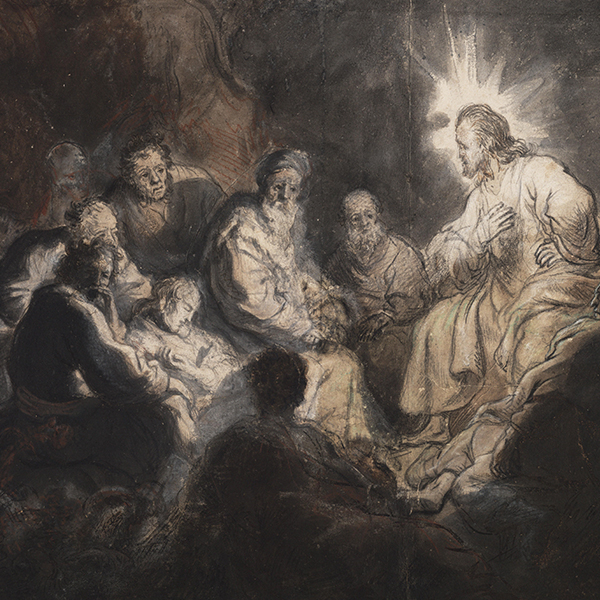
Ian saw things differently. “It feels like the parable of Jesus healing the paralytic man at Capernaum,” he replied. The chaplain looked up, surprised. “Tell me more about this,” he prompted. Ian turned to me and started to explain the parable. I had never heard it before – I was not yet Christian. He told me a man was paralyzed and wanted to see Jesus to be healed. His friends could not guide him through the crowds to reach Jesus, so they climbed onto a roof and lowered the man on a mat directly in front of him. “By the faith of his friends,” Ian said, “the man was healed.” He paused for a moment and then shifted his gaze over to the chaplain. “I can no longer walk this path on my own,” he said, “but I have all these people who are carrying me. They are making sure I end up where I need to be. By their love, I am healed.” I smiled. The chaplain did not say anything.
[.article__paragraph--cap][.small-caps]I met Ian in 2019,[.small-caps] when I was working at an ice cream shop. Even though it was easily eighty degrees outside, Ian was wearing a tan corduroy jacket with white fuzzy wool on the lapels. He was exceedingly friendly, and we struck up a conversation. I was twenty and fell for people quickly, but this was more than that. I was possessed by this sense that we had to know one another. One year later, I found him on Instagram, and we became friends.[.article__paragraph--cap]
I soon learned that Catholicism was at the center of Ian’s identity. Yet, I was surprised by how his faith gave life to a host of other aspects of his personhood, which led him to create friendships with people who were skeptical unbelievers with an ungrounded understanding of Christianity. Most of his companions from childhood and college were spiritual agnostics and atheists: they were music critics, baristas, jazz musicians, young actors, and visual artists. I had never met anyone like him. I had certainly never met a Christian like him.
My cultural understanding of Christianity, until age twenty, was primarily formed through music and the media. Born to a Zen Buddhist professor and an artist, I saw Christianity as an artifact of the “old world,” of a conservative past, while I was part of a new world. I learned about it in “Dear God” by XTC and “One of Us” by Joan Osborne. I assumed that the majority of Christians were more or less similar to the evangelicals in Emma Stone’s coming-of-age movie, Easy A: sitting in an isolated circle on a high school campus, singing a folk version of “Go Down, Moses,” and judging their peers for having premarital sex. I had internalized the notion that the Christian ethic of radical love was nearly always hypocritical.
In college, I never saw Christianity as an option. This was not because I was against it, but because I had never met a Christian who lived a life like mine. I did not know you could be a Christian and enjoy an indie rock show, nor did I understand that Christians could form friendships with people who held deep differences. Becoming friends with Ian led me to reevaluate these assumptions. In his praise of friendship in The Four Loves, C. S. Lewis writes, “When two such persons discover one another, when, whether with immense difficulties and semi-articulate fumblings or with what would seem to us amazing and elliptical speed, they share their vision – it is then that Friendship is born. And instantly they stand together in an immense solitude.” Ian and I shared our vision with one another, and I was overtaken by how much we had in common, despite our differences in faith.
[.pull-quote]In witnessing Ian’s life, I discerned that converting to Christianity did not mean that you were giving up on life or that it was falling apart; rather, it represented a coming together.[.pull-quote]
Ian was what the Anglican theologian Evelyn Underhill calls a “contagious Christian,” the kind of person from whom one could “catch the love of God,” not because of the ferocity of his evangelism, but because of the “humble and genial devotedness” with which he carried out his life. One of the first times I visited Ian’s house, he showed me a ceramic plaque of Saint James hung up on his wall. The saint clutched a pilgrim’s staff in his hands, and his eyes were downcast, almost tearful. “It’s one of my favorite images,” Ian told me, “because even though he is downtrodden, he still keeps moving forward. It’s an inspiration to me.” I was struck by the way that Ian saw his life in dialogue with the saints: Saint James, Padre Pio, and Saint John of the Cross. He spoke about them as if they were his dear companions. Ian was my friend, so I wanted to know them too.
As our relationship became serious, I grew increasingly curious about Ian’s faith. One winter afternoon, he took me to our local art gallery. In the small premodern section of the museum, there was a wall that contained illuminated triptychs of Jesus’ life, death, and resurrection. Ian gestured toward the images and asked, “Can I tell you about the story of Christ’s life?” In the same building where, as a child, I wondered at the works of Picasso, Chagall, and Kandinsky, I heard the foundational messages of the Gospels for the first time.
Ian was confidently Catholic, but he was also interested in learning how the faith I was raised in intersected with his own. Together, we spoke about Thomas Merton and Thich Nhat Hanh’s friendship. He told me about how Father Luigi Giussani traveled to Japan and visited the monastery of the Buddhist monk Shodo Habukawa. I was impressed he never put any pressure on me to convert. We started to attend church together, upon my suggestion, and Ian introduced me to a number of people in his parish. Though unspoken and, at the time, entirely unnoticed by me, a transformation had already started to occur in my heart.
I began to voraciously read literature by Christian authors who wrote about moments of conversion: I spent nights poring over Augustine’s Confessions and then Sigrid Undset’s Kristin Lavransdatter. In witnessing Ian’s life and learning about faith through him, I discerned that converting to Christianity did not mean that you were giving up on life or that it was falling apart; rather, it represented a coming together – an enlargement of one’s life through connecting to something greater than yourself. I did not convert to Catholicism. But I did become a Christian.
[.article__paragraph--cap][.small-caps]Ian passed away[.small-caps] in June of 2022. Six weeks prior to his death, I sat with his mother in a hospital hallway in the intensive care unit, as a doctor came up to us to tell us the results of a recent blood test. They were not promising. I should have been angry and despondent; I should have yelled at the inexperienced physician’s assistant who had little to no bedside manner; I should have curled up on the ground and wept, as I had done many times in the past two months. But I did not.[.article__paragraph--cap]
At this inexplicable moment of emptiness, I was filled with the love of Christ, or rather, the love that Christ had for Ian. I was endowed with an unshakable sense that no matter what happened, whether Ian lived or died, his love for the world would continue to grow. It was the first and only time I have been surprised by the presence of God.
Ian woke up from a medically induced coma the next day. I told him about this experience. He looked up from the bed, grabbed my hand, and said, “If I had died in that moment, it would have all been worth it, for you to have had that encounter with God.” He continued, “Now, a window has opened, and you have the choice whether or not to look through it, and see what is on the other side.”
I had not yet converted to Christianity because I had never witnessed the work of God in my own life. In that instant, everything changed.
I asked Ian once to explain what God meant to him, and he replied, “God is love. When you do a kind thing for another person, when you extend your hand to someone in need, that is God. It does not matter if either person believes in God for him to be there.” I was moved by this definition. I still am, and I use it to explain the meaning of God to my spiritually curious friends.
The presence of the radical love of Christ, of which I was once so skeptical, was the reason that I converted to Christianity. This love was discovered in a relationship with a Christian who extended his hand out to me, a nonbeliever who had no intentions of ever looking for God. Ian and I were drawn together because we were preoccupied with similar questions about the world – the value of art and music, the meaning of our callings during our time on earth. In some respects, our answers to these questions were similar to each other’s, but in others we greatly differed. For the foundation of a real friendship, upon which our relationship was built, this was unimportant.
Friendship is a peculiar form of grace, which comes with unexpected responsibility. It is also our only hope for reaching those people, like me, who never considered God an option in the first place.