Essay
I Have Called You Friends
How Jesus redefines friendship.
September 11, 2026
Try 3 months of unlimited access. Start your FREE TRIAL today. Cancel anytime.
START FREE TRIAL NOWI Have Called You Friends
How Jesus redefines friendship.
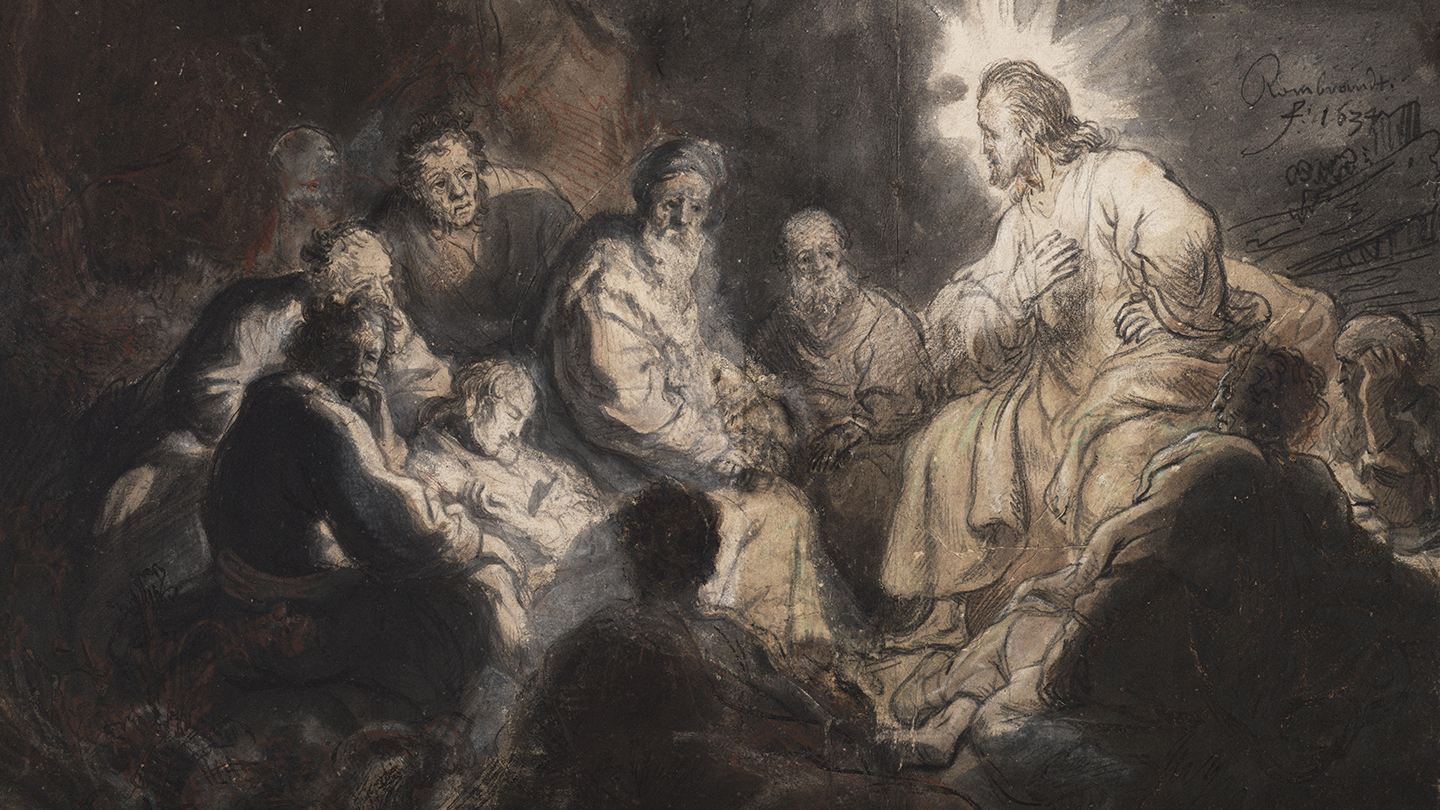
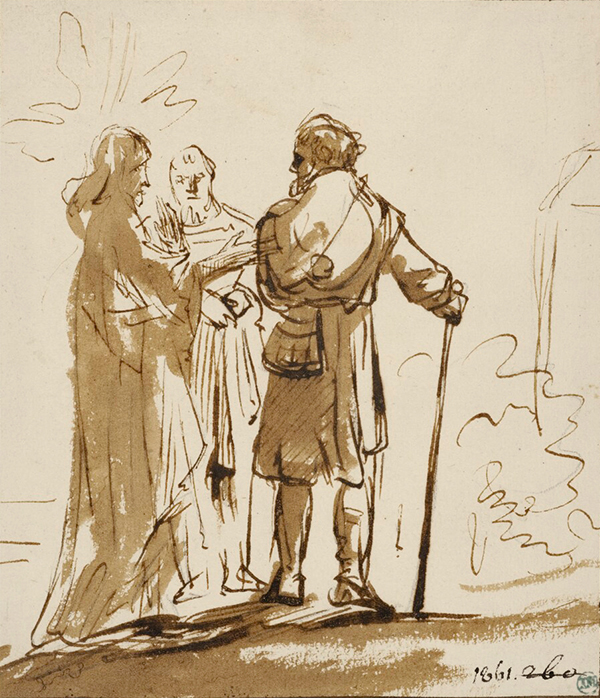
Rembrandt, Christ and the Apostles, pen, ink, and color wash on paper, 1634. [.smalltext]Wikimedia Commons (public domain).[.smalltext]
[.article__paragraph--cap][.small-caps]The “servants of God”[.small-caps] – well, that’s common to nearly any kind of theism; in the Enuma Elish, the Babylonian creation myth, human beings are made by the gods to be their servants. The “children of God” – a bit trickier, but it was a commonplace in Greek religion: Zeus is the “father of gods and men.” When Saint Paul is preaching in the Areopagus, he quotes the third century BC Greek poet Aratus, applying to the God of Abraham what the poet had said of Zeus: “we are all his children.” The “Bride of Christ” – that’s a bit more difficult, as a way for us to think of ourselves, but we manage it.[.article__paragraph--cap]
Not least on account of their frequency, these metaphors are familiar.
But what are we to make of the impossible claim that Jesus makes of us, and on us, in the New Testament: that we are to be his friends?
In John 15:12–15, Jesus speaks to his disciples:
This is my commandment, that you love one another as I have loved you. Greater love has no one than this, that someone lay down his life for his friends. You are my friends if you do what I command you. No longer do I call you servants, for the servant does not know what his master is doing; but I have called you friends, for all that I have heard from my Father I have made known to you.
Jesus seems here to be insisting on more intimacy than even Paul might initially seem to be comfortable with. Paul, after all, refers to himself at the beginning of the Epistle to the Romans as the doulos, slave, of Christ. But for these disciples, here, Jesus has a different word. “I have called you friends.”
The invitation is specifically to a kind of friendship that would have been familiar to these Romanized or Hellenized Jews: a friendship of common purpose, and, as we are told in John’s account of the scene in the Upper Room, it had been for three years a friendship that even entailed a common purse.
This kind of common-purse and common-purpose friendship was familiar to the apostles. A roving band of students following a rabbi was the Judaean version of the philosophical schools that proliferated throughout the Hellenized world at the time, and deep respect for the teacher was balanced with deep friendship shared between teacher and fellows.
On the other hand, there was something new about this: this roving band of students and philosophy-as-a-way-of-life practitioners was led by a man who would, after all, later turn out to be God. But there was more newness on top of this: before, they had been servants. Now, they would be called friends. And Jesus highlights another aspect of this newness, too, in his discourse in the Upper Room, after Judas had gone out from among them: “A new commandment I give to you, that you love one another: just as I have loved you, you also are to love one another. By this all people will know that you are my disciples, if you have love for one another” (John 13:34–35).
As the Law was already summed up in the two great love commandments, to love God and one’s neighbor (Matt. 22:34–40; cf. Lev. 19:18; Deut. 6:4–5), it might seem strange for Jesus to describe such a commandment as a new one. Yet there are important differences to observe, particularly the fact that Jesus’ commandment comes with an exemplary standard attached: “just as I have loved you. …” In Jesus’ laying down of his life, there is an objective and historical benchmark of love to emulate. Greater love has no one, after all, than that.
If the original love commandment of Leviticus 19:18 (“you shall love your neighbor as yourself”) is a form of the Golden Rule, the most familiar expression of which is found in Matthew 7:12 (“So whatever you wish that others would do to you, do also to them, for this is the Law and the Prophets”), Jesus’ words in John 13 and 15 represent a subtle but noteworthy development of it. If the Golden Rule encourages us to put ourselves in others’ shoes, to practice behavior we would wish reciprocated, Jesus’ statements in the Upper Room Discourse introduce a new animating principle.
In Jesus’ teaching, our actions ought to flow not merely from a wish for behaviors we might receive or have reciprocated, or even a deeper identification with our neighbor, but from the concrete reality of his surpassing grace, of which we have been the unworthy beneficiaries. In such a manner, the unilateral initiative of grace is presented as the proper engine of Christian behavior. For the recipients of such grace, any self-satisfied moralism is excluded from the outset, and the principle of reciprocity that might otherwise be imagined as returning to ourselves extends outward to others.
Jesus’ words in John 15:13 indicate that dying for one’s friends is the greatest expression of love. Yet the verses that follow suggest that Jesus’ self-giving act was something other than merely a superlative response to benefits of camaraderie and companionship that he had received from his disciples. Rather, Jesus was graciously bringing his disciples into a deeper form of relationship, one that would take shape in their following in his footsteps, actively participating in the movement of love that he had initiated.
The basis of this common life, the love that these friends have toward Jesus and toward one another, is not primarily what they bring to the table: their offerings to the common purse, their commitment to the common cause. These are present, but as responses. The overwhelming newness to be found here is the love that is poured out on this fellowship, that creates it out of the same kind of drive that led to the creation of the world itself.
The unilateral character of Jesus’ gift of himself is most arrestingly expressed in the apostle Paul’s words in the fifth chapter of his Epistle to the Romans. It is hard for us to hear how strange this was: it is something that, to the Hellenized world of his first hearers, was news in the sense of being new. Men had died for their friends, and this was recognized as supremely worthy. But it was still difficult: “for one will scarcely die for a righteous person – though perhaps for a good person one would dare even to die,” the apostle says to his readers. But then comes the shocking part: “God shows his love for us in that while we were still sinners, Christ died for us.”
Not content to leave it at that, Paul pushes his readers all the way to the end: “While we were enemies we were reconciled to God by the death of his Son.” Jesus died to make friends of his enemies. If this is the basis of the politics of Christ’s kingdom, it is the end of any commitment to the primacy of the friend-enemy distinction in political life. Of course we have enemies. What are we supposed to do about that?
We are supposed to imitate Christ. We may be called to die for them, and thus, participating in Christ’s own death, make them friends.
But our imitation is only possible because Jesus did it first, and his Spirit empowers us to do this, and empowers the new creation that it entails. Jesus’ death was an initiating act for the sake of the utterly undeserving. It was an action through which they would be made friends, in whom his sacrifice would bear fruit, their acts of love inspired by, modeled after, and expressive of his. It was not a self-gift without hope of return, but a gift to found a community in which that gift would produce and propel a rich and fruitful economy of continuing and answering gifts.
This is nothing like a dour ethic of duty; nothing like a measured utilitarian approach. It’s something else entirely. Jesus sends the spirit of his Resurrection into the foundation of the church, and the promise of future reward for his faithful ones is itself grounded in what he has already given.
This is a gift economy indeed: we are given, and we give, expecting nothing in return, because we have already received everything. We give, and as we give we are storing up treasure in heaven, sending our hearts ahead of us, where our treasure is: treasure that ultimately is not money, but the love that led to Christ dying for us, and that leads us to give to others. This is what is called a common good: it’s a good that by definition we can’t enjoy by ourselves, a gift that grows as it is shared. There’s no scarcity in the friendship which “holds all things in common.”
Obedience to a commandment might seem to be more characteristic of the duties of a servant, yet for this commandment it is a distinguishing mark of a friend: “You are my friends if you do what I command you” (John 15:14). The intimacy, mutuality, and transparency involved in friendship contrast with servanthood: whereas the servant must often obey blindly and is not privy to the counsel of his master, friends enter into each other’s confidence and into partnership with each other.
While gratitude is often presented as the impetus of Christian obedience, Jesus’ teaching here suggests something deeper. The response of friends goes beyond mere gratitude to someone who has shown them kindness; friends identify with each other and willingly participate in each other’s work. To receive such a command as a friend is to be granted to share in Jesus’ own mission.
In giving such a commandment to his disciples, Jesus relates to them in ways that are analogous to his relationship with his Father. Jesus’ own mission was driven by his Father’s authorizing commandment (John 12:49–50; 14:31). Jesus’ own loving intimacy with his Father, manifested in his keeping of his Father’s commandments, should be reflected in his disciples’ loving communion with him as they keep his (John 15:10). Far from being an onerous imposition, such a “commandment” is an authorizing charge entrusted to those most intimate to an authority. Besides being analogous to his relationship to his Father, receiving and keeping the commandment of Jesus is both a participation in the mission he received from the Father (John 20:21) and enjoyment of the Father’s love in him (John 14:21).
This partnership, we are given to understand, will eventually include the common project of judging and ruling the universe itself, as viceregents under Christ. “Do you not know you are to judge angels?” The apostle Paul asks this, in a distinctly annoyed tone of voice, when the bonds of common-good friendship have frayed within the church, the community that is the training-wheels version of the kingdom.
Jesus forms a community of disciples, in love lays down his life for them, elevating them to partnership in his mission as friends, entrusting them with the mission that his Father has entrusted to him. “As the Father has sent me,” he says, “so I have sent you.” It is the same friend-making mission of friends in both cases.
Friendship as a paradigm for thinking about relationship with God is found elsewhere in scripture. In Exodus 33:11, we are told that “the Lord used to speak to Moses face to face, as a man speaks to his friend.” The language of friendship with God is most extensively used of Abraham: “But you, Israel, my servant, Jacob, whom I have chosen, the offspring of Abraham, my friend …” (Isa. 41:8). This is but one example of many.
James alludes to such statements in the second chapter of his Epistle: “and the scripture was fulfilled that says, ‘Abraham believed God, and it was counted to him as righteousness’ – and he was called a friend of God” (James 2:23).
The association of Abraham’s friendship with God with the “completion” of his faith in his works is worthy of closer consideration. Within his argument, James alludes to two events in Abraham’s life: to Genesis 15, where God promised Abram a son and innumerable descendants, and to Genesis 22, where, in response to God’s charge, Abraham offered up his son Isaac, the fulfillment of the earlier promise.
Near the beginning of his story, in chapter 12, Abram had been charged to go from his land, his kindred, and his father’s house, to a land that God would show him. In Genesis 22, we find a similar call: Abraham is charged to take Isaac and to offer him as a whole burnt offering on a mountain God would show him. If the first call involved giving up his past, his fatherland, his father’s people, and his father’s house, the second call, which according to some Jewish tradition was the tenth and climactic test of Abraham, involved giving up his son and the future he represented. In the double sacrifice of his father and his son, Abraham cast himself entirely upon God, laying down his life as a friend.
James presents the sacrifice of Isaac as the completion of Abraham’s earlier belief in God’s promise of a son. The faith Abraham displayed in response to God’s promise of a son was confirmed in his willingness to give up Isaac when God called him to do so, reasoning, we are told in the Book of Hebrews, that God can and will raise the dead (Heb. 11:19). In the confidence Abraham demonstrated in God’s character and his faithfulness to God’s word in the teeth of contrary appearances, he was distinguished as a “friend of God,” a trusted and proven covenant partner and confidant (Gen. 18:17–19). Abraham’s vindicated standing with God exceeded that of a dutiful servant, being that of an honored friend.
Jesus came to make us friends of God, people with the same standing with God that our father Abraham had. As friends of God, we enjoy an intimacy with God and a participation in his work quite exceeding that of servants. In what the apostle Paul called “the ministry of reconciliation” (2 Cor. 5:18), he experienced the full measure of his own reconciliation, being made a partner in God’s work of reconciliation, not merely a recipient of it. As Jesus did from the Father, we have received an authorizing commandment, a charge that is to direct our behavior, to love others as we ourselves have been loved by Jesus. This is our proper response to Jesus’ love and the distinguishing mark of those identified with him.
Such a practice of friendship conscripts us into the unilateral initiative of divine grace: as God did with us, we must love not merely those who are already our friends, but also those still our enemies. This task of friendship is a work of reconciliation, making friends of those currently ill-disposed toward us. As we have seen, it disrupts any sharp friend-enemy distinction. But how precisely? How can this actually happen?
This is the work of the Spirit. In the Acts of the Apostles, the mission of the church is framed as a continuation of Jesus’ own. If Elijah’s ascension was Elisha’s Pentecost in 2 Kings 2, the ascension of Jesus and the anointing of the church with his Spirit are also two sides of the same reality. United with Jesus, the church acts as a community of friends, sharing in a common life, participating in Jesus’ mission, and acting in his authority. The Spirit of Jesus is the spirit of friendship, reconciling former enemies, knitting them together in the fellowship of a new body, and sending them out in the work of mission, making peace and forging friendship, across former barriers of enmity and division.
One of the paradigmatic stories of enmity in the Old Testament concerns King Saul and David. Threatened by David’s popularity and recognizing that David was destined to inherit the kingdom, Saul sought to destroy his perceived rival, pursuing and attempting to kill him. Refusing to respond in kind and resisting the temptation to take Saul’s life when he had the opportunity, David asked Saul why he was pursuing him (1 Sam. 24:14).
In Acts, David’s greater Son was also pursued by a murderous man named Saul. Saul of Tarsus sought to kill the friends of Jesus, attempting to destroy the fledgling church. Jesus confronted Saul on the road to Damascus; in an echo of 1 Samuel, Jesus asked Saul why he was pursuing the appointed king: “Saul, Saul, why are you persecuting me?” (Acts 9:4). Since the king identified with his friends, the persecution of the church was the persecution of Jesus himself.
When Jesus appeared to Ananias and instructed him to visit Saul in his lodgings in Damascus, Ananias responded with trepidation, having heard about Saul’s violent intentions against the church (Acts 9:10–14). Yet Jesus overcame the enmity of Saul, not only conquering him through friendship, but conscripting him as a leading voice in the mission of friend-making. This violent Saul became the friend of the Son of David and both a prominent token of and a leading pioneer of Jesus’ work of reconciliation. Later in Acts, Paul stayed with the evangelist Philip (Acts 21:8), a friend and fellow worker of Stephen (Acts 6:5), in whose murder Paul had earlier participated (7:58; 8:1).
Throughout Acts, the friend-making Spirit engages in the work of matchmaking, connecting people like Philip and the Ethiopian eunuch, Saul and Ananias, Peter and Cornelius, traversing the boundaries and divisions between insiders and outsiders, friends and enemies, between nations, races, and classes. The Spirit also binds people together in a new solidarity, manifested in the communion of gifts that re-presents the one gift of Jesus’ spirit and in the sharing of goods. This sharing both recalls Aristotle’s account of the ideal of friendship (Politics, Book II, chapter 5), and is an expression of love across former boundaries of difference, as in Paul’s collection among the Gentiles for the poor Christians in Jerusalem. The church is the community of the reconciled and a community of reconcilers, a fellowship of friends and a fellowship of friend-makers, gathered by Jesus, the friend of sinners, and sent forth by the empowering spirit of friendship into a world at enmity with God.
The primary mood of the Book of Acts is the sense of speed, motion, formation: power. The enmity is there, and it kills all but one of the apostles. But as we read, we are left with an overwhelming conviction that that world of enmity cannot hold out for long. The power of the Spirit, the joy of fellowship, is too great.
And it’s the same joy in which Christ went to the cross. By displaying the highest form of friendship to those yet his enemies, Jesus created a community of friends. And that was what he delighted to do. He went to the cross, we are told, for the sake of the joy set before him (Heb. 12:2). That joy was the creation of this community, this new group of friends. And it is that reality which, in the power of the Resurrection, was fully vindicated.