Interview
My Friend, Pope Bob
How a friendship that began in seminary has thrived across decades and Catholic–Lutheran divides.
September 16, 2026
Try 3 months of unlimited access. Start your FREE TRIAL today. Cancel anytime.
START FREE TRIAL NOWMy Friend, Pope Bob
How a friendship that began in seminary has thrived across decades and Catholic–Lutheran divides.
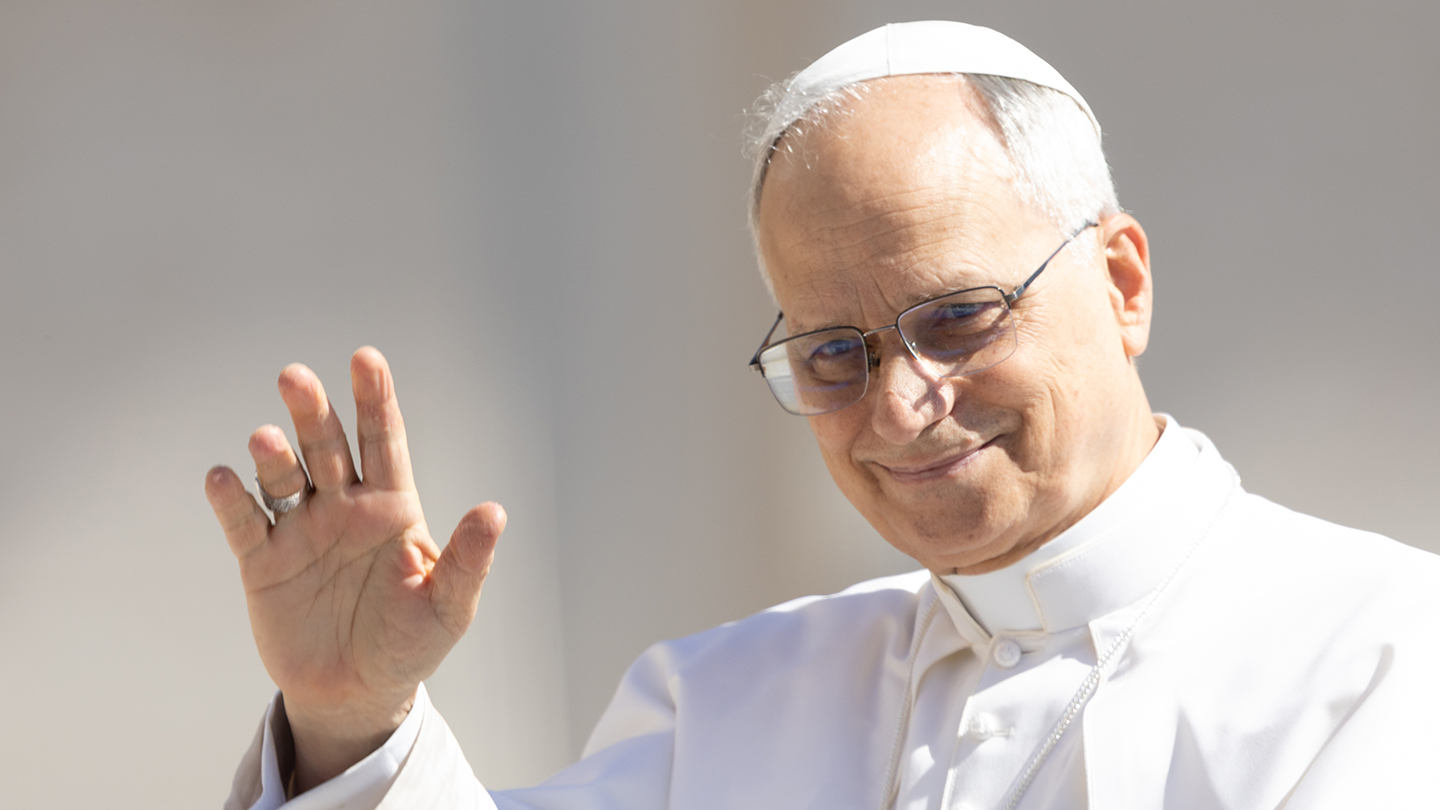
Pope Leo XIV in May 2025. Photograph by Daniel Ibañez. [.smalltext]Used by permission.[.smalltext]
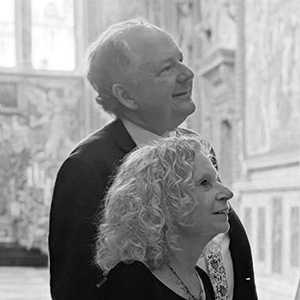
[.article__paragraph--leading]In 1980, John and Polly Snider were a young married couple embarking on a life of ministry and service in the Lutheran church. That year, they made a lifelong friend: Robert Prevost. Today, Bob – as they still know him – is Pope Leo XIV. John and Polly joined Plough editor Santiago Ramos to talk about what their friendship with Pope Leo XIV means for the walk of faith, what Lutherans and Catholics can learn from each other, and more.[.article__paragraph--leading]
Plough: First, the basics: When did you and Robert Prevost become friends?
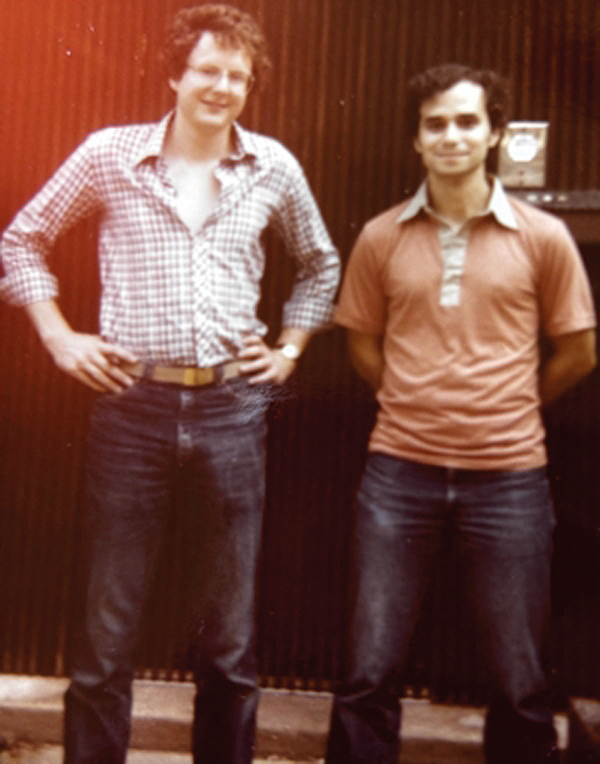
John Snider: In the summer of 1980, we participated in a Clinical Pastoral Education (CPE) program together: an intense ten-week immersion into hospital chaplaincy, done in a small group. There’s a practice we learned there, called a “verbatim,” a record of ministerial encounters, including meeting with people on their deathbeds. You’d report back to the group what you said, what you felt, what they said, what you think they felt, back and forth. You work on a real intimate level with each other.
In our case, it was at a hospital in Minneapolis. Bob, at the time, was signed up to become a priest – he was in seminary. I was studying to become a Lutheran pastor. I was about twenty-six, and Bob was twenty-five. There were five of us in the CPE group.
That’s how we met him. I came home to Polly and said, “There’s this young guy – he’s going to be a priest. I think he’s a great guy, I’d like to have him over.” So I went to Bob, “We gotta get together.” I think I said it too many times, in a kind of nonspecific way, because after one reminder, he put his finger up and said, “John, if we’re going to be friends, it takes a commitment.” That, to me, is the fulcrum of it. I think I might have been playing it a little distant – friendship and commitment are risky affairs – but he wasn’t distant at all.
So here was this single, celibate future priest, teaching a young married couple about commitment. We spent those ten weeks together; he was at our house all the time, we had him over for dinner a lot, went out, went to movies.
Why did he take friendship so seriously?
John: Because he was in formation to join the Augustinian order, and one of Augustine’s spiritual guidelines is friendship. Jesus said, “You are now my friends,” being in community. At the end of the ten weeks of CPE training, we wrote personal reflections to each other, and Bob wrote to Polly and me, “You were my community. And I really needed it.”
I think that whole sense of friendship and community … while I was the one being a little standoffish, not that serious about it, he was serious because he knew the value of it. He took friendship seriously because he believed that we are all children of God.
What did that commitment to friendship mean in practice?
John: Dinners at our home, spontaneous get-togethers – he was in a dormitory, Polly liked to cook, we were good for each other. We’d go out, do things together. One of the really significant ones, looking back, was a day trip to Saint John’s Abbey, a Benedictine abbey. One of the priests there had been my father’s Navy roommate, so we went up to meet him. But what struck us was how grounding it was for Bob to be in that monastic setting. He got it, and he loved it; his cup was overflowing, not with enthusiasm exactly but with presence, fullness. We were quiet on the hundred-mile ride home – it felt sacred, serene. It really spoke to him.
In my generation, it’s hard to be spontaneous; everything has to be planned weeks ahead.
Polly: That’s kind of true for us too now. But back then it wasn’t – I think because that level of commitment was there, anything that wasn’t already nailed down went to the front of the queue. You’d actually have the time: “What are you doing tonight? Nothing? Well, let’s go.”
Was Robert Prevost your first Catholic friend?
Polly: Bob was probably our first Catholic peer.
John: I remember the first conversation the three of us had together, I said: “I just want you to know, as a Lutheran, I’ve got some issues with the Catholic Church – this whole celibacy thing, Bob – I hope you’re OK with us poking around and talking about that.” He said, “Sure.” In retrospect, my own position on priestly celibacy changed because of him. I still think about it differently now.
Polly: That speaks to how well Bob listens. The night we had our first dinner with him, after he went home, I said to John, “I am not sure I have ever met anyone who listens so well.” He listens profoundly well, with his whole being. He is not distracted.
Were you always around people of other denominations, or did you grow up in a small Lutheran community and meet people from elsewhere later?
John: I didn’t grow up in Minnesota. We lived in six countries, my family was in international business, and I was raised Unitarian. My move into Trinitarian Christianity came during college, after I met a Christian there who inspired me.
Polly: I grew up in a very small rural town in North Dakota with no Catholic church nearby, so I didn’t know Catholic kids growing up. In college I had some Catholic friends, but we didn’t focus much on that, since we were in more of an ecumenical, Baptist-leaning crowd. When I worked at the state hospital, I worked with a nun, Monica Brown, my first year – she became my first Catholic friend and mentor. So there were a lot of years without much Catholic contact.
John: My own father had a friend who decided to become a Catholic priest after the war. My dad couldn’t believe it, called on him during his vow of silence, essentially stormed Saint John’s Abbey and wouldn’t leave until he could confirm his friend wasn’t being “brainwashed.” His friend told him, “No, this is what I want to be doing.” So on my side, it had been more open or exposed, but I’d never had a young peer who was training for the priesthood before.
You said early on, “I’ve got some issues with the Catholic Church, do you mind if I poke around?” So there was never a papering-over of the differences – it was a friendship in spite of them?
John: I’ve heard Leo say, as pope, “Do not lead with your differences; let’s not lead with what divides us.” I think the Christ in Bob recognized the Christ in us, and vice versa – that was what mattered: community, belonging, not being alone. I don’t know if that’s specifically the Augustinian charism, but it’s certainly strong in him.
Polly: In 2010, when we were in Rome with him – Bob was head of the Augustinians worldwide at that point – he took us to the Augustinian quarter and showed us where Martin Luther had stayed. On the way back we talked Lutheran and Catholic theology, differences and similarities; it was very comfortable, explorative, not combative.
[.pull-quote]“The institution matters – I’ve spent my career in it – but it’s not the core. The core is friendship with Christ, and from that you become a friend to the world.” —John Snider[.pull-quote]
John: Our connection was deeper than our theology.
Did you ever argue about politics?
Polly: I don’t think we argued about politics at all. We explored, tried to understand the other person. Who is this friend of ours? What does he believe? He was never trying to say, “I think you’re off.”
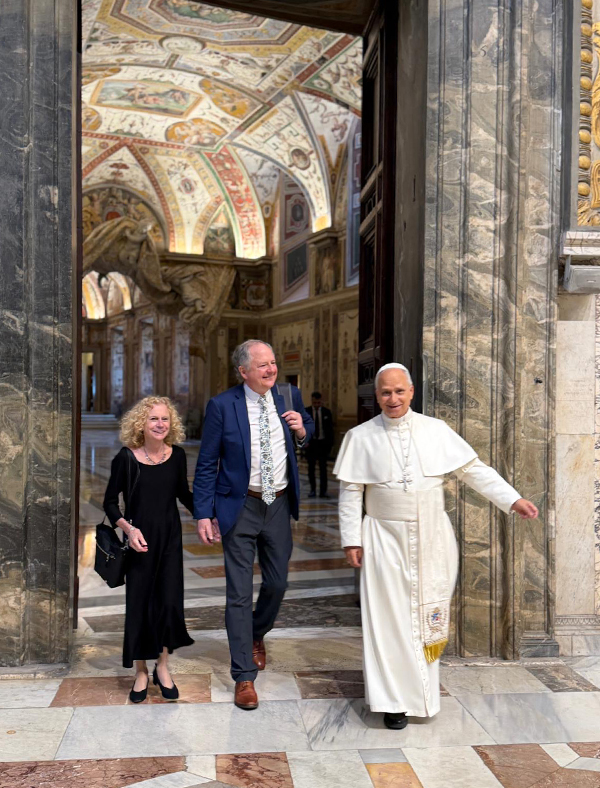
John: And we mixed it with humor. When he gave us a tour of the Vatican last May, I said, “You’re the first Augustinian pope!” “Yeah,” he said, “took a long time to regain trust after Luther.”
How has this friendship shaped your own faith, vocation, and life – individually and as a married couple?
John: Going back to that idea of commitment: he has maintained it – with two Lutherans, outside his sphere of influence, outside the Catholic institution.
Polly: He’s shown me the value of a friendship that involves prayer. I think of him as the kind of friend I could go to if my heart hurts, and ask for prayer. Recently, before our Rome trip, we asked him for prayers for a family member who passed, and then – right as we were heading to Rome – my brother, who had pancreatic cancer, died suddenly. The first thing Bob did when we saw him was give me a hug and say, “Condolences on losing your brother.” That highlights how important it is to have a prayer partner, so you can say at those times of life, “My prayers are with you,” knowing that those prayers are reciprocated.
John [to Polly]: He goes out of the elevator, goes right to you, gives you the hug. The pope has room for you and your grief. There’s real empathy, and it isn’t about us being special. It’s a Christian witness to friendship, and that’s what I find inspiring.
Were you able to maintain your friendship after he moved to Peru?
John: We have an old letter from him saying he wasn’t sure Peru would work out; he was doing a doctorate in canon law, and his order wanted him to stay in Rome. In a lot of ways our lives were already heading in different directions – we had babies, I was becoming a pastor, careers were moving. But I think that’s part of the point: friendship and commitment are renewable, they don’t really stop. We still touched base on occasion.
As soon as he became pope, we emailed, “Bob, congratulations,” and he wrote back, “Thanks, stay in touch, [signed] Leo XIV.” So from then on it was “Dear Leo XIV.” As we left Rome this last time, we thanked him and sent our love, addressed to Pope Leo – and he wrote back that the friendship hasn’t changed, signed “Love, Bob,” and then underneath, “Leo PP XIV.” Friendship runs deeper than titles.
You saw the pope recently, in Rome. How is the friendship different now that he’s pope?
John: I always knew how to be friends with Bob, but I didn’t think I knew how to be friends with a pope! Though it turns out I do, surprisingly comfortably, because it’s Bob. I found him, as pope, actually more friendly than ever, more comfortable. I asked him, half-joking, “Are you sleeping OK?” and he said, “Oh yeah, I sleep great” – he seemed to have carried more pressure as head of the Augustinians, honestly, than as pope. In the Vatican he was showing us the Sistine Chapel. We were with him for two hours – that is an indication of how important friendship remains to him. It felt like we could have been going to see the Blues Brothers again or going out to dinner; there was a flow to it. People ask, “Did you get to ask him about [x]?” No – it was friendship, not journalism.
Polly: He has an added depth now, an additional component to him.
Did you ever discuss friendship with the saints?
John: No, though I don’t think that’s really a divisive issue between us. I’ve always loved the Roman Catholic mystic writings; I do think of Rome as the capital of the Christian church, honestly – what else, Canterbury? Rome is the one, take it or leave it. So, now my friend is the pope, but I’m still a Lutheran through and through. I’m working on the theology of Mary, but I’m still a Lutheran, which doesn’t matter with this friend, though he happens to be the pope! In this divided world he is a concrete example we can all learn from. If Jesus is a friend to us, who can’t we be friends with?
Do you think your friendship has given you insight into what ecumenical dialogue should be about on the institutional level?
John: I think Bob, Polly, and I are, in a small way, living the fruits of ecumenism. We can go into a real ecumenical discussion, talk honestly about differences, and both hold our positions firmly, but that’s not the “sweet spot.” It’s interesting, but it’s not the connection itself.
We’ve been on radio, doing interviews – a Lutheran helping Roman Catholics get excited about their pope. I wonder if Martin Luther is happy about that. I’m not sure.
Some Protestants are suspicious of ecumenical dialogue, because they believe Catholics implicitly assume the goal of dialogue is for Protestants to return to Rome. The Catholic response to that might be: “Yes, we want you to return, but the Reformation has already changed us – you have already changed us.” How do you view the goal of ecumenical dialogue?
John: One radio host asked if we were ready to convert, and I turned it around: “I’ve tried really hard to convert Bob, and he’s not becoming Lutheran.” Lutherans believe that if Rome changed on certain things – celibacy, not taking Mary “too far” – we’d come back, since Protestantism is at its core a protest from within the Catholic context. But honestly, as far as I’m concerned: great, keep talking. We’ve got the friendship.
Many Protestants celebrate Reformation Day as a day of renewal, not division. In light of your friendship with Pope Leo, how do you feel about the Reformation?
John: I feel great about it. To me, Reformation Day is about the liberating power of the Word of God, unhooking church and faith from being just about the institution. The institution matters – I’ve spent my career in it – but it’s not the core. The core is friendship with Christ, and from that you become a friend to the world.
Polly: I think Bob as pope keeps emphasizing what everyone can grasp: the gospel. It’s always at the forefront of his messaging.
Here’s a quote from Martin Luther’s Treatise on Christian Liberty: “Christ ought to be preached to the end that faith in him may be established, that he may not only be Christ, but be Christ for you and me, in that what is said of him … may be effectual for us.” So, is Pope Leo “Christ for you”?
John: Absolutely. He knows how to love.
What do you think Luther would say about the pope?
John: He’d like Bob. If he didn’t like Bob, I wouldn’t like him.
Polly: The one thing I want to underline: what a peaceful presence Leo is. He’s not out to antagonize anyone politically – he’s a deeply serene person.
[.smalltext]This interview was conducted on June 10, 2026, and has been edited for length and clarity.[.smalltext]