Essay
Boy Talk
The loneliness of the American male and the warmth of the group chat.
September 8, 2026
Try 3 months of unlimited access. Start your FREE TRIAL today. Cancel anytime.
START FREE TRIAL NOWBoy Talk
The loneliness of the American male and the warmth of the group chat.
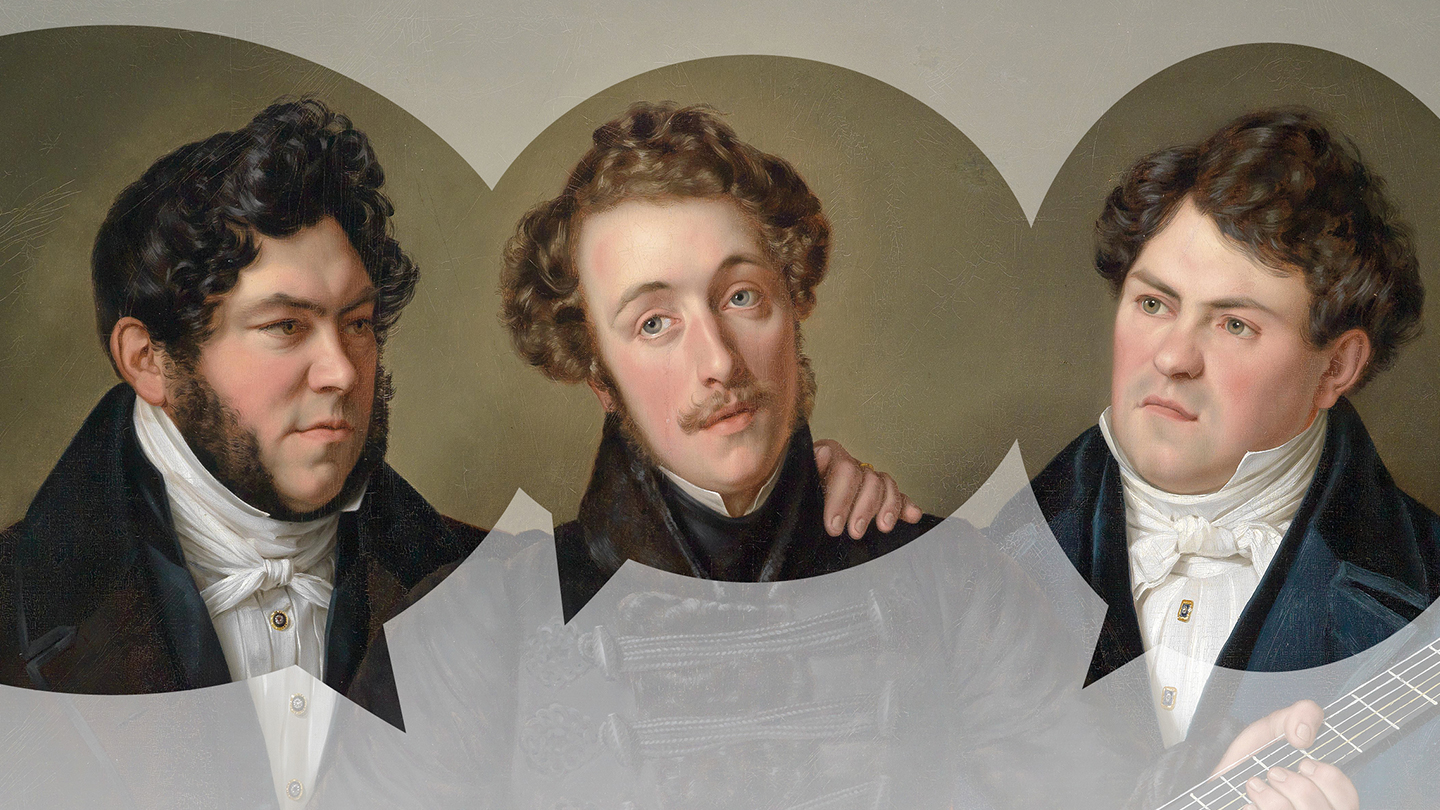
All original artwork by Benjamin Orth. [.smalltext]Wikimedia Commons (public domain).[.smalltext]
[.article__paragraph--cap][.small-caps]Most of the group chats[.small-caps] on my phone are dead – thank goodness. The one for the parents in my kid’s class went quiet over the summer. The dramatic ones from my last job have been silent for four years, and the current ones are matter-of-fact: Do you have the content for us or don’t you, Mr. Head of Content? The family threads are pure logistics, a place to negotiate childcare or determine who is hosting a holiday. The Pittsburgh sports chat with my brothers wakes up for twenty weeks a year when the Penguins and Steelers are chugging toward the playoffs, and then goes back to sleep. Each of those threads represents pure instrumentality, nothing more or less. The school year ends, you leave the job and mute the work Slack channel; the Pirates are already out of contention; the chat twitches on out of habit a while longer and then goes still too. I am a middle-aged man working out of a home office an hour south of Pittsburgh, a decade gone from a tenure-track academic job I walked away from, and I am not in the pew or at the union hall or drinking at the corner bar. Those real-life rooms emptied long before my group chats did, and I suppose their absence makes me the exact man the academics interested in loneliness keep writing about.[.article__paragraph--cap]
None of this has made me miserable – far from it. I have a tall wife and a small daughter and full-time (albeit perennially precarious) corporate creative work that I mostly like, and I am not writing essays like this from the bottom of a well, or bottling and then tossing them into the sea. But the men in my life are ghosts. My father and my uncle, another father figure, have both resided in urns for the past decade. The friends from grad school scattered to other cities, and the friends I have made since are work friends, the kind you lose the week you change jobs and only hear from again if they’re trying to coax you to join them at a new one. A man my age is supposed to coast on the friendships he banked young. I have one account still open.

Robert Putnam, the oft-quoted sage of Harvard’s Kennedy School, saw this kind of thing coming. Bowling Alone came out in 2000, and the concept of the title was pithy enough to launch a thousand takes: Americans were still bowling, more of them than ever, but they had quit the leagues. The bowling teams became men rolling frames alone on a Tuesday night; today, perhaps, they are reduced to doing so on a Nintendo Switch in the wee hours of the morning. Twenty years after the book’s publication, a pandemic closed what little was left: emptied the diners and the gyms and the lodges and the church basements, and sent everyone possible to work from home. Many of us never returned to the office. Now the numbers for men are worse than anything Putnam recorded. The share of men with no close friends at all rose from 3 percent in 1990 to 15 percent by 2021; the share with six or more fell from 55 to 27 percent. One in five men with no wife or girlfriend reports having no people at all they would call close. (The problem is sufficiently endemic that TFW No GF – “That feeling when no girlfriend,” in internet-speak – served as the title of a 2020 documentary film.) In 2023 the surgeon general estimated the toll of chronic loneliness on an individual’s health as roughly equivalent to smoking fifteen cigarettes a day. (Daniel Cox, who ran the original survey, has since redressed the gendered readings that suggested an exclusively male loneliness epidemic, finding the gap between men and women nearly closed, though both remain unspeakably lonely.)
Sociologist Ray Oldenburg put a name to what these men were missing back in 1989. Home was the first place, work was the second, and the third was wherever a man used to be a regular without being on the hook for familial chores: the tavern, the barbershop, the Elks or Moose lodges, the stoop. The talk in such places was cheap as it was free. Many of these “third places” are now gone. The last real one near me is a dingy Hungarian restaurant where the same few retirees, conversing in a pidgin dialect of Western Pennsylvania English and Slovak, take the same booth at eleven each morning. When the last of them dies, that booth will go to no one. What stands in for it, for me and perhaps for other men of my kind, is the smartphone, and that phone is not valuable for its benighted and thoroughly antisocial social media – increasingly awash in AI slop and outrage – but rather for a few meaningful group chats.
[.article__paragraph--cap][.small-caps]Of course,[.small-caps] there is the kind of chat that takes an ordinary man and turns him into something worse. In 2023 Breitbart, of all places, published the contents of a Telegram group a young right-wing influencer named Pedro Gonzalez had belonged to, one its members had named the Right-Wing Death Squad. Inside it, Gonzalez spent 2019 and 2020 escalating his racist and antisemitic comments, each line uglier than the one before, calling Ben Shapiro and Candace Owens things that needn’t be reprinted here, because escalation was what the rooms were all about. Such partisan rooms demand absolute irrational loyalty, as partisan groups both real and virtual always have, and loyalty there is signaled with transgression. You prove you belong by saying the thing you cannot take back, and once you have said enough of those things, the room is the only place that will still have you. A leaked Young Republicans chat surfaced two years later running on the same fuel. The surprise, each time, is that anyone is surprised. Take a man like Gonzalez out of the chat and place him somewhere else, somewhere real, and he might change. In 2024, he went to Springfield, Ohio, to report on the hoax about Haitians eating pets, met actual people instead of “based” dissidents hiding behind anime avatars, and renounced the whole movement. The chat had been doing his thinking for him. Away from it, out there in the real world, he got his mind back.[.article__paragraph--cap]
Lower the stakes and the same thing holds. The crypto chat rooms: hosted on Discord and sold as private “alpha groups” – alpha being the trade’s word for a masculine edge nobody actually has – where the tip you paid for turns out to be exit liquidity for the person providing said tip, beta-buyers that the canny moderators need only to unload what they bought the day before. The day-trading server of a hundred born-loser men taking turns as each other’s marks, every one of them certain he is the only man at the table who isn’t the sucker. The same hustle in different clothes, built to take something out of you yet styled to look at first like a virtual Cheers, at the bar where everybody knew your name.

I have not watched this only from the outside. Back when a podcast I cohosted – What’s Left?, for all two dozen or so people who might remember – still had an audience, I was added to a smoke-filled-room version: a chat of posters and would-be influencers from what was then called the post-left, a loose confederation of ex-leftist radicals and freshly minted reactionaries who had discovered they disliked the same people. They were workshopping takes, which is to say opinions built to go viral on social media, trying the lines on each other before posting them for public consumption on Twitter. It had the feel of an underground scene – several in the room turned up in the flesh at Dimes Square, the few blocks of downtown Manhattan that some were promoting as a new Warhol Factory (and that venture capital money was funding) – and the function of an SEO content farm. I enjoyed studying that room. I could feel a take warming up before the person typing it had finished thinking it, a valuable skill that does not switch off when you close the app – or get banned from the room, as I eventually was.
After my role in the scene ended, few of us ever spoke again, because there had never been anything underneath it. None of these were rooms of friends. They were rooms of operators, “doing the workers” in my own work-saturated parlance, and a “doing the worker” – an online hustler, a take-pusher – is the most isolated man there is, because he can never stop working the room he is standing in. What gets me about them is that the people inside are not fools, only lonely, which is a different thing entirely. They are “alone together,” in the superficial, technology-mediated way Sherry Turkle described in her 2011 book of that title. Yet everyone who finds their way into these sorry places is after the same thing: a room where the talk is its own reason and a person can be known. Loneliness is a market, and like any market, it is served by people selling something. The trick for locating a group chat that’s also a third place is finding the one room that is not for sale.
[.article__paragraph--cap][.small-caps]I have one chat,[.small-caps] my own “Doing the Work” room on Google Chat, which is none of that. It has lived on Google Chat since 2015. Eleven years, five of us, and it has never had a single take workshopped in it, never turned any of us into an influencer or a thought leader. It never needed such nonsense. It started as a couple of men who did not want to lose track of each other, and it has stayed exactly that, with nothing added. We have never once talked about why we keep it, because to talk about it would be to put it at risk.[.article__paragraph--cap]
There is an industry now devoted to fixing what I have always been fortunate to possess, consisting of the men’s gaming groups and the run clubs and the lifting clubs and the apps that promise to find you your people in a strange city. I do not begrudge anyone the run club or garage gym meetups; a man should take connection wherever he can get it. But the thing about my chat is that no one designed it to do anything. It works the way the old third places worked: by not being built for work, by being a place men happened to be when they weren’t working – until the mere act of happening to be there hardened into a habit. You cannot stand one of these up on purpose. You can only keep showing up to prevent it from dying.
Most of us in the group met around graduate school, while I was finishing a doctorate at Pitt. Greg was a state debate champion who became a philosopher and then a computer scientist; he runs a farm in Kansas now, knows more about livestock and soil than anyone I have ever met, and can lay out the science behind a sports training program we all know he has no intention of ever following. Wade is an Army veteran who homesteads, hunts moose, and pulls gold out of the ground in Alaska; two hundred and twenty pounds of the kind of strength you get from work and the service rather than “scientific” training programs promoted by one fitness influencer or another. Rob came up through the dance world at Pitt and still moves like it; he is also an economist turned business analyst, a bed-and-breakfast owner, a cook worth driving for, and a wine expert who could outshine any French sommelier, which is to say he is quite simply good at everything. And then there is JR, who goes back further than the Pitt years: the best writer almost no one has read, the man who motivated me to pursue this essential labor nearly thirty years ago, when we were undergraduates running imaginary wrestling promotions over email. He is thin and worn, living on the margins in Richmond, used up by the addictions he has written about more plainly and with less self-pity than anyone this side of Hubert Selby Jr.
We are all of us, except JR, fathers. You would never guess it from the chat. What goes in: A photo of the lump of roots one of us snaked out of his own sewer main. Whether a Facebook Marketplace barbell is worth the money. An argument about peptides that runs four days and settles nothing, Greg holding forth on BPC-157, which none of us will take. The price of gold, which Wade reports from the source. A bottle Rob opened, what it cost, and whether it was worth it, though Wade and I do not drink and Greg is busy trying to make wine from peppers. A beautiful, unwatchable Tito-era Yugoslavian movie JR is the only man alive still patient enough to sit through in its entirety. Tax questions in April, a busted water heater, a piece of gruesome local news too strange not to share, something that captures what my father would have called the bleak truth about “humanzees like us.” The chat can go dark for a week and then go two hundred messages deep in a night because Greg has a sick calf or Rob found something noteworthy at an estate sale.

Under all of it is the shared and unspoken understanding that the world has gone wrong in ways no man can fix from a phone, and that it is for us to acknowledge it here but not fix it – we cannot boil the ocean, as my corporate overseers frequently say during Zoom meetings. What does not go in: deep feelings, in any register a therapist like my wife would want to affirm and acknowledge. Certainly not sadness, properly so called. Talk of marriages, especially when they wobble, as several have. And above all, the children. Between us we have a passel of kids, born across these eleven years, and we almost never bring them up, though it goes without saying they are doing well enough, all things considered.
The same holds for all the other hard stuff, and my, how there has been hard stuff! JR has lived harder than any of us, despite a somewhat privileged childhood, yet you would never know it from the chat. What he has to say about the bad years he puts in his fiction, and once in a while an essay, where the rest of us read it like strangers, a little startled to get it from the page instead of from the man, who is himself a William Burroughs-esque wraith full of arthouse cinema and surrealist poetry trivia. In the chat, where he speaks the least of all, he is what he has always been, quick and funny and dead serious about some art object the world forgot. None of the rest of us is any different. Even the pandemic, which happened to all of us at once, entered the chat mostly as a four-day argument about the best places to acquire cheap gym equipment, which it is my job to know since MEL magazine paid me to write that very story. It is always about the tasks at hand, the work: the book somebody finished and what he made of it, the sheep somebody processed, the bug in the corporate code that Greg got a crew of Claude coding agents to fix, a truck that would not start, the weather (hotter than it’s ever been, more storms than a decade past, all confirmed on the record – Greg is doing climate tracking work, among his many projects – though without any accompanying pearl-clutching over climate change). You bring those cold hard facts, and you leave the rest at the door, as one might have at the dingy bar my father operated throughout the 1970s to launder dirty money.
There was an amusing post I saw to this effect, a list headed “Boys’ chat be like”: Anyone available to help move. Anyone want to buy a canoe with me. Here is an embarrassing photo of the birthday boy from fifteen years ago. Another baby announcement via ultrasound photo. Someone in the replies pointed out that in the boys’ chat the baby announcement gets three party-hat reactions and the embarrassing photos and prospective canoes get a baker’s dozen. When this post crossed my feed, I added that it’s impossible to remember the baby names and baby friends anyway, since they reside within an ever-expanding fog of war – a no man’s land patrolled by the wives who, driven by nature or nurture or some combination thereof, track all of that other stuff like bloodhounds.
That, I suppose, is the warp and weft of it. I have a kid at home, a day job that consists of researching how other people feel about their jobs, an essay or article always due, and a body to keep up. Every one of those is a role where I am being something for someone: a father, an employee, a writer, a man with a world-class deadlift to maintain. The chat, by contrast, is the only room I occupy where I am being nothing for anyone. No one in it is my audience, and no one is my mark. We knew each other in the flesh, in the marrow, before any of us had a platform, and the chat is where we go on confirming that we still do. It has outlasted jobs and moves and the scenes I mistook for a circle of friends. If Google vanishes, it will go somewhere else. This is truly the third place Oldenburg meant, the supper club where the talk costs nothing, except that it fits comfortably in a pocket – and that a couple of the regulars, who are people rather than posters, small language models instead of large ones, are always asleep. Eleven years of the best talk there is left, unmeasured and unimproved and, last I looked, currently discussing a lump of wet wipes or huge poop somebody pulled out of a pipe. For the record, I do not know whose baby was born last month. Fog of war, thicker than Robert McNamara’s or General Custer’s, though they’d have been welcome too, had I known them as one used to know and still can know such men.