Personal History
How a Rescue Dog Saved Me
When I first met Sam, he was nearly feral. But he became more than a friend.
September 12, 2026
Try 3 months of unlimited access. Start your FREE TRIAL today. Cancel anytime.
START FREE TRIAL NOWHow a Rescue Dog Saved Me
When I first met Sam, he was nearly feral. But he became more than a friend.
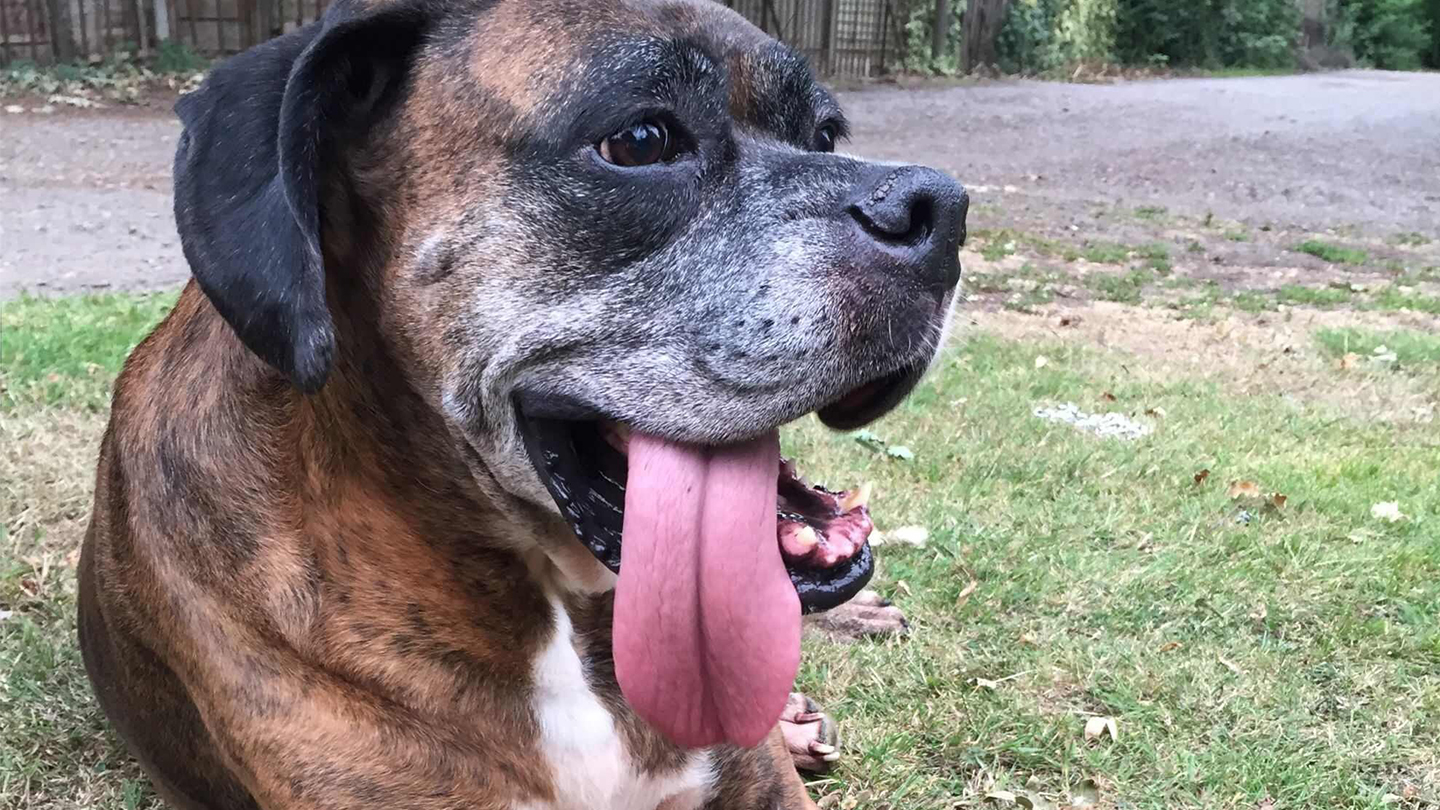
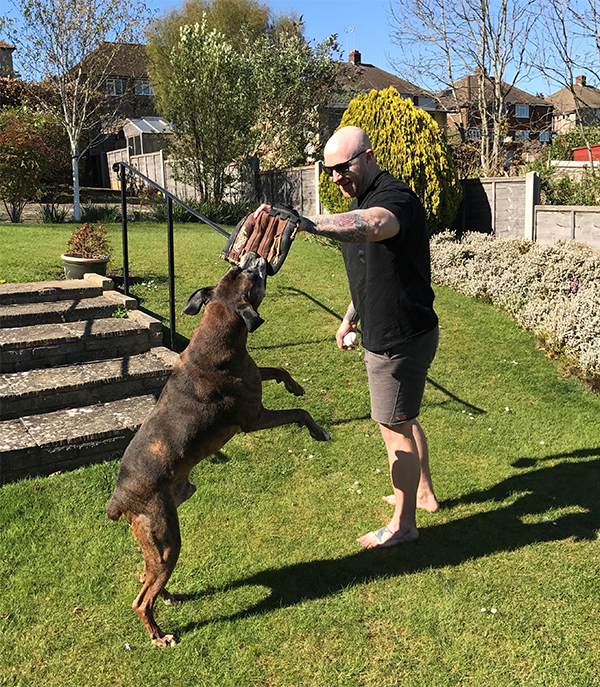
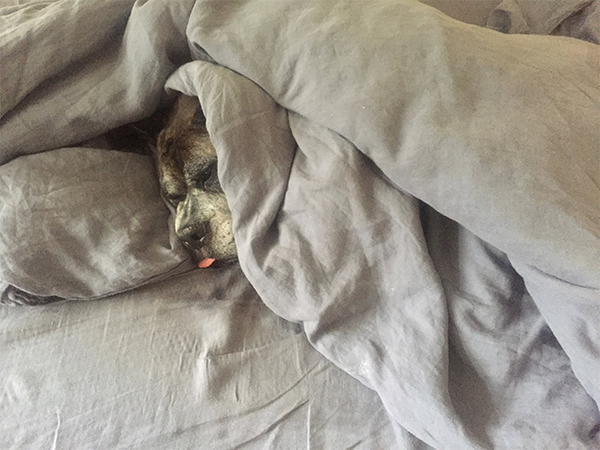
All photographs: The author’s dog Sam. [.smalltext]Courtesy of Erik Van Aken.[.smalltext]
[.article__paragraph--cap][.small-caps]In one of the most[.small-caps] haunting opening lines to a novel in the last hundred years, Albert Camus begins The Stranger: “Mother died today. Or maybe yesterday, I don’t know.”[.article__paragraph--cap]
I tend to pause when I’m reading, especially when I come across a line that surprises me. I look up from the book, close it, and sit dazed, rapt in thought, like a deer in headlights. I recall once, at Denver International Airport, reading such a line from Bertrand Russell’s The Problems of Philosophy, one that said we should believe a proposition in accordance with the available evidence.
I did not know it at the time, but that idea represents evidentialism, the idea that a belief has justification if it is supported by sufficient evidence.
I thought about that line for a long time. It had a profound effect on me. What was the evidence for Christianity? Given much else that I had read from Russell (and many others like him), I reasoned that what I had wasn’t very good. Could I prove, evidentially, that Jesus was God? That he had walked on water or risen from the dead? Following the thinkers I most admired, I knew I couldn’t. At the time, I was a Christian, but primarily because of what I felt; my experience, which is subjective, fell short of the criteria of “good” or “sufficient” evidence. We often don’t take the power of words seriously.
My close friends and family never seemed to believe me when I told them I lost my faith after reading a sentence by Russell during a layover at Denver Airport.
Camus’s line is different. It draws you in. What kind of person wouldn’t know if his mother died today or yesterday? Reading The Stranger, you soon find out.
According to Camus, life is absurd because we believe there must be some meaning or point to it all, some rationale for our hopes, desires, passions, fears, suffering, and guilt. For Camus, there isn’t any, and the novel’s protagonist, Meursault, portrays the “absurd hero,” the one who sees life for what it is – nothing – and lives in the face of that nothingness.
Because God does not exist, there is no moral standard; there is nothing we’re compelled or fated to do or become. Life has no compass.
After I lost my faith, I never became a card-carrying atheist (I didn’t have the evidence for that, either). But I was always searching, trying to figure out how to frame my life and my experiences. If God did not exist, I thought for years during graduate school, Camus must be right. But his prognosis of our condition is less than heartwarming.
Like Sisyphus, the absurd hero (as Camus would have it) whom the gods condemned to push a large rock up a mountain, repeatedly, for eternity, we need something to keep us going. We look for “happiness” in the little we have: a momentary peaceful sunset, a cigarette, a lover, a decent meal. We strive to create something worthy: a poem, a painting, a friendship, some artifact that says, I was here, I lived. The artifact itself, the “thing,” does not justify anything. It just helps us live.
[.article__paragraph--cap][.small-caps]There’s a story[.small-caps] in philosophy that has stuck with me, about John Stuart Mill. Mill, the prodigy of utilitarianism, was reading Greek and Latin by the age of eight. His father, a close friend of Jeremy Bentham, raised him to be the perfect consequentialist. Mill writes:[.article__paragraph--cap]
My conception of my own happiness was entirely identified with this object. … As a serious and permanent personal satisfaction to rest upon, my whole reliance was placed on this.
It’s quite a weight to carry, the happiness of all humankind. Eventually, inevitably, it broke him. Mill fell into a deep depression. He asked himself whether, if all his goals were achieved, he would feel joy. The answer was no.
What saved him was poetry. Specifically, Wordsworth’s poems, which expressed, Mill writes, “not mere outward beauty, but states of feeling, and of thought colored by feeling, under the excitement of beauty.”
Mill wasn’t reading poetry to be productive. He wasn’t reading to achieve anything. Yet he began to feel. And those feelings healed something in him and had a profoundly life-changing effect.
Had Mill merely found his “thing”? Camus’s framework leaves little room for what happened to Mill. For Camus, the meaning we make cannot transcend the absurd. Yet Mill’s story suggests these feelings may mean more than Camus allows. These states feasibly healed Mill not by helping him create meaning, but by awakening him to meaning already there.
Tolstoy, after achieving everything he’d ever wanted, fell into despair. He contemplated suicide. What saved him wasn’t success or reason, but witnessing the simple faith of Russian peasants, people who lived in connection to something beyond themselves.
And then there’s this, from “The Truelove” by the poet David Whyte:
There is a faith in loving fiercely
the one who is rightfully yours,
especially if you have
waited years and especially
if part of you never believed
you could deserve this
loved and beckoning hand
held out to you this way.
I am thinking of faith now
and the testaments of loneliness
and what we feel we are
worthy of in this world.
The testaments of loneliness. In Latin, testamentum comes from testari, meaning to testify, to bear witness. When Whyte writes of the “testaments of loneliness,” he’s talking about what loneliness reveals, what it says. These aren’t scientific claims or syllogisms. But they speak. And the question that lingers – on which everything hangs – is whether someone might be speaking back.
[.article__paragraph--cap][.small-caps]The theologian[.small-caps] David Bentley Hart draws a distinction between shallow atheism and profound atheism. A shallow atheist simply denies belief, like one might deny Santa Claus. But a profound atheist understands what it means, what it costs, to live without God. The payment we owe to nothing.[.article__paragraph--cap]
Perhaps better than anyone, Friedrich Nietzsche understood the cost. In his famous parable of the madman, he warns that if God is dead, then everything – truth, morality, value – changes. We lose not only the source of meaning, but the very structure by which meaning could be known. We face the abyss. To avoid collapse, haunted by the specter of nihilism, Nietzsche calls us to become Übermenschen, to create our own values and our own meaning. In Sartre’s later turn of phrase, we are “condemned” to be free.
The other of Camus’s most provocative opening lines is a direct offshoot of Nietzschean philosophy. In The Myth of Sisyphus, he writes:
There is only one truly philosophical problem, and that is suicide. Judging whether life is or is not worth living amounts to answering the fundamental question of philosophy.
To say that the fundamental question of philosophy is whether or not we should kill ourselves might feel dramatic. Yet, if situated in the godless world assumed by Camus, if located in the rubble of traditional metaphysics provided by Nietzsche, the question becomes all too necessary. “When the ground of morality has been cleared,” writes the philosopher John Kaag, “a thinker is left to question the ultimate worth of human existence. Without traditional metaphysics or religion, one is delivered – or returned – to the natural world and is charged to make meaning in that rugged landscape.”
How does one create meaning in a seemingly meaningless world? For Nietzsche, it is, to put it simply, owning up to every one of our choices, bearing the responsibility and pain that come with everything we do. It is making your life into a work of art; it is creating a story where you become the hero; it is taking responsibility for your life in the deepest way imaginable: all its misfortunes, setbacks, suffering, and occasional joys, and being able to say, Yes, I would do it again – and again, and again – for all eternity. The eternal recurrence, as Nietzsche labels it, is the idea that you can create a life such that the thought of living it again – in every minor detail, to the letter, for eternity – is one you can embrace. Saying “Yes” is the most meaningful thing we can do.
Though Nietzsche found the idea of eternal recurrence terrifying, we know through various biographies that he tried to live it out. I find his ending tragically revealing.
In the final years of his productive life as a writer, Nietzsche believed he had found respite from his chronic physical, social, emotional, and mental ailments in Turin, Italy. Yet, as the story goes, one day, as Nietzsche was leaving a shop, he witnessed a man violently beating his horse. Nietzsche was so outraged that he ran to the horse, screaming, and threw his arms around the animal to shield it. He collapsed, weeping, and never fully recovered. He spent the last eleven years of his life incapacitated, initially in an asylum in Jena but thereafter in the domestic care of his mother and sister.
Many claim that we have sufficient evidence about Nietzsche’s various ailments to explain his collapse in terms of predictable, physicochemical causes. But Lou Andreas-Salomé, Nietzsche’s first serious biographer and perhaps the only woman he ever truly loved, writes that Nietzsche’s breakdown was a direct result of his philosophy, specifically the result of his ardent effort to live it out. Whatever the case, it’s easy to imagine the cracks in Nietzsche’s worldview: the idea that the self, so small and limited, stands in the place of God. If the story is true, the irony is as profound as it is beautiful. Nietzsche became the hero of the tale.
[.article__paragraph--cap][.small-caps]Years after[.small-caps] the incident at the Denver airport, still without faith, I found myself settling into a kind of philosophical amalgam. I didn’t follow Camus all the way into absurdist rebellion, and I couldn’t match Nietzsche’s heroic self-creation. But I accepted their starting point. If God does not exist, then meaning must be made. Anything could serve as scaffolding.[.article__paragraph--cap]
I created a point system. It certainly wasn’t defensible, not logically. But it gave me a direction. For every action that improved someone else’s life, I awarded myself a point. For every action that caused harm, I took one away. I didn’t think the points would add up to anything. Chaos makes it impossible to discern the ripple effects of even the smallest choices; outcomes often do not align with intentions. The gods of chance stand indifferently over all things. All the same, it was the best I could do.
And then there was Sam.
As far as I could tell, I hadn’t made anyone’s life objectively worse. I wasn’t a moral saint, but I’d never tried to hurt anyone. Sam was the only thing I knew for sure. He put me in the black.
Sam was a rescue. The day I arrived at Boxer Rescue Los Angeles, they wouldn’t let me go inside. I was asked my preference for sex, age, and color – fawn or brindle – and that was all. I was surprised by the first dog they brought out: young, happy, well-mannered, and undeniably handsome. I could see he’d make a wonderful pet and would soon be adopted. On a whim, I asked the woman helping me if they had any dogs who’d been there longer, any that needed more help. She smiled and said, “We do.”
My first impression of Sam was a mix of sympathy and respect. He seemed nearly feral, pulling violently on the leash, lunging to attack another dog. I was taken aback by how firmly the volunteer corrected him. I was told Sam had been adopted and brought back three times. When I asked why, they said only that he was aggressive with animals and had likely been abused, or trained as a fighting dog. Sam was brindle, with a scar across his white chest, moving from his lower neck to his stomach. His jaw was slightly crooked, the result of an early break, and his large tongue continually hung an inch or so outside his mouth.
As we walked down the street, away from the chaos of the shelter, something changed. Sam’s weight shifted, and he looked up at me. I got the impression he was thanking me for taking him out. I admired him immediately for braving the leash with a stranger, for fighting his way out, and for offering me the possibility of trust.
Half a mile from the shelter, I sat on the curb in the adjoining neighborhood. I spoke only once: “You’re very brave,” as I gently touched his face. He took both paws and placed them on my shoulders, looking directly into my eyes. He slept on my lap for the two-hour drive from LA back to Orange County.
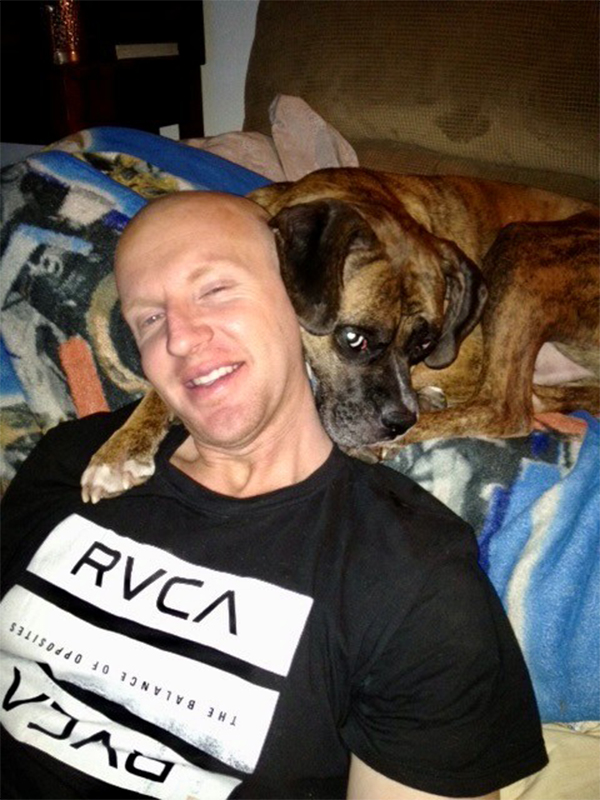
The first few weeks were a comedy of trials. I tested Sam for food aggression – he passed. I tested him with strangers entering the home – he passed. But he had night terrors. If I startled him while he slept or gently touched him, he’d wake up fighting. His main issue was other dogs. When he saw one his size or larger, he made a sound that rattled me, a scream masked with a growl. It scared me. And it was clear: in the wrong circumstances, Sam would be dangerous.
Training began with the basics, but he learned quickly. Within two months, he was safe off-leash; by five months, safe in all contexts, though only with me. Sam never trusted other dogs and only made two canine friends. Yet though he often stalked other animals and crouched low, as if hunting, he never hurt anything. He always loved people.
[.article__paragraph--cap][.small-caps]Sam was around four[.small-caps] when I lost my faith. A year later, I moved from California to the United Kingdom to begin graduate studies in philosophy. Sam came with me. In the second year of my PhD, I was almost certainly depressed. I had friends at school, colleagues, students, people I’d get coffee with or join for walks. I had gym acquaintances I saw nearly every day. But other than Sam, I had no close friends.[.article__paragraph--cap]
I woke most nights around 3 a.m. and developed the habit of walking Sam through the forest near our house. The lack of sleep was jarring, but the walks became ritual. I ruminated on my research, my advisor’s comments, and personal matters. Two or three times a year, I’d throw a long shot out into the woods:
God, if you’re there, show me something.
I heard the occasional owl. Once, only a second or two after the prayer, I heard a fox scream. I never took that as a definitive answer, but began to wonder what would count as one.
The walks continued, I progressed in research and teaching, and Sam grew grey. As he was a rescue, I never knew for sure how old Sam was, but I had him for ten years. By the end of my PhD, he was likely twelve.
His first seizure scared me. As it was his first, the young veterinarian who had looked after Sam for years recommended that I observe him closely and let her know if it happened again. It did, a month later. Then again. We discovered that Sam had a meningioma, a small tumor in his brain.
Sam had lived a great life. He had given me more than can be put into words. I scheduled and canceled the appointment to put him down twice. I could not risk losing him to a seizure or injury while I was out of the house. But it took time to let him go. The day the veterinarian finally arrived, I was calm. I never questioned whether it was the right thing to do. I remember that morning vividly. Sam and I walked our usual path, through our neighborhood, to a small trail that led into the woods. We saw a grey squirrel, which excited Sam. The wind was blowing unusually hard, pushing his floppy ears back against his large head. We sat once. I did not want to alert him. I did not cry. I hugged him once and thanked him. He ate a chicken breast with peanut butter, drank half a beer, and lay with me on the couch.
When the vet gave him the shot to fall asleep, I lay next to him. I thanked him again, trying to express how much I loved him. In his final gesture, he lifted his right forepaw and placed it into my open left hand. Though I had carried him a hundred times, he felt heavy when I last picked him up and laid him in a box.
[.article__paragraph--cap][.small-caps]Ten days after[.small-caps] he passed, I took an impromptu holiday. I missed my friend terribly. About a week after I returned, something strange happened.[.article__paragraph--cap]
When I woke that morning, it was still dark. I listened to the quiet, wondering whether I had slept long enough. As I turned over to look at my phone, I heard the unmistakable sound of Sam rising from the couch, shaking himself, and beginning the slow walk into my room. It did not scare me, but I sat up. I listened closer. Nothing was there. I felt silly as I walked through the house just to make sure. I thought it must be some type of grief process or memory recall. Then it happened again the next morning, this time while I sat at the end of my bed. As I rode the train to my university, I thought about telling someone. I never did. The third time it happened, the very next morning, I began to question my sanity.
The night after, after three days of hearing … (Sam?), I could not sleep. For the first time since he died, I walked our old path at 3 a.m. The wind had dropped, and it was quiet. I recall feeling oddly suspicious walking the streets alone. I eventually sat on the large log where I used to watch Sam wade through the tall grass in summer, following scent trails. I don’t know how long I sat there. I was not praying. But Sam’s lingering presence felt like a thread. What I thought was this: I would say yes. I would live the whole thing again, all of it. Forever. I would sit alone on this log every night for the rest of my life to have rescued Sam. He had made the whole thing worthwhile.
Then I was not alone.
I experienced a profound sense of presence and love. Sam’s love, but more than that. It was an unexpected and totally unique sense of hope, so powerful that it became, almost instantly, a deeply felt knowledge. I am extremely careful with that word. But I knew – however inexplicable or mysterious, however any single person alive or dead might question it – that what came over me was a sudden and life-altering revelation of the force of love. Love was the measure of all things. I had been, only a moment prior, connected to Sam through history, memory, scars, and torn hoodies. Now it was more. How strange and fitting that God would use my friend Sam. A dog.
I did not hear a voice, audibly or mentally. But what God said was:
See. I’ve been here the whole time.
I never heard Sam again.
[.article__paragraph--cap][.small-caps]Camus’s answer[.small-caps] to the question of suicide is “No.” For Camus, we embrace the absurd. Above all else, we avoid the false hope of religiosity. Camus demands that we see the world as it “really is.” He invites us into despair, to stand and to live in that despair, rebelliously, incongruously, absurdly.[.article__paragraph--cap]
But what if Camus is wrong? What if despair is a way in, a door into something real and profoundly meaningful?
Lisa Miller is a clinical psychologist at Columbia University. As a scientist, she believes that anything true can be shown. Over the course of two decades, in dozens of published studies, Miller and her team have discovered something that Camus could not have anticipated: our brains seem to be hardwired to locate spirituality through depressive states. In her words, the relationship between spirituality and depression is like “two sides of the same door.” The brain regions worn thin by depression, across the parietal and occipital cortex, the regions of perception and reflection, are the same regions that thicken when a person awakens to something transcendent. Not in nearby regions; the same ones. Our brains use despair as a passage into the spiritual, or what Miller calls the “awakened” brain. When this happens, when one connects to something outside the self, what had been broken by grief, depression, or despair is repaired, often for life.
In her prospective ten-year study, Miller measured three variables: the importance a person ascribes to spirituality, frequency of church attendance, and denomination. Only one variable was found to consistently predict protection against depression – the effect was an enormous 90 percent decrease in risk for those most vulnerable. What mattered was not church attendance or which denomination, but whether someone experienced a personal sense of connection to something transcendent, something beyond the self.
When asked what the transcendent is, Miller correctly notes that she cannot say: “I am a scientist, not a theologian.”
Miller does not prove the existence of God. What she proves is that we are not built to live in despair. The absurd hero, who stands before the door Camus told him never to open, is not heroic. He is a man living against his own neurobiology.
[.article__paragraph--cap][.small-caps]Seven months after[.small-caps] Sam died, I moved back to California. When I was asked to teach a college course on “spiritual journeys,” I was initially reluctant. My immediate feeling was that the course was fated to the frictionless spirituality of Eckhart Tolle’s The Power of Now. Yet as I began researching and building the course over the summer, I came to see the extraordinary opportunity I had been given.[.article__paragraph--cap]
It was my three-year-old son who provided the breakthrough. We were driving along the coast in Palos Verdes, listening to his playlist, when he asked me to turn up the radio. Tracy Chapman’s “Fast Car” was playing. As my son sang along, I listened as if hearing the song for the first time. Maybe together we can get somewhere. … Starting from zero.
If zero is the rationalist, materialist paradigm that nearly all my students were swimming (or drowning) in, the destination was somewhere transcendent. Any place is better.
Through a decade of teaching philosophy, religion, and spirituality, I have never seen a course have a more profound impact on my students. I have them read Saint Teresa of Ávila’s The Interior Castle, C. S. Lewis’s Surprised by Joy, and Henri J. M. Nouwen’s Life of the Beloved; they read Thich Nhat Hanh’s The Art of Living, Sam Harris, and Dostoyevsky. I encourage them to go twenty-four hours without their phones. They watch The Tree of Life and The Shawshank Redemption. They write poetry and share their own stories. And I tell them my story. I tell them about Sam.
… we are all
preparing for that
abrupt waking,
and that calling,
and that moment
we have to say yes,
except it will
not come so grandly,
so Biblically,
but more subtly
and intimately in the face
of the one you know
you have to love,
… and if you wanted
to drown you could,
but you don’t
because finally
after all the struggle
and all these years,
you don’t want to any more,
you’ve simply had enough
of drowning
and you want to live and you
want to love and you will
walk across any territory
and any darkness,
however fluid and however
dangerous, to take the
one hand you know
belongs in yours.
[.smalltext]From David Whyte, “The Truelove”[.smalltext]
My life and my relationship with God will never be the same after Sam and my experiences after his death. It is like the truth of the simplest sum, like the man healed in John 9, “I was blind but now I see.”
The year after I lost Sam, I adopted another boxer rescue, Reg. I’m now back in the United Kingdom, where I am a member of a small Reformed church in a leafy village in Kent and teaching secondary students. I’m no longer lost, and most nights I can sleep. When I find myself in the forest at night, with Reg, Sam is there.