Essay
Death and the Farmer
How can you care for farm animals and also kill them?
December 15, 2026
Try 3 months of unlimited access. Start your FREE TRIAL today. Cancel anytime.
START FREE TRIAL NOWDeath and the Farmer
How can you care for farm animals and also kill them?
[.article__paragraph--cap][.small-caps]I was born in 1974[.small-caps] into a traditional farming community in the northern valleys of England. In that community it was not uncommon for young farmers to live in council houses, as their first home, before they rented a farm, or moved into the farmhouse when their own parents retired. So my first years were spent in a row of gray houses, which sat on the roadside between a railway and some electricity pylons.[.article__paragraph--cap]
Our next-door neighbor was an old farm worker who caught rabbits with a ferret or snares. Rabbits hung by the back door. Eyes bulging. Specks of blood on their coats. On the other side lived my friend Rachel. She was detached and cool, and only just suffered my presence. But we were the same age, rode the same school bus, were in the same class, and hung out together in a mob of half-wild children after school.
One day, in the early 1980s, we all crammed onto the sofas in someone’s house and watched Watership Down. An hour later, Rachel was sobbing on the sofa because the rabbits got killed. I wasn’t sobbing, because they were rabbits. I remember thinking it was weird how we reacted differently. I wondered what that was about.
A few months later there was an incident that made me realize we were farmers, and different from other people. Rachel’s dog, a scraggy wolfhound, was shot by my dad because it had started to roam around the fields and chase our sheep. My dad came home and said he’d tried to warn her parents several times. They had not listened, so he had shot it. My dad knew that a dog that learned to chase sheep was a dog that would kill. Understanding that too made me a “farmer.” It made me different from Rachel.
She was heartbroken. We had killed her beloved pet. She didn’t talk to me much after that. It was as though we were destined to be in different tribes, the world pulling us in different cultural directions. By the time I was eight years old I knew that death troubled other people, troubled them greatly, and was somehow beyond the pale of polite conversation.
My dad was surrounded by death. It was totally normal to him. I sometimes helped him throw sheep carcasses into our “dead hole,” a few fields away from the village. When animals died, you couldn’t leave them to rot in the fields, so you threw them in the dead hole, and when you got time, buried them with the digger. At the end of winter the hole was like something from a Goya painting. A swollen cow in there, tongue out, a dead calf, three or four sheep, a fox someone had shot, and maybe a few hens. There would often be a rather bloated raven hanging about the dead hole.
A day or two in the lambing fields and you saw death – lambs born dead, or killed by a fox or a raven. Or they’d drown in the beck. My dad worked fifteen hours a day to try to keep all his animals alive, trying to keep more and more cattle to stay afloat economically, in worn-out old buildings that got dirty and hot. In spite of his work they’d find ways to die. Hard times make hard people.
One day my dad said he was going to fill in the dead hole because someone had looked in it and complained. He said people didn’t like to see dead stuff anymore, and it was best we covered it. I wasn’t sure what to make of my dad’s rough farmyard ethics, or Rachel’s very different sensibilities. I have thought about these moments all my life.
[.article__paragraph--cap][.small-caps]I am now fifty-two[.small-caps] years old, and I still live surrounded by animals, birth, and death. The world around farming has changed enormously since those childhood years. Modern industrial society depends on hundreds of millions of domesticated animals living and dying for human benefit, and yet fewer and fewer people have any direct contact with those processes. We have never eaten so many animals, and we have never been so detached from their lives and deaths. And our stories about animals have changed.[.article__paragraph--cap]
Many people learn about animals and farming from children’s stories, which increasingly ask us to imagine animals as furry little people, innocent creatures exploited by cruel human beings. From Watership Down to Bambi, from Babe to Chicken Run, our moral instincts are nudged toward sympathy with the animals and suspicion of the farmer. Think of the three farmers in Fantastic Mr. Fox:
Boggis and Bunce and Bean
One fat, one short, one lean.
These horrible crooks,
So different in looks,
Were nonetheless equally mean.
This is pretty much the default image of farmers in animated films now. I understand why these stories move people. They moved Rachel, and parts of them move me too. But they have always felt incomplete to me. I can’t square such detached idealism with the ecosystem management required to feed large numbers of humans. Can we really have ethics about our diet if they don’t make ecological sense? These cartoons ask us to imagine morality detached from ecology.
What are we to make of the great white shark in Finding Nemo who goes vegan to show solidarity with his fish friends? Or the young lion in The Lion King who decides to forego predation to make his little friends feel safer, and eats insects? Both creatures would die if they did that in a real ecosystem. We need a morality for our relationship with animals that fits with ecology, however complex that might need to be.
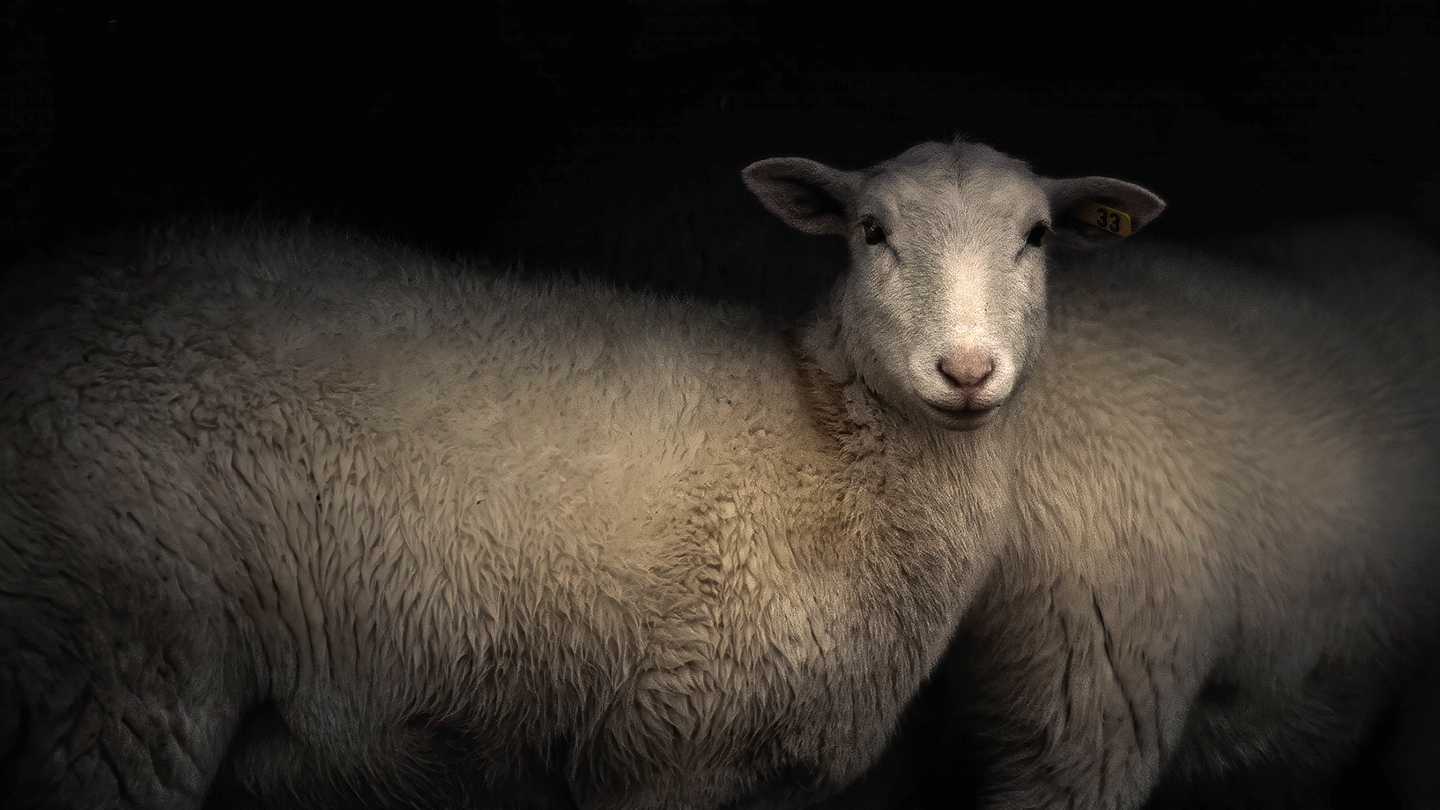
I am responsible for three hundred sheep, sixty cattle, twelve laying hens, four pigs, and five sheepdogs. And I am responsible for five hundred acres of the North of England (an acre is roughly the size of a soccer field). This inheritance has taught me some tough truths: all food comes from death. From the moment the first cell devoured another cell, about two billion years ago, nature has always involved predation and death. Almost all life we now see has been shaped by predation and disease (another kind of predation) – a huge arms race that leads from amoeba right up to orcas hunting gray whales and lions trying to take down elephants. Nature isn’t moral – it is the stage on which life plays out, and killing is a key process in that. We exist in a food chain, we take “life” from our ecosystem, and we consume it to grow our own.
If the point of life was simply killing, we would be living in something like Cormac McCarthy’s The Road – a wasteland in which everyone is prey. And, for all the flaws in our societies, they are not that grim. People rise above killing by choice, by moral codes, through developing ideas and beliefs that separate us from our animal nature. We are risen apes that live from death and killing, but we have brains and imaginations that recoil from such barbarism. We may be the most murderous thing on the planet, but we are capable of extraordinary moral imagination.
Geography often shapes our morality. We have outsourced food production to about 1 percent of the population. Farming realities are now often hidden, or simply far away, from the average consumer. People try very hard to navigate their moral connection to the food system, and are encouraged to do so by various labels and promises, choosing plant-based, vegan, vegetarian, organic, cruelty-free, or welfare-friendly products. Indeed, I often urge people to make such choices. But make no mistake: we are not able to remove ourselves from ecological realities. We may reduce the killing done in our name, we may help land or animals be better managed, but we haven’t escaped killing or death – not even close. Forty years of farming has taught me that there is absolutely nothing you can eat that would take you outside this harsh truth.
Fields are killing zones. A field is a place where someone cleared the original habitat – using fire, or an axe, or a chainsaw, or a giant wire rope pulled between two bulldozers. They either killed and ate the larger creatures that existed in the diminishing wild habitat, or simply took away their habitat so they couldn’t eat, drink, shelter, or reproduce. Nature is always trying to take a field back from the drastically simplified ecosystem that humans have turned it into and get it back on the path to be dense woodland or forest again. As part of resisting this process, farmers continue to kill vast numbers of things. The amount of death involved in feeding you and me is almost beyond calculation – worms, small birds, rodents, invertebrates, and microscopic soil organisms in the billions and trillions dying to make a single acre of field.
Although all agriculture does this, annual plant-crop agriculture does it to the most extreme forms. Plant cropping is more land efficient, but ecologically simplified to the extreme, and difficult to sustain on its own. Animal farming is less land efficient, but can be far more sustainable, and done in ways that let landscapes remain full of life. Of course, both forms of farming can wreck ecosystems if done badly.
[.article__paragraph--cap][.small-caps]So if innocence is[.small-caps] impossible, and all human food inevitably involves death and killing, what metric should we judge food systems by? Robin Wall Kimmerer, the Potawatomi author and professor, writes in her 2013 book Braiding Sweetgrass about asking her students to imagine humans living in harmony with nature. They couldn’t. They had absorbed the idea that humans were separate from nature, and mostly destructive within it.[.article__paragraph--cap]
Many older cultures, like those of the indigenous peoples of North America, understood humans differently – as participants in ecosystems, capable of enriching them through careful stewardship. This is important. If humans are only destroyers, then the logical response is retreat: leave nature alone and move human life elsewhere. But good farming, what was once called “husbandry,” has always been about another possibility – that humans might live from ecosystems while also tending them and helping them flourish.
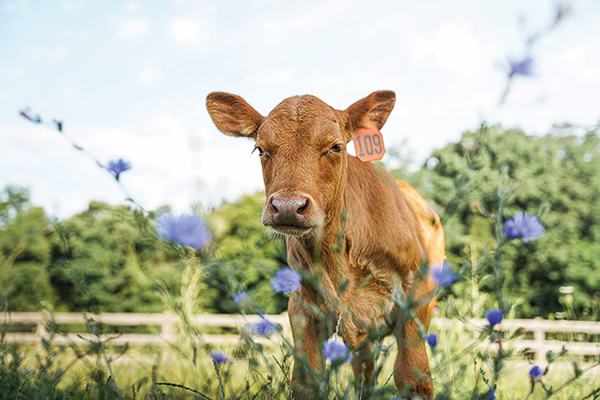
My greatest pleasure is watching my cows doing their natural behaviors: grazing among the wildflowers or woodland, as their wild ancestors would have done, or birthing without assistance and nursing their calves. Or seeing a young female given the job of nursery maid to the young calves as the matriarchs wander away to graze. I am fascinated by how mother cows comfort their grown-up daughters as they labor and give birth. One of my cows, Jolene, gave birth this morning. When I got to the field, she was licking a strong black calf dry, and he was blinking in the sunlight.
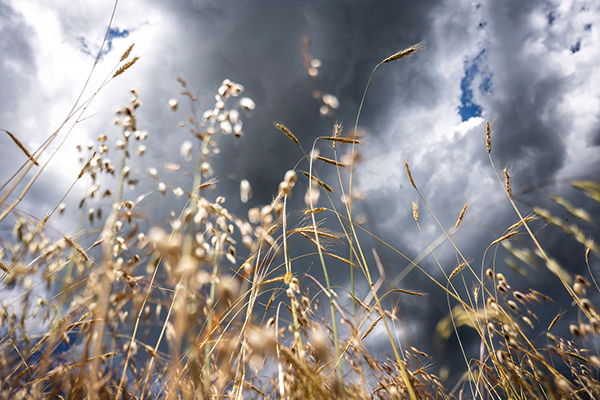
We move our cattle frequently, sometimes twice a day, trying to mimic the old movements of wild herds across the landscape. This helps to create the processes that allow more than two hundred wild grasses, forbs, and wildflowers to thrive. We allow pastures to grow long, turning sunlight into carbons and sugars to feed the soil biology, billions of living things powered to life.
We treat every field like a woodland clearing, ensuring they are all bordered by scrub, trees, or hedgerows to mimic the savanna that our flora and fauna evolved in. We have let rivers run free, and engineered ponds and wetlands. And we have planted over one hundred thousand trees to restore the woodland elements that were missing. Herons wander among the cows hunting for toads and frogs, and swallows flit out the barn and away across the pastures to hawk to-and-fro over the cows for flies. The cuckoo lobs from bush to bush in the hedge at the field’s edge and then calls for its mate.
Good farms sustain people too, giving them healthy food and meaningful work. I smile when my son Isaac asks to come to the cows and stands smiling among them. He told me recently that cows make you feel calm and happy, like a kind of magic that rubs off. None of this makes me a friend to my cows; it makes me a farmer.
A farmer is a dizzying number of different things to his cows. Like a midwife, I help them birth and make sure the young ones can suckle. I am their guardian protecting them from predators, thieves, or stray dogs. I am their doctor if they are ever sick. I am their showman, preparing the best of them for sales and shows, washing, drying, and combing them to perfection. But I also act as their predator in two senses: I keep them moving each day for nature-mimicking grazing, and I select which animals to cull to maintain the quality and health of the herd. The great American cattleman Greg Judy calls this “being the predator in the herd.” Yes, when the time is right, I kill them.
To many modern people the relationship seems contradictory – how can you care for animals and also kill them? But for most of history humans have lived with that tension. This multifaceted relationship seems to confuse people, who now can often only understand animals as “wild” or “pet.” It is tempting to think my farming is “good” because I know my cows by their names, and scratch their backs, and often chat to them in the sunshine. But it is not the affection between man and beast that matters, or lack of it, but the system, the order of life they are part of.
All of the animals in my care are part of this order. The nearest thing I have to a pet is my sheepdog, Tig. She gets cuddles, but even she is really a working animal. She slinks away from groups of children eager to pet her, and gives me a look to say, “Can we get back to the sheep, boss?”
I believe that abundance is the key metric for land health, and that a farmer can be a good steward, helping build ecosystems rich in life. My job is to help create such a system, one capable of feeding people while remaining alive with cattle, birds, insects, grasses, flowers, and trees. Death is part of that system, inevitably so, but so is birth, growth, and flourishing. In my farming family, we try, wherever possible, to go with the flow of nature these days, producing cattle and sheep from more natural landscapes that require less fight and destruction than modern agriculture does. We fatten cattle in semi-natural savanna, a habitat the native flora and fauna recognize as home. The farm is full to bursting with wildlife.
We believe that a morality for farming has to work ecologically; it has to accommodate our eating habits. That black bull calf down the fields will someday feed my family for as much as a year, just as I will someday feed the worms in the churchyard a little farther down the valley.
We often have school groups come to the farm. We show them how we manage the land, bringing nature back around the farm’s production. We teach them that their ethics matter, that their choices as shoppers and voters affect how farmers care for animals. For all the distance now between farms and the lives of most people, we find that children are drawn to farm life. They are fascinated by the animals, and want to understand their lives and deaths. Sometimes I look at their little faces and wonder if some of them are troubled by what we do, like Rachel was, or are at peace with it, as I am.