Essay
A Royal Horse for a Beggar
The Christian idea of human dignity has shaped the history of England.
December 15, 2026
Try 3 months of unlimited access. Start your FREE TRIAL today. Cancel anytime.
START FREE TRIAL NOWA Royal Horse for a Beggar
The Christian idea of human dignity has shaped the history of England.

[.article__paragraph--cap][.small-caps]In September 2026[.small-caps] a bill to legalize assisted suicide in the United Kingdom was narrowly defeated after protracted debate. The result is a relief to many who, through Christian conviction, see state-endorsed suicide as an affront to fundamental notions of God-given human dignity.[.article__paragraph--cap]
It is striking that in the debate, both in Parliament and in the national media, this essential Christian idea was deeply underplayed by the bill’s opponents. Much of the discussion focused on the dangers of coercion, inadequate safeguards, and the likelihood of the law eventually being used to offer suicide to more than just the terminally ill with less than six months to live. Even the Archbishop of Canterbury was rather more full-throated in discussing the jeopardy the bill posed to vulnerable minorities than in putting the concept of the inalienable dignity of all humans, made in the image of God and redeemed by Christ, at the head of her condemnation of it – though to give her due credit, she did at least propound the idea, unlike many others.
A reluctance to draw from Christian ideas of personhood and human dignity in political debate is relatively new in Britain. As progressive and inclusive as it might seem, it is questionable whether such reluctance makes for a better society. The British debate about assisted suicide became drawn out and convoluted as participants struggled to argue that life should be protected without referring to Christian ideas of its fundamental sanctity. But in considering how important it is to include this outlook in such debates, it is worthwhile to take a more positive perspective. A recollection of just how much of a role Christian ideas of personhood have played in the formation of our society is the strongest argument for them not to be cast aside.
[.article__paragraph--cap][.small-caps]These ideas are[.small-caps] at the foundation of Britain’s national tradition. They made themselves felt long before the emergence of England as a state. Their early influence is visible in some of our oldest histories. For example, the monk and scholar the Venerable Bede, writing in the 720s, tells a story of a spat that took place around 650 between a bishop, Saint Aidan of Lindisfarne, and the local king, Oswin of Deira (a part of Northumbria).[.article__paragraph--cap]
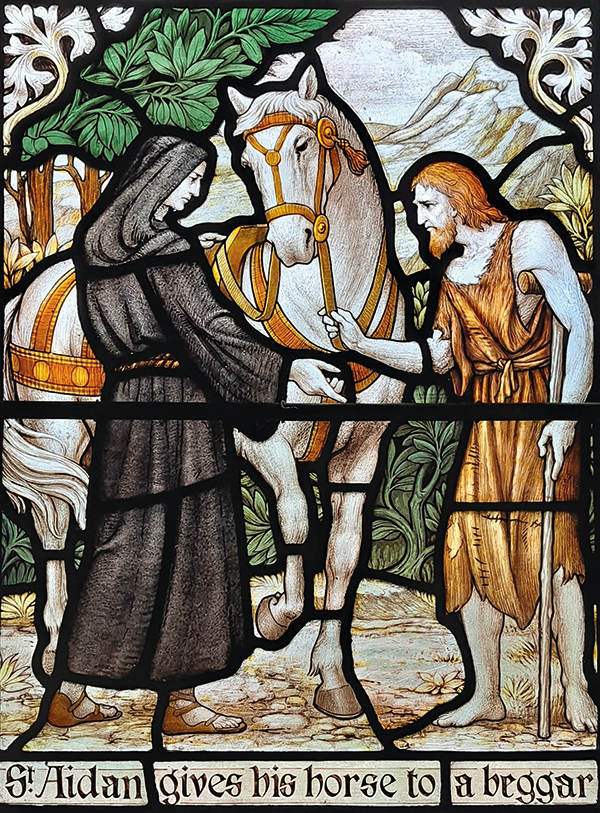
According to Bede’s Ecclesiastical History, Oswin was known for his generosity, moderation, and humility, but Aidan had these virtues in even greater abundance. “He neither sought nor loved anything of this world,” says Bede, “but delighted in distributing immediately among the poor whom he met whatsoever was given him by the kings or rich men of the world.” Part of Aidan’s humility was his refusal to travel on horseback, except in case of extreme necessity. He liked to be able to stop and speak easily to whomever he met on his way, rich or poor, Christian or pagan, to encourage them either to receive or grow in the faith.
King Oswin was concerned that Bishop Aidan be able to get around in times of urgency, so he gave him a fine horse from his stables, decked out with royal trappings. Soon after Aidan received this gift, he happened to be traveling on it when he met a poor man begging for alms. Without hesitation, he handed over the horse, along with its magnificent tack. A little later, Aidan met Oswin as they were going into a dinner, and the king heard of Aidan’s actions. “What did you mean,” asked the king, “by giving the poor man that royal horse, which it was fitting that you should have for your own use? Had not we many other horses of less value … which would have been good enough to give to the poor, instead of giving that horse?” Aidan’s reply was pointed: “Is that son of a mare more dear to you than that son of God?”
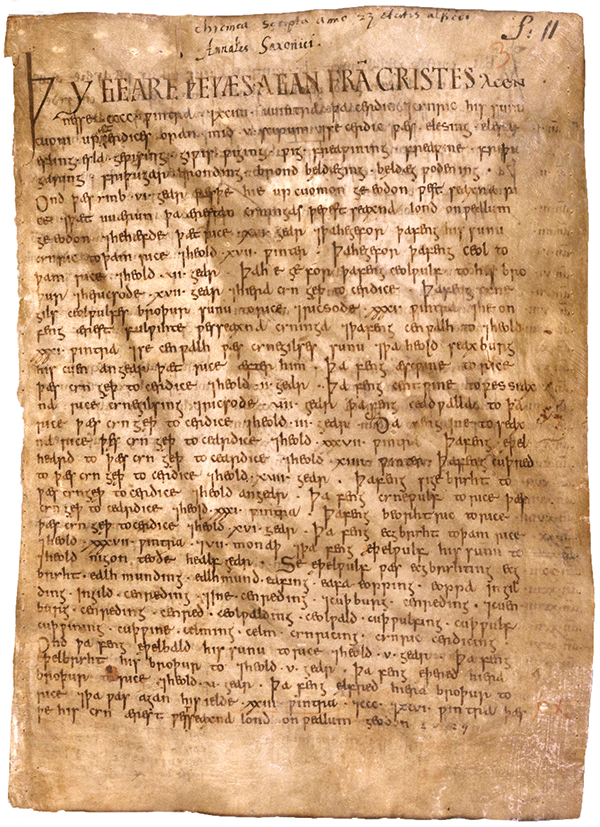
The Christian sensibility in this response, emphasizing the dignity of the beggar, became essential to the development of the country’s most important institutions. Take kingship. Bede, whose writings laid out a paradigm for the concept of English kingship, insisted that charity and service were an essential part of it. His greatest approval was reserved for kings who displayed these virtues. These included Edwin of Northumbria, who kept the peace rigorously for the benefit of the humble so that “even if a woman should have wished to walk along with a newborn baby over all the island from sea to sea, she might have done so without injury from any,” and who set up posts hung with copper vessels by roadside springs so that ordinary travelers might refresh themselves. Another such was Oswald of Northumbria, who at one Easter feast heard that a crowd of hungry beggars were at his gate: he not only gave away to them the feast itself, but even the silver platters on which it was served.
In many ways, Bede’s ancient vision that the God-given dignity of all requires the monarchy to have a character of humility and service still holds good nearly 1,400 years later. “I come not to be served but to serve,” King Charles III said at the beginning of his coronation service, paraphrasing Christ’s words in Matthew 20:28, which he carries out in practices such as the twelfth-century royal tradition of handing out alms on Maundy Thursday. This sets a profound example for the rest of society.
By the late seventh century, Christian precepts were beginning to leave a strong impression on the royal law codes. King Wihtred of Kent and his neighbor, Ine of Wessex, forbade work on a Sunday. The latter ordered that any slave forced to work on a Sunday was to be made free, and his lord fined thirty shillings. Wihtred pioneered the law for churches to offer sanctuary; those under threat of harsh punishments who took refuge there should have the punishments lessened. English churches kept their rights as a place of sanctuary for nearly one thousand years afterward.
Aethelstan, the first king of a united England, even legislated for social welfare more than a millennium before the welfare state: “You shall always provide,” he directed his officials, “a destitute Englishman with food.” From the king’s own revenue, they “shall be supplied with an amber of meal, a shank of bacon or a ram worth four pence every month, and clothes for twelve months annually.” It should not be forgotten the very term “welfare state” was coined by a twentieth-century Archbishop of Canterbury, William Temple.
[.article__paragraph--cap][.small-caps]Likewise, the idea[.small-caps] of every person possessing an equal God-given dignity was vital for their relationship with the law. Early kings recognized that the equal dignity of all required equality of treatment. “Judge very evenly,” demanded the law code of Alfred in the 890s, following Exodus and Leviticus, “judge not one judgment to the rich, another to the poor; nor one to your friend, another to your foe.” Even kings had to be subject to God and the law. The idea was implicit in Bede’s vision of a good king’s humility and dutifulness.[.article__paragraph--cap]
It was recapitulated in the 1215 Magna Carta, which its chief framer, Stephen Langton, Archbishop of Canterbury, saw as being an Old Testament-style biblical covenant between God, the king, and the people, circumscribing the king’s powers in order to protect the people. It was later repeated by generations of English jurists, most memorably in 1608 by the Chief Justice Sir Edward Coke, who warned the increasingly absolutist King James I, “the king is under no man, save God and the law, for the law makes the king … for where will and not law doth sway, there is no king.” This idea in later generations bound the king’s ministers, and hence modern governments, also to act within the law and not to act arbitrarily.
God-given human dignity demanded not only equal treatment before the law, but also merciful treatment. The early eleventh-century code of King Canute was forthright: “We forbid the practice of condemning Christian people to death for very trivial offenses. On the contrary, merciful punishments shall be determined upon for the public good, and the handiwork of God and the purchase which he made at a great price shall not be destroyed for trivial offenses.”
[.article__paragraph--cap][.small-caps]The Christian idea[.small-caps] of human dignity was not just something that mitigated the cruelty of the law in the nation’s formative period. It has been an active idea, bringing improvements in more recent times of economic growth and societal change. The efforts of William Wilberforce and his associates in the campaign to abolish slavery are well known, with their refrain that the enslaved was “a man and a brother.”[.article__paragraph--cap]
Less well remembered is the work of other nineteenth-century social reformers, for example Anthony Ashley-Cooper, seventh Earl of Shaftesbury. Despite his elevated status, Shaftesbury spent his life endeavoring to improve the lot of the poor. He started with the practical. He personally evangelized in London’s East End slums. He taught children at the makeshift “ragged schools,” and told the wider crowds that Christ stood outside every one of their houses, and that if only they would throw open their doors “he would come and sup with them.” Back in Parliament he worked tirelessly to alleviate the harsher consequences visited by the Industrial Revolution on those in poverty. He advocated to improve the quality of working-class housing, for the poor to have access to schooling, to prevent young children from working in factories, to limit the hours worked by adolescents, to stop women and young children being sent down mines, and most memorably of all, to stop young children being sent up chimneys to clean them.
In all that he did, Shaftesbury was unashamed that Christianity was his motivation, and in particular his desire to respect the God-given dignity of every person: “Is this a state of things, my Lords, which is to be permitted to go on?” he asked in an 1863 debate in which he argued for outlawing the use of children as chimney sweeps. “Are we to call ourselves a free and Christian country, knowing that two thousand of our fellow-creatures, just as good as ourselves, are doomed to the most excruciating and intolerable agony, because some gentlemen say they will have sweeping-boys and will not use machines?”
Shaftesbury was just one of the many reformers of the nineteenth century who, inspired by the love of Christ for all humanity, helped to lay down so many institutions and concepts we now take for granted: the system of foster care, universal schooling, social assistance for the aged and infirm with an emphasis on the needs of every individual, the foundation of many hospitals, modern ideas of nursing and prenatal care, the protection of the young from sexual exploitation, prison reform, and much more. The list of achievements is so long that only the headlines can be mentioned. Even this brief recital of the impacts of Christian concepts of human dignity and personhood on the shaping of society is enough to suggest what we are losing in our recent failure to take them into account.
These ideas have acted as a guiding light in unsettled times as disparate as the formative years of the English kingdom and the Industrial Revolution. We now face a new and equally unsettled age of vertiginous technological development, with the prospect of AI models undermining the settled patterns of human work, interaction, and creativity, not to mention transhumanism (the attempts to enhance human biological capacities with technology) and the grand challenges all of this poses to the future of the economy and human culture. This is not to mention the questions of suffering and vulnerability that recur in some way in every age, and the need to address them with compassion and the affirmation of each person’s intrinsic worth.
We may feel adrift as we grapple with the practical and ethical problems these changes present. But those who dare to proclaim the timeless notions of Christian personhood will be better placed to help society navigate these difficult waters.