Dispatch
This American Corner
In a small Muslim town in Kosovo, America is loved with a surprising fierceness.
July 15, 2026
Try 3 months of unlimited access. Start your FREE TRIAL today. Cancel anytime.
START FREE TRIAL NOWThis American Corner
In a small Muslim town in Kosovo, America is loved with a surprising fierceness.
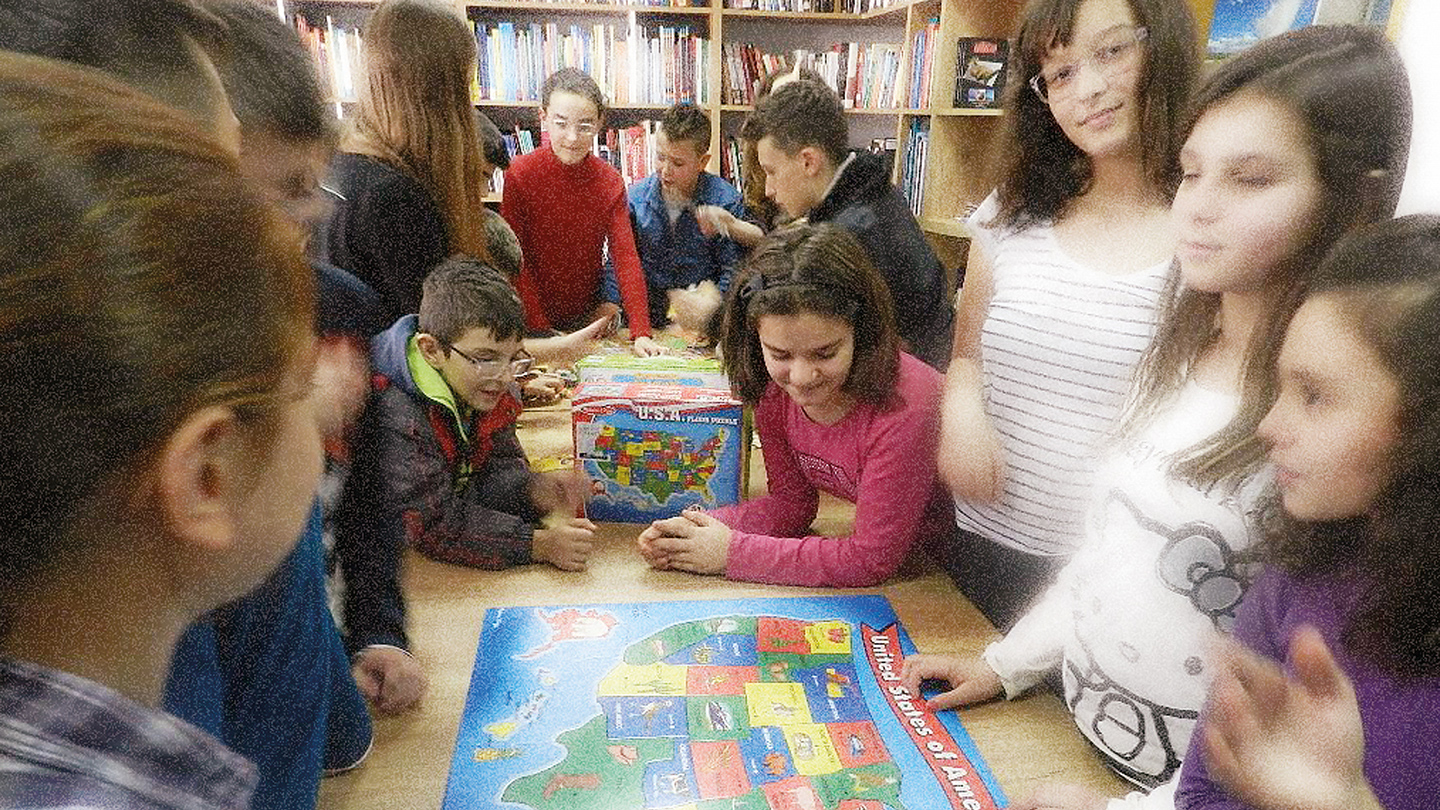
Students at the American Corner in Prizren. [.smalltext]Photograph courtesy of American Corner Prizren.[.smalltext]
[.article__paragraph--cap][.small-caps]I’ve started to dream[.small-caps] in stone: stone bridges, fortresses, cobbles, and ramparts. Sometimes I dream in metal, the metal the Kosovars knock on for good luck instead of wood, or the clashing swords the Serbs and Albanians both used to fight the Ottomans. During the day I feel the heavy residue of a thousand years of battles. I wonder if this residue explains the Kosovar attitude toward foreigners. Most foreigners, when they arrived in Kosovo, came to dominate, subdue, or kill.[.article__paragraph--cap]
I ask my friend Fitim about this and he simply laughs. “The first word in the Koran,” he said, “is ‘read.’ It’s not ‘pray.’ It’s not ‘do good deeds.’ It’s ‘read.’ The problem is that when we were oppressed by the Ottomans for hundreds of years, they did not encourage us to read. That way they remained in power.” He complains that every time he reads a book his aunts worry about him. They say, “He’s becoming too European.”
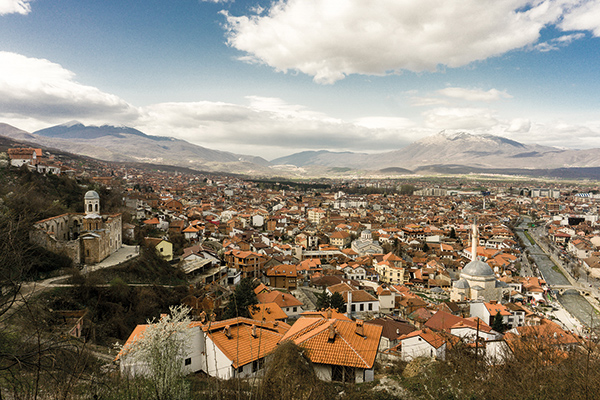
I met Fitim at the American Corner in Prizren, the small, conservative, Muslim town in Kosovo where I am working as an English Language Fellow, unfortunately referred to by the US State Department as an ELF.
“American Corner?” my cousin asked when I told her I would be working there. “This is a real place?”
It is. I believe it is meant to be a happy refuge, part of a PR campaign to promote positive and wholesome American “mentalities” in remote corners around the world. Usually located in a city library, American Corners are replete with American games, books, movies, computers, and visiting Americans. The Americans are friendly and helpful, assisting people in English and in applying for American scholarship programs. It’s pleasant to meet friendly faces in a setting where grimness is the dominant expression on the street. But every Wednesday, when I go to the American Corner in Prizren, where I volunteer to teach a conversation class, I can’t help but think I am witnessing a reality TV show called “This American Corner,” where people perform their most ideal version of America.
[.article__paragraph--cap][.small-caps]When I first arrive[.small-caps] at the American Corner in Prizren, I notice that the only books on display in the library window are the complete collections of Danielle Steel and Rajneesh. When I suggest to the Kosovar coordinator that Americans read other books, she waves my concerns aside and fervently explains to me that Halloween is coming soon and that the American Embassy insists that the American Corner must promote Halloween. “We must!” she cries. I wonder why the US Embassy thinks it crucial to promote a secular holiday with pagan and Christian roots in a Muslim country. Nevertheless, for Halloween we host an activity for children to carve faces with different emotions on pumpkins, and then identify those emotions in English.[.article__paragraph--cap]
The activity flops, because we can only find green pumpkins, and not enough of them, so the fifth graders end up fighting over them with the carving knives.
I also didn’t realize that there is a rivalry between the American Corner in Prizren and the one in Pristina, the capital of Kosovo, over whose activities are the most American. Over the weekend, I visit the American Corner in Pristina, located in the National Library near the Bill Clinton statue on Bill Clinton Street, which is perpendicular to George Bush Street (formerly Lenin Street). The National Library looks like it’s wearing chainmail. Allegedly, when Joe Biden visited Kosovo, he said, “Now that the war with Serbia is over, will you get rid of those bars on the library windows?” The Kosovars thought that was a strange thing to ask.
The American Corner in Pristina is buzzing with activities. I meet an American soldier who works at Bondsteel, the giant American military base in Kosovo, who came to give a talk about American airplanes. Then I meet a Kosovar man who had lived in Oklahoma for six years. He says he can imitate an Oklahoman accent. He takes a deep breath and pronounces, “Hey, boy, git over here!” before bashfully blushing. He tells me that in Oklahoma he studied creative writing at a university. He says, “All these Kosovar Albanians go to America to get MBAs. But why study business? If you want to study business, just open a shop. You can do that anywhere. But America is the only place where you can study creative writing!”
In one corner of the American Corner, some students present research topics. Others are playing a video game produced by the State Department called “Trace Effects,” where, as the trailer to the video game states, you learn American values and get points by collaborating and cooperating and by helping people with disabilities. Gamers help Trace, the androgynous main character, learn English and navigate through the United States, participating in community service projects, environmental restoration, women’s leadership, and international understanding. Trace can time-travel and visit the Incas. Trace can visit malls too. Trace can visit Uzbekistan and do good deeds.
Later, in my hotel room, rewatching the trailer on YouTube, I read the comments at the bottom of the screen. I can’t help secretly liking the kid who commented, “Has anyone managed to complete the ‘find the source of pollution’ quest yet? I keep selecting the coal plant, but it just tells me that Congress refused to complete my quest.… Also, how do I stop the officer at the Grand Canyon from checking my documentation? The deportation mechanic is so stupid.”
The American Corner in Pristina ends up one-upping our American Corner in Prizren by decorating their whole space with paper cutouts of pumpkins, ghosts, and spiders, and showing the (British) zombie movie Shaun of the Dead. Unfortunately for them, after they boast about their activities on Facebook, the US Embassy calls them up and says, “You showed Shaun of the Dead? Did you download it off the internet? You cannot show pirated videos at the American Corner!” (I can’t help thinking how, when the United States first became a country, we pirated all our books from England for the first hundred years. Since Kosovo became a country in 2008, maybe it should be allowed to pirate books and movies for at least the first few decades.)
My Kosovar students say that one of the reasons America is so great is because if an American gets killed abroad, our president will go after that country. “Here, our prime minister will do nothing,” they complain. “He only takes selfies and posts them on Facebook.”
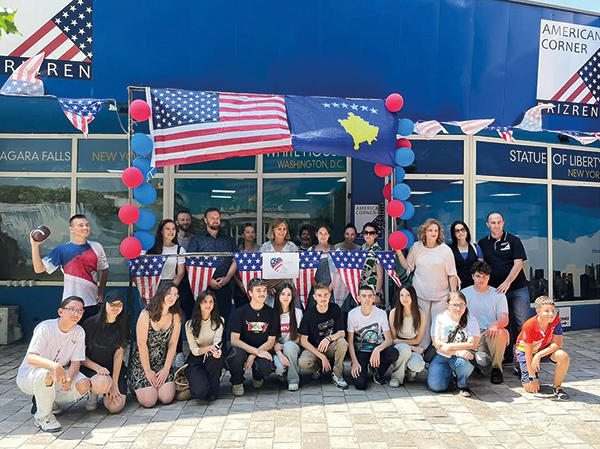
Probably most Americans would be surprised to know that this small Muslim region of Kosovar Albanians – of alleged gangsters, as the Serbs would have us believe – loves America with a fiercer and more loyal love than a reasonable person would imagine. Since 1999, when NATO airstrikes forced the Serbian army to withdraw, they have been praying for us, grieving over our droughts, plagues, and forest fires, thinking of us as their brothers and sisters. Our flag flies next to theirs on Bill Clinton Street. Forget about Greater Albania; Kosovo wants to become the fifty-first state of America.
[.article__paragraph--cap][.small-caps]The next Wednesday,[.small-caps] when I walk into the American Corner in Prizren to teach my conversation class, Fitim pulls me over to the computer. “Look at these photos our coordinator posted on Facebook about today’s American board game activity! Do you notice anything strange in them?”[.article__paragraph--cap]
“What should I be looking for?”
“The coordinator only posts pictures of my bald head! She does it on purpose.”
“Have you talked to her about it?”
“Yes, I said to her, ‘Why do you always post pictures of my bald head?’”
“What did she say?” I ask.
“She said, ‘I am a good person. I did nothing wrong.’”
I look over at the coordinator. She is sitting at her desk with some watercolors and is painting a picture of an Albanian flag.
I walk over to her.
“How are you?” I ask.
“I am sad,” she says. “The US Embassy is coming next Wednesday, and they are going to criticize me and not listen to me. That one, Fitim,” she whispers, pointing at him, “he put up a picture of Che Guevara on the American Corner Facebook page. The US Embassy called me. They said, ‘Why is Che Guevara on the US Embassy Facebook page?’ I told them, ‘It was not my fault. It was a student!’ What can I do about this? Oh, I worry about my job. I have too much work here. And I do not have any cousins who work here.”
The importance of Facebook in Kosovo cannot be overstated. Ever since Facebook officially recognized Kosovo as a country in 2013, it may be the only thing holding the country together. The deputy minister of foreign affairs proudly reported that he had contacted Facebook and got them to add Kosovo to the scroll-down list of countries. He told them more than a hundred other nations recognize Kosovo as a country. “It was not a hard sell,” he said.
Since my Kosovar students usually only like to talk about wedding traditions, and how a Kosovar bride must wear bright lipstick for five years after marrying, today I’ve brought a list of State Department-recommended conversation topics. The first topic that a girl pulls out of a hat is, “If you could break any law for one day without any consequences, which law would it be?”
She says, “I think this is not a good question for me because if Kosovo has any laws, I am not acquainted with them.”
Since everyone agrees on this point, we move on to a new topic. The next student chooses, “Should husbands and wives work together in the same office?” and they all agree that this is a very interesting conversation topic.
Some say that this is a bad arrangement because it will kill the couple’s social life, since they will have the same friends and get bored with each other at night.
Fitim talks about jealous husbands and how a husband and wife should work together because this way the man can keep an eye on his wife.
“But what if she gets a promotion?” one of the women asks. “Or what if she is always going into the office of her boss?”
“It is not a problem,” Fitim counters. “Here in Kosovo the boss would never close the door.”
“But if the husband is already jealous, this will make him more jealous,” a woman suggests. “Working with his wife is not going to solve this problem of his.”
“Teacher!” a student suddenly shouts. “Here in Kosovo, we don’t talk about animals in the room.”
“What do you mean?” I ask.
“We don’t talk about the elephant in the room or the birds and the bees.”
A woman responds by complaining, “Compared to Pristina, we are so fourteenth-century.”
“We’re not that far behind,” another says.
“Actually, since coming to the American Corner, I am learning not to be such a jealous person,” Fitim admits. “On some occasions, I might even allow a man to hug my wife.”
I suggest that in America if a husband and wife work together, they might giggle together all the time, but a student tells me that there is no word in Albanian for “giggle.”
“We don’t really have that many words,” another student says. “We weren’t as lucky as you Americans. We didn’t have a Shakespeare to make up a lot of words for us.”
The next Wednesday, as soon as I arrive, the coordinator starts the vacuum cleaner. She vigorously vacuums around the conversation table even though we are about to begin. Fitim leans over and whispers to me, “Do you see? She wants you to think she is very busy and tired all the time. But she was just waiting until you arrived to start the vacuum.”
When she stops the vacuum, she tells Fitim to turn off the lights in the room because there is a problem with the electrical wires. “They could get too hot and explode and then we all might die,” she says.
I’ve come prepared with my own battery-powered pocket LCD projector. Since there is no screen, I have to aim it at the little white space between the top of the chalkboard and the ceiling. My students claim they can see it, but its beam of light isn’t strong enough unless the room is completely dark. The sun is streaming through the windows and there’s no way to block it. I jokingly ask the coordinator if she has a blanket with which we can build a little movie theater fort to hide under, but the coordinator says somberly that the representative of the US Embassy is coming and she would ask, “Are you misrepresenting our dwellings in America?”
When the representative from the embassy arrives – an American who is living in Belgrade and an expert on American Corners – the lights miraculously work again. She examines our library of English-language books and complains that they are not spiffy enough. “We are representing America,” she says, pointing to a frayed corner. “The books must look new. The corners of books should not be torn.”
“But isn’t it better if the books look used so the students will use them?” the coordinator asks. The American disagrees.
The expert on American Corners brought her own high-powered LCD projector and portable screen. She brings up the United States on Google Earth, clicks on some photo icons, and we take a tour of America’s national parks. The photos make me a bit homesick. She clicks on an icon located in Virginia and says, “Well, whenever you all are in this area, you might consider visiting Shenandoah National Park. It’s a long drive from here to here,” she says pointing with her laser to different places on the map. “And oh, here’s Death Valley. If you ever make it down there, make sure to bring a lot of water. Even though my brother-in-law has a house down there, we’ve never made it there yet. Just to give you an idea of how big we are, here’s Connecticut. That’s the same size as Kosovo. See what a big country we have?”
“We were salivating,” my student tells me afterward. “We can’t even get a visa to go to America. How will we visit one of your parks? It is every Kosovar’s dream to go to America.”
[.article__paragraph--cap][.small-caps]Sometimes I wonder[.small-caps] if certain countries represent different parts of the soul, allowing us access to parts of ourselves that we can’t access on our home turf. Why do I sometimes feel that I can access the soul of America in Kosovo in a way that I can’t at home? And why do I feel I can access America’s soul even in Serbia?[.article__paragraph--cap]
I went to Belgrade, Serbia’s capital, for the weekend, but I can’t tell that to anyone here in Kosovo, and so this morning I look for a place to hide the empty package of Chipsy, Serbia’s potato chip, I ate on the bus ride home. I fold it into a tiny square and stuff it into the bottom of the garbage can where my landlady won’t find it. She comes in when I’m not here and puts things in order: straightens the soap in the bathroom, my shoes by the door. I am touched by her gestures, but it also means I have to hide all the Serbian products I bought.
The problem for me is that I discovered I really like the Serbs. I love their bookstores and people reading books on trolleys, in playgrounds, and in dog parks. I sit on my couch, riveted to a Serbian vampire novel or a collection of Serbian short fiction about borders – borders between self and other, borders between dreams and reality, borders between countries that dissolve and reappear according to which mythologies and histories the culture believes at the time. I read a book that contains a fourteenth-century Serbian poem glorifying the field of Kosovo, where the Serbs fought the Ottoman Empire. That poem branded that war into the Serbians’ collective memory, immortalizing Kosovo as the Serbian land of spiritual sustenance. The Albanians, of course, say all that is bunk, that it’s just an old poem, that they are the ancient Illyrians, the ones here first.
I think of the advice I once read in an online missionary handbook about the Balkans, the only handbook about Kosovo I was able to find. It said, “The one certain thing about Balkan history is that it is disputed. Every nation has a different perspective on what has happened and a Western attempt to understand both sides is not appreciated.” But my American consciousness can’t help trying to understand both sides. I can’t help thinking that trying to understand both sides is a superior way of being. But, then again, to think that I’m superior is not a superior way to be.
[.article__paragraph--cap][.small-caps]In the afternoon,[.small-caps] on the way to the American Corner, the streets are blocked off because the Turkish prime minister is coming to town to promote his new airport investment project. Torrents of people are heading to the center of town, waving Turkish flags. So I am surprised that all my students are waiting for me.[.article__paragraph--cap]
Around the conversation table I ask them, “What’s the best advice your mother ever gave you?” We go around the room. The first one says, “To survive.” The second says, “To be honest.” Another says, “Never to lie.” Another says, “Always help others.” I tell them that one of the best pieces of advice my mother gave me was that what you see on TV isn’t real. I tell them how I hear people say, “It is my dream to go to America.” I tell them that today I want to show them another side of America. I show them images of Detroit, the parts that look like a bombed city after World War II, the parts that look like Kosovo, the half-built and then abandoned brick buildings. I say, “We have this too.”
One of them says to me, “You are our American nightmare, breaking up our dream.”
“But there are also good things,” I say. I tell the American myth of Johnny Appleseed, the barefooted animal lover, how he didn’t conquer land but planted trees. I show them pictures of my hometown, Sebastopol, California, and all the apple orchards and our apple blossom parade and the apple blossom queen sitting on a big apple float waving to all the townspeople.
They tell me how in Rahovec, where the vineyards grow, they nominate a grape queen.
I show them the Sebastopol city police and recall how they would give movie tickets to kids riding their bikes with helmets or to those they see picking up garbage.
“This is a good policy,” Fitim confirms, nodding his head.
I show them a picture of the former mayor dressed up like Rumi, the thirteenth-century Sufi poet, giving a Rumi recitation.
“Rumi!” they all exclaim. Fitim posts Rumi poems on Facebook every day. Fitim spontaneously recites a Rumi poem:
Be like the flower that gives its fragrance
to even the hand that crushes it.
A girl rolls her eyes and says, “In Kosovo, everyone is always giving advice.”
I show them the local Sebastopol sculptor who solders together spare metal parts. “If someone is a fireman, he commissions this artist to create a fireman on his lawn. If someone is a waitress, this artist makes a sculpture of a waitress on her lawn.”
“I’ve heard of this,” Fitim says. “It’s called recycled art. I want to do a project like that.”
But I also know that in this little corner of Kosovo, I am representing my ideal version of America, where people can reinvent themselves, where mayors read poems, where spouses giggle together at work, where everyone can study creative writing and no one believes what he sees on TV.

So then I introduce the activity I have created from Geert Hofstede’s book Exploring Culture, a series of questions that asks students how they would react to certain scenarios to determine whether they come from an individualistic or a collective culture. Even though, according to their answers, they clearly come from a collective culture, they all want to be rebels. They all want to be individualists like the Americans. “We are selfish these days,” a student says. “Not like old times.”
“We are egoists!” another says proudly. “Like Americans!” I realize they are as puzzled as I am about what it means to be Kosovar, or American, for that matter. But the class suddenly feels like a symphony whose instruments have come into tune. For a moment, in our mutual search, I become a part of their “we.”
Walking home with the streams of people who had gone out to see the Turkish prime minister, I realize how similar Americans are to the Kosovars. We like to lose ourselves in ideas or public festivals greater than ourselves. I hear the call to prayer – muezzins singing out into the afternoon light. I am reminded of the Bangladeshi poem by Farhad Mazhar, who writes how on his birthday he would transform the city into a birthday cake, and scatter pistachio nuts over the “Central Military Office, the President’s House, the banks, the stadium, the Embassies.” I think most Kosovars and Americans would too! And then I realize that everyone is eating Chipsy, Serbia’s potato chip, the hotdog-flavored variety!