Essay
The Birth of Religious Liberty
How America’s founding generation won the right to free exercise of religion.
July 20, 2026
Try 3 months of unlimited access. Start your FREE TRIAL today. Cancel anytime.
START FREE TRIAL NOWThe Birth of Religious Liberty
How America’s founding generation won the right to free exercise of religion.
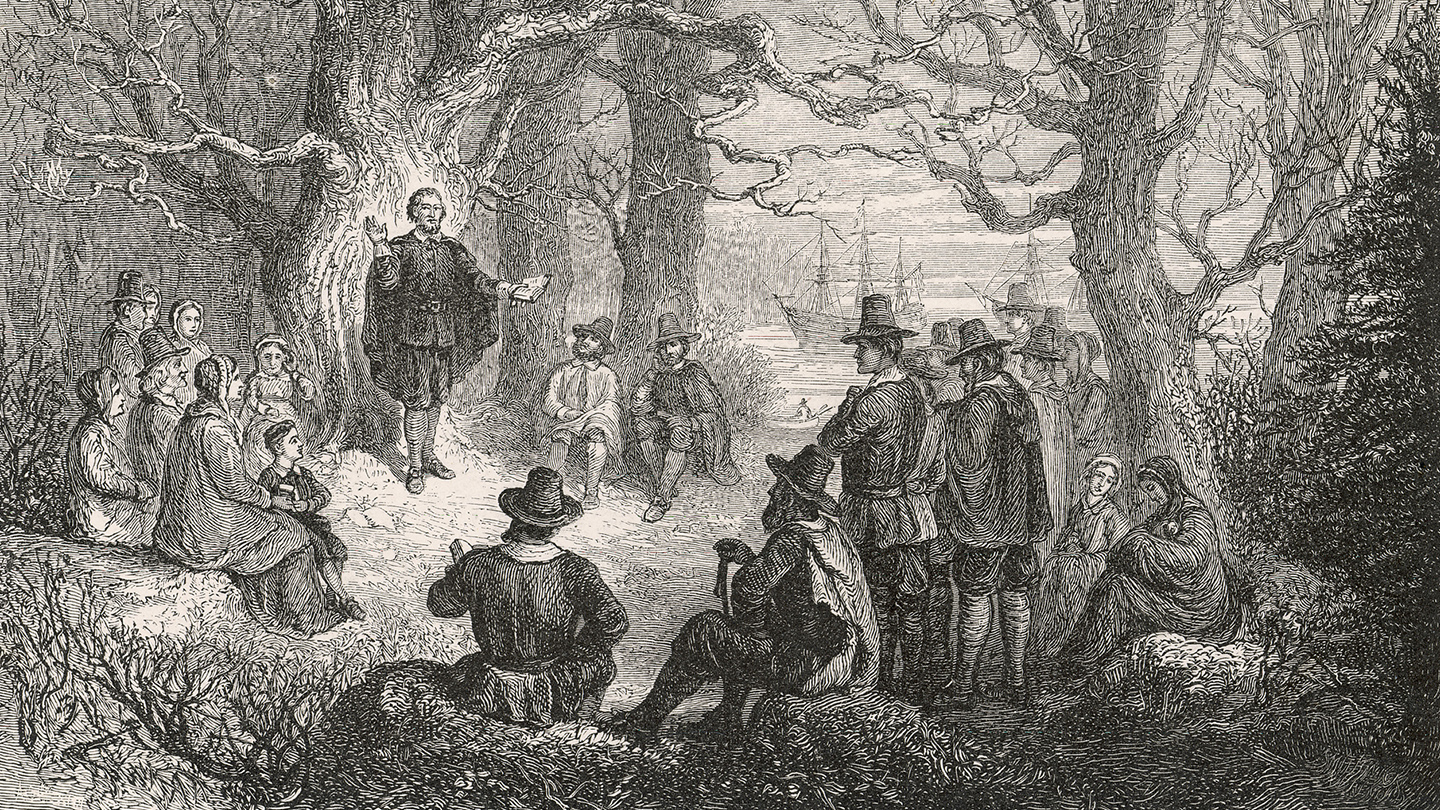
Nineteenth-century woodcut illustration of Puritans led by John Davenport celebrating their first Sunday at New Haven, Connecticut, in the 1630s. [.smalltext]Image from Alamy. Used by permission.[.smalltext]
[.article__paragraph--cap][.small-caps]Religious liberty[.small-caps] is one of the great tenets of the American creed. The Pilgrims came to North America to practice their faith freely, as they could not in Britain. Religious liberty is the first of the liberties enshrined in the Bill of Rights, along with freedom of speech, and remains one of our most iconically American freedoms.[.article__paragraph--cap]
And yet religious liberty is also one of our most contested freedoms. The Puritans who sought it in the New World did not extend it to others once they arrived. Animus against Catholics and other religious minorities endured into the twentieth century. For decades some of our most fraught public debates have centered around religious liberty cases at the Supreme Court. More recently, some Christians have come to look askance at religious liberty as a fruit not of charity but of Enlightenment skepticism or indifference. They argue that the public commitment to religious liberty turns religion into a matter of private rather than objective truth, thereby making religion safe for secular society.
A return to the earliest sources tells a different story. If we look at sermons and tracts on religious liberty from the time of America’s founding, we can see how this commitment stems from a profound concern for religion and a desire to protect and foster the worship of God, not quench it. These sources help us rightly understand religious liberty and its canonical texts, which remain influential for our own debates.
Elisha Williams came from old New England stock. A great-grandson of both the Puritan minister John Cotton and Massachusetts Bay Colony governor Simon Bradstreet, Williams graduated from Harvard and later became the rector of Yale, before resigning due to poor health. In 1742, the state of Connecticut passed a law prohibiting ministers from preaching outside their own parishes – unless invited to do so by the local clergy – under pain of being deprived of financial support and the authorization to preach. In a pamphlet called The Essential Rights and Liberties of Protestants, published in 1744, Williams argued that the law and its penalty violated scripture, natural rights, the social contract, and the Toleration Act of 1688, which allowed public worship for Trinitarian Protestant dissenters from the Church of England.
Williams’s argument begins from the principle of sola scriptura. Given that all Protestants agree that scripture alone is the rule of faith and practice, it says, they must also hold “that every Christian has a right of judging for himself what he is to believe and practice in religion according to that rule.” This, Williams concludes, is inconsistent with the government making laws in matters of religion. If we remember that Christ set us free and understand our rights as Christians, we will be better disposed to show charity to those who differ from us in their religious sentiments.
To flesh out his argument, Williams examines the origin and end of civil government. Echoing John Locke and other Enlightenment thinkers, he argues for natural liberty and equality and a natural right to private property. We give over a portion of our power to protect and vindicate these rights when we join a society and submit to its government. However, we retain our natural liberty in all cases that do not relate to the ends of civil society, including religion. Williams writes:
Every man has an equal right to follow the dictates of his own conscience in the affairs of religion. Every one is under an indispensable obligation to search the scripture for himself (which contains the whole of it) and to make the best use of it he can for his own information in the will of God, the nature and duties of Christianity. And as every Christian is so bound; so he has an unalienable right to judge of the sense and meaning of it, and to follow his judgment wherever it leads him; even an equal right with any rulers be they civil or ecclesiastical.
Two things stand out here. First, Williams sees religious liberty as a positive right, not a negative one. We have rights of conscience, not to be left alone to do whatever we please, but for the express purpose of striving to study scripture and follow God. The right of religious liberty is for the sake of the duty of Christian study and worship, and it runs as deep in our nature as the rights and duties of conscience in all moral action. Second, religious liberty is so deeply inherent in us that we cannot give it up, nor can any government claim it from us any more than it could lay claim to our other rational and moral actions.
It follows from this, Williams argues, that civil governments have “no power to make or ordain articles of faith, creeds, forms of worship, or church government.” This is not only because religious matters exceed the ends of civil society, but because they are ultimately under Christ’s jurisdiction, which Christ effectively delegates to a particular “worshipping assembly” of Christians. Likewise, the civil authorities have no power to establish any religion in civil law. In short, it is the Christian’s job to determine which church to join, and a church’s job to determine how it should worship God and be governed. It is the government’s job to protect the rights of its citizens to worship God individually and communally according to their consciences.
Three decades later, in 1773, Isaac Backus, a Baptist pastor in Massachusetts, published a much longer pamphlet, titled An Appeal to the Public for Religious Liberty. A convert during the Great Awakening, Backus served as a trustee of Brown University and also as an itinerant preacher. He estimated that he had traveled 68,800 miles, mostly on horseback, between 1748 and 1802. Backus’s Appeal begins with the distinction between civil and ecclesiastical governments, which serve the kingships of an earthly king and that of Christ. The church is “armed with light and truth, to pull down the strong holds of iniquity, and to gain souls to Christ, and into his church, to be governed by his rules therein.” The state, by contrast, is armed with the sword to uphold the peace and the civil rights of persons and societies. When these kinds of government and their respective weapons remain separate, societies flourish. When they begin to mix, “no tongue nor pen can fully describe the mischiefs that have ensued of which the Holy Ghost gave early and plain warnings.”
The practical concern behind Backus’s argument was the colonial practice of taxing citizens to support the maintenance of local churches. He cautions that America’s democratic character tends to make “the majority of the people the test of orthodoxy.” Those in the majority are inclined to think that people only join religious minorities for bad motives. They argue that the state must protect and support “all regular religious societies of protestants,” and that it should pay skeptical attention to any religion that “wears an ill aspect to the state.” Backus charges that the Congregationalist majority is inclined to put Baptists in this suspect category. By way of illustration, he recounts a story that could have come out of P. G. Wodehouse, in which a local Baptist pastor was deemed unfit for ministry because instead of speaking of “the thick bosses of God’s buckler,” he was said to have used the word butler.
Backus’s more serious point is this: civil authority has no jurisdiction over ecclesiastical bodies, and therefore colonial governments have no right to tax their citizens for the support of local churches. He concludes:
The custom which they want us to countenance, is very hurtful to civil society: for by the law of Christ every man, is not only allowed, but also required, to judge for himself, concerning the circumstantials as well as the essentials, of religion, and to act according to the full persuasion of his own mind; and he contracts guilt to his soul if he does the contrary. (Rom. 14:5, 23)
Like Elisha Williams, Isaac Backus sees religious liberty as a natural right given to humans for the sake of their duty to worship God as their consciences best dictate.
In 1791, a Presbyterian minister named Israel Evans preached a sermon before the General Court of New Hampshire at its annual election. It begins with a paean to liberty, which, Evans says, is both civil and moral or religious. True liberty “has nothing in contemplation but the happiness of mankind, and therefore it is the principal glory of man; and, in this world, there can be nothing more dignified, or more exalted.” And, he continues, “The true spirit of the Gospel contains the true spirit of liberty.”
Evans argues that religious liberty is a natural right derived directly from God, not granted by a civil authority. Like Williams and Backus, he argues that “it is the natural privilege of worshiping God in that manner which, according to the judgment of men, is most agreeable and pleasing to the divine character.” But to their arguments he adds the idea of conscience as “the image and representative of God in the human soul.” Since our freedom and duty to act according to conscience are both directly tied to our being made in the image of God, we are responsible for pursuing the truth and living according to its lights, and cannot be judged by others: “Truth and religion are subjects of determination entrusted to all men; and it is a privilege of all men to judge and determine for themselves.”
Religious liberty secures this right of conscience and worship for all citizens. It exists for the sake of free and genuine worship. Only God has the right to receive our worship, and this worship must be founded on our convictions and be freely offered in order to be pleasing to God. The state may not punish people for their beliefs or attempt to control their consciences. Of course, Evans qualifies, religious liberty has its limits. If your beliefs in practice “counteract the peace and good order of society,” then the state can punish you – not for acting according to your conscience, but for “violating that universal law of rectitude and benevolence which was intended to prevent one man from injuring another.” Happily, Evans concludes, Americans may rejoice to live in a land and age of religious liberty by which Christ has made them free: “Here every man has equally the freedom of choosing his religion; and may sit every man under his vine, and under his figtree, and, on the account of religion, none shall make them afraid.”
Taken together, Williams, Backus, and Evans give us a coherent picture of religious liberty at the time of America’s founding. First, they remind us that many American arguments for religious liberty came as the responses of dissenting Christians to a history of religious establishment: religious tests for public office, government recognition of preaching positions, and taxes for the support of churches. Religious liberty is therefore not a matter of secular voices trying to keep religion out of politics. It is a matter of religious voices trying to keep civil politics out of religious bodies, of ensuring that the state – and the governing majority backing it – does not encroach on their freedom to worship God and respects the division between civil and religious authorities.
Second, they remind us that religious liberty is not a negative liberty to be left alone, nor a matter of religious relativism or liberalism, but a positive liberty to fulfill our duty to worship God. Religious liberty is intimately connected with our being made in the image of God and possessing a conscience that guides our discernment of what is right. On these grounds, religious liberty is inherent in our nature; it is a natural right that the state recognizes and respects, not a privilege that it grants us. And it is a right for both individual believers and the communities they form. Religious freedom is therefore closely connected to the freedoms of conscience, expression, and assembly. These ministers showed how religious liberty protects religion and allows it to flourish, rather than relativizing or taming it.
When we read more famous texts on religious liberty by the Founding Fathers themselves, we find that they have a similar understanding. In August 1790, George Washington visited Newport, Rhode Island. Members of the town and Christian clergy delivered addresses to the president. Moses Seixas, a leader of the Newport Jewish community, delivered an address as well. The next day, Washington composed a letter, “To the Hebrew Congregation in Newport, Rhode Island.” The citizens of the nascent United States, he wrote, have enacted a policy of freedom of conscience that is worthy of imitation. He then specified the essence of this policy: “It is now no more that toleration is spoken of, as if it was by the indulgence of one class of people, that another enjoyed the exercise of their inherent natural rights.” In other words, American religious liberty is a matter of the government respecting the natural rights of citizens to worship God according to their consciences, not granting them toleration under their laws.
Twelve years later, in a letter to the Danbury Baptist Association in Connecticut, President Thomas Jefferson outlined a vision of religious liberty consonant with that of the Connecticut Baptists we have already encountered. He agrees with them that religion is a matter of conscience that lies solely between a person and God, and that the civil government’s powers govern actions and not beliefs. He then famously characterizes the First Amendment as “building a wall of separation between Church & State” and safeguarding rights of conscience, which he also calls natural rights. Much has been made of Jefferson’s wall metaphor, but in its textual and historical context, its meaning is clear. Jefferson’s concern is the intrusion of government in the religious beliefs and practices of citizens; there is little here about the intrusion of religious belief into politics.
More substantively, we see this vision of religious liberty reflected in James Madison’s “Memorial and Remonstrance.” In 1776, Madison had drafted the language of the Virginia Declaration of Rights that stated that “all men are equally entitled to the free exercise of religion.” In October 1784, Patrick Henry proposed a bill in Virginia’s General Assembly that would establish “a provision for the teachers of the Christian religion” – the kind of establishment of religion that the Connecticut Baptists had protested. Eight months later, Madison published an argument against it as “a dangerous abuse of power.”
Madison begins the argument with our religious duty to worship our Creator, which must be guided by free reason and conviction, quoting his own language from the Virginia Declaration of Rights. The duty of religious worship requires the liberty of religion and conscience. Like Williams, Madison characterizes this as an inalienable right prior to the claims and jurisdiction of civil government: “It is unalienable also, because what is here a right towards men, is a duty towards the Creator. It is the duty of every man to render to the Creator such homage and such only as he believes to be acceptable to him. This duty is precedent, both in order of time and in degree of obligation, to the claims of Civil Society.”
Before we are citizens, we are God’s subjects. The rights by which we give God what we owe him precede the jurisdiction of the state. By contrast, religious establishment implies that the state is a judge of religious truth, or that it can use religion for civil purposes. Madison opposes both: “The first is an arrogant pretension falsified by the contradictory opinions of Rulers in all ages, and throughout the world: the second an unhallowed perversion of the means of salvation.”
As Vincent Phillip Muñoz shows in his 2009 book, God and the Founders, Madison, Jefferson, and Washington differed in the finer points of how religious liberty should work in American society. But the framework they share with Williams, Backus, and Evans remains one of the great achievements of American thought. The 250th birthday of the country gives Americans the opportunity to thank God for many blessings. Among these, they should be especially grateful for religious liberty. The best way to do that is to use it: to seek God and worship him together.