Editorial
How to Love America
Where do Christians owe their allegiance?
June 15, 2026
Try 3 months of unlimited access. Start your FREE TRIAL today. Cancel anytime.
START FREE TRIAL NOWHow to Love America
Where do Christians owe their allegiance?
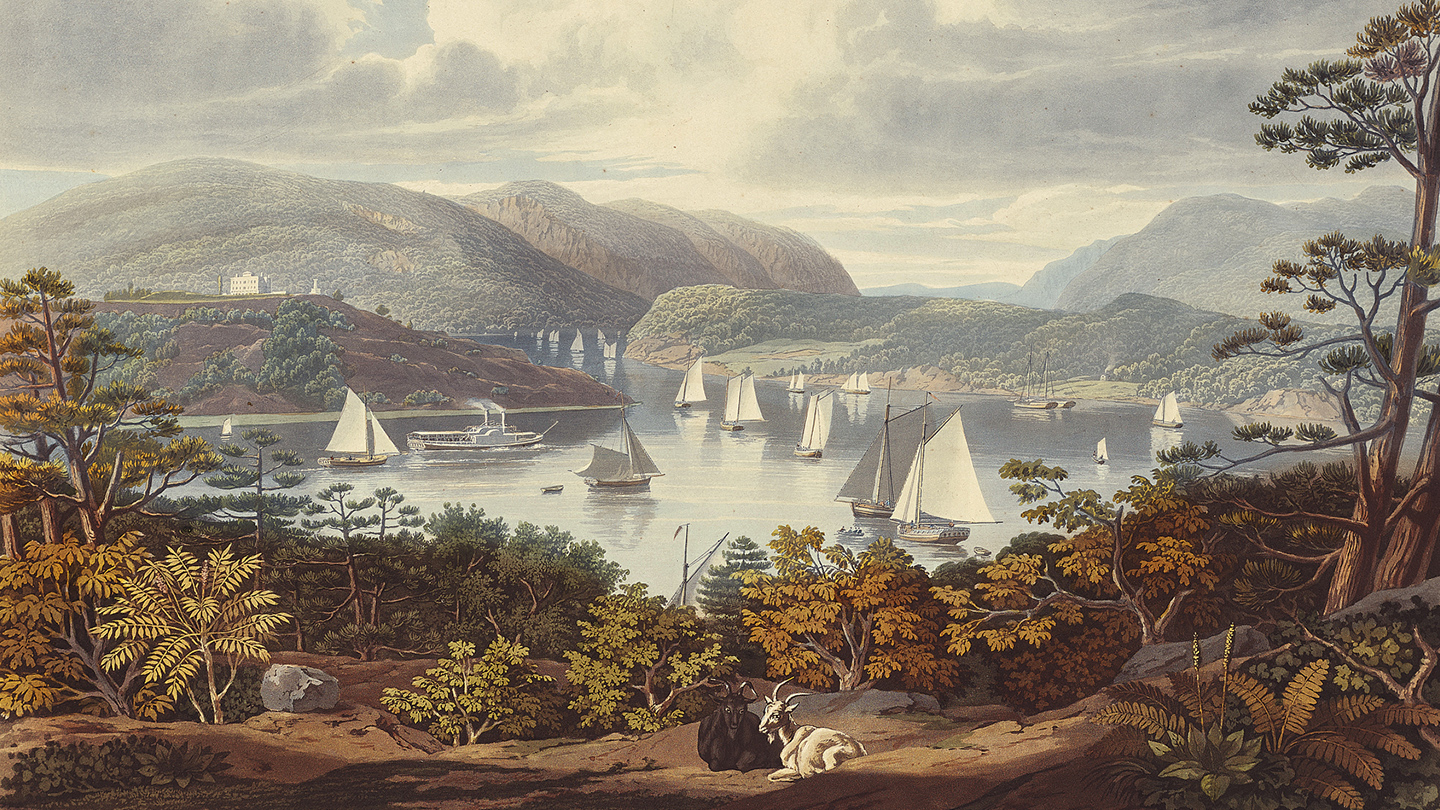
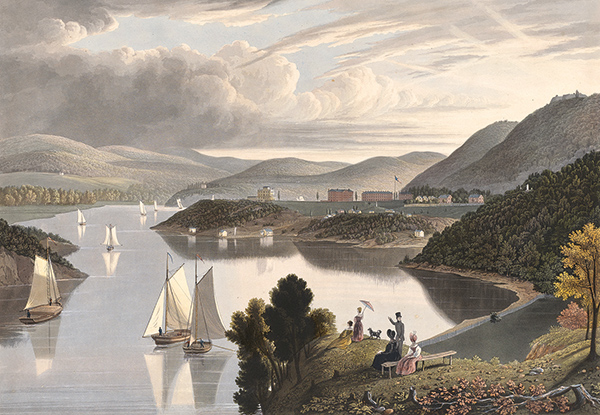
William James Bennett, West Point from Phillipstown, color aquatint with engraving, hand-colored, on wove paper, 1831. [.smalltext]Image from Wikimedia (public domain).[.smalltext]
[.article__paragraph--cap][.small-caps]Love of America[.small-caps] comes easy when you’re heading to an Army football game at West Point. By midmorning, miles of cars with “Duty, Honor, Country” bumper stickers clog the rural road that snakes along the Hudson River toward the military academy. The high-spirited soldiers at the security gate yell “Go Army” through the window as we drive onto the campus where Grant, Custer, and Eisenhower learned the art of war.[.article__paragraph--cap]
In the parking lot, we find we forgot to pack matches, grilling tongs, or chairs. The people in the neighboring spots, who have elaborate tailgating tents, share their supplies and more. Our new friends-for-the-day are alumni, active-duty service members, cops, and locals, with their families. A magnificently broad swath of America’s cultural and ethnic variety has turned up: E pluribus unum. There’s beer, and margaritas, and cornhole, and we are one nation, indivisible, of United States Army fans. Then it’s time to head to the stadium to watch the Black Knights play.
Before the game begins, the West Point Band performs the national anthem. In Michie Stadium, thirty thousand people face the flag, hands on hearts. The Corps of Cadets, in formation behind the field goal, salutes. The familiar American ritual feels different here, in a working military post dedicated to training this cohort of Gen Z to kill and die for their country. Here, I can’t forget that this flag also flies over long rows of grave markers in US military cemeteries around the globe, from Arlington to Manila to Normandy. The solemnity of the moment comes from this blood sacrifice, and from the ideals of liberty, equality, and democratic self-rule in the name of which it was offered, and from all the glories and ignominies of the American story. Here, allegiance to the flag means something.
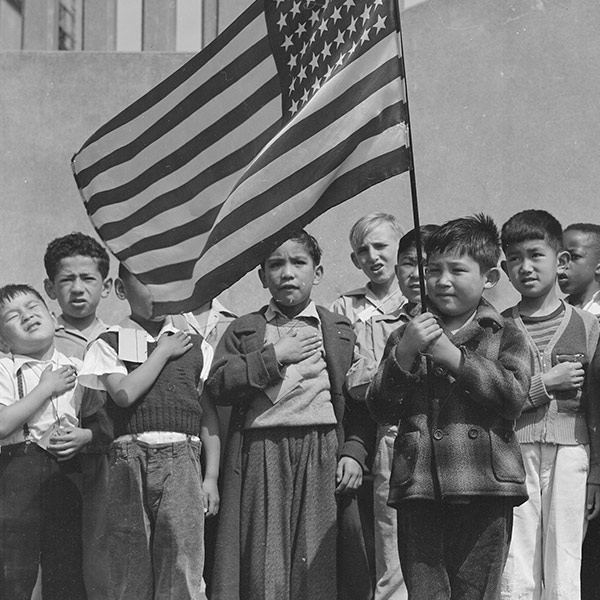
But is this an allegiance a Christian is free to pledge? In the Bruderhof, the community where I grew up and of which I am now a member, the assumed answer is no. As Christian pacifists, my early mentors and role models loved America for its freedoms and believed in its ideals, but had an aversion to rites of patriotism. It’s an aversion they passed on. So when my Bruderhof friends and I started ninth grade in public high school, the Pledge of Allegiance that began each school day posed a dilemma. We’d stand with our classmates, but kept our mouths shut and our hands at our sides. The same went for the national anthem before games in the school stadium. Our daily refusal went over about as well as you’d expect, but for me it was a sign of something important I didn’t quite understand. Even so, every now and then I’d break our code just to see what it felt like. Then the thrill of joining in was all the more intense for being accompanied by an uneasy conscience.
How much such things matter can be debated. Still, the New Testament counsels caution when it comes to questions of allegiance. Jesus came proclaiming the arrival of a new political reality, the kingdom of God, and called his followers to give it their undivided devotion. For early church fathers, this cast doubt on the permissibility of any competing loyalty. In AD 387 in Antioch, the future saint John Chrysostom admonished his congregation:
If you are a Christian, no earthly city is yours. Of our City the Builder and Maker is God (Heb. 11:10). Though we may gain possession of the whole world, we remain but strangers and sojourners in it all. We are enrolled in heaven: our citizenship is there. Let us not, after the manner of little children, despise things that are great, and admire those which are little.
To be sure, early church leaders also taught their flocks to “be subject to the governing authorities” (Rom. 13) and to “honor the emperor” (1 Pet. 2:17). But such deference, for them, is strictly qualified; loyalty to God’s eternal kingdom trumps the claims of transient human commonwealths. “Our citizenship is in heaven,” writes Paul, “and from it we await a Savior, the Lord Jesus Christ” (Phil. 3:20). By this standard, for a Christian to pledge allegiance to any earthly sovereign verges on disloyalty to his true king: no one can serve two masters.
Then there is the question of idolatry. Early Christians felt keenly the significance of everyday gestures in demonstrating to whom they belonged. On the one hand, they would make the sign of the cross and use the fraternal kiss of peace to show they belonged to Christ and his family, the church. On the other hand, they made plain the limits of their loyalty to Rome by refusing to offer incense to the emperor’s genius. Martyrs died rather than make that seemingly inconsequential concession.[#continue] [#continue]
In the 1930s, these early-church precedents became decisive for the German theologian Eberhard Arnold, founder of both the Bruderhof and this magazine. After the National Socialists rose to power, Arnold refused to allow the swastika flag to fly on the German Bruderhof, interpreting it as a religious, not merely political, symbol. Then when the Heil Hitler greeting became mandatory, he likewise refused to cooperate: “The Hitler salute reminds us of the age of Nero. Just a bit of frankincense for Nero, and everything was fine! We cannot participate in this idolatry with a good conscience.” (In this, he went beyond other Christian opponents of the Nazis such as Karl Barth, who grudgingly used the prescribed greeting in social situations, while making a point of omitting it when giving theology lectures.) Arnold explained:
We refuse to greet the imperator with Ave; this must be clear to us and remain so. If we were to relent in this respect, we would be granting the military and legal force of the state that divine honor deserved only by the heart of God which he revealed in Jesus Christ and which will culminate in the kingdom of God.
Certainly, Arnold was opposed to the substance of Hitler’s political agenda. But for him, the crucial thing that made the Heil Hitler greeting intolerable for a Christian was that it represented a demand to give the state what is due only to God: religious devotion.
[.article__paragraph--cap][.small-caps]Religious devotion[.small-caps] is what America demands today, argues Stanley Hauerwas in essays collected in War and the American Difference (2011). To be clear, he is not equating American patriotism with fascism, but rather highlighting the dangers of a religious conception of America. Already at the country’s beginning, President Washington cast America’s birth and survival as a work of Providence, claiming divine sanction (if somewhat vaguely) for the American project. Hauerwas, however, identifies the Civil War as the moment when America became a counter-church: a religion that resembles, but isn’t the same as, the Christian one, and so presents a snare to the faithful. After the First Battle of Bull Run crushed Northern hopes for a quick victory, many Union supporters came to see their cause as God’s cause. Only so could the horrific death toll be justified, and the nation be assured (in President Lincoln’s words) “that these dead shall not have died in vain.”[.article__paragraph--cap]
The most influential manifesto for this theological conviction came from the abolitionist poet Julia Ward Howe. Seven months into the war, when the North’s fortunes were at their nadir, she visited a Union army camp and, early next morning, penned the “Battle Hymn of the Republic”:
Mine eyes have seen the glory of the coming
of the Lord;
He is trampling out the vintage where the grapes
of wrath are stored;
He hath loosed the fateful lightning of His terrible
swift sword:
His truth is marching on.
Hauerwas notes that if the Union’s cause is God’s cause, then death in battle is martyrdom, a sacrifice like Christ’s. In a transmutation of Tertullian’s aphorism, the blood of the fallen becomes the seed of the nation. Their sacrifice lays an obligation on the living to be ready to sacrifice in their turn. This idea is the key to the eloquence of the Gettysburg Address. Here, Lincoln’s stirring oratory – “dedicate,” “consecrate,” “hallow,” “devotion,” “new birth” – derives from Christianity but has a different end in view: the American nation, rather than the kingdom of God.
For Hauerwas, all this is spiritually dangerous. The Pledge of Allegiance invokes “one nation under God” – but which God? Christians must learn to distinguish between “America’s god,” whose church is America, and “the God we worship as Christians,” whose church is the universal body of Christ:
If the Civil War teaches us anything, it is that when Christians no longer believe that Christ’s sacrifice is sufficient for the salvation of the world, we will find other forms of sacrificial behaviors that are as compelling as they are idolatrous. In the process, Christians confuse the sacrifice of war with the sacrifice of Christ.
America needs war, Hauerwas argues, because without the ever-renewed sacrifice of soldiers’ blood, America’s god loses its convincing power to forge the unum from the pluribus. That’s why war is “America’s central liturgical act necessary to renew our sense that we are a nation unlike other nations.”
“My beloved, flee from idolatry,” Paul tells the believers in Corinth (1 Cor. 10:14). Hauerwas urges Christians to do just that vis-à-vis America’s god. He wishes that in this respect, America were “more like Europe,” that is, more “secular.”
American history offers ample support for Hauerwas’s diagnosis, right up to the present. From self-interested appeals to Manifest Destiny in the nineteenth century, to claims of divine sanction for US adventures in the Middle East today, the past 250 years show a pattern of invoking God to justify violence that Christians should learn to recognize and deplore. A disordered love of America quickly becomes the cult of a vampiric idol.
[.article__paragraph--cap][.small-caps]Yet there are other things[.small-caps] to say about America as well. There’s a moral grandeur to the American story that shines out repeatedly, and that tells against attempts to dismiss the American project as a hypocritical mistake. For the sake of this divine spark, if nothing else, America deserves our love. Such a love, like any worth the name, must have as its object America as she really is, in all her distinctiveness: one might say, with the soul she has. As a mongrel patriot – I’m a dual national who by birth and heritage owe the duties of citizenship to both the United States and Germany – I don’t want America to be more European, any more than I want Europe to be more American. So what might a purified love of America look like?[.article__paragraph--cap]
For many Americans today, after all, the temptation is not to love America wrongly, but to fail to love her at all. The flip side of the insolent claim that of course God backs my nation is the slow-hearted failure to acknowledge God’s hand where it is at work. Scripture teaches that God is the Lord of history: “For dominion belongs to the Lord, and he rules over the nations” (Ps. 22:28). According to the biblical interpretation of church fathers such as Origen, God assigns an angel as steward for each nation, just as he assigns a guardian angel for each human being. As Augustine summarized in The City of God, “Human kingdoms are established by divine providence.”
If that is true, then great Americans such as George Washington, Abraham Lincoln, and Martin Luther King Jr., in their quite different ways, were right to invoke God as the author of America’s imperfect but still hope-laden story. (The same, of course, can be said of other nations, each according to its own genius – or, perhaps, the charism of its own national angel.) Lincoln in particular was clear-eyed that to affirm the hand of Providence in America’s story doesn’t mean America will automatically enjoy divine favor. As he acknowledged in his Second Inaugural Address, the nation’s sins can call down God’s judgment. God may or may not bless America: “The Almighty has his own purposes.” Nevertheless, the goodness, truth, and beauty of America still need accounting for.
In 2005, I went on a road trip through France, Belgium, and Germany with Don Ryan, a friend and World War II veteran. Six decades earlier, Don had come here as a US artilleryman serving in 12th Army Group, commanded by Gen. Omar Bradley, West Point Class of 1915. We were retracing the route his unit had taken in the last months of the war, as the Americans forced the Wehrmacht back eastward to the Elbe River, where they linked up with Soviet forces pushing west.
At least, we were trying to retrace the route. Don said that during the war, he’d traveled much of the way by night in the back of a truck, and key battles had been offroad or at obscure villages. There were four of us along. Each evening we’d plot out the next day’s itinerary using Wikipedia and some creative guesswork.
Don was an enthusiastic tourist. On his first time here, he remarked, he hadn’t been able to enjoy the wine or food, or meet regular Germans, whose culture he admired (back home, he was a proud member of the German Club of Kingston). Now we made up for those omissions, and then some. We visited Charlemagne’s Palatine Chapel in the cathedral at Aachen, took the wine boat down the Rhine, downed Kölsch in a tavern near Cologne, and took photos at the site of the bridge over the Elbe at Torgau where, on April 25, 1945, 2nd Lt. William Robertson of the United States shook hands with Lt. Alexander Silvashko of the USSR. Wherever we went, Don struck up conversations with somewhat surprised locals.
Don’s bloodiest battle had been in the Hürtgen Forest near Germany’s Belgian border. We drove around the general area without having an exact destination. Outside a hamlet just on the Belgian side, we saw a homemade sign for a World War II museum, and of course turned in.
The driveway brought us to a small, somewhat rundown farm. The woman who met us was about Don’s age. She was delighted when she heard Don had been an American GI, and invited us into her kitchen for coffee and tiny dry waffles. On the walls were American flags and photos of the Belgian royal family. She told us, as if it were yesterday, of how the Germans had occupied her village.
The museum was an old barn filled with World War II military gear, plus souvenirs and gifts from former US servicemen. There were American uniforms, canteens, pieces of downed planes, and an almost intact American tank – the assorted debris that war had left behind on a working farm, painstakingly collected, cleaned, and exhibited. “I was so happy when you Americans came,” the woman told Don repeatedly. She added: “The Nazis shot so many of our young men.”
After saying goodbye, we made a stop at the nearby Henri-Chapelle American Cemetery. There the flag flies over 7,987 American military dead. The grass was well cut and deep green, the crosses clean and upright, stretching over fifty-seven acres of undulating hills. I was reminded of a military cemetery 150 miles south in France, with crosses much like these, one marking the grave of my great-uncle Otto Wächter. In 1914, Otto volunteered for the Imperial German Army at age seventeen, together with his entire high school class, and was killed in action eleven months later. There’s a nobility to both cemeteries, but what makes the American one hopeful rather than melancholy is the sense that here at least there was a point to it all: the GIs were fighting, in some sense, to save their enemies from themselves.
My own conviction, and the conviction of my church, remains that the vocation of a soldier can’t be squared with the vocation of a disciple. As often discussed in these pages, Jesus’ teaching against violence and his example of the saving power of defenseless love are too compelling to be explained away.[.footnote-link]1[.footnote-link] (That in part explains why I still don’t say the Pledge of Allegiance or join in the national anthem.) But at the same time, who can doubt that the men buried in Henri-Chapelle died for a cause that was worthy? The same applies to others on the opposing side, such as Claus von Stauffenberg, the German military officer who attempted to assassinate Hitler and was shot by a firing squad soon after. Such sacrifices, inevitably made by imperfect people, must surely be acceptable to God.
America isn’t the church; if invested with more religious significance than it can bear, it devolves into the church’s caricature, as Hauerwas rightly warns. But there are other possibilities, too. In a place like this military cemetery, America seems to be an almost-church, or, in Lincoln’s words, an “almost chosen people.” The “almost” matters: this must remain a mere analogy, without claiming more. It’s suggestive that the Gospel of Matthew offers an analogy of a similar kind when it tells the story of a Roman centurion who asked Jesus to heal his paralyzed servant (chapter 8). Just as Jesus saw true faith in the centurion’s confidence that his military authority over his subordinates was somehow akin to the Messiah’s authority to heal, so here too, perhaps, we can discern a partial likeness, a half-rhyme.
America is not the new Israel, nor is it, contra John Winthrop, the “city on a hill.” Those titles belong to another, infinitely grander polity. Yet despite its manifold foibles and crimes, America – the first nation in history conceived in liberty and dedicated to the proposition that all men are created equal; a country that brings together many peoples and seeks, at its best, to make them one – can remind us of that more perfect kingdom. For this, it deserves our gratitude and love, even as we reserve our allegiance not for the symbol, but for the real thing.