Reflection
The Soul of a Nation
What my immigrant father taught me about love of country.
June 21, 2026
Try 3 months of unlimited access. Start your FREE TRIAL today. Cancel anytime.
START FREE TRIAL NOWThe Soul of a Nation
What my immigrant father taught me about love of country.
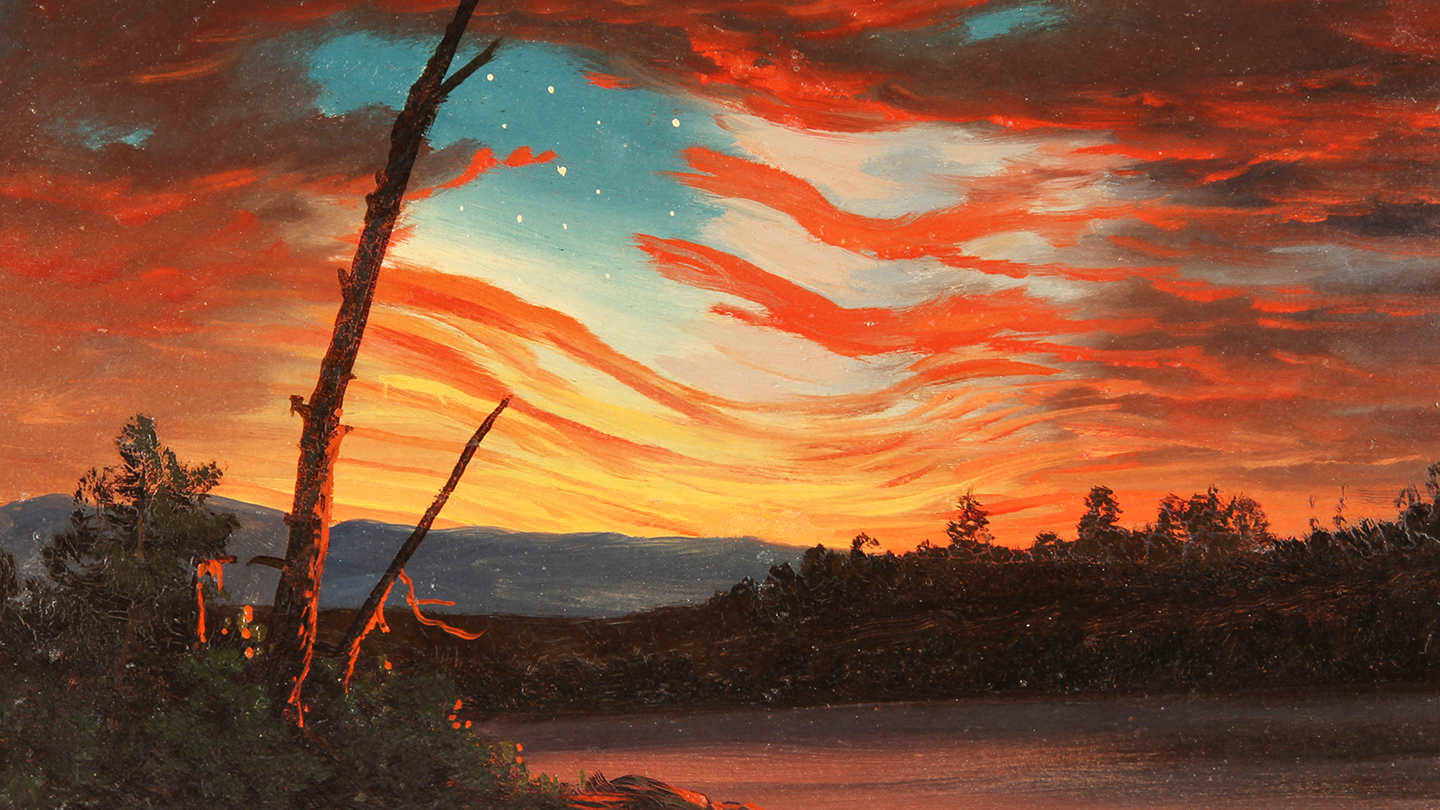
Frederic Edwin Church, Our Banner in the Sky, oil on paper, 1861. [.smalltext]All artwork from Wikimedia (public domain).[.smalltext]
[.article__paragraph--cap][.small-caps]It’s the fifth century bc.[.small-caps] The Peloponnesian War is raging. In the port of Athens, at the house of a rich man called Cephalus, a group of men are gathered. At the center of this group is Socrates. The men are discussing the soul of a nation of a different kind: a republic. The conversation gradually comes to something like a conclusion: a just republic “is possible only as first [justice] resides in the hearts and souls of the citizens.”[.article__paragraph--cap]
I say a conclusion, but this question – the question of the soul and the nation – has been raised in every generation since that time, and will no doubt be raised in every generation yet to come. As Aristotle quips at the start of De Anima, “To attain any assured knowledge about the soul is one of the most difficult things in the world.” And so, what I write today is not a conclusion, a final statement, but rather a reflection: a reflection on the soul of our nation, the United States of America, and on the God who is the God of that just peace and complete love which in Hebrew is called shalom.
What is a soul? And what is a nation? Soul is depth of meaning, longing, and being – the spark of God, the breath that animates human life. Christ commands us to love God not only with our hearts and our minds, but also with all our soul. Soul presides in presence, harbors in history, and moves between time and eternity. Every person is a soul. Nations build on people, so it follows that every nation has a soul.
To reflect on our nation’s soul is to see God working in those who built, lived, and died for our land. It is to see God’s love, God’s freedom, and God’s justice at work. A soul may be lost, but what is lost can be found again. So we must focus on the life-giving impulses of our nation’s soul in our history and present, and on God’s design for society.
[.article__paragraph--cap][.small-caps]Though vast and varied,[.small-caps] the Native American nations, tribes, and cultures who were here before us shared a core belief in the Great Spirit. This Spirit was called by many names but was understood to be the Creator, the principle of order and of life. This Spirit was, surely, that unknown God of whom the Apostle Paul – back in Athens, though more than five hundred years after Socrates – said had “from one man made every nation of mankind to live on all the face of the earth … that they should seek God and perhaps feel their way toward him and find him. Yet he is actually not far from each one of us, for ‘in him we live and move and have our being’; as some of your own poets have said, ‘For we are indeed his offspring.’” [.article__paragraph--cap]
The colonial period brought those who knew these words of Paul into contact for the first time with the native nations. Europeans flooded across the Atlantic, seeking religious and economic freedom, new opportunities, and adventure. They were explorers, opportunists, and idealists with a vision and a will to build a nation, a home for the flourishing of their souls. They built homesteads, worked the land, fought to survive – and founded a system of government that aimed at harmony: a constitutional republic, a government of, by, and for the people, with laws aimed at freedom. The opening lines of the Declaration of Independence beautifully reflect their desire to found this nation on what was given by God. “We hold these truths to be self-evident, that all men are created equal, that they are endowed by their Creator with certain unalienable Rights, that among these are Life, Liberty, and the pursuit of Happiness.” This is soul.

This period also saw hundreds of thousands of people, mainly from the African continent, shamefully forced into bondage and brought to America. While enduring this long-lasting moral horror, they brought much soul through their persistent fight and longing for freedom. Songs of suffering inspired many as they followed the Drinking Gourd north to freedom. Notably, Frederick Douglass, Harriet Tubman, and Sojourner Truth led the fight against slavery, to rip up the roots of the unjust laws that held them in bondage and to plant instead laws that reflected the love and justice that was in their souls. Backed by President Abraham Lincoln, their efforts culminated in the Civil War, the abolition of slavery, and the Reconstruction era.
Mass migration from Germany, Ireland, Italy, and Eastern Europe saw over twelve million people come through Ellis Island during the late nineteenth and early twentieth centuries; many more arrived in California from Asia. This influx added to the collective soul of America. The Statue of Liberty offered a beacon of hope for those who looked for freedom as represented by the plaque inside her pedestal: “Give me your tired, your poor, your huddled masses yearning to breathe free.”
[.article__paragraph--cap][.small-caps]The restrictions and quotas[.small-caps] of the early twentieth century shut down most immigration. But in 1955, my own family came to America, or to be exact, they came back, after more than a century (it’s a long story). My father was fifteen years old when he arrived in New York from South America. He enthusiastically embraced his new home and country. [.article__paragraph--cap]
He’d spent his life before that in the backwoods of Paraguay after his parents had been religious and political refugees from Germany’s Nazi regime, along with other members of the Bruderhof community, sojourning through Liechtenstein, England, and South America. He – and the whole community – found the Hudson Valley a welcome refuge. More than a refuge – a home. He loved learning the American story; the founding concepts of faith, liberty, and justice rang true to his upbringing, and the history of his family and church.
He also loved America’s drive-in theaters, the jukeboxes playing Elvis, the Dairy Queens, and the soda fountains. And baseball. Particularly, he loved the Yankees. Arriving at the back door of the Bronx in the heyday of Mickey Mantle, Roger Maris, Joe DiMaggio, Yogi Berra, Whitey Ford, and Don Larsen, he was smitten. The little transistor radio given to him by a family friend also helped.
The soul of America, the promise, took root in my father’s soul. Although he was born in England and had spent fourteen years of his life in Paraguay – a country he loved – he didn’t think of himself as a British or Paraguayan patriot. But America was different. In school, he later recounted:
I kept a notebook and meticulously recorded all the things I found important about the Constitution, the preamble, and many of the different writings, the amendments.… I had them all memorized, because it somehow excited me that here was a government that had an open heart to people and proclaimed “life, liberty, and the pursuit of happiness” to every American. Coming from Paraguay that was more important than you realize.
Five years after my father’s arrival, John F. Kennedy was elected president. My father recalled hearing these words from the inauguration address on the radio: “Ask not what your country can do for you – ask what you can do for your country.” This was “not only political rhetoric,” he told high school students decades later. These words “were divinely inspired. They spurred thousands of America’s youth to serve their country either in the Peace Corps or in the Armed Forces.”
My father was, at age eighteen, a patriot and a convinced pacifist. He answered President Kennedy’s call in the way that he could, by standing up and refusing to fight in a war that, among other things, he believed to be unjust. The cost could have been severe. If he refused to fight and his stand as a conscientious objector (CO) were not accepted, he would be imprisoned.
His CO status was approved, but the next years brought great turmoil in America with the assassinations of John F. Kennedy, Martin Luther King Jr., and Robert F. Kennedy. “It was like a door slammed shut,” he told the students. “It was uncanny. Americans were scared. After these assassinations a certain era of home, of excitement, of purpose was over.” But for my father, these dark times brought an old challenge to the fore:
Loving one’s country and wanting to serve it especially in dark times can be compared to a biblical mandate: “Love the Lord your God with all your heart and with all your soul and with all your mind… and love your neighbor as yourself.” You now live in America. Are you going to love God with all your heart, mind, and soul? Are you going to love your fellow Americans like yourself? If you do that, then you are serving your country.
My father’s love of America was never something only focused backward on this nation’s storied history. Although he participated in some of the most consequential moments in modern American history, he always pointed to the present and the future, calling himself and those around him to action. As he told another group of high school students in 2014:
As a young man I [marched] with Martin Luther King Jr. in Selma, Alabama, and Atlanta, Georgia, and also met him in Washington, DC. I experienced the funeral of a young African American whose only crime had been trying to protect his mother, and for that he was shot and killed by an Alabama state trooper. You can imagine the agony, the anger of family members and friends who wanted human justice. But Martin Luther King said, “No, there is a better way, and that is forgiveness.” …
Now we need new leaders, people willing to lead our nation as president, congressmen, state representatives, teachers, professors, and medical doctors, to lead our nation into the future, to show the world that we are truly a democracy; that we are a country in which we truly love one another.… Let us truly live the words: “We hold these truths to be self-evident, that all men are created equal, that they are endowed by their Creator with certain unalienable Rights, that among these are Life, Liberty and the pursuit of Happiness.”
It’s because of these words that my family and I chose to come to this country as immigrants from Paraguay to experience them, live them, and be part of them. So, here in America, you are part of something great. And it is up to you to contribute something positive so that when you leave the world, people remember that this woman, this man, truly loved and cared for God and their fellow men. For that you will be remembered. Make your life meaningful, make it count, and you will not regret it.
My father’s words of love for America express a gratitude and loyalty that countless immigrants to this country have felt.
[.article__paragraph--cap][.small-caps]And so, 250 years[.small-caps] after its founding, how do we rediscover, refine, and reconnect to our God-given soul, and to the true soul of our country? It is only by finding God, feeling the spark that he places in each heart and life, and letting him fan that spark into a flame of living soul. It is by living together with love and freedom, in goodwill, repentance, forgiveness, and faith in God, in the true design and purpose of family, community, country, and humanity. There are no national borders to the soul. In the end, we find our souls through God and together with each other, seeking that harmony that is between our soul and the community of eight billion souls on this precious planet.[.article__paragraph--cap]
These words from Abraham Lincoln, spoken to a broken nation in need of healing after a bloody civil war, speak truth today. This is the path to health and strength of soul: in ourselves, in our nation, and in our world.
With malice toward none, with charity for all, with firmness in the right as God gives us to see the right, let us strive on to finish the work we are in, to bind up the nation’s wounds, to care for him who shall have borne the battle and for his widow and his orphan, to do all which may achieve and cherish a just and lasting peace among ourselves and with all nations.