Essay
Running in Circles
There is only one truly redemptive form of memory: baseball.
June 17, 2026
Try 3 months of unlimited access. Start your FREE TRIAL today. Cancel anytime.
START FREE TRIAL NOWRunning in Circles
There is only one truly redemptive form of memory: baseball.

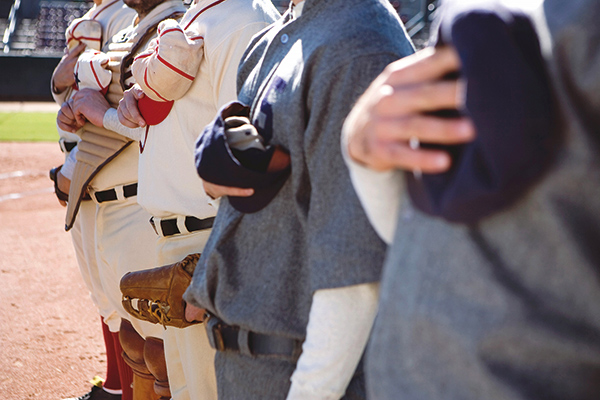
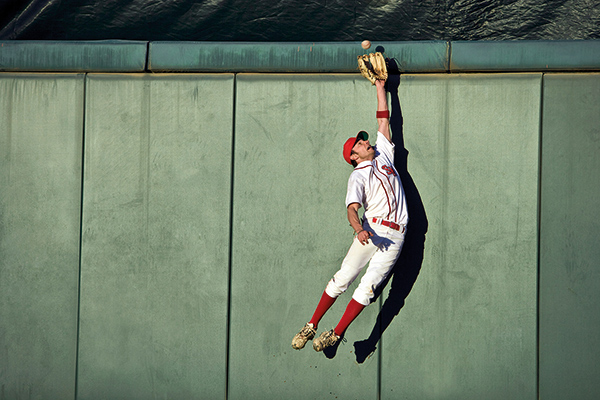
[.smalltext]Photograph by AJ / AdobeStock. Used by permission.[.smalltext]
Remember now thy Creator in the days of thy youth, while the evil days come not, nor the years draw nigh, when thou shalt say, I have no pleasure in them;
While the sun and the light, the moon and the stars, are not darkened, and the clouds do not return after the rain.
—Ecclesiastes 12:1–2
[.article__paragraph--cap][.small-caps]Part of the peculiar predicament[.small-caps] of being human is our need to remember, not simply in the sense of retaining useful lessons acquired in our encounters with our environment, but in the more mysterious sense of situating ourselves within stories that might explain us to ourselves and help rescue us from our bewilderment at finding ourselves thrown into this world from we know not where. That is not a merely private labor; it cannot be. It is by definition a communal act, not only shared in common but regularly reenacted, ritually or liturgically, practically or poetically, in countlessly diverse modes of celebration, lamentation, speculation, and observance. This is memory understood in the full sense of anamnesis, the positive overcoming of forgetfulness not only of the past of an individual psychology, but of the past of all things, in all its archetypal dimensions – memory, that is, continuously recovered through fidelity to immemorial customs. It is also of necessity a constant merging of horizons, a constant superimposition of mnemonic layers one upon another, which are often stubbornly opaque but which we are always nevertheless attempting to make diaphanous before something deeper than we can immediately recall. We have a spiritual need to make sense of our own lives by glimpsing a larger history through our personal recollections, but that history too is comprehensible to us only to the degree that it allows us to see through it and to catch further glimpses of a remote mythic time lying before and beyond the flow of ordinary time. And even this is not enough. Mythic time is intelligible – or, at any rate, illuminating – only insofar as it permits us to remember eternity.[.article__paragraph--cap]
This is no easy feat; to dwell in history, which may be our unique curse as a species, is to dwell in exile from the eternal. But, so long as we remain true both to the richness and to the poverty of our humanity, we yearn to reconcile the fragmented and seemingly aimless diachrony of life in the world with the abiding truth of the world; and, given the limitations of our imaginative resources, our best way of accomplishing this, and of making the temporal as transparent as possible to the eternal, is under the form of faithfully repeated cycles. And this is why, as far as American society as a whole is concerned, in all its diversity, there is only one truly redemptive form of memory available: baseball.
Yes, of course, as individuals and as distinct communities, we have our various religious and cultural mediations between time and eternity. All human culture, at least of the kind that emerges naturally over generations and epochs, is a structure of cyclic repetitions and returns, dramaturgical and narrative recapitulations of history and myth and the timeless origin of all things, interweaving and inflecting one another and drawing us out of the barren banality of mere sequential time. But I am talking not about individual Americans or discrete ethnic factions or elective affinities; rather, I mean America as a civic totality, and there the situation is either grave or ridiculous by turns. On the whole, religion inevitably fails in this country. We may have the greatest number of religious adherents, at least per capita, of any “developed” nation, but there is something about American culture that is relentlessly corrosive of genuinely spiritual values. Our indigenous forms of Christianity in particular are essentially shams and perversions, not only in the bizarre universe of white Evangelicalism, with its hospitality to blasphemous nationalism, diabolic militarism, and lunatic chiliasm, but also in many mainline Protestant denominations and increasingly in Catholic and Orthodox circles as well. America’s principal religion is America, and it tends to extinguish or subvert any rivals to its supremacy. One way or another, the myth of America insinuates itself into the sacred memories preserved in the faith and practices of Christian creeds and communities, and the sanguinary gods of patriotism manage to force their way into the company of Christ and the saints. Our civic pieties, moreover, are morasses of saccharine sentiment spiced with crass belligerence. Nationalism is, of course, a perennial temptation for Christians everywhere within the lands of Christendom. America is hardly unique in this regard. But here that temptation comes laden with all the ludicrous apocalypticism and messianism of America’s delusions regarding its own historical destiny. All is corrupted, all is idolatry. Only one institution stands out in public life that is more or less innocent of these evils but also capable of bearing the full weight of a people’s need for the sacred integration of personal, historical, mythic, and timeless memory: again, baseball (even when played with the designated hitter).[#continue] [#continue]
Oh, you may think I am being hyperbolic, but I am convinced I am right. To be clear, I am talking about baseball in particular, not sport in general. The latter is a universal possession of the species, and everywhere it plays its part in forging communities and sustaining civic identities and whiling away the otherwise empty hours in the company of other souls united around a collection of blessedly trivial enthusiasms. Baseball, however, is not merely a sport; it is first and foremost The Game, and more than that: it is the great mystery play that joins us ever and again to our childhoods, our cultural history, our lost paradise in illo tempore, and ultimately to the divine. No other sport native or imported to these shores has anything like that uncanny sacral power. Certainly not American football, which for all its strategic complexity is ultimately just an exercise in military logic, a clash of advancing fronts seeking to penetrate and conquer one another’s territory. As a version of what I have in the past disdainfully dubbed the “oblong game,” it is ontologically bounded, both in time and in space. It is played by the clock, under the tyranny of the sand that pours through the hourglass, and it is enclosed on all four sides by inviolable boundaries that dictate the strictly guarded dimensions of play. It wholly lacks baseball’s angelic indifference to the passing of the moments, and certainly baseball’s openness to the infinite that lies beyond the imposing but not inviolable barriers of the outfield walls. A wide receiver cannot score a touchdown if so much as a toe lands out of bounds before he has possession, while an outfielder can always bring a potential home run back into the field and secure an out; if his arm were long enough, he could do so from a mile away and still produce the same result. The game is notionally boundless in its dimensions.
Even considered purely as a cultural artefact, baseball is shot through with a quality of the numinous that the imbecile sport of football could never possibly convey, any more than a block of granite could permit sunlight to pass through it. For one thing, baseball is essentially a nineteenth-century pastoral game, and over the course of its existence it has acquired numberless successive elements of cultural and historical associations without shedding its idyllic purity. It is played for the most part in cities, at least at its highest tier, but in a park and not simply on a field (not, that is, on a battlefield). In this sense, wherever play unfolds, it takes us somewhere always further back in time than the present, deeper in the collective memory of humankind, nearer the oldest sources of life and community.
And then there are all the mundane but oddly profound ways in which the game serves as a repository of cultural memory. It is, for example, among the most significant sites for the archaeology of American idioms. It is a marvelously preserved trove of cultural relics, simply by virtue both of its hoary venerability and of its rootedness in the folk poetry of an older reality that no longer exists in any living memory. The Americas have many antiquities, but the nation called America has none; baseball, therefore, is our Pompeii, preserving frescoes and fountains and anonymous desiccated cadavers from a different age. Some of the turns of phrase peculiar to the game remain largely intelligible to us, of course, if we have any aptitude for metaphor; we do not have to strive to understand what is meant by a “worm-burner” or “seeing-eye single,” or why we call a squeeze a squeeze. Most of the avian imagery is grasped easily enough: a “dying quail” or “ducks on the pond.” But other terms emanate from a vanished cultural world. We still describe, say, a softly lofted single dropping into shallow right field as a “can of corn,” and no doubt that still summons up in our minds some picture of a heavy object falling ponderously to earth; but none of us is old enough to remember directly, and so connect the phrase to, the days when one went shopping by telling the man behind the counter what to fetch and he responded by reaching up to the tinned goods on the higher shelves with a clawed or hooked stave and pulling down cans of vegetables to drop into the basket below. The idiom remains long after the metaphor has dissolved, but the earnest philologist can still plumb its depths in search of what now lies buried.
There are also all those more mysterious and contested metaphors whose exact origins and meanings we cannot quite determine but which have migrated into the national patois on account of their gorgeous suggestiveness. When we speak of someone or something “coming in out of left field,” we know what we mean, and we know that we could not possibly express it better, but we actually cannot say with perfect confidence what the phrase originally referred to. Was it the surprise felt by a runner rounding third, expecting to score, finding himself cut off at the plate by a magnificent outfield assist? Or perhaps just an unexpected catch by the left fielder of a ball dropping toward no-man’s-land? Or perhaps an assist from left field to second on a force play? Or (as I have heard hypothesized by a scholar of the nineteenth-century state of the game) might it mean an outfielder summoned in to assume an infield position, even perhaps as the relief pitcher? Whatever the case may be, the phrase is indispensable to us now, and its origins, if they can ever be unearthed, will be found deep in the game’s historical strata.
These are small matters, I suppose. There are, however, more morally consequential ways in which baseball preserves historical memory. It may have begun as a pastoral lark, full of the romance of the bucolic, but it also began in an era when a great deal of labor in the fields was that of slaves. And, for more than eighty years after the end of the Civil War, it remained a segregated sport. The Negro Leagues thus functioned both as a source of community for an oppressed population, a nation within the nation, and as a persistent moral reproach of white society and its injustices. Then, as the color barrier was broached by Jackie Robinson, Larry Doby, and the rest of the first wave of black players in the (officially recognized) major leagues, baseball became the cultural axis of a still incomplete reckoning with the darkest depths of historical memory, as well as of an awakening to the redemptive possibilities within ordinary time. That work continues, of course. The induction of great Negro Leagues players into the MLB Hall of Fame, beginning in 1971, was at once a festal and a penitential act. The yearly celebration of Jackie Robinson Day, when every player briefly becomes number 42, is a genuinely sacred civil observance. The recent full integration of Negro Leagues statistics into the official statistics of MLB – and what other game so lovingly and obsessively cherishes its statistics and the long memory they cultivate? – was yet another way in which the game continues to contribute to the salvation of the nation’s soul. And, given the special barbarity and cruelty of the nation’s current government, the international cast of the game’s players, and most especially the enormous numbers of Latino players in the major leagues, baseball has become something of a sacred pageant for the country, providing us a picture of what we could and should be as a people.
[.pull-quote]Earliest childhood is the moment when our souls are most transparent to all the realities encompassing us; it is when the veils between the historical and the mythic, the personal and the universal, the terrestrial and the heavenly are at their thinnest.[.pull-quote]
The special enchantment of liturgical memory – liturgical anamnesis – is that it preserves the linear narrative of the historical past under the form of a constantly repeated cycle. It achieves a reconciliation, even to the point of perfect unity, of all the dimensions of memory, making them transparent to one another and to something more luminous than their factual content. Absolutely essential to baseball’s mystic merging of horizons are the personal memories, and specifically the childhood memories, that return with ever greater depths of significance each time one goes to a game. This is more than mere nostalgia; it is the opening of a spiritual causeway between the private and the cosmic. If your father took you to a game at Memorial Stadium in Baltimore in 1973 on a night when Bobby Grich happened to hit three home runs (to take an example wholly at random), the recollection of that magical episode in that fabulous fairy realm becomes over the years far more than just a pleasant souvenir of happier days. It is a retreat into a deeper, more primordial, purer kind of time: a golden age of endless days and star-hung nights, of guileless joys, of an Edenic innocence so perfect that as yet no moral categories existed, a time in which no one ever died and in which we all still enjoyed admittance into the gardens of the gods. It is in this fusion of historical, personal, and mythic time that baseball provides an always open passage from the temporal to the eternal. Earliest childhood is the moment when our souls are most transparent to all the realities encompassing us; it is when the veils between the historical and the mythic, the personal and the universal, the prosaic and the epic or lyrical, the terrestrial and the heavenly are at their thinnest.
Baseball, after all, possesses a depth of mythic memory that our other sports cannot, not only because of its longer and richer cultural history, but also because of the game’s peculiar shape. Not only is it not a squalid struggle for territory, as every variant of the oblong game is; it never involves an actual direct conflict between massed forces. Technically it is a team sport, but offense and defense participate in it in radically different ways, almost as if they are playing two separate games in synchrony with one another, but not according to the same logic. There is the board game played on the diamond, where the two sides meet, one attempting to advance the runner or runners around the bases, the other attempting to thwart that little odyssey; but even here the terms of engagement are totally dissimilar. The point of encounter between the two sides is never that of two teams directly posed against each other; it is a truly heroic spectacle, in which a lone figure at the plate stands facing all the ranks of the adversary, staring out into the limitless vista of that open field of play, while another lone figure stands on the mound seeking to defend his people: two champions engaged in a trial by ordeal. Thus individual achievements emerge from the contest in ways that they cannot in American football, and so fix themselves in memory, both collective and personal, with a positively archetypal salience. I am talking not about feats of mere athletic excellence on the part of particular players amid the swirling crowd of other players, or about mere wildly improbable turns of events. Do not bore me with rhapsodies on the “immaculate reception” or the “helicopter run” or the “helmet catch”; these are all just so many predictably unpredictable, wholly happenstantial results of the violent aimlessness of multiple bodies in diverse motion. I am talking about the lonely grandeur of that single hero gazing out from his lonely station on the ramparts of the infinite: the batter standing in at the plate, the pitcher toeing the rubber, the runner on base, the isolated fielder moving toward the batted ball. I am talking about Willie Mays and “the catch,” about Joe DiMaggio and the impossible fifty-six, about Bobby Thomson and the “shot heard ’round the world,” about Rickey Henderson and that 130th steal, and so many other legendary achievements. For me, as it happens, the grandest tale to have emerged from the age of heroes is that of Frank Robinson’s Triple Crown and championship campaign in 1966, beginning properly on May 8 of that year when he became the only player ever to hit a ball entirely out of Memorial Stadium – a home run reported to have traveled 541 feet but which I know in my heart that godlike man actually drove across a distance as immense as the galaxy. But, for others, other heroes – other Perseuses and Bellerophons and Hectors – light the way out of history and into the realm of myth.

Even mythic memory, however, is only a stage along the way to the still richer anamnesis of the eternal, which carries us first back to that primordial paradise from which we departed before we knew ourselves and then, at the last, back to the mystery of God. Again, so much depends upon the shape of the game, and upon its mystic proportions and ratios. The oblong game tells only a tale of invasion and conquest; it is nothing more than a mobile allegory of human history in a fallen world, confined within the time of death and under the reign of fate. It is the tale of temporal finitude and physical mortality. The tale baseball tells, by contrast, is one of divine exitus and reditus, the eternal truth of all things coming from God and returning to their true homeland in the divine ground. It is a story that of its nature breaks free from any frame of mere consecutive time. It speaks of the garden of our first innocence, which Nicholas of Cusa identified as our birth within the divine Logos, and of our entry into the city of our final innocence when we have completed the Platonic circuit of the Great Year. It speaks of our spiritual and ontological Ithaca, from which we have always ventured forth into the labor of history, but to which we must return.
Yes . . .
All right, perhaps I am, after all, indulging in hyperbole here. Love chafes at every restraint, and I truly love the game. But there is a certain serious moral point I am trying to make, all facetiousness aside. I do think that the displacement of baseball by the NFL at the center of American culture is indicative of a certain kind of spiritual sickness. In part, this is simply because it marks a movement away from the pastoral to the military in our shared imagination, and away from a lyrical celebration of grace and speed to a gladiatorial spectacle of physical prowess and brutality. It also, however, marks a turn away from dreams of eternity to ambitions with respect only to the terrestrial future. One of America’s sins of the heart is its belief in itself as bearing a sacred vocation, a sacred destiny within time to become the kingdom on earth – or, as we like to say, the greatest nation in history. That is a sordid aspiration. No other people is as prone as we are to an “immanentization of the eschaton.” While it may be a genuine spiritual imperative that we try to achieve some semblance of eternal verities like love and justice in time, it is sheer insanity to allow ourselves to forget the difference between the temporal and the eternal, and to fall prey to the frustration and violence to which the confusion between them leads. History, as Walter Benjamin so acutely saw in his meditation on Paul Klee’s Angelus Novus, is a relentless accumulation of debris, a ceaseless process of ruination. Time is redeemed only in moments of messianic interruption, when the eternal becomes incarnate within it. How we dwell within time – whether as strangers and pilgrims seeking a better city or, instead, as partisans in a bloody war for the future – depends on what we choose to remember and how we cultivate that memory. To remember eternity and not merely the past, to remember God and not merely the call of destiny, is to be partially liberated from the brutality and idiocy of history. And, in its humble way, baseball really is a vehicle of reconciliation between simple recollection of the past and a transfiguring anamnesis of the eternal, experienced in the enchanted form of repeated cycles within repeated cycles, across an ever-widening expanse of years. The game really is a kind of civic liturgy, a kind of ritual repetition, that allows time to become transparent to the timeless. It cannot redeem souls, obviously, but even so it does have the power to aid in the redemption of the culture’s imagination and deepest longings. Or so I like to think. At the very least, it offers us a glimpse into paradise – into childhood’s innocence, into Eden, into what Nicholas of Cusa called the walled garden of the divine essence – all under the aspect of play; and that is a great blessing. Only in play, whether in sport or in art or in other “ahistorical” endeavors of that kind, can we really understand the true nature, the original peacefulness, and the final purpose of creation.