Dispatch
Searching for the Fountain of Youth
I went to St. Augustine, Florida, to find America’s Hispanic roots.
June 18, 2026
Try 3 months of unlimited access. Start your FREE TRIAL today. Cancel anytime.
START FREE TRIAL NOWSearching for the Fountain of Youth
I went to St. Augustine, Florida, to find America’s Hispanic roots.
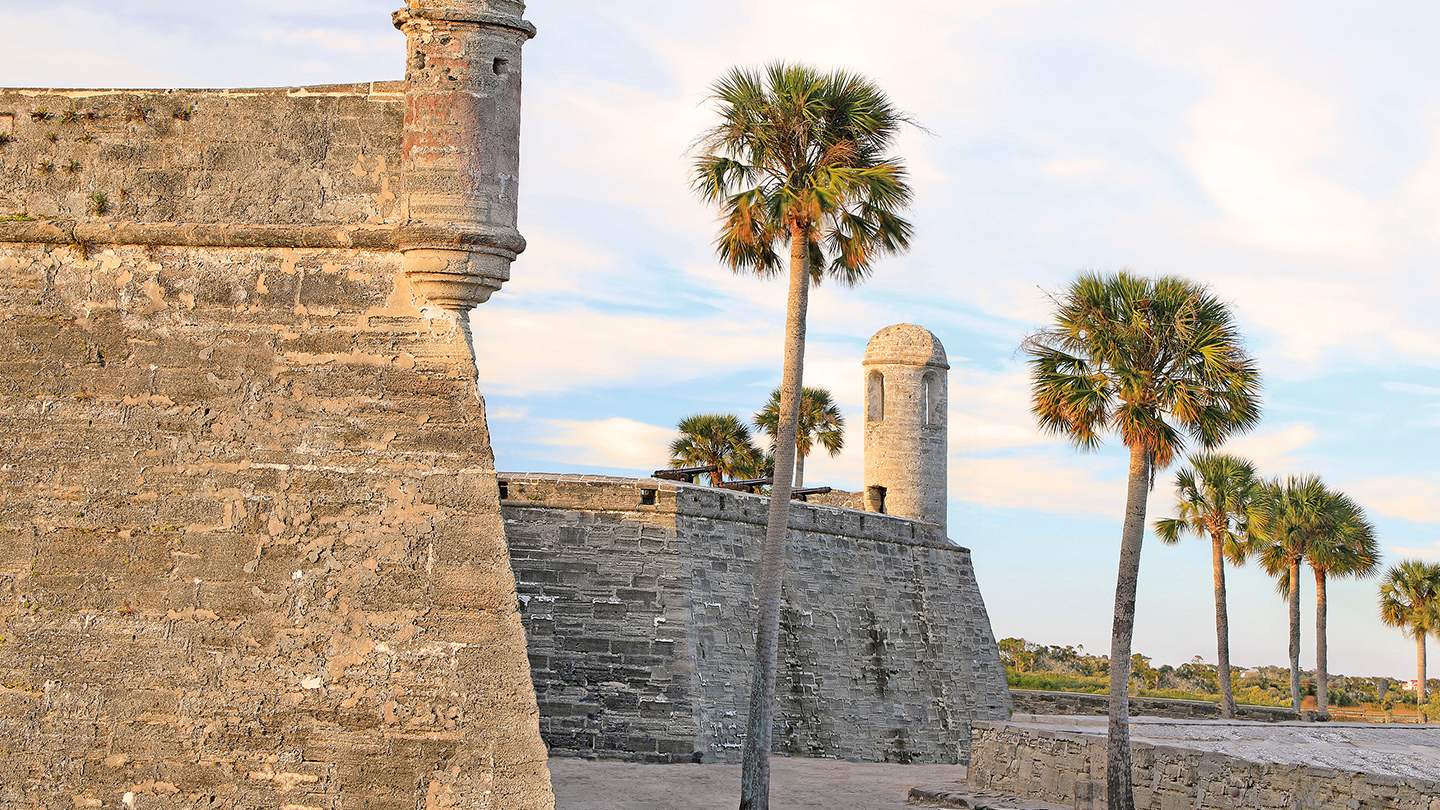
Castillo de San Marcos, St. Augustine, Florida. [.smalltext]Photograph by Vlad_g via AdobeStock. Used by permission.[.smalltext]
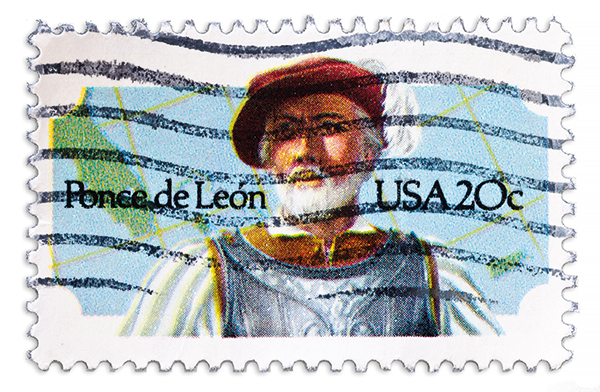
[.article__paragraph--cap][.small-caps]The Puritans went[.small-caps] to Massachusetts for God and for the freedom to worship him. The settlers in Jamestown were looking for wealth. And the Spanish went to Florida in search of immortality. So the legend goes. What we actually know is that Juan Ponce de León, a Spanish explorer, spotted the coast of Florida on Easter Sunday, 1513. Although Norse explorers reached Greenland five hundred years earlier, Ponce de León is generally credited with being the first European to explore and try to colonize North America. Sailing from the Spanish colony in Puerto Rico, Ponce de León was looking for an archipelago called Bimini, in present-day The Bahamas, and instead discovered a new terra firma whose inhabitants would hold out against the Spanish for far longer than the Aztecs resisted Cortés. For forty years, neither the Catholic Spanish nor the French Huguenots who followed after were able to establish a permanent colony in Florida.[.article__paragraph--cap]
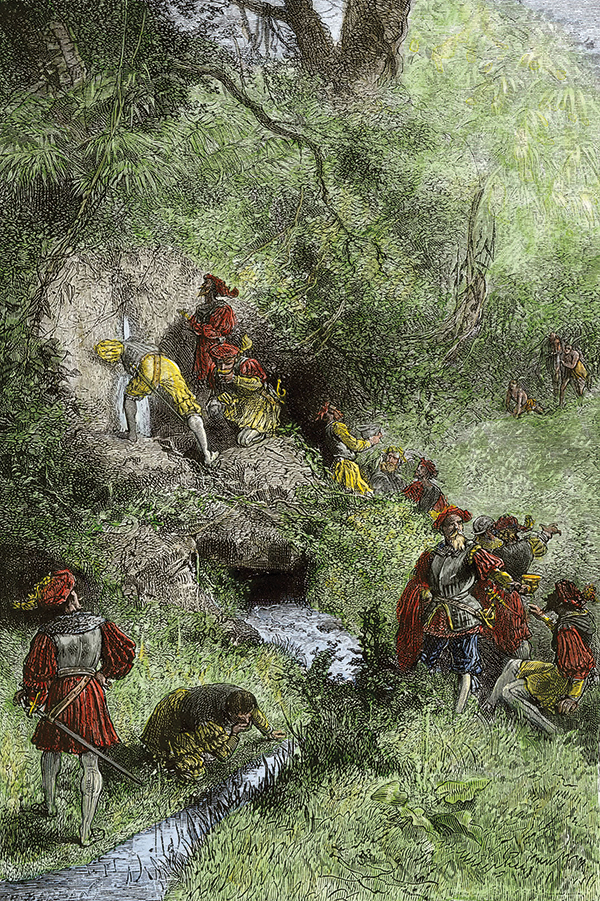
That’s the historical record. The earliest telling of the legend – that is, of Ponce de León’s alleged search for a Fountain of Youth somewhere in Florida – is found in a Spanish chronicle by Gonzalo Fernández de Oviedo from 1535. Ponce de León, then governor of Puerto Rico, having heard rumors of land to his north, with two caravels “discovered the islands of Bimini . . . and then that fable was spread about the fountain that made old men grow young again or return to youth.” In pursuit of this eccentric goal, Oviedo’s records claim “he learned of the mainland, and saw it, and gave a name to a part of it that extends into the sea like a sleeve for a span of a hundred leagues in length and a full fifty in width, and he called it Florida.”
The Spanish eventually succeeded in establishing their permanent colony: in 1565, Pedro Menéndez de Avilés founded a military outpost, massacring the French Huguenots also trying to settle in the region, and naming the settlement San Agustín. The city of St. Augustine still exists and is the oldest continuously inhabited European settlement in North America. Today, it runs largely on tourism, and the travel package bundles the history and legend together.
If you visit Ponce de León’s Fountain of Youth Archaeological Park, as I did this past January, you will find several historical markers from over the decades, each indulging the legend to a different degree. “The Fountain of Youth Is Maintained Here,” reads a plaque from 1950. Another historical marker, cosponsored by the Florida Department of State, makes a more restrained set of claims: “Archaeological excavations at the Fountain of Youth Park since 1934 have revealed the shell mounds of the Archaic inhabitants, parts of Seloy’s town” – Seloy was the local Timucua chief – “[and] remains of the Spanish colony.” The sign that dominates the scene, and welcomes you to the park, says: “Ponce de Leon’s Fountain of Youth. Welcome to America’s First Colony.”
After the sign comes a paved walkway flanked by palms, Spanish moss, banana trees, two or three ancient rusty Spanish cannons, and roaming peacocks. The first place it takes you is to the Spring House, something between an archaeological site and a carnival attraction, which houses a bubbling spring. A guide stands at the entrance. She fills me in on the history: What we know for certain is that Ponce de León set foot in this exact place. The fountain is not, of course, a real fountain of youth. No one ever believed this, not even Ponce de León himself. The legend was spread by people trying to ruin his reputation among the Spanish nobility. The water is drinkable. There are free cups inside.[#continue] [#continue]
Inside the Spring House is a diorama in which a life-sized Spanish conquistador wearing a morion combat helmet is led toward the water by a Timucuan native. Suspended from the ceiling above them, five banners mark the pivotal years in St. Augustine’s history – 2400 BC: Ancestors of Timucua begin making pottery; 1513: Juan Ponce de León claims La Florida for Spain; 1565: Pedro Menéndez de Avilés settles St. Augustine; 1586: Sir Francis Drake raids St. Augustine; etc. A stone marker sits next to a plastic cup dispenser: “THE FOUNTAIN OF YOUTH,” it reads. “This spring was discovered in 1513 and was recorded as a landmark in a Spanish Grant.”
I see people taking sips from their paper cups. I wonder whether they are a mysterious group of eternal-youth-seekers, who have found each other on the internet and updated the legend to satisfy their own immortal longings. “Does anyone come here believing or half-believing that it’s really a fountain of youth?” I ask the guide.
“No,” she laughs. “Though some people really, really want to believe it.”
[.article__paragraph--cap][.small-caps]I landed in Florida[.small-caps] on the day that Alex Pretti was shot in Minneapolis by federal officers; for several weeks in Minnesota, Hispanic families were afraid to leave their homes for fear of being detained by ICE. From St. Augustine, it felt like all that was taking place in another country. If the conflict up north was at least partially about enforcing a clear border between Anglo and Hispanic America, then that conflict seemed senseless in “America’s First Colony,” a town that celebrates its deep Spanish roots, where the historic downtown district still preserves several colonial-era homes from historic families with names like Avero and González.[.article__paragraph--cap]
I was drawn to St. Augustine precisely for this reason: it constitutes a fuzzy border between the United States and Latin America. I was born in the latter and grew up in the former, and one of the ways I’ve been coping with homesickness in middle age is by looking for where these two places are not actually distinct. At the very least, they must overlap. Hispanic America is part of the American story. I can take solace in history.
St. Augustine’s historic district is a row of bars, novelty shops, restaurants, and museums where I saw more Spanish flags than I ever expected to see flown outside of Spain. Alone beyond a main road lies the star-shaped Castillo de San Marcos, the seventeenth-century Spanish fort whose cannons point out across the Matanzas River and toward the Atlantic. (This relic of war is now a museum; the real war-making power resides in the Northrop Grumman “Aircraft Integration Center of Excellence,” a few miles north of St. Augustine, on Route 1.) The Spanish heritage, the French Protestants, and the later occasional English pirates are all part of the town’s self-presentation – one conceived, I assume, by the local gentry who brought prosperity to the city and funded its libraries, museums, and schools. The museums carry unpretentious lists of the lands’ previous masters: first the Timucua, then the Spanish, the English, then the Spanish again, and finally the Americans – and ultimately, the ownership of Henry Flagler.
Flagler, a founder of Standard Oil who built up the tourist infrastructure of the region, has his name and imprint everywhere in St. Augustine. The hotel he built and named after Ponce de León, a beautiful Spanish Revival building standing between palm trees, today is part of Flagler College. To walk past “the Ponce” on a sunny day is to be tempted by the belief that all this history has culminated in this singularly pleasant day. The Ponce de León is one of several Gilded Age architectural jewels – of Spanish and Moorish Revival – that adorn the town, each as shamelessly colorful and gaudy as the other. These delights soften the jagged edges of history; even the Spanish fort is built with compressible coquina rock, made up of limestone and shellfish. It’s as if the entire town has been soaked in the waters of the Fountain of Youth, and carries on like an old man enjoying a second childishness.
But that illusion lasts only for so long. Passing the Huguenot cemetery, a tour guide points: “Each grave has ten people in it.” This cemetery is the final resting place of many who died during a Yellow Fever epidemic in 1821. The tour guide continues: “If you were lucky enough to be the last person piled on, closest to the top, you would have your name on the gravestone.”
[.article__paragraph--cap][.small-caps]Ponce de León was born[.small-caps] into a noble family that had lost its money. Although he never actually searched for a Fountain of Youth, he did long for gold and glory, and in pursuit of both, he became a soldier. He fought against the Moors in Spain before coming to the Americas with Columbus. He served as governor of Puerto Rico before being deposed by Columbus’s son and losing a suit in the Spanish courts. In St. Augustine, Ponce de León’s half-legendary legacy lives on as a historical curiosity. The Christian institutions that entered Florida through him, though, remain active.[.article__paragraph--cap]
In his account of Ponce de León’s travels, Oviedo suggests that Native Americans pretended to believe in Ponce de León’s fantasies about a Fountain of Youth in order to lead him astray and subvert his plans of conquest. The Fountain of Youth legend was so convincingly repeated by the Indians, “that Captain Joan Ponce and his men and caravels wandered lost and with much hardship for more than six months among those islands, seeking this fountain.” It was a “great mockery on the part of the Indians,” the chronicler continues, “but a greater folly for the Christians to believe it and to spend time searching for such a fountain.” Oviedo believes that, as a Christian, Ponce de León should have known that the Resurrection is a greater and more certain prize – that eternal youth is a dream, but life after death is real.
Even if Ponce de León’s search for the Fountain of Youth never took place, it’s possible to imagine Native Americans spinning stories for the would-be Spanish conquerors, just to throw them off course. Though Ponce de León did not do any evangelizing himself (he was too busy pillaging), the Christian promise of bodily resurrection was adopted by many of the native tribes who encountered the Spanish in the decades that followed. Today, the Christian identity of the town is preserved in the National Shrine of Our Lady of La Leche, which sits on the same grounds as the Fountain of Youth, now separated by a wall and under different management. The shrine is part of the Nombre de Dios Mission, founded in 1587 by a Franciscan missionary named Francisco de Mendoza, who had been present with Pedro Menéndez at the founding of St. Augustine.
The shrine has an adjacent museum with its own small diorama, not life-sized like the one at the Spring House, depicting the first Catholic Mass celebrated in North America. It also has an impressive collection of historical artifacts illustrating the evangelization of the region by Catholic missionaries. I couldn’t find Ponce de León’s name anywhere in the museum – maybe I missed it. But certainly the heroes of the story that the museum tells are neither Ponce de León nor even Pedro Menéndez, but the Franciscans who brought the word of God to the New World. This history is woven through St. Augustine: in the cathedral, the Catholic bookshop, and in the name of the town itself.
While admiring a replica of the sixteenth-century Franciscan church further down the path from the Spring House, I struck up a conversation with a man who seemed to know a lot about the history of the church in Florida. He was a proud Catholic, told me he preferred the Latin Mass, and in the course of regaling me about the history of Christianity spoke of the “so-called Reformation.” Yet I was struck by the way that this provocateur adopted a more nuanced position when it came time to discuss what he knew best – the religious history of St. Augustine itself. At that point, his triumphalist attitude disappeared. “The Franciscans would have never succeeded in building a mission without the help they received from the Timucuans,” he said, in obvious admiration for the Native population of his hometown.
[.article__paragraph--cap][.small-caps]When the New York Times published[.small-caps] the 1619 Project in 2019 – a collection of articles retelling the American story starting from the arrival of the first slave ship on Virginia’s shores – historian Susan Parker wrote to the Times to issue a correction. As she would later put it in her weekly column in the St. Augustine Record: “I do not know that St. Augustine wishes to engage in a contest for ‘bragging rights’ over this issue.… Yet the 1619 Project chooses to overlook more than half a century of the presence of enslaved blacks in the Southeast and along the Atlantic coast before 1619.” The first black slaves, Parker writes, arrived in Florida with the Spanish in September 1526.[.article__paragraph--cap]
The authors of the 1619 Project were aware that slavery existed in North America before 1619, but chose that year as a symbolic starting point when the “country’s defining contradictions first came into the world.” Parker wasn’t the only St. Augustine resident to voice her disapproval. “It just doesn’t resonate,” said Kathleen Deagan, a Florida archaeologist quoted in USA Today. “I don’t know whether it’s just ingrained English-Anglo attitudes, that anybody who isn’t like us can’t really be American.”
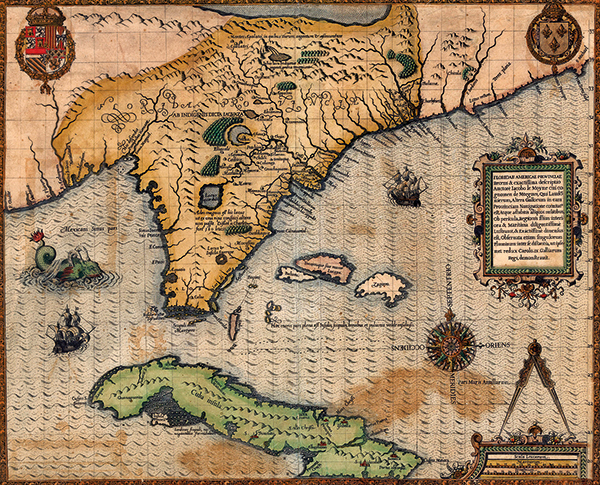
There’s no good reason why St. Augustine should be so neglected. It should be on par with Jamestown and Plymouth. Even if Florida did not join the United States until 1819, Americans should recognize the state as the birthplace of what we today call North America, of the product of an (often catastrophic) encounter between Europeans and the Native population. “I think that the inclusion of St. Augustine and the settlement endeavors by the Spanish should be included in the historical view of the country,” Parker told me in an email. “Until the K-12 textbooks truly incorporate the Spanish, the dismissal of St. Augustine as well as other areas will continue.” The city itself, with its devoted historians and caretakers, does a good job of keeping its heritage alive. The touristic charm may soften the blows of history, but it preserves their memory all the same. Instead, the United States as a whole has decided to stow this crucial part of its history in a box marked “La Florida,” and keeps it shut.
[.article__paragraph--cap][.small-caps]The Timucua peoples[.small-caps] lived in present-day northern Florida and southern Georgia, and were united not by a central government but by a common tongue. The Franciscan missionaries identified ten dialects of the Timucuan language, and a priest named Francisco Pareja composed a Timucuan grammar and wrote several religious texts in Timucuan. The Franciscans succeeded in converting many Timucua, but not in keeping them alive: three decades after the founding of St. Augustine, the pre-Columbian population of up to two hundred thousand Timucua was reduced by two-thirds. The main causes of death were the European diseases for which the Timucua had no immunity, though many were also killed in conflicts between rival tribes that were stirred up by the European powers vying for control of the region. When the British seized St. Augustine in 1763, there were fewer than two hundred Timucua left. By the time Florida was annexed with the Adams-Onís Treaty between the United States and Spain, the Timucua were all but extinct as a people.[.article__paragraph--cap]
The last thing I see in the Fountain of Youth archaeological site is the Timucuan burial exhibit. This burial site was only discovered by chance in 1934, when a gardener, planting orange trees, discovered a skeleton. The park’s website reports that after establishing that these were remains of a Native American, “further research by the Smithsonian Institution revealed that the entire area was covered with the graves of the first Christianized Native Americans buried in the United States.”
Over the years, as the archaeological and tourist infrastructure expanded, more remains were uncovered. Today, at the burial site, you can find the framed program from a special Mass celebrated in 1991, part of the ceremony to reinter the uncovered remains. I notice that the Mass was presided over by a man who today is a retired archbishop. I write him asking whether he remembers that Mass and what, if any, thoughts he has about the event.
The bishop’s name is Charles Chaput. He is eighty-four and retired from a long career as, among other things, the second Native American bishop in American history. He has fond memories of St. Augustine, but unfortunately, he can’t remember any details of the event. “If I would give you a clear message, it would be made up by my imagination and not based on any true memory.”