Personal History
Down the Tunnels of Richland Creek
In an old book, I discovered my hometown’s hidden mining history.
July 29, 2026
Try 3 months of unlimited access. Start your FREE TRIAL today. Cancel anytime.
START FREE TRIAL NOWDown the Tunnels of Richland Creek
In an old book, I discovered my hometown’s hidden mining history.
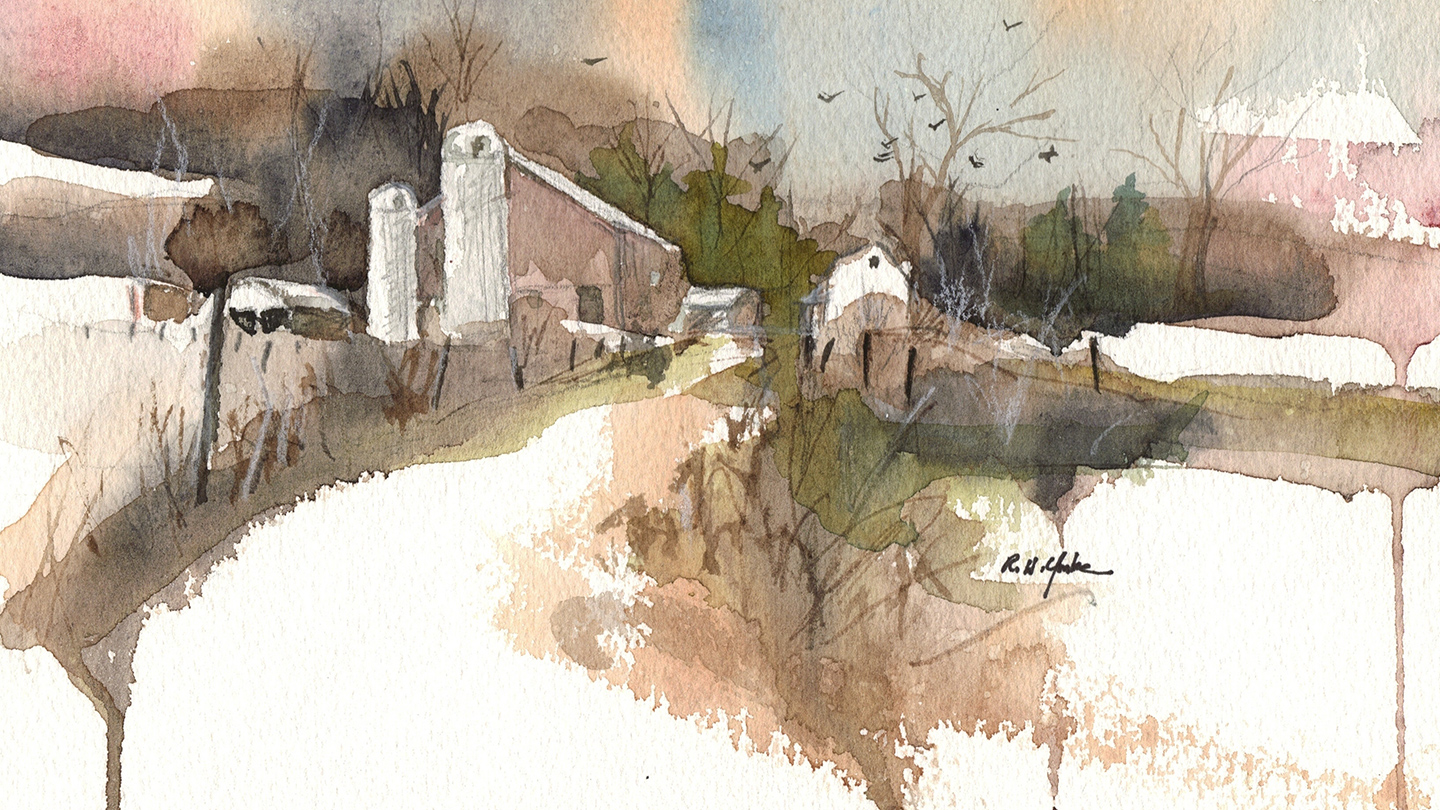
Robert Yonke, Thirty-Two Acres, watercolor, 2012. [.smalltext]All artwork by Robert Yonke. Used by permission.[.smalltext]
[.article__paragraph--cap][.small-caps]As far as I was concerned,[.small-caps] it had never not been there – that gaping black hole in the side of the gorge.[.article__paragraph--cap]
I was a teenager, growing up in a small town in East Tennessee. My friends and I were limited when it came to fun weekend activities: we could go to the pool hall, cruise the Walmart parking lot, or watch a movie at the single-screen theater where the old projector would often jam, ripping the 35 mm film mid-flick – what you might call a “showstopper.”
Fortunately, we were all outdoor enthusiasts (as most kids are in Southern Appalachia), which meant my summer Saturdays were spent rambling along the banks and boulders of Richland Creek, whose rushing waters cut deep into the Walden Ridge of the Cumberland Plateau.
Under the towering oak and birch trees, we’d traverse the muddy trail leading to our favorite swimming spot, Blue Hole. We’d strip down to our swimsuits and cannonball into the shimmering turquoise water, cooling our heat-weary bodies. Rising from the creek bed were the remnants of old railroad trestles. We’d stay away from those, as they were teeming with water snakes and too slick to climb. But if we were feeling especially ambitious, we’d hike up to Snow or Laurel Falls, maybe even Buzzard’s Point. On the way we’d stop to rest a while, our backs reclined against moss-covered stone walls, derelict industrial furnaces sprouting white trillium.
Inevitably, one of the adolescent boys in our group would dare another to venture past the threshold and down into that black hole in the side of the earth. We’d all go together sometimes, holding hands and tiptoeing into the sudden chill of earthy, damp darkness. Before too long, fear (and our better judgment) would send us scrambling back into the light. We never found out just how deep and dark that hole was or where it ultimately led, though something in me always felt it was somewhere mysterious and foreboding – a true abyss.
I suppose I always knew it was a mine of some sort. But I never stopped too long to wonder about the history of such ghostlike structures, who had built them, and why they’d been abandoned. I never thought to question what had been pulled from the earth here, and the role these ruins had played in the story of my hometown. In my mind, they were just part of the God-given landscape. I had no idea what stories were simmering just beneath my feet.
[.article__paragraph--cap][.small-caps]Twenty-five years later,[.small-caps] I am hunched over the musty pages of an old history book, lost among the countless shelves of the Appalachian State University library in Boone, North Carolina. The book, Miners, Millhands, and Mountaineers (1982) by Ronald D. Eller, is an analysis of industrialization in the mountain South and the impact the coal and timber boom at the turn of the twentieth century had on communities and migration patterns.[.article__paragraph--cap]
As I skim through the book’s chapters, two words jump out at me from the page: Richland Creek. I read on and learn that in 1895, beneath those hills where I rambled as a teenager, twenty-nine men and boys lost their lives in an explosion and subsequent cave-in just five days before Christmas.
I learned this wasn’t the only incident. Two other major accidents occurred in the mines along Richland Creek, in 1901 and 1902, killing twenty and sixteen men respectively. Victims from these tragedies are buried in graveyards throughout my hometown.
Graveyards I’d never visited. Names I’d never known. Stories I’d never heard. An entire history hidden in my own hometown.
The story of these accidents wasn’t all I learned in the Appalachian State library. There, I began to understand the long history of land dispossession in the mountain region, how coal companies had acquired huge swaths of the terrain – mountain by mountain, farm by farm – through intimidation, one-sided deals, and nefarious mineral-rights contracts.
I learned about the environmental devastation that industrialization imposed on Appalachia, how timber companies had denuded the hillsides of their trees and strip mining had contaminated the soil and waterways, poisoning the ecological base of the region’s subsistence economy. I learned how coal had created a new mono-economy, paying miners in company scrip (of worth only at the company store), building company towns, and installing puppet politicians in positions of power.
And then I learned that when the miners fought back, forming unions and going on strike to demand fair wages and safer working conditions, the coal companies tried to crush them with an iron fist, sending in their private police and strikebreakers and turning miners’ families out of their company-owned houses into the cold. And as the nation watched the drama of the coal wars unfold, the wealthy coal barons portrayed these miners as backward rednecks and deviant lowlifes to justify their reign of terror.
The degenerate mountaineer is an archetype that has been long in the making and lives on to this day in the American imagination. From the bucolic portrayals of the late-nineteenth-century travel writers to the violent “hillbilly” tropes of the silent film industry, Appalachia has been viewed (in the words of William Wallace Harney, a writer and entrepreneur, in 1873) as “a strange land,” its inhabitants “a peculiar people.” The stereotypes perpetuated by popular media were based not on reality, but rather on hyperbole and conjecture (and the desire to entertain and entice readers and filmgoers).

Thus, Appalachia has been seen as a culture apart from the American mainstream and is often the object of the nation’s collective pity or ire. Sixty years after Appalachia became the epicenter of Lyndon B. Johnson’s War on Poverty, political pundits continue to descend upon the region in search of content for their “Trump Country” think pieces. Vice President J. D. Vance’s own rise to power was due in part to his wildly popular book Hillbilly Elegy, a memoir not just of a family, but of a culture in crisis – the culture being Appalachia and the children of the Appalachian diaspora. Relying on the same tropes as the travel writers of the last century, Vance’s account insinuates the region’s best days are behind it (and even its best days were perhaps a little too uncivilized).
As the political scientist Jack E. Weller put it in 1965, Appalachia is the home of “yesterday’s people.” With these perceptions comes the implicit suggestion that the people of this region are an impediment to progress, a hindrance to American advancement.
In fact, it was “yesterday’s people” who for generations mined the coal and cut the timber that enabled the country to churn ever forward toward its bright and industrious future. Coal mined along the banks of Richland Creek and elsewhere in Appalachia forged the steel that built our nation’s glittering skylines and helped the United States achieve victory in both world wars. Striking miners in Appalachia spearheaded significant advances in the cause of workers’ rights, building a foundation for a strong American middle class.
Yet many in our region internalized the hillbilly stereotypes imposed upon them, believing outsiders’ fictional version of this land and its people. The belief remains: This is just how things were. This is just who we are. And as wealth flowed out of this region and into the nation’s centers of prosperity and power, the real story seemed to be buried, perhaps as deep as those mines around Richland Creek.
[.article__paragraph--cap][.small-caps]I know I’m not the only one[.small-caps] who has a complicated relationship with my hometown. The locales that serve as the settings of our personal coming-of-age stories can feel fraught, teeming with complex memories. Just as we are raised in families, we are raised in places. We might not fully understand the dynamics of our families of origin until we mature into adulthood. Likewise, we don’t understand our places of origin until we develop a deeper sense of orientation to the wider world and broader history. This is why some people say you can’t really know a place until you leave it. I like to think I could know the people and the place that raised me without having to leave (and without needing the help of a university library hundreds of miles away). But it was in that library that I began to realize that the story of my hometown I’d always accepted as true and complete was only half true and was certainly incomplete.[.article__paragraph--cap]
This is, in part, because I was contending with competing narratives, stories that took up so much space in our collective imaginations about this little town called Dayton, Tennessee. The complex reality had been crowded out by a simple headline: “Scopes Trial Opens Today: Battle of Evolution Is On.”
[.article__paragraph--cap][.small-caps]My hometown[.small-caps] hasn’t always flown under the radar of history. Our little community on the banks of Richland Creek was not only the scene of one of the nation’s deadliest coal-mining accidents, but also the stage on which one of the world’s most polarizing legal dramas played out, a court case some at the time called “the trial of the century.”[.article__paragraph--cap]
In 1925, a young Dayton substitute teacher named John T. Scopes was charged with the offense of teaching the theory of evolution in school, violating the state’s Butler Act (which prohibited such teaching). The trial and subsequent furor galvanized religious fundamentalists across the region. The trial’s illustrious cast of characters only served to heighten the intrigue around the case, dubbed the “Monkey Trial” by progressive journalist H. L. Mencken. The famed lawyer and agnostic Clarence Darrow joined the defense, while the renowned Christian orator and three-time presidential candidate William Jennings Bryan led the prosecution.
Even casual students of history understand that the case was meant to be a show trial from the start, cooked up by the American Civil Liberties Union in hopes of bringing the issue all the way to the Supreme Court. But why Dayton, Tennessee? I’d always accepted the dominant explanation, which fit neatly into the narratives and stereotypes about rural Appalachia: Southern “hillbillies” were too stubborn and backward to let go of their fundamentalist religious views. We were too stubborn and backward, unable to progress into modernity. This was the story I’d absorbed based on my limited understanding of my own hometown.
Religious fundamentalism is indeed a reality in the mountain South, but the primary architect of the trial was a New Yorker named George Washington Rappleyea. He was the manager of the Cumberland Coal and Iron Company, whose mines ran under the banks of Richland Creek and were the site of all those devastating accidents. Shuttered due to those numerous explosions, cave-ins, strikes, and depleted or unreachable coal seams, the mines failed and left the communities along Richland Creek in dire economic straits. Rappleyea, along with other town leaders, thought a show trial would bring an economic windfall to the town.
That windfall was short-lived and came at a price. Mencken’s coverage of the trial was broadcast around the world. The Baltimore satirist had no love for the mountain South, describing the residents in support of Bryan’s cause as “halfwits,” “peasants,” “yokels from the hills,” and “gaping primates from the upland valleys of the Cumberland Range.” This of course only reinforced harmful stereotypes and set a precedent for news media coverage of the rural South for decades to come.
[.article__paragraph--cap][.small-caps]There’s something else[.small-caps] I learned in that Appalachian State library. Over the years, William Jennings Bryan (and his fictionalized stand-ins) have been portrayed and parodied in ways that profoundly misrepresent his actual temperament and true convictions. From Mencken’s dispatches to the 1955 play and 1960 film Inherit the Wind, Bryan is often shown as having taken up the fight against evolution because he, like the “hillbillies” who supported him, had an archaic worldview and a deep-seated, simple-minded resistance to scientific progress.[.article__paragraph--cap]
Instead, I learned that Bryan’s adamant rejection of new evolutionary origin stories was due to his fear of the violence and oppression that could ensue with the loss of the Genesis account of creation, in which God imprints his image on every human person. Bryan and those who followed him were extremely wary of the eugenics movement that had coincided with the rising popularity of the theory of evolution.
In the closing argument he prepared for the trial, Bryan states:
Science is a magnificent material force, but it is not a teacher of morals. It can perfect machinery, but it adds no moral restraints to protect society from the misuse of the machine. It can also build gigantic intellectual ships, but it constructs no moral rudders for the control of storm-tossed human vessels. It not only fails to supply the spiritual element needed but some of its unproven hypotheses rob the ship of its compass and thus endanger its cargo.
Far from an impediment to progress, Bryan and those who shared his convictions were a prophetic voice warning society of the pitfalls of unfettered scientific advancement. They intended to offer a moral safety net for the nation’s most vulnerable, who were being erased and marginalized by the progressive eugenics movement. You might even say those Appalachian “hillbillies,” who had spent so much time digging coal underground, had become a kind of “canary in the coal mine” sounding the alarm about the erosion of human dignity.
[.article__paragraph--cap][.small-caps]Last year, my hometown[.small-caps] marked the hundred-year anniversary of its most consequential event – the Scopes Monkey Trial. With the milestone came a slew of stories and analysis about the historic impact of the trial, most of them harking back to the trial’s original question: Are religion and science compatible? Can our nation progress when it is impeded by the antiquated values of its conservative, religious populace?[.article__paragraph--cap]
These stories ignored the questions that were likely foremost on the minds of the actual citizens of Dayton at the time: Will our community survive the boom and bust of coal? Is this just how it is, and is this just who we are? Will human dignity win the day?
One year later, as we celebrate the 250-year anniversary of the nation’s founding, no doubt we will encounter many stories amidst the celebration – many that rely on simple narratives and reductive explanations. But if we want to truly celebrate a nation, with all its complexities, perhaps we need to get lost in a library somewhere, looking for the lesser-known titles that challenge the stories we know by heart, because it is by the work of unseen heroes that nations are actually built. We play on their ghostlike structures, living our lives on the foundations they formed. They may simply seem like part of the God-given landscape, like the Richland Creek of my adolescent years. But we need to look for the history among the ruins we assume have always been there, covered in moss and sprouting white trillium. And though one should never venture into a literal derelict coal mine, we must be willing to explore those black holes in our collective memories, like the one whose darkness felt like an abyss to me as a kid growing up with such limited understanding of the maze of tunnels under my feet.
Only then can we really come home to this country, as I did to my hometown. As the years passed, the pool hall in Dayton shut down and the projector at the theater was eventually upgraded, but it’s still the same place I knew and loved. And it is different somehow. Fuller. More dynamic. Vibrating with story and sadness, triumph and hope – always sprouting something new.