Essay
Hallowed and Haunted
What’s the point of visiting Monticello and Gettysburg?
June 16, 2026
Try 3 months of unlimited access. Start your FREE TRIAL today. Cancel anytime.
START FREE TRIAL NOWHallowed and Haunted
What’s the point of visiting Monticello and Gettysburg?
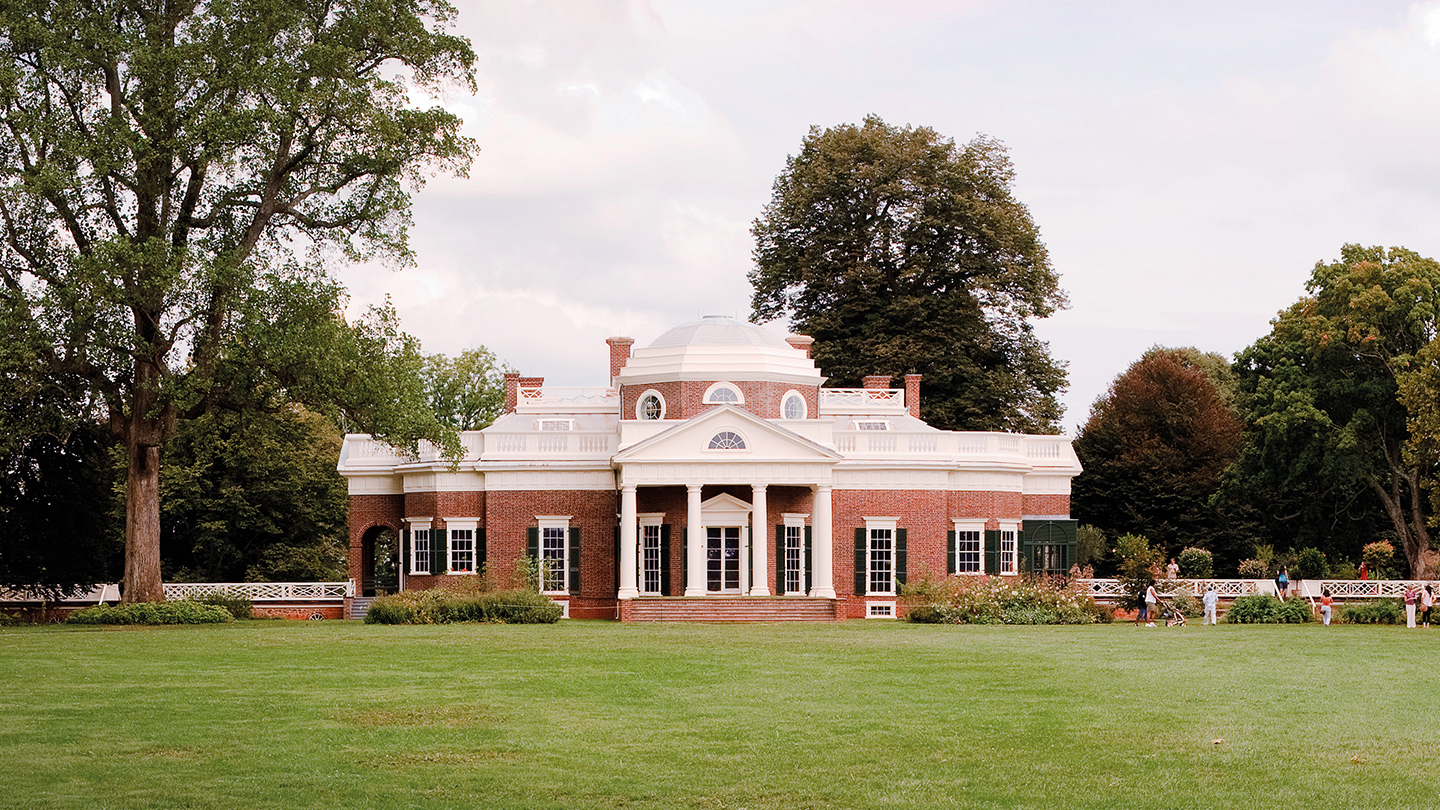
Monticello, the home of Thomas Jefferson, in Virginia. [.smalltext]Photograph from Wikipedia (public domain).[.smalltext]
[.article__paragraph--cap][.small-caps]Monticello is on a mountain.[.small-caps] From the ridge around the home, forested hills undulate into the blue line of the horizon. Grapevines snake around a long arbor. Lawns and flower gardens surround the palatial home, itself a graceful melding of white Grecian columns and hearty American brick.[.article__paragraph--cap]
When I stood there, the air was crisp and clear – an early fall coolness that hadn’t chilled into winter. I felt like I was on top of the world.
I’m probably not alone in coming to a new appreciation for history as an adult – queuing up The Rest Is History podcast episodes, going down Wikipedia rabbit holes, occasionally forging through tomes like Battle Cry of Freedom.
But recounted history can only do so much to capture the ineffable, ambient information of historical places. I’ve crisscrossed the country seeing battlefields, abandoned pueblos, graveyards, and monuments.
Monticello stands out, because of its startling intimacy – Thomas Jefferson haunts every corner. His brilliance and ambition radiate from the home he designed himself – from its setting to its architecture. Stepping through the doors is like stumbling into a genius’s workshop. Maps and memorabilia cover the walls – mounted elk antlers, an engraving of the signing of the Declaration of Independence, a copy of a sixteenth-century painting of Jesus. A custom clock wraps around the room, a Rube Goldberg-style invention, whimsical, a little mad. Here, the polygraph Jefferson used to copy letters. There, a revolving bookstand he designed so he could flip back and forth between different volumes like pages on a web browser. The window from this study looks out onto roses. The genteel, intellectual atmosphere evokes Europe.
To one side of the house are the slave quarters: spartan dwellings. Rough-hewn logs and dirt floors. Sally Hemings grew up in those cabins – though eventually, after she became the mother of a half-dozen of Jefferson’s children, she’d move to a room in the South Wing servants’ quarters.
I came away from Monticello thinking we would all talk more intelligently about the Founding Fathers if we took the time to visit their houses. Maybe not all of them. But it’s hard to leave Monticello without feeling a far greater gut understanding of Thomas Jefferson, the man, the genius, the aristocrat. Jefferson, the progressive aesthete, so forward-thinking, so witty, so influential – the slave owner, the slave master, the libertine.
In a strange way, Jefferson’s contradictions don’t feel quite so inconsistent when considered from his palace on a mountain. For all Jefferson’s airy soliloquizing about America’s farmers, he lived like the nobleman he was. His son Madison Hemings was interviewed by an editor who wrote a dispassionate “first-person” recollection of his childhood in 1873, and used a tellingly antiquated word to describe his mother: concubine. (Hemings’s understated, concise, and unsentimental article – assuming of course that the interviewer captures his voice – made me think, with a chill of recognition: Oh, of course! He takes after his father.)
The way we talk about history – and historical sites – often borrows the language of religion. Sacred. Hallowed. Glorious. American Christians have a tendency to tut over such language as a conflation of two distinct spheres. But if “sacred” merely means “set apart,” then our civic shrines can be seen as proper objects of such descriptions. Things are “set apart” for many uses.
Still, the excesses can be striking. I suspect George Washington – the man who shot down his vice president’s suggested mode of address, “His Highness,” for “Mr. President” – would have loathed the Capitol Dome fresco of himself seated in the heavens and surrounded by Roman goddesses. The Lincoln Memorial’s central inscription declares itself a temple.
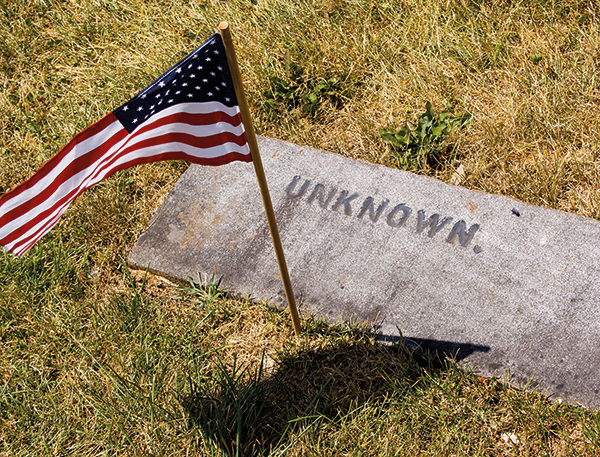
These are spaces devoted to honoring great men, but the sites of immense tragedy or grief earn the same heightened language and rigorous ritual, from the 9/11 memorial to the Tomb of the Unknown Soldier. The former are hallowed and the latter are haunted.
Some places are both. Not every national park site oscillates between hallowed and haunted ground quite as starkly as Monticello, the third president’s “little mountain.” Usually, a site is characterized by one mood or the other.
[.article__paragraph--cap][.small-caps]“We cannot hallow[.small-caps] this ground,” Abraham Lincoln mused at Gettysburg soon after the battle. “The brave men, living and dead, who struggled here, have consecrated it, far above our poor power to add or detract.” Even Lincoln felt humble on hallowed ground.[.article__paragraph--cap]
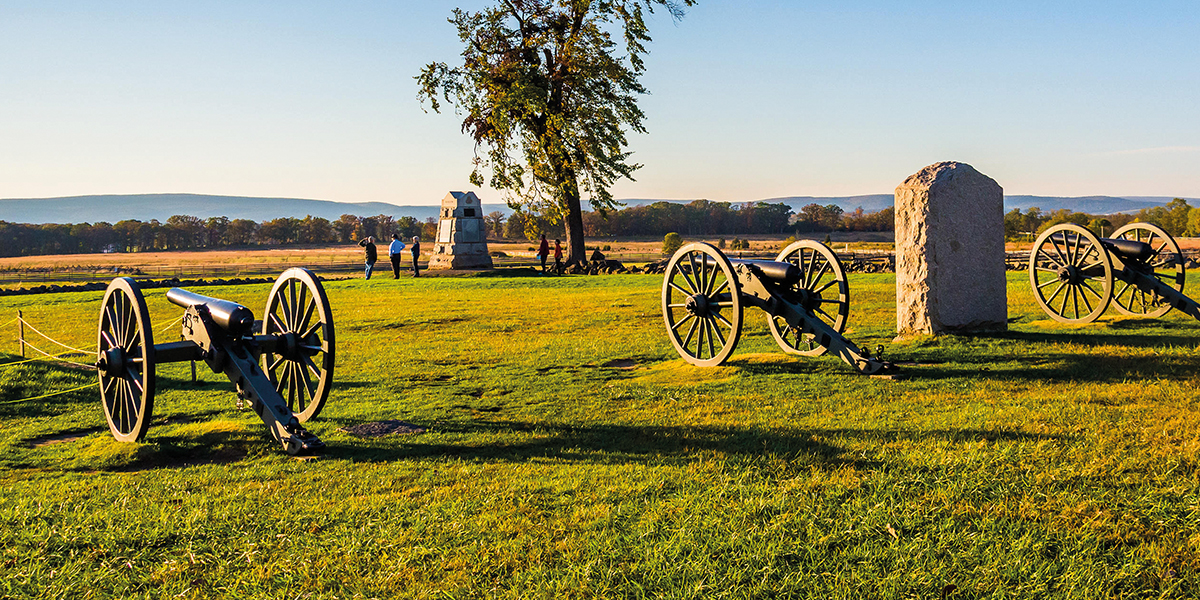
I visited Gettysburg during the 2025 government shutdown that left visitor centers shuttered at other sites, like Antietam. Gettysburg remained open and operating. It’s run by the SEAL Team Six of tour guides. The acceptance rate for the guide position is lower than at many top-tier colleges. A rigorous exam is followed by a panel interview, and finally a two-hour practice tour. Some people move to Gettysburg and wait years to gain a spot – a novitiate of pious citizens.
Anything to spend more time on the hallowed ground. Not far from the outskirts of the small Pennsylvania town, a gas flame flickers atop a looming monolith of Maine granite and Alabama limestone. Our guide, a matter-of-fact but jovial granddad, solemnly told us that the sacred flame was lit in 1938 by one Union and one Confederate veteran. The eternal flame is what prevents a second civil war, he informed us, and he may have even been serious. These days, I’m in the mood to believe that our fragile domestic peace might just depend on the piety of Gettysburg guides.
He also spent a significant portion of the tour wearily trying to redirect our attention from Hollywood’s favorite Gettysburg hero, Joshua Lawrence Chamberlain. But that was a lost battle. As tourists file out of the extensive museum in the visitor center, Bowdoin rhetoric professor and war hero Chamberlain’s words glow from a darkened wall:
In great deeds, something abides. On great fields something stays. Forms change and pass; bodies disappear, but spirits linger, to consecrate the ground for the vision-place of souls.
Whatever you heard in the early 2000s, reports of the death of transcendence have been greatly exaggerated. Secularization seems instead to provoke anxious religiosity, like a bird with no place to land. The hallowing of the sacred flame at Gettysburg is matched by an equally intense desacralizing instinct, yet even that zealous iconoclasm has a mystic quality of its own.
When I visited the Hudson Valley School painter Thomas Cole’s house in upstate New York, I noticed a tag informing me that an object had been “owned by an enslaver” (or words to that effect). I was struck by the implication that the object was stained somehow. We might not use the word “sin” anymore, but the concept is still there. The extreme scrupulosity, combined – naturally – with an Indigenous land acknowledgment, wasn’t even for Thomas Cole, but for the people who had owned the house before him. My goodness, I thought, how stressful it must be to live in a constant state of confession of an ancestor’s sins. The past is never dead. It’s not even past.
But the matter of accuracy is unavoidable. If history is always edited, how much do we include? What emphasis do we pick? With Chamberlain, it’s the Gettysburg tour guides who become the iconoclasts. Popularized by Michael Shaara’s 1974 novel The Killer Angels and the subsequent film adaptation, Chamberlain’s heroic charge at Little Round Top must be placed in its tactical context, tour guides will tut. During the 1990s, at the height of Chamberlain fandom, guides wore T-shirts under their uniforms with the slogan, “Joshua who?” We can’t really give him the credit that myth did, our guide reminded us, earnestly defending the reputation of Paddy O’Rorke, who charged down the other side of the hill and avoided immortality by catching a fatal bullet in the neck right away.
I can’t bring myself to mind too much. Political myths are always stuffed with a good dose of hokum, and Chamberlain did actually charge into gunfire.
Anyway, the solution to hagiography is not less study of history but more. A closer regard for historical detail may give one the ability to mythmake with more verve, but it’s just as likely to disrupt pat narratives of heroes and villains. That same weekend that my family went to Monticello, we also visited Appomattox. The location of the Civil War’s most famous surrender is a simple house in the middle of a flat field and looks like pretty much every other place in central Virginia. The courthouse is surrounded by a few other ordinary farmhouses. It’s unassuming. But it was the location of the last hurrah of the old world – of Thomas Jefferson’s world. Robert E. Lee walked into the room in full uniform, dressed to the nines, his sword ready to surrender.
Ulysses S. Grant hadn’t expected the meeting to happen this soon, so he arrived in what he called “rough garb,” the uniform of a private with “the straps of a lieutenant-general,” dropped off his horse and galumphed into the room, a true plebeian. Lee surrendered to the scruffy little Westerner, a man who some five years before had been selling firewood on the streets of St. Louis to bail his family out of debt.
Before the surrender, Lee greeted Native American Union officer Ely S. Parker with the quip, “I am glad to see one real American here.” Parker replied, “We are all Americans.”
How is one to interpret this exchange? Fitting it into our modern discourse is impossible. Is Lee self-deprecatingly dismissing the squabbles of a white nation of interlopers? Is he the true progressive, elevating the victimized out-group? And yet, surely this is a hypocritical posture given his fight for the nation of slavers. Or should we question Parker’s response – brushing race aside as a hallmark of “real” Americans, and welcoming back the Confederate rebels? It’s a fantastically pithy exchange, but it doesn’t really give modern readers an easy punchline with which to whip their opponents.
[.article__paragraph--cap][.small-caps]The real conundrum[.small-caps] of historical places, both the hallowed and the haunted, is not actually to do with the spaces themselves – it is the troublesome people who made the places historical in the first place. A champion of liberty who saw a teenage girl as his property. A Native soldier joking – graciously – with a man he should hate.[.article__paragraph--cap]
What makes history compelling is how uncontrollable and improbable people are – they zig when they should zag. If history was just a record of people doing the expected thing, no one would be interested.
Here’s Madison Hemings writing about his father: “About his own home he was the quietest of men. He was hardly ever known to get angry, though sometimes he was irritated when matters went wrong, but even then he hardly ever allowed himself to be made unhappy any great length of time.”
Here’s Thomas Jefferson, who hacked out the parts of his Bible that he found irrational: “Indeed I tremble for my country when I reflect that God is just, that His justice cannot sleep forever.”
What underwrites the angst of the Thomas Cole plaque writers is a good and healthy worry that we should not hagiographize sinners. Their problem is that they don’t go far enough, refusing to recognize their own debts to imperfect people in their eagerness to distance themselves from those same people’s sins.
Christianity offers a conceptual catharsis to the tension. If there is none good but all have fallen short of the glory of God, all our virtues are really a manifestation of common grace. Praising George Washington’s Cincinnatus-like qualities is an expression of gratitude – how wondrous that he reflected his maker in this remarkable way.
Since no one is perfect, a hero shouldn’t be expected to be perfect. Conversely, the presence of heroism or greatness in one respect shouldn’t bestow godlike status on the hero.
Christianity’s utility in this respect doesn’t make it true. Nor do Christians always reflect it in their actual attitudes to history. Yet our faith should give us the gift of entering our sacred civic spaces with clear eyes.
History is there to be found. There’s only so much a guide or a plaque can do to obscure it. In haunted and hallowed places, we feel the ghosts of people who did something worthy of remembrance.