Family and Friends
The Tiny Homes Behind My Church
In Minnesota, we made a community for formerly homeless people.
August 1, 2026
Try 3 months of unlimited access. Start your FREE TRIAL today. Cancel anytime.
START FREE TRIAL NOWThe Tiny Homes Behind My Church
In Minnesota, we made a community for formerly homeless people.
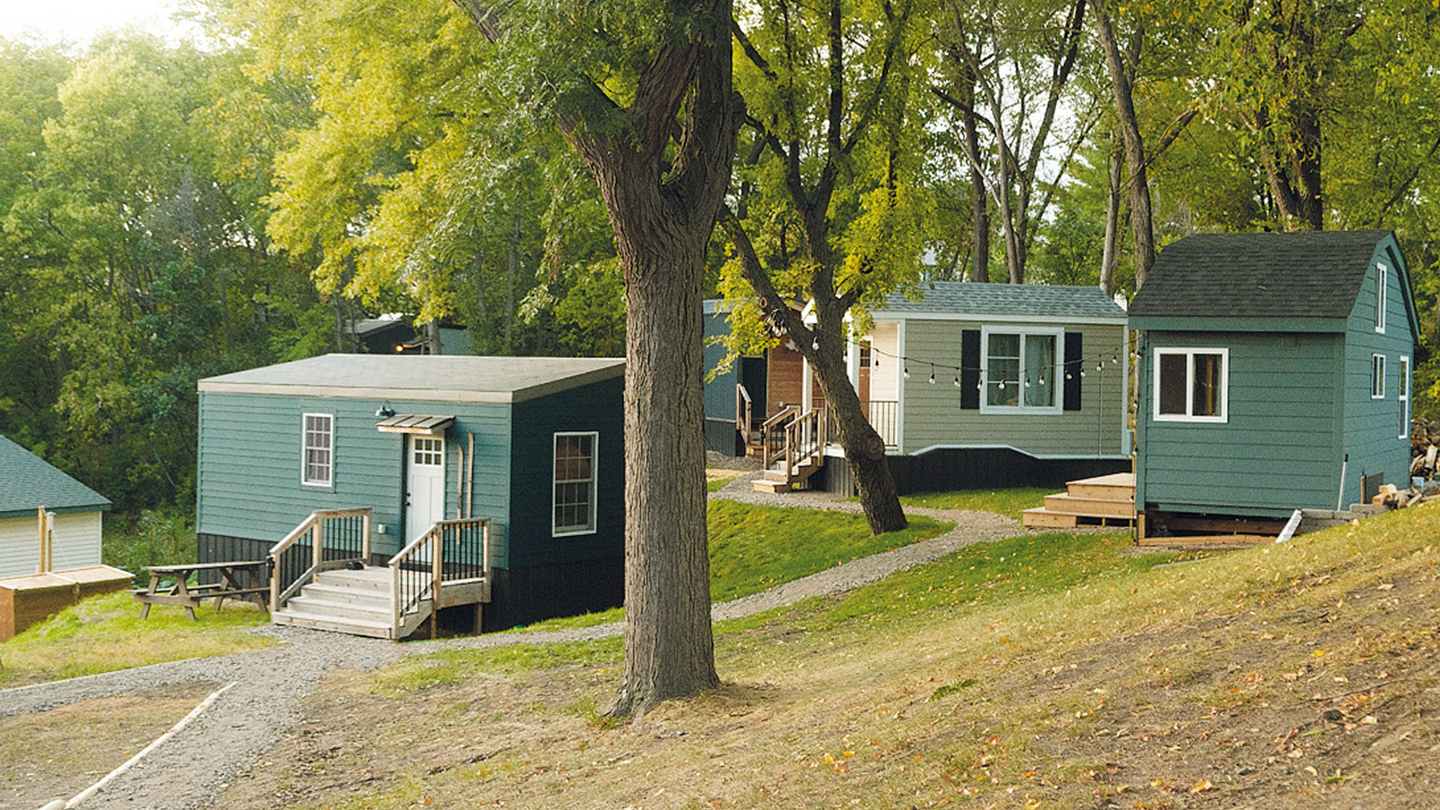
Tiny homes at the Sacred Settlements community in Minnesota. [.smalltext]Tiny homes at the Sacred Settlements community in Minnesota.[.smalltext]
[.article__paragraph--cap][.small-caps]There’s a sign hanging[.small-caps] on an old tree in an alley on the east side of St. Paul, Minnesota. The sign is a relic from years past, when the plot of land was overgrown and littered with trash.[.article__paragraph--cap]
“No Dumping Allowed,” it still reads.
Once a final destination for the working-class neighborhood’s discarded mattresses, worn-out car tires, and empty gas cans, the land is now a place of rest, stability, and belonging for several people who had previously been homeless.
The sign serves as a backdrop to a current reality: people society deemed worthless are treasured, part of God’s kingdom, and a blessing to the surrounding neighborhood.
As my church, Mosaic Christian Community, has tried to be a Christlike, hospitable presence in our semi-urban neighborhood with families and empty-nesters, including many refugees and other immigrants, we have looked for ways the church land and building can serve as a resource to people living nearby every day of the week.
What started as an effort to provide safe, family-friendly activities and gatherings during the week has become a place where people can come stay, know they belong, and learn that they are loved.
We partnered with the nonprofit organization Settled to build the Sacred Settlement, an intentional, permanent tiny home community where five people coming out of chronic homelessness live alongside three people from the church who have elected to live with them. The church building acts as an extension of each person’s tiny home – a shared dining room, kitchen, laundry facility, and shower room. Each person who moves in receives a key to a tiny home and a key to the church.
Our formerly homeless neighbors have goals and dreams. One wants to run his own mechanic shop. Another finds joy in woodcarving. We have a creative type who sings while drawing and one day wants to be published. Another neighbor is among the best chefs I have ever had the pleasure of meeting – and eating with. One resident always blows bubbles at our weekly summer block parties and occasionally sets up a snow-cone table.
Slowly people in the tiny home community are being woven into the neighborhood’s fabric. One resident, Rian, has found friendship with an immigrant family across the street. One day, beaming with excitement, Rian explained how he fixed the family’s sedan that hadn’t run for years. Another resident, Junior, proudly handles landscaping work for an Ethiopian family a few houses down. Junior recently described the difference between his previous life in the woods and life in a neighborhood: “Out there,” he said, “they know of me. Here, people know me.”
Settled’s research-based, biblically inspired approach to addressing chronic homelessness, the “Full Community Model,” has five key elements: cultivated places, permanent homes, intentional neighbors, purposeful work, and supportive friends. Together, these elements are a redemptive response to the major challenges that keep people on the streets and the poor and marginalized at arm’s length from the church.
The six permanent tiny homes on Mosaic’s land were donated and built by five different congregations from four different denominations. Historic divisions between Christians quickly fall away when we agree that the church has a role to play in God’s redemptive work, and show up to volunteer on the construction site or to help prepare a community dinner.
Over the first three years at the Sacred Settlement, we have celebrated many birthdays and holidays together, learned how to share a common refrigerator, and only seen one person decide to leave the community. We are witnessing a way the church can re-create family for a segment of the population that is, statistically, the hardest to house and most expensive to the public. The psalmist wasn’t mistaken who wrote, “God sets the lonely in families” (Psalm 68:6).
A shared life together isn’t all easy. In fact, families can be extremely challenging. But God hasn’t invited his people into an easy life without challenges. He has invited us to welcome the stranger into our lives, lean into the messiness of humanity, and share the property and resources we are handed. In three years, I have learned much about what “love your neighbor” can mean, and about the resiliency and creativity of people whose mindset has shifted from survival to belonging.
At Sacred Settlement Mosaic, we are still figuring it out. We realize this model is not the answer for everyone. But for five individuals who have experienced deep trauma and historically been cast aside and kept away, along with three others who desire life in community – and dozens of “church people” with a willingness to learn and grow – this experience has been deeply transformative. On the sloping church land once riddled with rubbish, it’s a little peek into God’s kingdom – a tiny city on a hill.